
Nothing undermines a festive outdoor display faster than patchy, clumped, or glaringly sparse lighting. When strings of lights are hung linearly—end-to-end, aligned at identical heights, or spaced without rhythm—the result is visual “banding”: bright stripes interrupted by dark voids that make your home look hastily decorated, not thoughtfully illuminated. Staggering isn’t just an aesthetic preference—it’s a foundational technique used by professional lighting installers to distribute light intensity evenly across surfaces, eliminate hotspots, and create depth and dimension. Unlike simple “even spacing,” staggering introduces intentional variation in vertical alignment, horizontal offset, string density, and layering sequence. This article distills field-tested methods developed over decades of residential and commercial holiday installations—not theory, but practice refined through thousands of real-world applications on varied architectural features: steep gables, wide soffits, irregular shrubbery, multi-level decks, and mature evergreens.
Why Uniform Spacing Fails—and What Staggering Actually Fixes
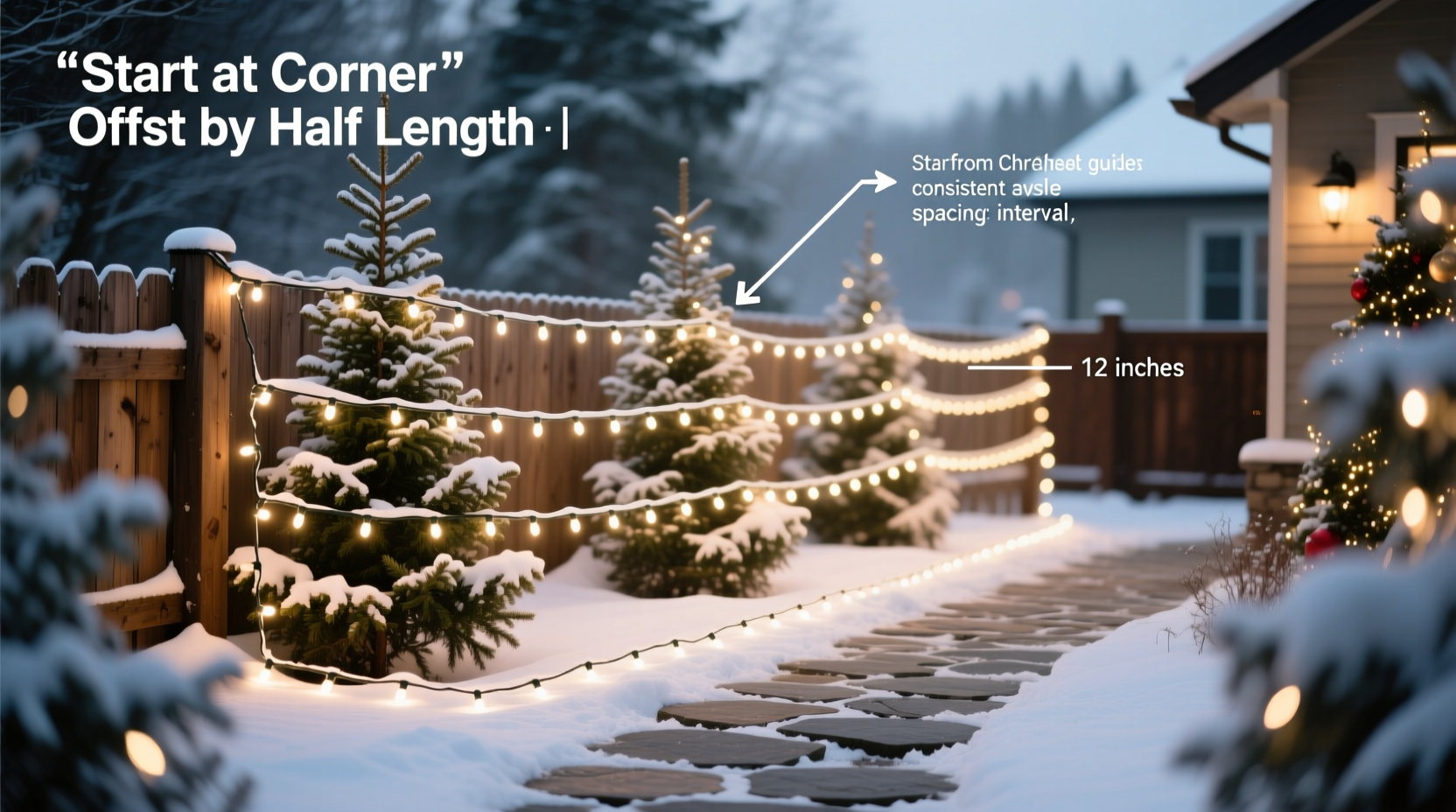
Most homeowners begin with a ruler and a goal: “I’ll place a clip every 6 inches.” That approach works for straight runs on flat surfaces—but fails dramatically on complex façades. Light bulbs emit illumination in a conical pattern, not a flat plane. When bulbs line up vertically (e.g., all strings aligned along the same eave line), their cones overlap directly above one another, creating concentrated brightness directly beneath the string while leaving diagonal gaps between rows. Similarly, when strings run parallel at identical intervals—say, three rows spaced precisely 12 inches apart—their light fields intersect in predictable, repeating patterns that emphasize the grid rather than softening it. Human vision perceives this as rhythmic pulsing or “moire” effects, especially at dusk or night when contrast is highest.
Staggering disrupts those patterns. By shifting bulb positions horizontally relative to adjacent strings, you force light cones to interlock like overlapping shingles. Vertical offsets prevent stacked glare; horizontal offsets fill lateral gaps. The result isn’t randomness—it’s engineered diffusion. As lighting designer Marcus Bell explains in his 2022 field manual *Residential Holiday Illumination*, “A staggered layout doesn’t hide the infrastructure—it reveals the intention behind it. You’re not hiding the wires; you’re using them to sculpt ambient light.”
“Even coverage isn’t about equal distance—it’s about equal luminance perception. Your eye averages light over a 5°–10° field. Staggering ensures that average stays constant across the entire surface.” — Dr. Lena Torres, Lighting Psychophysicist, University of Michigan School of Architecture
The Four-Point Staggering Framework
Effective staggering rests on four coordinated variables: vertical alignment, horizontal offset, string density, and sequencing order. Adjust any one in isolation, and coverage suffers. Apply all four together, and coverage becomes resilient—even on imperfect surfaces.
1. Vertical Alignment: Vary Row Heights Strategically
Never hang multiple horizontal rows at mathematically identical intervals. Instead, use a graduated spacing pattern:
- First row (lowest): Attach at the bottom edge of fascia or soffit trim
- Second row: Position 9–11 inches above the first (not 12”)
- Third row: Place 14–16 inches above the second (not 12”)
- Fourth row (if needed): Set 10–12 inches above the third
This irregular vertical rhythm prevents repetitive shadow bands. On steep gables, reduce vertical spacing incrementally as you ascend—bulbs near the peak cast shorter shadows downward, so tighter spacing there compensates naturally.
2. Horizontal Offset: Shift Bulb Positions Between Rows
Within each row, bulbs should align vertically—but between rows, shift every other string horizontally by half the bulb spacing. For standard 6-inch-spaced mini lights, offset adjacent rows by 3 inches. For C7/C9 bulbs spaced 12 inches apart, offset by 6 inches. Use this rule consistently: if Row 1 starts at the left corner, Row 2 starts 3 inches right of that point, Row 3 starts aligned with Row 1 again, and Row 4 repeats Row 2’s offset. This creates a brickwork pattern—visually stable yet optically diffused.
3. String Density: Match Bulb Count to Surface Area, Not Linear Feet
A common error is using the same number of strings on a 20-foot porch as on a 20-foot garage wall. Porches have depth (soffits, rafters, columns) that absorb light; walls reflect it. Calculate density by square footage, not length:
| Surface Type | Recommended Bulbs per Sq. Ft. | Why |
|---|---|---|
| Flat exterior wall (brick, stucco) | 0.8–1.2 bulbs | High reflectivity requires fewer bulbs to avoid glare |
| Porch soffit + fascia combo | 1.5–2.0 bulbs | Depth creates shadow zones needing denser coverage |
| Dense evergreen (spruce, fir) | 2.5–3.5 bulbs | Foliage absorbs light; interior branches need penetration |
| Wrought-iron railing or lattice | 1.0–1.3 bulbs | Open structure casts intricate shadows requiring precise placement |
4. Sequencing Order: Layer from Background to Foreground
Staggering fails if applied haphazardly. Always install in this sequence:
- Back layer: Lights farthest from viewer (e.g., roof peak, top of tall tree, rear fence)
- Middle layer: Primary architectural lines (eaves, windows, door frames)
- Foreground layer: Closest elements (porch railings, potted plants, mailbox)
Within each layer, stagger vertically and horizontally—but never stagger *across* layers. Keeping layers distinct preserves spatial hierarchy. Viewers subconsciously read depth cues; crossing layers flattens the effect.
Step-by-Step: Staggering Lights on a Typical Two-Story Colonial Porch
This realistic walkthrough applies the framework to a common residential challenge: a 12-foot-wide, 8-foot-deep covered porch with exposed rafters, soffit, fascia, and two support columns.
- Measure & Map: Sketch the porch in elevation view. Note rafter spacing (typically 24”), soffit depth (12”), fascia height (6”), and column diameter (10”).
- Plan Vertical Rows: Assign four rows: (A) soffit underside, (B) rafter bottoms, (C) fascia top, (D) column wraps. Space A→B = 10”, B→C = 15”, C→D = 8” (columns start lower).
- Calculate Density: Soffit area = 12’ × 1’ = 12 sq. ft. → 18 bulbs needed. Use two 35-bulb strings (70 total) but stagger placement—don’t use full strings end-to-end.
- Offset Strings: For Row A (soffit), start first string at left edge. For Row B (rafters), start second string 3” right of left edge. For Row C (fascia), restart alignment with Row A. For Row D (columns), wrap each column individually with alternating start points (left column: top-down; right column: bottom-up).
- Install in Sequence: Hang Row A fully. Then Row B—checking alignment against A’s offset. Then Row C. Finally, wrap columns last, ensuring their vertical rhythm complements (not competes with) the overhead rows.
- Final Check: Step back 15 feet at dusk. If any zone appears brighter or dimmer, add or remove one bulb *in that specific zone*—never globally adjust.
Real-World Case Study: The “Patchy Gable” Fix in Portland, OR
In November 2023, homeowner Priya M. contacted a local lighting contractor after three seasons of failed attempts to light her steep, 30-foot cedar-shingle gable. She’d used identical 100-light strings, spaced 12” apart vertically, starting from the eave upward. Result: a bright band across the bottom third, then diminishing brightness toward the peak, with stark triangular shadows under each rafter tail.
The contractor applied the four-point framework:
- Vertical spacing changed from uniform 12” to 10”–14”–11”–13”–9” (five rows, tightening near peak)
- Each row offset horizontally by 4” from the one below (using 8”-spaced bulbs)
- Bulb density increased from 1.0 to 1.7 bulbs/sq. ft. on upper sections to penetrate deep shingle grooves
- Installation sequenced from peak (back layer) down to eave (foreground), ensuring upper lights didn’t visually “float” above lower ones
Result: Coverage became perceptually uniform. Neighbors reported the house “glowed warmly” instead of “blinking in stripes.” Priya noted the display required 12% fewer total bulbs than her prior setup—proof that intelligent staggering improves efficiency, not just aesthetics.
Common Staggering Pitfalls—and How to Avoid Them
Even experienced decorators stumble here. These mistakes sabotage even the most meticulous planning:
| Pitfall | Why It Breaks Coverage | Solution |
|---|---|---|
| Using identical string lengths on uneven surfaces | Forces compression or stretching, distorting bulb spacing | Trim strings to fit *exact* segment length; splice only with UL-listed connectors |
| Staggering on curves (e.g., archways) without adjusting offset | Fixed horizontal offsets cause unnatural “kinks” in visual flow | On curves, vary offset gradually: 2” at ends, 4” at apex |
| Ignoring bulb wattage variance between string batches | Older LEDs (0.07W) vs. newer (0.04W) create visible brightness gradients | Buy all strings from same manufacturer, same model year; test brightness with a lux meter app |
| Over-staggering (excessive offset or random placement) | Destroys visual rhythm, making the display feel chaotic, not cohesive | Limit horizontal offset to ≤50% of bulb spacing; maintain consistent vertical rhythm |
FAQ: Staggering Questions Answered
Can I stagger lights on a tree without damaging branches?
Yes—use soft-grip, non-metallic clips designed for foliage (e.g., twist-tie style with rubberized coating). Wrap lights spirally from base to tip, but stagger the spiral’s starting point on each pass: first pass begins at 12 o’clock, second at 4 o’clock, third at 8 o’clock. This creates natural vertical staggering without wrapping force. Never staple or nail into bark.
Do warm-white and cool-white bulbs need different staggering approaches?
Yes. Cool-white (5000K+) has higher perceived intensity and casts sharper shadows. Reduce bulb density by 15% compared to warm-white (2700K) on the same surface. Also, increase vertical spacing between cool-white rows by 1–2 inches to prevent glare stacking.
How do I stagger when mixing incandescent and LED strings?
Avoid mixing unless absolutely necessary—color temperature and beam angle differ significantly. If required, segregate by layer: use all-LED in background layers (roof, tall trees) for energy efficiency and cooler operation, and incandescents only in foreground (railings, wreaths) where warmth is desired. Stagger within each type, but keep types physically separated by ≥3 feet to prevent visual competition.
Conclusion: Light With Intention, Not Habit
Staggering Christmas lights isn’t about adding complexity—it’s about removing visual noise. It replaces the fatigue of staring at repetitive patterns with the quiet satisfaction of balanced, harmonious light. You don’t need more bulbs, more time, or more expensive gear. You need attention to vertical rhythm, disciplined offsetting, density calibrated to surface physics, and layered sequencing. These aren’t decorative flourishes; they’re principles drawn from optical science and decades of field refinement. When you step back this season and see even, enveloping glow—not stripes, not voids, not glare—you’ll recognize the difference intention makes. Your home won’t just be lit. It will feel considered, cared for, and quietly joyful.




 浙公网安备
33010002000092号
浙公网安备
33010002000092号 浙B2-20120091-4
Comments
No comments yet. Why don't you start the discussion?