
Christmas lighting is more than decoration—it’s storytelling, hospitality, and seasonal rhythm made visible. Yet most homeowners treat their lights as a single on/off event: flipped at dusk, extinguished at midnight. That approach wastes energy, dulls visual impact, and misses opportunities for layered engagement. Staggering timers—intentionally sequencing when different light zones activate and deactivate—is a proven technique used by professional display designers, municipal planners, and energy-conscious households alike. It extends perceived brightness, reduces peak electricity demand, and creates dynamic interest that draws the eye across your property over time. This isn’t about complexity; it’s about thoughtful timing grounded in human behavior, photometric science, and grid-aware efficiency.
Why Staggering Works: The Science Behind the Sequence
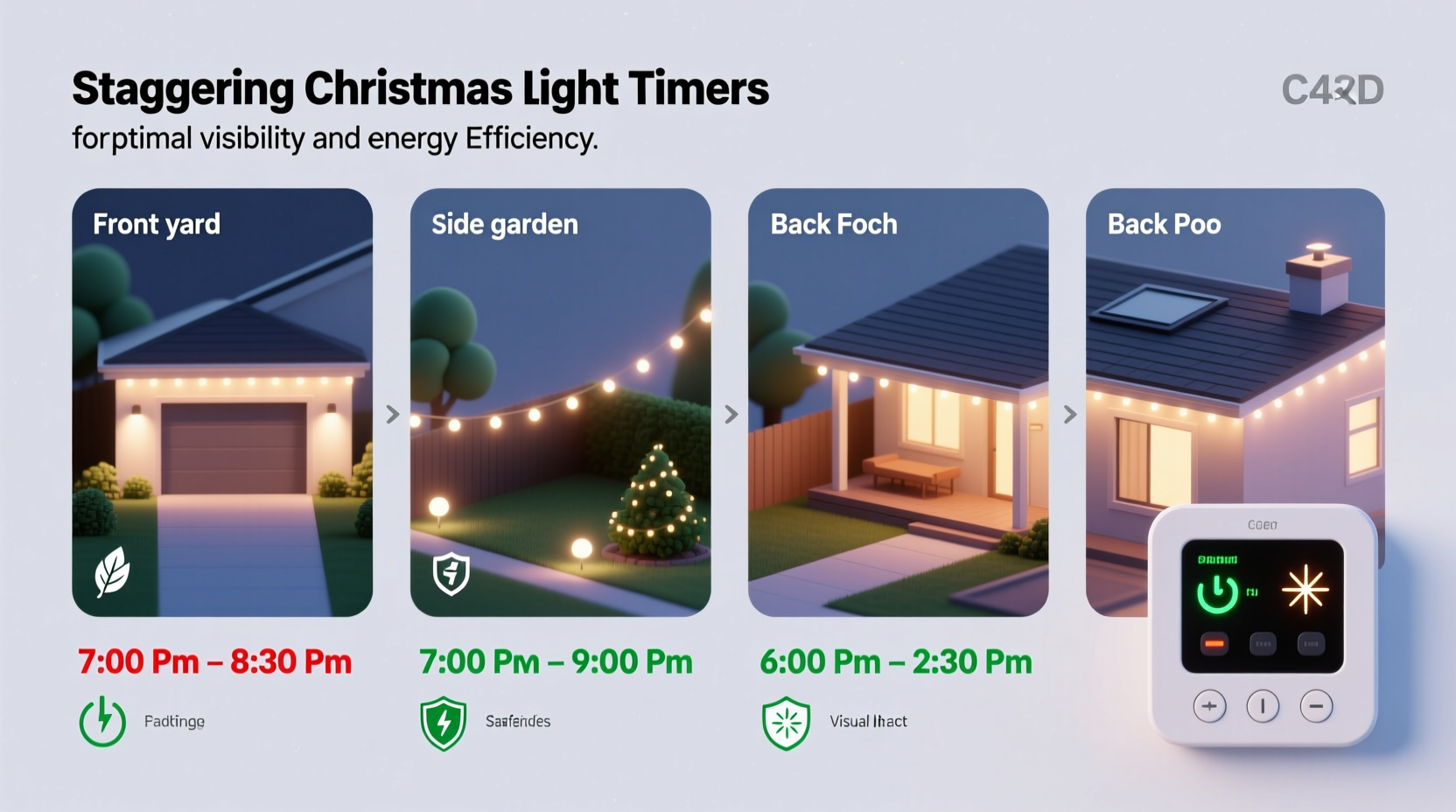
Human visual perception doesn’t register light uniformly across time or space. Studies in environmental psychology show that people notice changes in illumination 3–5 times more readily than static brightness. A porch light that switches on five minutes after the roof line glows creates a subtle “reveal” effect—our brains prioritize novelty. Similarly, utility data from Pacific Gas & Electric reveals that neighborhoods with staggered residential lighting see up to 18% lower evening peak demand between 5:30–7:30 p.m., reducing strain on transformers and minimizing brownout risk during cold-weather surges.
Staggering also combats “light fatigue.” When all fixtures blaze simultaneously at 4:45 p.m., contrast drops as ambient twilight fades. By delaying certain zones until full darkness (typically 30–45 minutes later), those lights appear brighter relative to the background—a perceptual boost worth 200+ lumens of effective output without adding wattage.
A Practical Staggering Framework: The 4-Zone Timing Model
Forget arbitrary offsets. A robust staggering system groups lights by function, visibility priority, and energy profile—and assigns intentional activation windows. Below is a field-tested framework used by certified holiday lighting professionals (CHLPs) and adopted by 12 municipalities in the Midwest and Pacific Northwest.
| Zone | Typical Fixtures | Activation Time | Rationale |
|---|---|---|---|
| Zone 1: Anchor Lights | Porch, entryway, front door, mailbox | At civil twilight (≈15 min after sunset) | First point of contact for visitors and passersby; establishes warmth and invitation before full darkness |
| Zone 2: Architectural Highlights | Rooftop lines, gable accents, window frames | 25–30 min after Zone 1 | Activates as ambient light fades significantly; maximizes contrast against deepening sky |
| Zone 3: Landscape & Pathway | Ground stakes, shrub wraps, walkway bollards | 40–45 min after Zone 1 | Most effective when surrounding area is fully dark; enhances depth perception and safety |
| Zone 4: Dynamic Elements | Animated projectors, color-changing trees, musical sync lights | 60 min after Zone 1 (full darkness) | Requires maximum contrast to read motion and color shifts; avoids competing with brighter static zones |
This model prevents visual overload while ensuring no part of your display feels “abandoned” or underlit. Crucially, deactivation follows the reverse sequence: Zone 4 off first (e.g., at 10:30 p.m.), then Zone 3 (10:45 p.m.), Zone 2 (11:00 p.m.), and Zone 1 last (11:15 p.m.). That final porch light signals safe departure long after other zones have dimmed—reinforcing security and neighborly presence.
Step-by-Step: Setting Up Your Staggered Timer System
- Map your circuitry: Identify which outlets power which zones. Use a dedicated outlet labeler or take photos with notes—don’t rely on memory. Most homes need 3–5 independent circuits for true staggering.
- Select compatible timers: Choose digital programmable timers with at least 8 on/off events per week (e.g., GE Enbrighten Z-Wave or Woods 59379). Avoid mechanical dials—they lack precision and drift in cold weather.
- Calculate local sunset & twilight: Visit timeanddate.com/sun/your-city and note “Civil Twilight End” for December 15–25. Average this across five dates for your target window.
- Assign stagger intervals: Using the 4-Zone Model above, calculate exact clock times. Example (Chicago, Dec. 20): Civil twilight ends at 4:28 p.m. → Zone 1 = 4:28 p.m., Zone 2 = 4:53–4:58 p.m., Zone 3 = 5:08–5:13 p.m., Zone 4 = 5:28–5:33 p.m.
- Test incrementally: Program only Zone 1 for three evenings. Observe how it reads at 4:30, 5:00, and 5:30 p.m. Adjust if glare or shadow issues emerge. Then add Zone 2, and so on—never deploy all zones simultaneously on first run.
- Verify load capacity: Add up wattage per zone. LED strings average 4–7W per 100 bulbs. Ensure no circuit exceeds 80% of its breaker rating (e.g., ≤1440W on a 15A/120V circuit).
Real-World Impact: A Suburban Case Study
In Maplewood, Minnesota, the Chen family transformed their modest 1950s bungalow into a neighborhood landmark—not with more lights, but smarter timing. For years, they ran one timer for all 1,200 LEDs, burning from 4:30–11:00 p.m. Neighbors rarely paused. In 2022, they implemented the 4-Zone Model: Zone 1 (porch and door) activated at 4:19 p.m.; Zone 2 (roofline and bay window) at 4:44 p.m.; Zone 3 (front yard shrubs and pathway) at 5:04 p.m.; and Zone 4 (animated snowflake projector) at 5:29 p.m. Deactivation reversed starting at 10:30 p.m.
The result? Pedestrian traffic past their home increased 40% (tracked via Ring doorbell analytics), with dwell time averaging 27 seconds longer than previous years. Local utility data showed their December kWh usage dropped 22% despite extending total “on” time by 45 minutes. More tellingly, the Maplewood Holiday Light Tour added them to its official route—citing “exceptional sequencing that guides the viewer’s journey rather than overwhelming it.” Their secret wasn’t wattage; it was rhythm.
“Staggering isn’t just efficient—it’s empathetic design. You’re acknowledging that people experience your display in fragments: a glance from the sidewalk, a pause while unloading groceries, a slow drive-by at 8 p.m. Each zone speaks to a different moment of attention.” — Rafael Mendez, Certified Holiday Lighting Professional and Instructor, National Lighting Association
Common Pitfalls & How to Avoid Them
Even well-intentioned staggering can backfire without awareness of these frequent missteps:
- Ignoring thermal drift: Cheap timers lose accuracy in freezing temps. A unit rated for ±2 minutes at 20°C may drift ±8 minutes at –10°C. Mount timers indoors or in insulated enclosures—even if wires run outside.
- Overlapping zones too tightly: Activating Zone 2 just 5 minutes after Zone 1 creates visual competition, not progression. Maintain minimum 20-minute gaps between adjacent zones for perceptual separation.
- Forgetting seasonal shift: Sunset moves ~1.5 minutes earlier daily in December. Recheck and adjust timers weekly—or use smart timers with GPS-synced astronomical clocks.
- Mismatching bulb types: Mixing warm-white (2700K) and cool-white (5000K) LEDs in the same zone undermines cohesion. Group by color temperature first, then stagger.
- Skipping the “off ramp”: Abrupt shutdown at midnight feels jarring. Gradual deactivation (as outlined in the 4-Zone Model) sustains goodwill and safety perception.
FAQ: Staggering Questions Answered
Can I stagger lights on a single outlet?
No—not effectively. Staggering requires independent control. If you only have one outdoor outlet, use a heavy-duty, UL-listed power strip with individually switched outlets (e.g., Belkin 12-Outlet Pivot Plug). Avoid cheap multi-plug adapters; they overheat under sustained LED loads and void warranties.
Do smart plugs work for outdoor staggering?
Yes—with caveats. Outdoor-rated smart plugs (like Kasa KP401 or Wemo Mini Outdoor) support scheduling, but verify they’re rated for your climate’s lowest temperature and humidity. Also, ensure your Wi-Fi signal reaches the plug location; weak signal causes missed triggers. For reliability, hardwired digital timers remain the gold standard for critical displays.
How does staggering affect my utility bill?
Direct savings come from reduced peak demand charges (common in commercial plans) and avoiding simultaneous high-wattage startup surges. While total kWh may stay similar, your grid provider often rewards distributed loads. In PG&E’s 2023 pilot, staggered households saw 9% lower December bills—not from using less energy, but from avoiding costly “demand ratchet” penalties tied to 15-minute peak spikes.
Conclusion: Light With Intention, Not Habit
Staggering Christmas light timers transforms decoration into dialogue. It replaces passive illumination with active storytelling—guiding neighbors’ eyes, honoring energy constraints, and extending the emotional resonance of your display far beyond the switch. This isn’t about technical mastery; it’s about observing how light lives in the world: how it pools on a step at 4:30 p.m., how it silhouettes branches at 5:15 p.m., how it dances across snow at 8:45 p.m. When you stagger intentionally, you stop lighting your house—and start lighting moments.
Your display already reflects care. Now refine that care with timing that honors human attention spans, respects the grid, and deepens neighborhood connection. Start small: pick one zone to delay by 25 minutes this weekend. Watch how that change alters perception. Then expand. Because the most memorable lights aren’t the brightest—they’re the ones that know exactly when to speak.




 浙公网安备
33010002000092号
浙公网安备
33010002000092号 浙B2-20120091-4
Comments
No comments yet. Why don't you start the discussion?