
Keeping a gratitude journal sounds simple—write down what you’re thankful for each day. But many people start with enthusiasm only to abandon it within weeks. The gap between intention and consistency is real. The key isn’t just starting; it’s designing a practice that fits your life, not one that feels like another chore on the to-do list.
Research from positive psychology shows that regular gratitude journaling can improve sleep, reduce stress, and increase overall well-being. But only if you actually do it. This guide focuses on practical, sustainable methods to help you build a lasting habit—not just for a week, but for months and years.
Why Most Gratitude Journals Fail
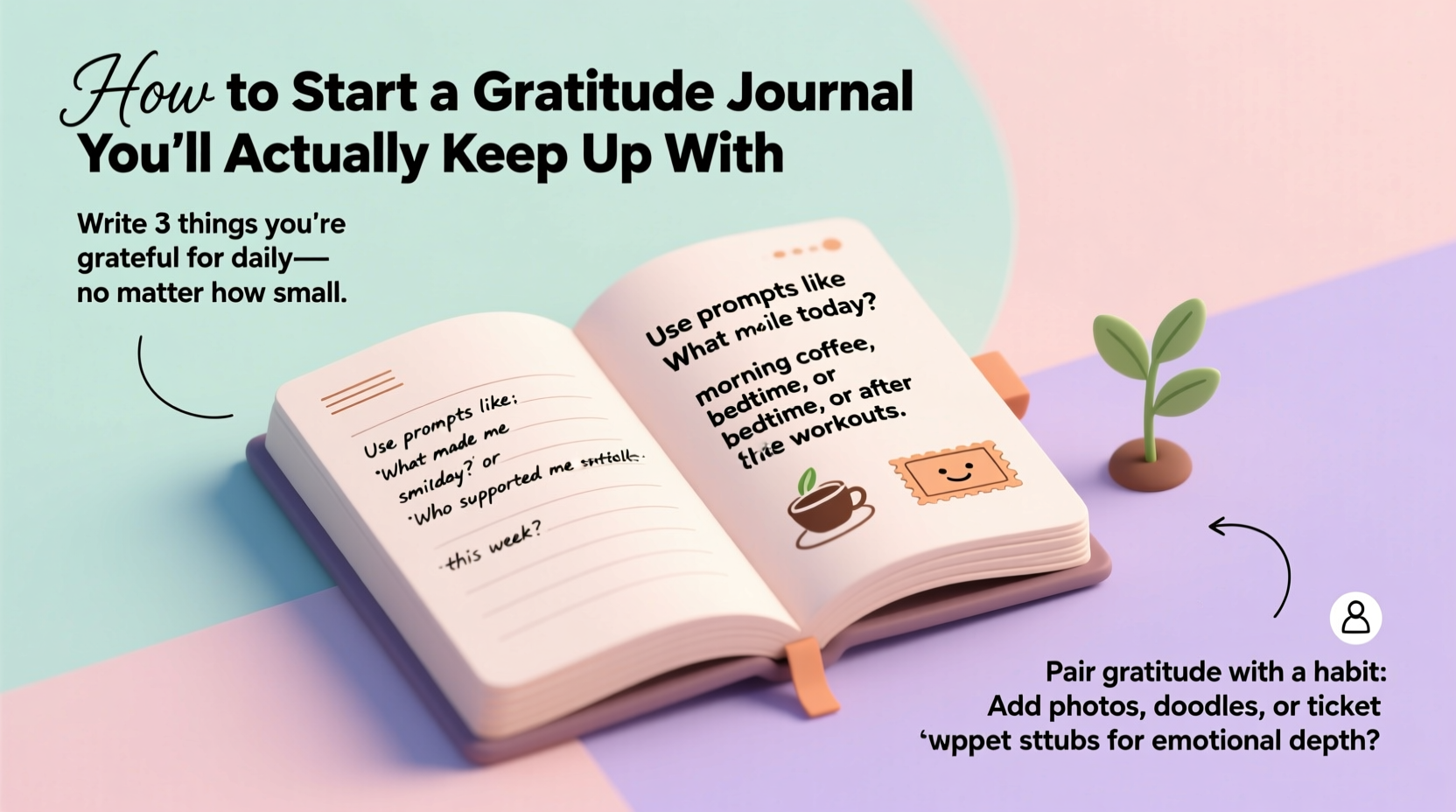
The typical approach is straightforward: buy a notebook, write three things you’re grateful for every night, and repeat. Yet studies show that adherence drops sharply after the first month. Why?
- Routine mismatch: People try to journal at times that don’t align with their energy or schedule.
- Vagueness: Entries become repetitive (“I’m grateful for my family”) without depth or variation.
- Perfectionism: Missing a day leads to guilt, which kills momentum.
- Lack of personalization: A generic template doesn’t reflect individual rhythms or values.
Gratitude journaling works best when it feels meaningful, not mechanical. The goal isn’t perfection—it’s presence.
Design Your Ideal Journaling System
Before choosing a notebook or app, ask yourself: What kind of person am I when it comes to habits?
If you thrive on structure, a daily prompt-based system might work. If you're more spontaneous, a voice memo or occasional deep reflection could be better. The format should match your personality, not someone else’s ideal.
Choose the Right Medium
You don’t need a leather-bound journal. Consider these options based on your lifestyle:
| Medium | Best For | Potential Drawback |
|---|---|---|
| Physical notebook | Tactile learners, minimal tech users | Easy to misplace; hard to search |
| Digital note app (e.g., Notes, Notion) | Busy professionals, frequent travelers | Less sensory engagement |
| Voice memos | People who think aloud, low-energy days | Harder to review later |
| Photo + caption journal | Visual thinkers, social media users | May feel performative |
The best tool is the one you’ll use consistently. Test one for two weeks. If it feels burdensome, switch.
Set a Realistic Frequency
Daily journaling is often unsustainable. Instead, aim for “minimum viable consistency”—the least amount that still creates impact.
- Three times a week (e.g., Monday, Wednesday, Friday)
- After meaningful events (a good conversation, small win)
- Weekly reflections with deeper entries
What matters is continuity, not quantity. One thoughtful entry per week beats seven rushed ones.
“Gratitude is not about counting blessings, but feeling them. A single genuine moment of appreciation rewires the brain more than ten robotic lists.” — Dr. Elena Torres, Positive Psychology Researcher
A Step-by-Step Guide to Starting (and Sticking With) Your Journal
Follow this five-step process to create a gratitude practice that lasts:
- Clarify your purpose. Ask: Why do I want to journal? Is it to reduce anxiety? Feel more joy? Strengthen relationships? Write your reason down. Revisit it when motivation fades.
- Pick your trigger. Attach journaling to an existing habit: after brushing your teeth, during morning coffee, or right before bed. Habit stacking increases adherence by up to 70%, according to behavioral research.
- Create a starter template. Use prompts to avoid blank-page paralysis. Examples:
- One small thing that made me smile today
- Someone who helped me this week—and how
- A challenge I faced, and what it taught me
- A sensory detail I appreciated (sunlight, smell of coffee, a song)
- Start small—under 5 minutes. Set a timer. Two sentences are enough. The act of showing up builds the habit. Depth grows naturally over time.
- Review monthly. Once a month, flip back through your entries. Notice patterns. Are certain people, places, or moments recurring? This reflection reinforces the value of the practice.
Real Example: How Sarah Built a Lasting Practice
Sarah, a project manager in Chicago, tried gratitude journaling three times before it stuck. Her first attempt was a beautifully designed notebook she used for four days. The second was a notes app she forgot existed. The third time, she changed her approach.
Instead of nightly entries, she began writing on Sunday evenings while drinking tea. She used voice memos because typing felt formal. Her prompts were simple: “What went well this week?” and “Who made a difference?”
She didn’t aim for eloquence—just honesty. Sometimes she cried. Other times she laughed at how grateful she was for quiet mornings or a coworker who covered her shift.
After six months, she transcribed her favorite audio entries into a digital doc. Reading them before a big presentation became a grounding ritual. It wasn’t perfect, but it was real—and that’s why it lasted.
Common Pitfalls and How to Avoid Them
Even with the best intentions, obstacles arise. Here’s how to navigate them:
| Challenge | Do | Don't |
|---|---|---|
| “I keep forgetting.” | Set a visual cue (journal on pillow) or phone reminder with a personal message. | Rely solely on willpower. |
| “It feels repetitive.” | Use varied prompts or focus on micro-moments (e.g., warm socks, a text from a friend). | Force yourself to write if you’re drained—skip and return fresh. |
| “I’m too tired at night.” | Switch to morning or midday journaling—even 90 seconds counts. | Assume there’s only one “right” time. |
| “I missed a week. Now what?” | Resume with kindness. Write: “I’m grateful I’m giving this another try.” | Quit because you weren’t perfect. |
Remember: missing days doesn’t break the habit. Giving up does.
Your Gratitude Journal Checklist
Use this checklist to set up your journal the right way:
- ☐ Define your personal reason for journaling (stress relief, mindfulness, etc.)
- ☐ Choose your medium (notebook, app, voice memo)
- ☐ Decide on frequency (3x/week, weekly, event-based)
- ☐ Pick a consistent trigger (after coffee, before bed, Sunday evening)
- ☐ Prepare 3–5 go-to prompts to avoid blank-page stress
- ☐ Place your journal where you’ll see it
- ☐ Schedule a monthly review date
Complete this in one sitting. The setup phase is where most people succeed or fail.
FAQ: Common Questions About Gratitude Journaling
How long should each entry be?
There’s no minimum or maximum. Start with 1–3 sentences. Some days you’ll write more, others less. Focus on sincerity, not length. Even “I’m grateful the rain stopped” counts.
What if I don’t feel grateful some days?
That’s normal. On tough days, look for small anchors: a working heater, a glass of water, a pet’s presence. You’re not denying pain—you’re acknowledging that even in difficulty, something still supports you. That’s the core of resilience.
Can I share my journal with others?
Only if it feels safe and supportive. Some people find sharing deepens connection; others find it dilutes authenticity. You can share highlights without revealing private details. Trust your instinct.
Make It Yours—And Keep Going
A gratitude journal doesn’t have to be poetic or profound. It just has to be yours. The magic isn’t in flawless execution, but in repeated return—to noticing, to appreciating, to remembering that light exists even in ordinary moments.
The most powerful journals aren’t those filled with elegant handwriting and perfect insights. They’re the ones with coffee stains, crossed-out lines, and entries written at 11:58 p.m. because someone finally remembered. Those are the ones that change lives.
You don’t need motivation to begin. You need a system that respects your time, energy, and humanity. Build that, and your gratitude practice won’t just survive—it will grow quietly, steadily, into something that sustains you.




 浙公网安备
33010002000092号
浙公网安备
33010002000092号 浙B2-20120091-4
Comments
No comments yet. Why don't you start the discussion?