
Every day, millions of households receive a mix of important letters, bills, and personal correspondence—alongside an ever-growing pile of unsolicited catalogs, credit card offers, and promotional flyers. This constant influx of junk mail isn't just annoying; it's a waste of paper, time, and space. For many, the mailbox has become less a portal for meaningful communication and more a dumping ground for marketing material they never asked for.
The good news is that you don’t have to accept this clutter as inevitable. With targeted actions and consistent follow-through, you can significantly reduce or even eliminate most physical junk mail. Unlike digital spam, which filters itself with ease, stopping unwanted postal mail requires proactive effort—but the results are worth it. A cleaner mailbox means less clutter, greater privacy, and fewer environmental concerns tied to mass-produced paper waste.
This guide walks through practical, legally supported strategies to reclaim your mailbox. From national opt-out programs to direct contact with senders, every step is designed to be actionable and effective.
Step 1: Register with DMA’s Mail Preference Service
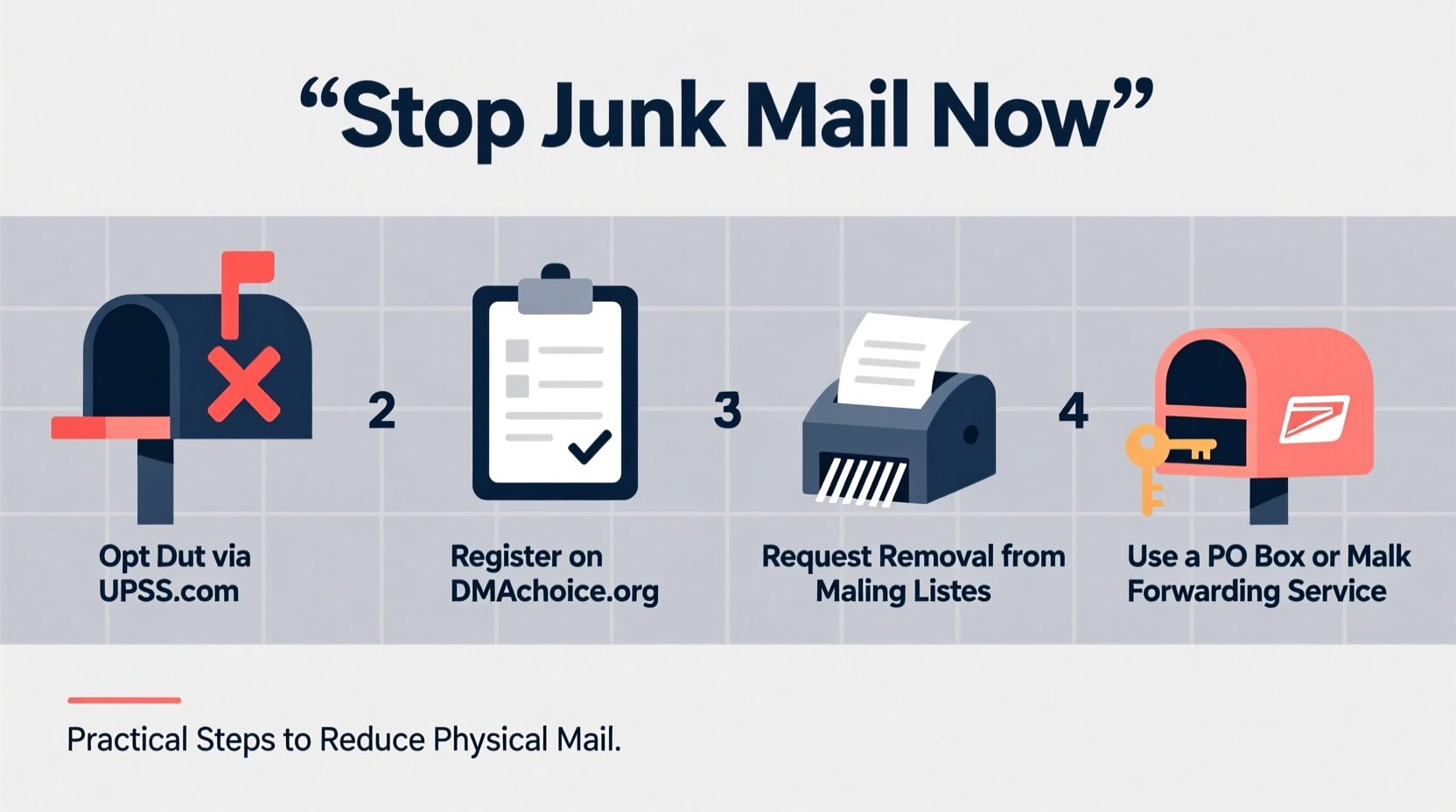
One of the most recognized tools in the fight against junk mail is the Direct Marketing Association (DMA) Mail Preference Service. While not instantaneous, registering here signals to hundreds of member companies that you no longer wish to receive their promotional materials.
To use the service:
- Visit dmachoice.org, the official site operated by the Association of National Advertisers.
- Select “Remove My Name” and choose between the free option (processing takes up to three months) or a paid removal ($2 per name for faster processing). <3>Provide your full name, address, and any alternate names used at that address (e.g., initials, nicknames).
- Submit the form electronically or print and mail it if preferred.
Once processed, participating organizations are required to suppress your name from future mailings within a few months. Note that non-member companies aren’t bound by this request, so additional steps will be necessary.
Step 2: Opt Out of Credit Card and Insurance Offers
Pre-screened credit card and insurance offers are among the most common—and invasive—types of junk mail. These aren’t random solicitations; they’re based on soft credit checks performed by lenders using data from credit bureaus.
Luckily, federal law gives consumers the right to opt out under the Fair Credit Reporting Act. The official program, managed by major credit reporting agencies, allows both temporary and permanent removal.
How to Opt Out
- Online: Visit optoutprescreen.com, the secure website jointly operated by Experian, Equifax, TransUnion, and Innovis.
- Choose between a 5-year opt-out or a permanent one (requires mailing a signed form).
- Verify your identity with basic personal information such as name, address, date of birth, and Social Security number.
Permanent opt-outs require returning a confirmation form via postal mail to verify your request—a security measure to prevent fraud.
“Opting out of pre-screened offers doesn’t affect your credit score and can dramatically reduce unwanted financial solicitations.” — Federal Trade Commission (FTC)
Step 3: Contact Companies Directly
Many large retailers, charities, and subscription services allow individuals to unsubscribe directly. While tedious, this method often yields fast results because it removes you from their internal database rather than relying on third-party suppression lists.
Look for customer service phone numbers or mailing addresses on the junk mail itself. A simple letter stating your request to be removed from all mailing lists is usually sufficient. Be sure to include:
- Your full name and current address
- Any account or donor numbers listed on the mail
- A clear statement: “Please remove my name from all mailing lists, including affiliate and partner distributions.”
Mini Case Study: Reducing Catalog Volume in 6 Weeks
Sarah M., a resident of Portland, Oregon, received an average of eight catalogs per week—from fashion brands, outdoor gear companies, and home goods retailers. Overwhelmed by the volume, she began tracking each sender and contacting them individually via email and postal letter.
Within six weeks, seven of the eight companies confirmed her removal from their mailing lists. One company initially refused but stopped sending mail after she cited the FTC’s Consumer Control of Credit Information rule. By combining direct outreach with DMA registration, Sarah reduced her junk mail by over 90% in two months.
Step 4: Use Third-Party Unsubscribe Services
For those seeking a more automated solution, several reputable services streamline the process of removing yourself from multiple mailing lists at once. These platforms analyze your junk mail and initiate opt-out requests on your behalf.
| Service | How It Works | Cost | Effectiveness Timeline |
|---|---|---|---|
| DMACHoice + PaperKarma Integration | Upload photos of junk mail; app identifies sender and submits opt-out | Free (basic), $2.99/month (premium) | 4–12 weeks |
| Escape the List | Manual submission of company names; tracks progress | $49 one-time | 8–16 weeks |
| MyPreferences.org (by NNA) | Industry-backed tool focusing on political and nonprofit mail | Free | 6–10 weeks |
PaperKarma, though limited since changes to its API access, still offers value when combined with manual efforts. Escape the List is particularly effective for persistent mailers who don’t respond to standard opt-outs.
“We estimate that consumers can eliminate up to 80% of junk mail within 90 days using verified opt-out channels.” — National Newspaper Association (NNA), Consumer Advocacy Division
Step 5: Prevent Future Mail Through Address Management
Even after successful opt-outs, new junk mail may appear due to data sharing, public records, or changes in residence history. To maintain long-term results, adopt preventive habits:
- Limit sharing your address: Avoid giving your home address for online purchases unless required for shipping. Use P.O. boxes or package lockers when possible.
- Opt out during sign-ups: When creating accounts, uncheck boxes that allow companies to share or sell your information.
- Monitor change-of-address leaks: If you’ve recently moved, ensure only trusted parties have your new address. Scammers and marketers often buy bulk change-of-address data.
- Use a secondary address: For warranty registrations or product rebates, consider using a dedicated P.O. box or virtual mailbox service.
Do’s and Don’ts of Junk Mail Reduction
| Do | Don’t |
|---|---|
| Register with optoutprescreen.com for credit offers | Respond to junk mail with personal info to \"unsubscribe\" |
| Contact senders directly using return addresses | Assume one opt-out stops all mail permanently |
| Use a centralized log to track removals | Throw away mail with barcodes or visible account numbers without shredding |
| Re-submit opt-out requests annually if needed | Pay for \"guaranteed\" junk mail elimination services without research |
Frequently Asked Questions
Will stopping junk mail affect important letters?
No. Legitimate bills, government correspondence, tax forms, and personal mail are unaffected by opt-out services. These systems target only marketing and promotional mail from commercial entities.
How long does it take for junk mail to stop?
Most people see a noticeable reduction within 6 to 10 weeks. Full results may take up to four months, as companies update their mailing lists on different schedules. Persistence is key—some require repeated requests.
Can I stop political mailings and charity appeals?
Yes, but these are harder to eliminate completely. Political campaigns and nonprofits are exempt from many commercial opt-out rules. However, services like MyPreferences.org specialize in reducing nonprofit and campaign-related mail. You can also contact individual organizations directly to request removal.
Checklist: How to Stop Junk Mail – Action Plan
Follow this step-by-step checklist to systematically eliminate unwanted physical mail:
- ✅ Gather recent examples of junk mail (credit offers, catalogs, flyers)
- ✅ Visit optoutprescreen.com and opt out of credit/insurance offers (choose permanent if desired)
- ✅ Register with dmachoice.org (free or paid)
- ✅ Identify top 10 senders from your junk mail stack
- ✅ Contact each sender via phone, email, or mail to request removal
- ✅ Consider using a third-party service like Escape the List for stubborn mailers
- ✅ Begin using a log to track submissions and response times
- ✅ Shred or securely dispose of sensitive mail pieces
- ✅ Re-evaluate your mailbox in 8–12 weeks and repeat steps as needed
- ✅ Adopt preventive habits: minimize address sharing and monitor data exposure
Conclusion: Take Back Your Mailbox
Stopping junk mail isn’t about finding a single magic solution—it’s about combining reliable tools, legal rights, and consistent follow-up. Each opt-out you complete brings you closer to a quieter, cleaner mailbox. Beyond convenience, reducing unsolicited mail enhances your privacy, cuts down on waste, and saves time spent sorting and recycling.
The steps outlined here are accessible to anyone, regardless of technical skill or budget. Whether you start with the national credit opt-out or begin calling catalog companies one by one, momentum builds quickly. Within weeks, you’ll notice fewer envelopes cluttering your daily haul and more space for what truly matters.




 浙公网安备
33010002000092号
浙公网安备
33010002000092号 浙B2-20120091-4
Comments
No comments yet. Why don't you start the discussion?