
When tasks pile up, deadlines loom, and your mental bandwidth feels stretched thin, it’s easy to freeze. Procrastination isn’t just laziness—it’s often a response to emotional overload. The brain, under pressure, seeks relief through avoidance. But the longer you delay, the heavier the burden grows. The good news? You don’t need willpower alone to break the cycle. With targeted psychological strategies, you can rewire your response to overwhelm and start moving forward—without burnout.
The Psychology Behind Overwhelm and Delay
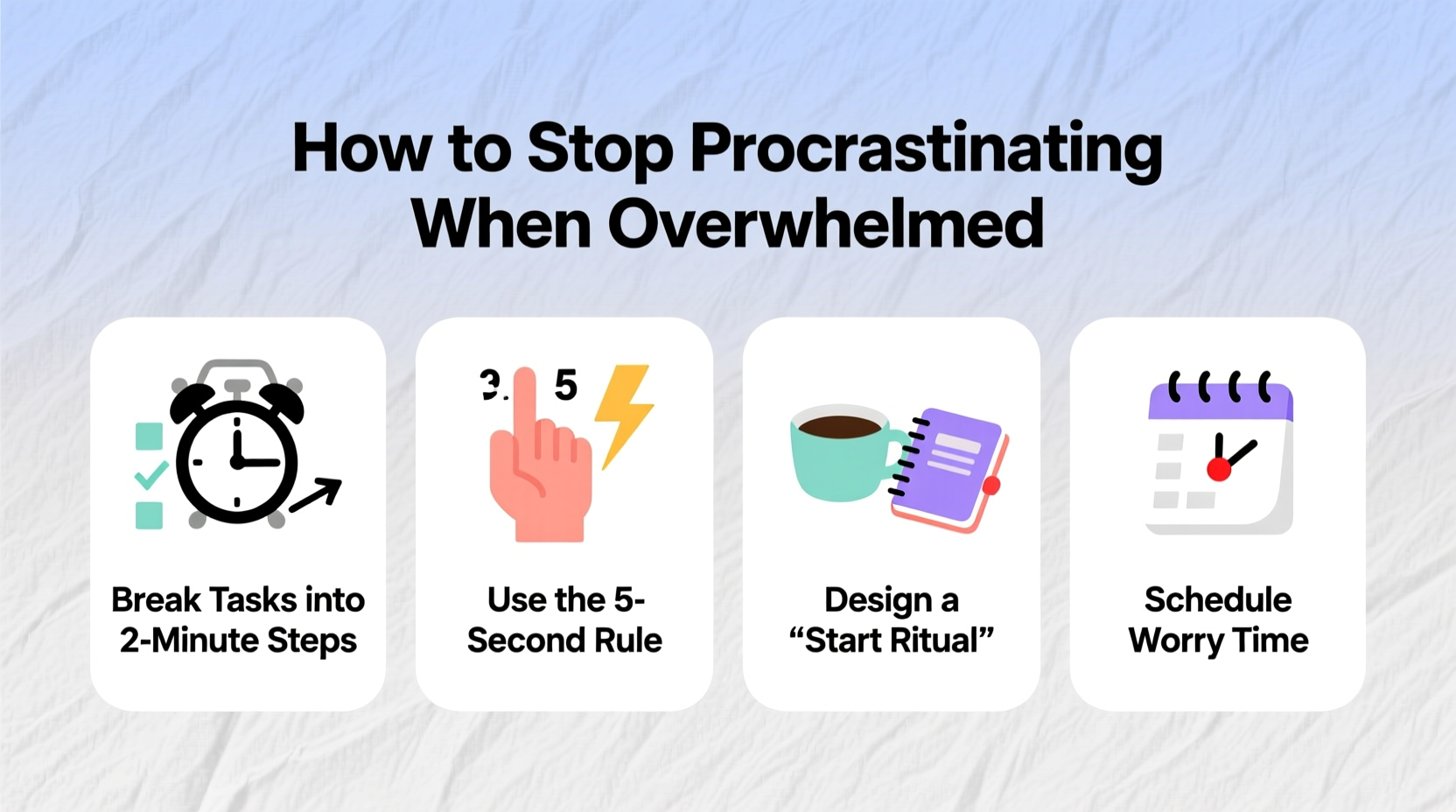
Procrastination in the face of overwhelm is less about time management and more about emotion regulation. Research from Dr. Timothy Pychyl at Carleton University shows that people delay tasks not because they lack motivation, but because they’re trying to escape negative emotions like anxiety, fear of failure, or decision fatigue.
When your workload feels unmanageable, the prefrontal cortex—the part of your brain responsible for planning and focus—becomes impaired. Stress hormones like cortisol flood your system, shifting control to the limbic system, which governs survival instincts and emotional reactions. In this state, short-term relief (like scrolling social media) feels safer than tackling a daunting task.
This creates a feedback loop: avoid → feel temporary relief → experience guilt → feel more overwhelmed → avoid again. Breaking this cycle requires interrupting the emotional trigger, not just adding more productivity hacks.
“Procrastination is an emotion regulation problem, not a time management problem.” — Dr. Tim Pychyl, Psychologist and Author of *Solving the Procrastination Puzzle*
Trick #1: The 5-Minute Rule to Bypass Resistance
The most effective way to overcome initial inertia is to lower the bar for starting. The 5-Minute Rule leverages the psychological principle of “behavioral momentum”: once you begin, continuation becomes easier.
Tell yourself you only have to work on the task for five minutes. No more. This reduces the perceived threat of effort and commitment. In practice, most people continue well beyond five minutes once they’ve crossed the threshold of action.
This trick works because it sidesteps the brain’s resistance mechanism. Instead of asking, “Can I finish this?” you ask, “Can I spend 5 minutes on this?” The answer is almost always yes.
Step-by-Step Guide: Using the 5-Minute Rule
- Identify the task you’re avoiding.
- Break it into the smallest possible first step (e.g., “open the document,” “write one sentence”).
- Set a timer for 5 minutes.
- Work without judgment or expectation—just focus on the next moment.
- When the timer ends, decide whether to stop or continue.
Over time, this builds a habit of initiation, weakening the hold of procrastination.
Trick #2: Reframe Tasks with Identity-Based Language
Traditional goal-setting focuses on outcomes: “I need to write a report.” But when overwhelmed, outcome-based thinking increases pressure. A more effective approach is identity-based reframing—shifting from “I have to do X” to “I am someone who does X.”
Instead of saying, “I must finish this email,” say, “I’m the kind of person who handles responsibilities promptly.” This subtle shift activates self-perception theory: we act in ways consistent with how we see ourselves.
Studies in behavioral psychology show that people who identify with a behavior are more likely to follow through, even when motivation is low. When you view action as an expression of identity, it becomes less of a chore and more of a reflection of who you are.
| Old Thinking | New Identity-Based Reframe |
|---|---|
| I have to exercise. | I’m someone who values health and movement. |
| I should reply to this message. | I’m the kind of person who communicates clearly and promptly. |
| I need to study for the exam. | I’m a dedicated learner who prepares consistently. |
This isn’t positive thinking—it’s cognitive restructuring. It reduces internal conflict and aligns action with self-image.
Trick #3: Use the “Worst First” Strategy to Reduce Anxiety
When overwhelmed, many people avoid the hardest task, hoping to build momentum with smaller wins. But this often backfires. Unfinished high-stakes tasks linger in the background, draining mental energy through what psychologists call “attention residue.”
The “Worst First” strategy flips this: tackle the most intimidating task early in the day, before decision fatigue sets in. Completing it provides a psychological win that reduces overall stress and frees up cognitive space.
Dr. Roy Baumeister’s research on ego depletion supports this: willpower is a finite resource that diminishes with use. By using your peak mental energy on the hardest item, you prevent it from consuming your focus all day.
Mini Case Study: Sarah’s Turnaround
Sarah, a project manager at a tech startup, found herself constantly behind on deliverables. She’d start her day checking emails, then jump between meetings and minor requests, leaving her biggest task—writing client proposals—for late evening. By then, she was too drained to focus, and deadlines slipped.
After learning about the “Worst First” method, she began blocking 8:00–9:30 AM for proposal drafting—no emails, no calls. The first week was difficult, but by week three, she completed two proposals ahead of schedule. “It felt counterintuitive,” she said, “but doing the hard thing first made everything else feel manageable.”
Her stress levels dropped, and her team noticed improved responsiveness. The change wasn’t in her workload—it was in her sequence of action.
Trick #4: Chunking + Time-Blocking for Cognitive Relief
Overwhelm often stems from vague, monolithic tasks: “prepare presentation,” “organize finances.” These lack clear boundaries, making them feel infinite. The solution is chunking—breaking large tasks into small, time-bound units.
Instead of “work on report,” define “write introduction (25 minutes), create charts (30 minutes), review data (20 minutes).” Then assign each chunk to a specific time block in your calendar.
Time-blocking transforms abstract duties into concrete appointments. It also leverages Parkinson’s Law: work expands to fill the time available. By setting tight, realistic limits, you increase focus and reduce perfectionism.
Checklist: Implement Effective Chunking
- Write down the full task.
- Break it into steps of 15–45 minutes each.
- Estimate time needed for each step.
- Schedule each chunk as a calendar event.
- Include 5–10 minute breaks between blocks.
- Review and adjust after completion.
This method doesn’t eliminate effort, but it contains it. You’re no longer facing a mountain—you’re climbing one switchback at a time.
Trick #5: Activate the Zeigarnik Effect with Open Loops
In the 1920s, psychologist Bluma Zeigarnik discovered that people remember uncompleted tasks better than finished ones. The brain naturally fixates on unresolved actions, creating mental tension. While this can fuel anxiety, it can also be harnessed to drive progress.
Use the Zeigarnik Effect intentionally: start a task, even briefly, to create a psychological “hook.” Once begun, your mind will nudge you to finish it. For example, open a blank document and write a title. Or draft the first sentence of an email. That small act creates an open loop your brain wants to close.
This is especially useful for tasks you’ve been avoiding for days or weeks. The mere act of initiating—even imperfectly—shifts the task from “dreaded future obligation” to “in-progress project.”
“The urge to finish what we’ve started is one of the most powerful forces in human motivation.” — Bluma Zeigarnik, Soviet Psychologist
Avoid Common Traps: Do’s and Don’ts When Overwhelmed
| Do | Don’t |
|---|---|
| Break tasks into tiny, actionable steps. | Try to “clear your plate” in one day. |
| Use time-blocking to create structure. | Wait for motivation to strike. |
| Start with a 5-minute commitment. | Believe you must finish what you start. |
| Reframe tasks around identity (“I’m someone who…”). | Criticize yourself for past delays. |
| Leverage the Zeigarnik Effect by beginning small. | Assume overwhelm means you’re failing. |
These distinctions separate sustainable progress from self-sabotage. The goal isn’t perfection—it’s consistent, compassionate action.
FAQ: Practical Questions About Overcoming Procrastination
What if I start but still can’t focus?
That’s normal. Focus isn’t a switch—it’s a muscle. If you sit down for 5 minutes and accomplish little, you’ve still succeeded in breaking avoidance. Return later with a fresh block. Sometimes, showing up is the real victory.
How do I deal with multiple overwhelming tasks at once?
Prioritize using the “Eisenhower Matrix”: categorize tasks by urgency and importance. Focus first on what’s important but not urgent—these are often the items that become crises if ignored. Then apply chunking and time-blocking to each.
Is it okay to take a break when overwhelmed?
Yes—strategic breaks are essential. But distinguish between restorative pauses and avoidance. Set a timer: 10–20 minutes for a walk, meditation, or hydration. Schedule the break, then return. Unstructured breaks often extend into longer delays.
Conclusion: Start Small, Stay Consistent
Procrastination under overwhelm isn’t a character flaw—it’s a predictable response to cognitive and emotional strain. The strategies above aren’t quick fixes, but tools to reshape your relationship with difficulty. You don’t need to overhaul your habits overnight. Pick one trick—the 5-Minute Rule, identity reframing, or time-blocking—and test it for three days. Notice the shift in your mental load.
Momentum builds quietly. A single initiated task can unravel a web of delay. Over time, these small actions accumulate into resilience. You’ll find that clarity follows action, not the other way around.




 浙公网安备
33010002000092号
浙公网安备
33010002000092号 浙B2-20120091-4
Comments
No comments yet. Why don't you start the discussion?