
Working from home offers flexibility and comfort, but it also brings a unique challenge: an endless supply of distractions. From household chores to social media, streaming services to family members, the environment that should boost productivity often becomes its greatest enemy. Procrastination creeps in quietly—first as a quick scroll, then a delayed task, and eventually, a full day lost to avoidance. The good news is that procrastination isn’t a character flaw; it’s a habit rooted in psychology, environment, and routine. With intentional strategies, anyone can regain control, focus deeply, and work effectively—even in a distracting home setting.
Understanding Why Procrastination Thrives at Home
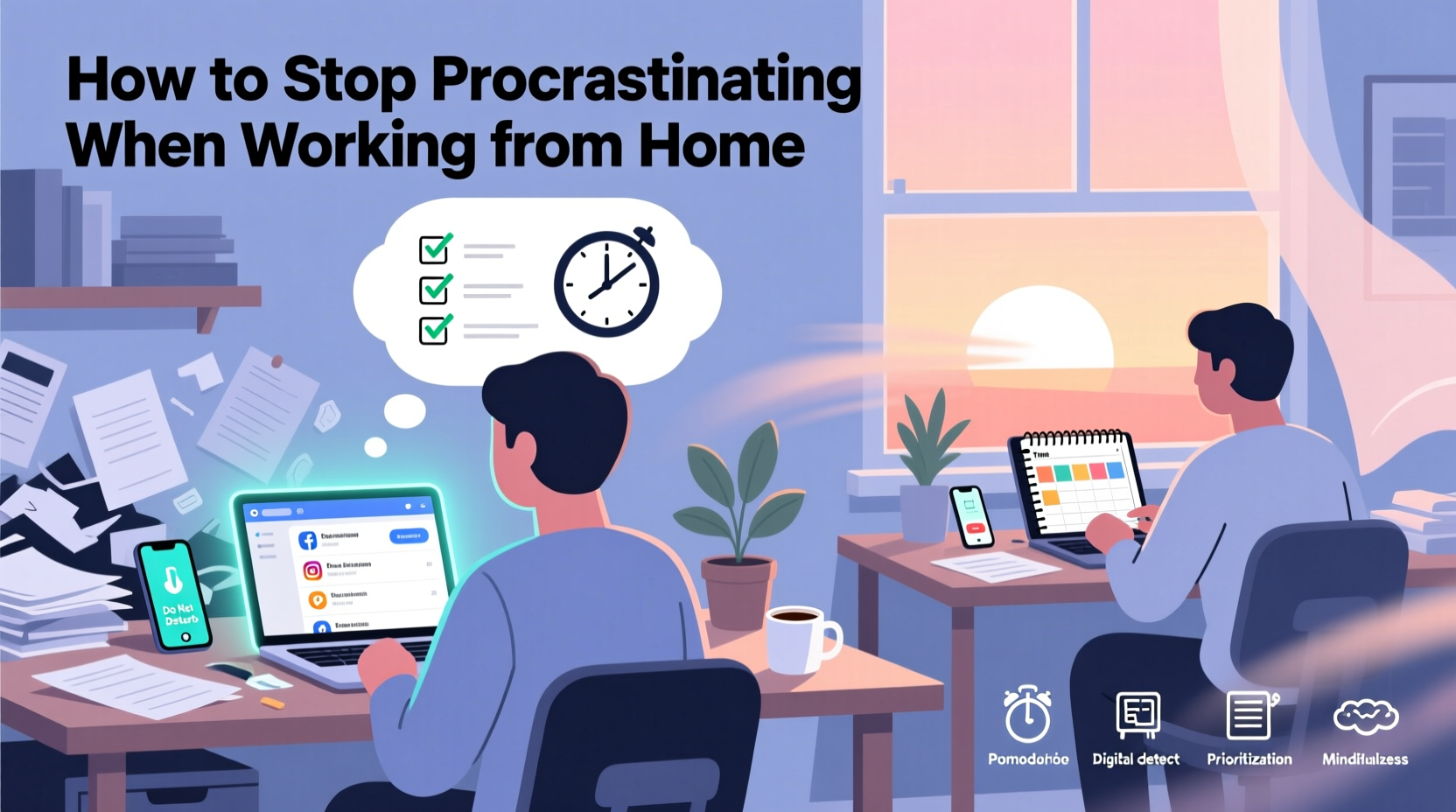
Procrastination isn't just about laziness. It's a response to emotional discomfort—tasks that feel overwhelming, boring, or uncertain trigger avoidance. At home, these triggers are amplified. Unlike an office, where structure and social cues encourage productivity, the home environment blurs boundaries between work and relaxation. Your brain associates your couch with rest, your kitchen with food, and your bedroom with sleep. When you try to work in these spaces, your mind resists because it lacks psychological separation.
Additionally, digital distractions are more accessible. A smartphone on the table, a TV in the background, or a laundry basket calling for attention—all compete for cognitive resources. Research from the University of California, Irvine shows that it takes an average of 23 minutes to refocus after an interruption. In a typical remote workday, this adds up to hours of lost concentration.
“Procrastination is less about time management and more about emotion regulation. We delay tasks not because we don’t know what to do, but because we don’t feel like doing them.” — Dr. Timothy Pychyl, Procrastination Researcher, Carleton University
Create a Dedicated Workspace (Even If You’re Short on Space)
One of the most effective ways to reduce procrastination is environmental design. Your surroundings shape your behavior more than willpower ever will. A designated workspace signals to your brain: “This is where focused work happens.”
If you have a spare room, use it. If not, carve out a corner of a room with clear boundaries. Even a small desk facing a wall can create psychological separation. Avoid working from bed or the couch—these areas are tied to relaxation, making focus harder.
Keep your workspace minimal. Only include tools essential to your current task: laptop, notebook, water bottle. Remove unrelated items—especially phones, snacks, or books unrelated to work. This reduces visual clutter, which research shows increases cognitive load and decision fatigue.
Structure Your Day with Time Blocking and Task Batching
Without a commute or office schedule, the workday can blur into a formless mass of time. This lack of structure makes procrastination more likely. Time blocking—assigning specific blocks of time to specific tasks—is a proven method to create rhythm and accountability.
Start by identifying your peak focus hours. Most people are sharpest in the morning. Use this window for high-concentration tasks like writing, coding, or strategic planning. Schedule lower-energy tasks—emails, calls, admin work—for later in the day.
Batch similar tasks together. Instead of checking email throughout the day, allocate two 20-minute slots: one mid-morning and one mid-afternoon. This prevents constant context switching, which drains mental energy.
Sample Work-from-Home Time Block Schedule
| Time | Activity | Focus Level |
|---|---|---|
| 8:00 – 8:30 AM | Morning routine + review daily goals | Low |
| 8:30 – 10:00 AM | Deep work: Project task (no interruptions) | High |
| 10:00 – 10:15 AM | Brief walk or stretch break | None |
| 10:15 – 11:30 AM | Second deep work block | High |
| 11:30 – 12:00 PM | Email & messages | Medium |
| 12:00 – 1:00 PM | Lunch + screen-free break | None |
| 1:00 – 2:30 PM | Meetings or collaborative work | Medium |
| 2:30 – 3:00 PM | Admin tasks, planning next day | Low |
This structure creates predictability. Over time, your brain learns to associate certain times with certain types of work, reducing resistance and procrastination.
Use the 5-Minute Rule to Overcome Initial Resistance
One of the biggest hurdles to starting a task is the initial friction. The thought of writing a report, analyzing data, or making difficult calls feels heavy before you begin. The 5-Minute Rule dismantles this barrier by lowering the commitment threshold.
Tell yourself: “I’ll work on this for just five minutes.” Often, once you start, momentum takes over. After five minutes, you’ll likely continue because stopping feels more effortful than continuing. This technique leverages the Zeigarnik Effect—the psychological tendency to remember uncompleted tasks more than completed ones—which motivates us to finish what we’ve started.
Mini Case Study: Sarah’s Writing Breakthrough
Sarah, a freelance content writer, struggled to start her articles. She’d sit down, check emails, scroll social media, and suddenly it was noon with nothing written. After learning about the 5-Minute Rule, she committed to writing just one paragraph. To her surprise, she wrote three. By week’s end, she had doubled her output. “It wasn’t about motivation,” she said. “It was about tricking myself into starting. Once I began, the work flowed.”
Eliminate Digital Distractions with Intentional Tech Use
The internet is both a tool and a trap. Notifications, autoplay videos, and infinite scrolling are engineered to capture attention. Fighting them requires deliberate countermeasures.
- Turn off non-essential notifications: Silence apps like Instagram, Slack (except urgent channels), and news alerts during focus blocks.
- Use website blockers: Tools like Freedom, Cold Turkey, or LeechBlock let you block distracting sites during set hours.
- Enable grayscale mode: Turning your phone screen black-and-white reduces dopamine-driven scrolling. It sounds minor, but it works.
- Designate a distraction device: If possible, use one device for work and another for leisure. This creates physical separation.
Avoid multitasking. Despite popular belief, the human brain doesn’t truly multitask—it switches rapidly between tasks, degrading performance. A study from Stanford found that heavy multitaskers perform worse on cognitive control tests than those who focus on one thing at a time.
Do’s and Don’ts of Managing Digital Distractions
| Do’s | Don’ts |
|---|---|
| Use app timers (e.g., Screen Time on iOS) | Leave email open all day |
| Charge your phone outside the workspace | Scroll social media during short breaks |
| Work in full-screen mode | Respond to messages immediately |
| Set “Do Not Disturb” during focus sessions | Use your work computer for entertainment |
Build Accountability and Reward Progress
Procrastination thrives in isolation. Without coworkers or managers nearby, there’s no external pressure to perform. Creating accountability systems bridges this gap.
Share your daily goals with a colleague, friend, or online community. Better yet, find a virtual coworking partner. Platforms like Focusmate connect you with someone for a 50-minute silent work session. Knowing someone is “watching” (even silently) increases commitment.
Rewards also play a key role. Your brain needs positive reinforcement to associate work with satisfaction. After completing a challenging task, reward yourself with something meaningful—a walk, a favorite snack, or 10 minutes of guilt-free browsing. Avoid using rewards that pull you back into distraction loops (e.g., “I’ll watch one YouTube video” turning into an hour).
“Accountability isn’t about shame—it’s about support. When you tell someone your goal, you’re more likely to follow through because you’ve made a social contract.” — Dr. Katy Milkman, Behavioral Scientist, Wharton School
Checklist: Daily Anti-Procrastination Routine
- Define 1–3 priority tasks for the day each morning.
- Set up your workspace free of distractions.
- Time-block your schedule with focus and break periods.
- Use the 5-Minute Rule to start tough tasks.
- Block distracting websites and silence notifications.
- Take real breaks—move, hydrate, look away from screens.
- Review accomplishments at day’s end, no matter how small.
Frequently Asked Questions
Isn’t some procrastination normal?
Yes. Occasional delay is part of being human. Procrastination becomes problematic when it’s chronic and interferes with responsibilities, deadlines, or well-being. The goal isn’t perfection—it’s progress toward better habits.
What if my house is too noisy or crowded?
In shared spaces, use noise-canceling headphones with white noise or focus playlists. Communicate your work hours to family or roommates. If possible, negotiate quiet zones or alternate schedules. Some people find early mornings or late evenings quieter and more productive.
How long does it take to break the procrastination habit?
Habit change varies, but research suggests consistent practice over 6–8 weeks leads to noticeable shifts. Focus on small wins. Each time you resist distraction and complete a task, you strengthen your self-regulation muscle.
Conclusion: Take Back Control One Step at a Time
Procrastination while working from home isn’t inevitable. It’s a pattern shaped by environment, emotion, and routine—and all of these can be redesigned. Start small: pick one strategy from this article and apply it tomorrow. Maybe it’s creating a dedicated workspace, using the 5-Minute Rule, or blocking social media during work hours. Success builds on itself. As you experience even minor victories, your confidence grows, and the cycle of avoidance begins to reverse.
You don’t need to be perfect. You need to be consistent. With the right tools and mindset, you can transform your home from a distraction hub into a space of focused, meaningful work. The ability to manage your attention is one of the most valuable skills of the modern era. Begin building it today.




 浙公网安备
33010002000092号
浙公网安备
33010002000092号 浙B2-20120091-4
Comments
No comments yet. Why don't you start the discussion?