
Dogs are naturally alert and protective, which makes them excellent companions—but their instinct to bark at unfamiliar people approaching the home can become a problem when it's triggered daily by delivery drivers. The constant arrival of packages has turned this behavior into a modern pet owner challenge. Rather than suppressing the bark with punishment or quick fixes, a more effective and humane solution lies in desensitization training. This method helps your dog remain calm by gradually reducing their emotional reaction to the trigger: someone approaching the door with a package.
Desensitization isn’t about teaching obedience commands like “quiet”—though those can support the process. It’s about changing how your dog feels when they see a delivery person. When done correctly, this approach reduces anxiety, fear, or overexcitement, leading to lasting behavioral change. This article outlines a science-backed, step-by-step plan to help you implement desensitization effectively and humanely.
Understanding Why Dogs Bark at Delivery Drivers
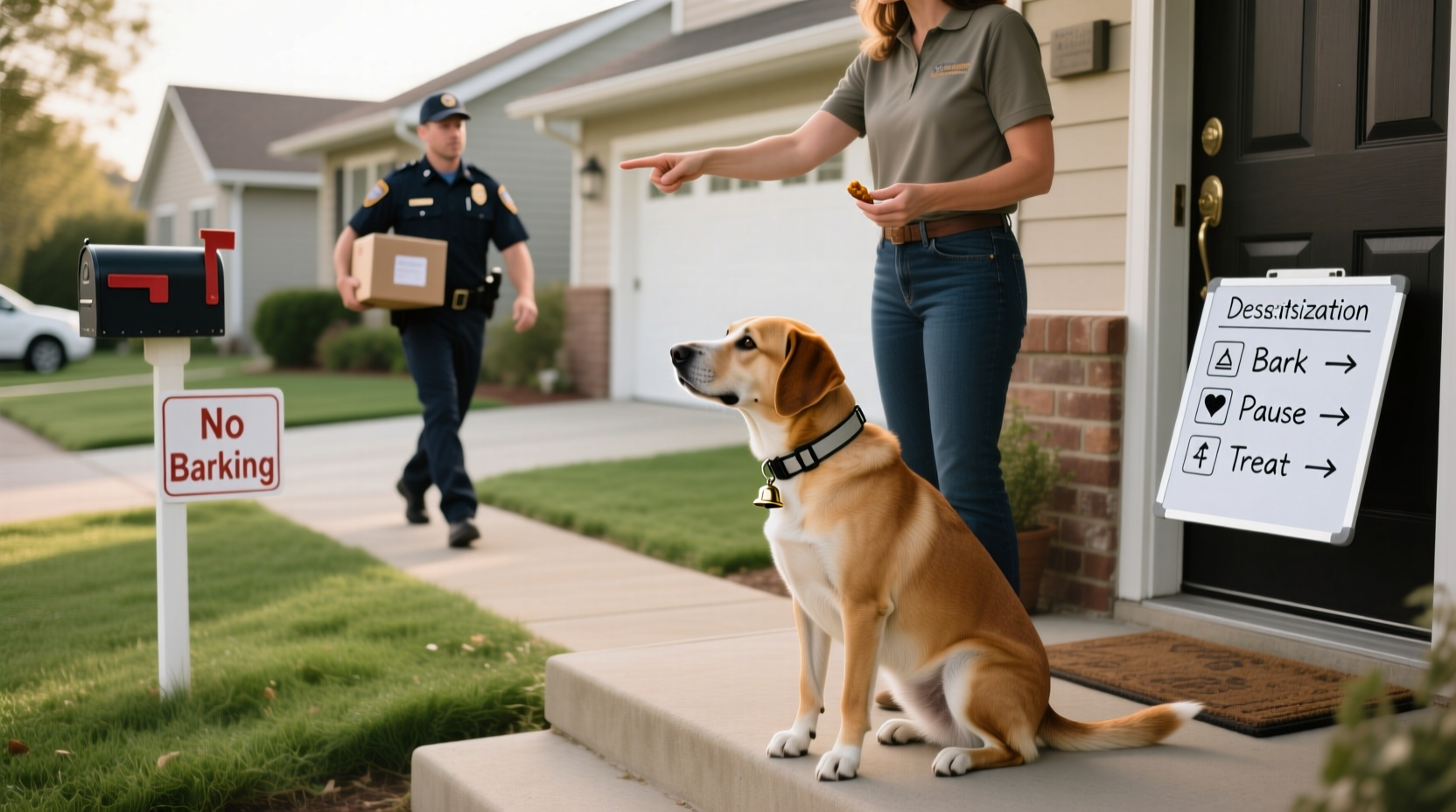
Dog barking at delivery personnel is rarely malicious. It stems from one or more underlying motivations:
- Protective instinct: Your dog views the home as their territory and sees strangers approaching as potential threats.
- Fear or uncertainty: Uniforms, backpacks, and brisk movements may seem unusual or intimidating.
- Excitement: Some dogs associate door approachers with social interaction or rewards.
- Reactivity loop: Barking often causes the person to leave, reinforcing the belief that barking made the threat go away.
Without intervention, this behavior becomes habitual. Each delivery strengthens the neural pathway linking “person at door” to “bark aggressively.” Desensitization breaks this cycle by exposing your dog to the trigger in a controlled, non-threatening way—starting at a level so mild that it doesn’t provoke a reaction.
“Desensitization works because it targets the emotional root of reactivity, not just the surface behavior. You’re not silencing the dog—you’re helping them feel safe.” — Dr. Karen Overall, Veterinary Behaviorist
The Science Behind Desensitization and Counterconditioning
Desensitization is most effective when paired with counterconditioning—the process of changing your dog’s emotional response to a stimulus. Together, these methods form a cornerstone of modern canine behavior modification.
Here’s how it works: Instead of reacting with alarm when a delivery driver appears, your dog learns to associate that sight with something positive, like treats or play. Over time, the brain begins to expect good things when the trigger occurs, replacing fear or arousal with calm anticipation.
This process relies on two key principles:
- Gradual exposure: Start with a version of the trigger so mild it doesn’t provoke a reaction. For example, a video of a delivery person viewed from across the room.
- Positive reinforcement: Every time your dog notices the trigger without reacting, they receive a high-value treat (like chicken or cheese). This builds a new association: “Person approaching = good things happen.”
Success depends on careful control of intensity. If the trigger is too strong too soon, your dog will react, reinforcing the old pattern. That’s why progression must be slow and individualized.
Step-by-Step Desensitization Plan
Follow this structured timeline to systematically reduce your dog’s reactivity. The entire process can take several weeks, depending on your dog’s sensitivity and consistency of practice.
Week 1–2: Build Foundation & Identify Threshold
Begin by identifying what level of stimulus causes your dog to react. This is your baseline.
- Show your dog a video of a delivery driver walking up a driveway (YouTube has many). Play it on a tablet or TV at low volume.
- Observe your dog’s body language: tail stiffening, ears forward, staring, or growling means they’ve noticed and are aroused.
- If there’s no reaction, increase intensity slightly—louder audio, closer viewing distance, or full-screen playback.
- Once you find the point where your dog reacts, back off to the last non-reactive level. This is your starting point.
- At this safe level, pair the video with high-value treats. Give one treat every few seconds while the video plays.
Repeat daily for 5–10 minutes. The goal is for your dog to look at the screen, then at you, expecting a treat—not feeling threatened.
Week 3–4: Simulated Scenarios
Move from videos to real-life simulations. You’ll need a helper.
- Have a friend dress like a delivery driver (wear a uniform or backpack).
- Start at a distance where your dog notices but doesn’t bark—perhaps 50 feet away in a quiet parking lot or sidewalk.
- As your dog sees the person, begin feeding treats continuously. Stop when the person leaves or disappears from view.
- Repeat multiple times per session, always ending on a calm note.
- Gradually decrease distance over days, only progressing when your dog remains relaxed.
Never force proximity. If your dog tenses or barks, increase distance and continue at that level for several more sessions.
Week 5–6: Controlled Home Exposure
Now bring the training to your front yard or window.
- With your helper outside, have them approach slowly and stop well before your dog reacts.
- Feed treats inside the house, behind a window or screen door.
- After a few seconds, the helper turns and walks away. Treats stop.
- Repeat 3–5 times per session, increasing proximity only when your dog stays relaxed.
- Eventually, allow the helper to ring the doorbell once, then immediately leave. Reward calmness.
At this stage, your dog should begin to anticipate treats when seeing a delivery-like figure, not alarm.
Ongoing: Real-World Generalization
Once your dog remains calm during rehearsals, begin applying the training to real deliveries.
- Monitor delivery schedules and prepare treats in advance.
- When a driver approaches, quietly offer treats to your dog before barking starts.
- If your dog does bark, do not scold. Wait for a pause—even a split second—and reward that moment.
- Over time, reduce treat frequency as calm behavior becomes consistent.
Patience is essential. Some dogs improve within weeks; others require months. Progress isn’t linear—setbacks are normal.
Common Mistakes to Avoid
Even well-intentioned owners can undermine desensitization through common errors. Avoid these pitfalls:
| Mistake | Why It’s Harmful | Better Approach |
|---|---|---|
| Rushing the process | Triggers strong reactions that reinforce fear | Progress only when your dog is consistently calm |
| Punishing barking | Increases anxiety and damages trust | Ignore barking; reward calm moments instead |
| Practicing during uncontrolled deliveries | Unplanned exposures reset progress | Limit real-life practice to scheduled sessions |
| Using low-value treats | Dog won’t be motivated to focus | Use smelly, soft treats like boiled chicken or liver paste |
| Training when distracted or tired | Dog can’t learn effectively | Choose quiet times with minimal distractions |
Real-Life Example: Training Max, the Reactive Terrier
Max, a 3-year-old Jack Russell Terrier, barked wildly at every Amazon driver, often triggering neighborhood complaints. His owner, Sarah, tried yelling “no” and closing blinds, but the behavior worsened.
She began desensitization using a YouTube video of a UPS driver. At first, Max lunged at the screen when played from 10 feet away. Sarah moved the tablet to 20 feet—where Max only glanced at it—and started tossing chicken bits whenever the video played.
After five days, Max looked at the screen, then immediately at Sarah, wagging his tail. She gradually brought the tablet closer. Two weeks later, she enlisted a neighbor to simulate a delivery from 100 feet away in the street. Max received treats the entire time the person was visible.
By week six, Max could watch a volunteer approach the porch without barking. When real deliveries resumed, Sarah stood by the window with treats. Max now looks at her for a snack instead of charging the door. Occasional lapses occur, but they’re rare and short-lived.
“I used to dread the doorbell,” Sarah said. “Now, Max actually sits down when he sees someone coming. It’s like he’s learned a new language.”
Essential Tools and Checklist
To ensure success, gather these tools and follow this checklist:
What You’ll Need:
- High-value treats (small, soft, aromatic)
- Tablet or phone with delivery videos
- Helper willing to role-play
- Crate or mat for focused training
- Treat pouch for hands-free feeding
Desensitization Action Checklist:
- ✅ Identify your dog’s reaction threshold using videos
- ✅ Begin counterconditioning at sub-threshold levels
- ✅ Schedule daily 5–10 minute training sessions
- ✅ Recruit a helper for real-world simulations
- ✅ Gradually decrease distance to the trigger
- ✅ Practice at your home with controlled approaches
- ✅ Transition to real deliveries with treat support
- ✅ Monitor progress and adjust pace as needed
Frequently Asked Questions
Can older dogs learn this technique?
Yes. While puppies are more adaptable, adult and senior dogs can absolutely benefit from desensitization. The process may take longer, but consistency yields results at any age.
What if my dog is aggressive, not just reactive?
If your dog has ever attempted to bite or shows stiff, intense aggression, consult a certified veterinary behaviorist before beginning training. Safety is paramount, and professional guidance ensures the right protocol.
Do I need to train for every delivery service?
Not necessarily. Once your dog generalizes the lesson—understanding that all similar figures mean treats—individual uniforms (FedEx, USPS, etc.) become less relevant. However, initial training with varied appearances helps speed generalization.
Final Thoughts and Next Steps
Stopping your dog from barking at delivery drivers isn’t about dominance or discipline—it’s about empathy and education. By using desensitization, you’re not just creating a quieter home; you’re building a more confident, emotionally balanced dog.
The key is consistency, patience, and respect for your dog’s experience. Progress may be slow, but each small step reinforces a new, positive narrative: the world is not full of threats, but sometimes, it brings chicken.




 浙公网安备
33010002000092号
浙公网安备
33010002000092号 浙B2-20120091-4
Comments
No comments yet. Why don't you start the discussion?