
Puppies explore the world with their mouths, and while ankle-biting might seem harmless at first, it can quickly become a frustrating or even dangerous habit as they grow. This behavior is rarely aggressive—it's rooted in play, curiosity, and teething—but allowing it to continue sends the wrong message. The good news: with consistent training, clear boundaries, and smart redirection, you can teach your puppy to interact gently and respectfully.
Understanding why puppies bite is the first step toward changing the behavior. Puppies use their mouths during play, just as they do with littermates. When they nip at your ankles, they’re not trying to dominate or attack—they’re inviting you to play. Unfortunately, humans aren’t built for puppy-style interaction, and reinforcing this behavior by running away or reacting dramatically only encourages more biting.
The key is to replace unwanted behavior with desirable alternatives. Effective training doesn’t rely on punishment but on redirection, consistency, and positive reinforcement. With patience and structure, most puppies outgrow ankle-biting within a few weeks of dedicated effort.
Why Puppies Bite Ankles (And Why It’s Not “Just a Phase”)
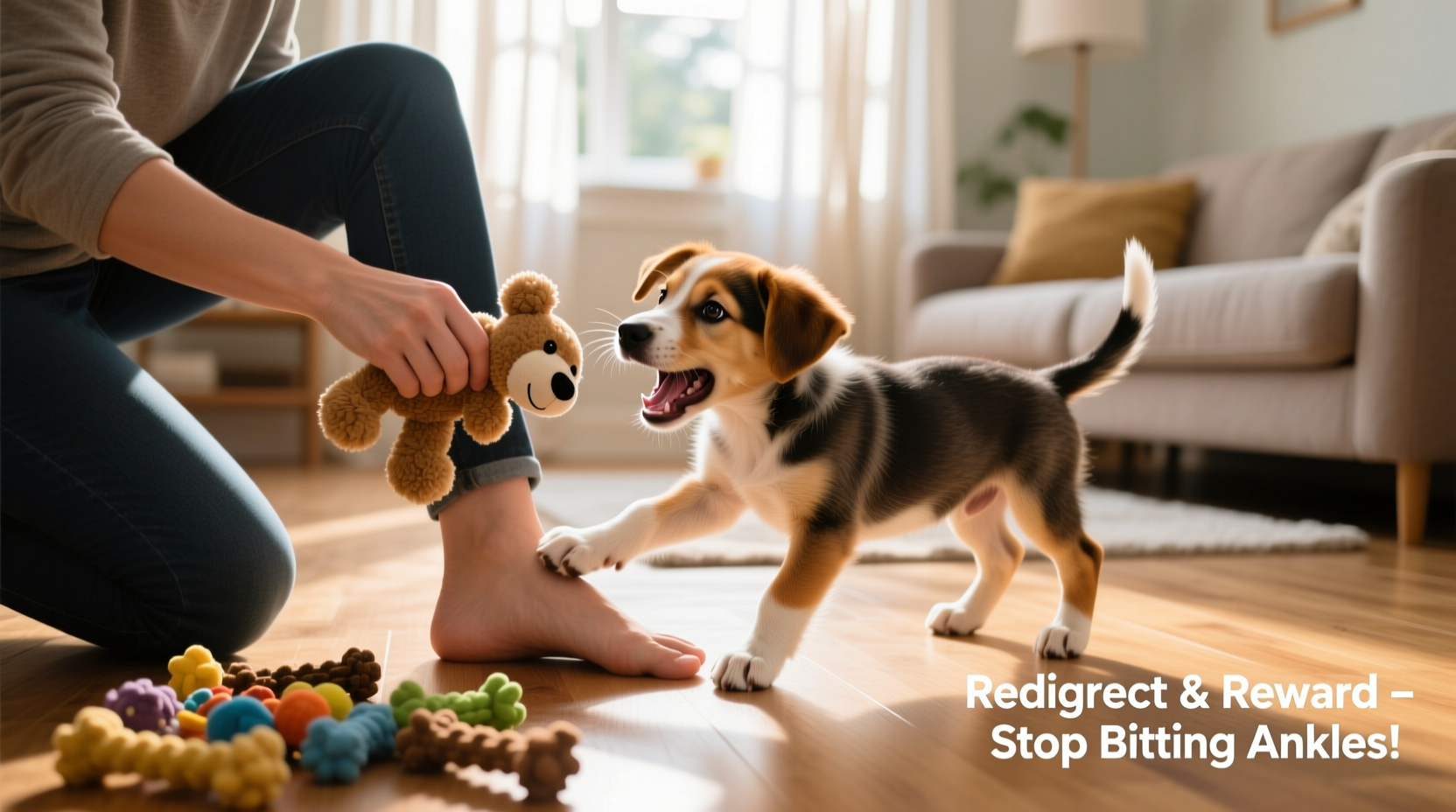
Ankle-biting is common in puppies between 8 and 20 weeks old, but it can persist into adolescence if unaddressed. Several factors contribute to this behavior:
- Teething discomfort: Puppies begin teething around 3–4 months. Chewing relieves gum pressure, and moving objects—like feet—are irresistible targets.
- Play instinct: In litter play, puppies chase, pounce, and mouth each other. Your moving feet mimic prey, triggering their natural urge to engage.
- Attention-seeking: Even negative attention reinforces the behavior. If your puppy bites and you react by yelling or running, they learn that biting gets results.
- Lack of boundaries: Without clear rules, puppies assume all body parts are fair game for mouthing.
While some believe this will “pass with time,” unchecked biting can escalate. A puppy who learns that aggression gains attention may grow into a dog with impulse control issues. Early intervention is crucial.
Step-by-Step Guide to Stopping Ankle Biting
Changing your puppy’s behavior requires a structured approach. Follow this six-step process consistently for best results:
- Recognize the trigger: Most ankle biting occurs during high-energy moments—when you arrive home, walk through a room, or wear slippers. Identify these patterns.
- Remove reinforcement: Stop reacting emotionally. No shouting, no laughing, no sudden movements. Calm disengagement teaches the puppy that biting ends fun.
- Redirect immediately: The instant your puppy lunges for an ankle, offer an appropriate chew toy. Keep toys nearby for quick access.
- Teach bite inhibition: Allow gentle mouthing during calm interactions, but say “ouch!” and withdraw attention if pressure increases. This mimics how littermates respond.
- Use time-outs when needed: If redirection fails, calmly place your puppy in a safe, boring space (like a playpen) for 30–60 seconds. This isn’t punishment—it’s a reset.
- Reward alternative behaviors: Praise and treat your puppy when they choose a toy over your foot, or when they sit calmly near you.
Consistency across all family members is essential. Mixed signals—such as one person using time-outs while another runs and laughs—will confuse your puppy and delay progress.
Effective Redirection Techniques That Work
Redirection is the cornerstone of stopping ankle biting. Instead of focusing on what not to do, give your puppy a clear, acceptable alternative. Here’s how to make redirection effective:
- Keep chew toys accessible: Place durable rubber toys, rope chews, or frozen washcloths (for teething pups) in every room your puppy frequents.
- Engage before the bite happens: Anticipate bursts of energy. Toss a toy down the hall before your puppy zeroes in on your ankles.
- Use movement-based toys: Wand toys, flirt poles, or balls on strings satisfy the chase instinct without involving your body.
- Incorporate food puzzles: Mental stimulation reduces compulsive mouthing. Frozen Kongs or treat-dispensing toys keep jaws busy.
Timing is critical. Redirect *before* or *immediately* after the bite—not minutes later. Puppies live in the moment; delayed correction won’t connect cause and effect.
“Redirection works because it satisfies the puppy’s need to chew or play, but channels it appropriately. The goal isn’t suppression—it’s substitution.” — Dr. Sarah Lee, Veterinary Behaviorist
Do’s and Don’ts of Puppy Biting Training
| Do’s | Don’ts |
|---|---|
| Stay calm and consistent in your response | Yell, hit, or use physical punishment |
| Use high-value treats to reward good choices | Reinforce biting with attention—even laughter |
| Practice short, frequent training sessions | Expect perfection after one lesson |
| Rotate chew toys to maintain interest | Give inappropriate items like shoes or socks to chew |
| Supervise closely during high-risk times | Leave your puppy unsupervised with free roam |
This table highlights the importance of proactive management. Success comes not from scolding but from setting your puppy up to succeed through environment and routine.
Real Example: Turning Around a Persistent Biter
Milo, a 14-week-old Australian Shepherd, joined the Thompson family full of energy. Within days, his ankle-chasing became a daily ordeal—especially when anyone wore socks or moved quickly. The family initially responded by scooping him up and saying “no,” which only excited him more.
After consulting a trainer, they implemented a new plan:
- They kept a basket of chew toys by every doorway.
- When Milo lunged, one parent would toss a squeaky toy across the room while saying “Find it!”
- If he returned to feet, he got a 45-second time-out in his playpen with a frozen Kong.
- They practiced “sit” before petting or feeding, rewarding calmness.
Within 10 days, Milo’s biting dropped by 80%. By week three, he ran to grab a toy whenever someone entered the room. The turning point was consistency—every family member followed the same rules, and Milo learned that self-control led to rewards.
Essential Checklist for Ending Ankle Biting
Follow this checklist daily for at least two weeks to establish new habits:
- ✅ Remove shoes/socks or wear closed-toe footwear indoors during training phase
- ✅ Stock multiple chew toys in high-traffic areas
- ✅ Practice “leave it” and “take it” commands with treats and toys
- ✅ Schedule three 5-minute redirection sessions per day
- ✅ Use time-outs calmly and consistently after biting
- ✅ Reward calm behavior with treats, praise, or petting
- ✅ Limit off-leash freedom until biting stops for 72 hours straight
- ✅ Involve all household members in the training plan
Track progress by noting incidents in a journal. Most puppies show improvement within 5–7 days when the plan is followed rigorously.
Frequently Asked Questions
Is it normal for my puppy to bite only certain people?
Yes. Puppies often target the most active or playful household member. They may also sense hesitation or fear, which can trigger chasing. Ensure everyone uses the same redirection technique regardless of their comfort level.
What if my puppy bites harder when I try to redirect?
This usually means the redirection came too late or the toy wasn’t enticing enough. Try higher-value options like a stuffed Kong or a squeaky toy. Also, avoid waving the toy in their face—toss it a few feet away to spark chase instinct away from you.
Will neutering/spaying stop biting?
No. While spaying or neutering supports long-term behavioral stability, it doesn’t address mouthing directly. Biting is developmental, not hormonal. Training and redirection are far more effective solutions.
Conclusion: Building a Gentle, Well-Behaved Companion
Stopping your puppy from biting ankles isn’t about dominance or breaking their spirit—it’s about teaching them how to interact safely and respectfully in a human world. Every redirection, every calm response, and every rewarded choice shapes your puppy’s understanding of boundaries.
The habits formed in these early weeks lay the foundation for a lifetime of good behavior. What might seem like a small nuisance now can evolve into serious issues if ignored. But with clear guidance, empathy, and consistency, you’re not just stopping a bad habit—you’re building trust, confidence, and a deeper bond.




 浙公网安备
33010002000092号
浙公网安备
33010002000092号 浙B2-20120091-4
Comments
No comments yet. Why don't you start the discussion?