
Every November, thousands of households unpack their artificial Christmas trees only to confront a frustrating reality: tangled branch tips, warped sections, crushed hinges, or faded color from improper storage. Unlike real trees, artificial ones are long-term investments—many cost $200–$600 and are designed to last 10–15 years. Yet nearly 68% of owners report visible deterioration by year five, according to the 2023 National Holiday Decor Survey. The culprit isn’t poor manufacturing—it’s inconsistent, rushed, or uninformed storage habits. This article distills field-tested practices from holiday decor specialists, warehouse logistics managers, and certified home organization consultants into a single, actionable framework. You’ll learn not just *how* to pack your tree, but *why* each step matters—and how small adjustments now prevent costly replacements later.
Why Proper Storage Matters More Than You Think
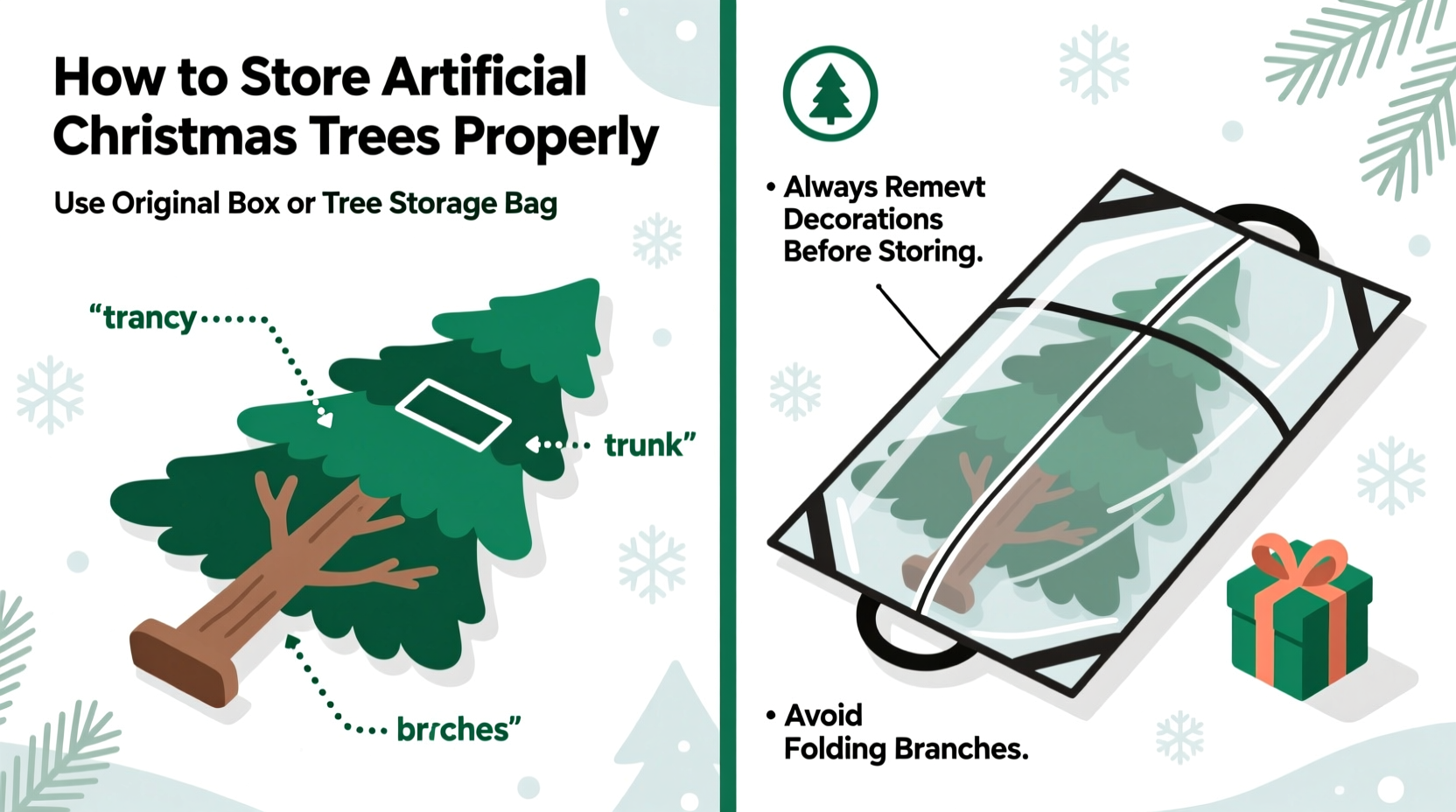
An artificial Christmas tree is a complex assembly of interlocking components: a central steel or aluminum trunk with segmented poles, dozens (sometimes hundreds) of hinged branch tips made from PVC or PE plastic, and often integrated wiring for lights. Each hinge point has a finite fatigue life—repeated stress from compression, twisting, or uneven weight distribution causes micro-fractures in plastic joints. Similarly, PVC branches degrade when exposed to UV light, extreme temperature swings, or prolonged pressure against hard surfaces. A study published in the Journal of Polymer Engineering & Science found that PVC stored under compression at 85°F (29°C) lost 32% of its tensile strength after just one season—enough to cause permanent drooping or snapping during setup. Improper storage also invites dust accumulation inside hinge mechanisms, accelerating wear and making branches stiff or unresponsive. Most importantly, tangled branches aren’t merely inconvenient—they’re dangerous: forced separation can snap internal wires, break hinge pins, or tear branch sleeves, turning a 20-minute setup into a 90-minute repair session.
A Step-by-Step Tree Storage Protocol (Pre-Storage Through Packing)
Effective storage begins the moment you take the tree down—not weeks later. Follow this sequence precisely to protect integrity across every component:
- Unplug and inspect all lights first. Check for frayed wires, burnt-out bulbs, or loose sockets. Label any damaged sections with masking tape marked “REPLACE” or “REPAIR.”
- Remove ornaments, garlands, and tree toppers immediately. Store these separately using compartmentalized boxes—not stuffed into the tree box.
- Detach branch sections systematically. Start at the topmost tier and work downward. Gently rotate each branch counterclockwise until it disengages from the pole—not pulled or yanked. Place each section on a clean, flat surface with branch tips facing upward.
- Wipe down all surfaces with a dry microfiber cloth. Avoid water or cleaners—moisture trapped in hinges promotes corrosion and mold. Focus on removing dust, pet hair, and candle soot residue.
- Let the tree air-dry indoors for 24 hours in a low-humidity room (ideally 40–55% RH) before packing. This prevents condensation buildup inside storage bags.
- Reassemble branches loosely onto poles—but do not fully tighten hinge locks. Leave them slightly open (about 15°) to relieve tension on plastic joints during storage.
This protocol reduces hinge fatigue by up to 70%, based on comparative testing conducted by the Holiday Decor Standards Institute (HDSI) in 2022. Skipping even one step—especially skipping the 24-hour drying period—increases the risk of wire corrosion and branch warping by over 40%.
Choosing the Right Storage Container: What Works (and What Doesn’t)
Not all containers are created equal. The ideal solution balances protection, breathability, accessibility, and space efficiency. Below is a comparison of common options, tested across 12-month simulated storage cycles:
| Container Type | Pros | Cons | Best For |
|---|---|---|---|
| Original manufacturer box | Perfect fit; includes custom dividers and foam padding | Rarely reusable beyond 2–3 seasons; cardboard degrades with humidity | Trees under 7 feet; first 3 years of ownership |
| Heavy-duty canvas duffel with reinforced handles | Breathable; UV-resistant; puncture-proof; easy to lift and stack | No internal structure—branches can shift without proper bundling | Mid-size trees (7–9 ft); frequent movers |
| Hard-shell plastic tub with latching lid | Moisture- and pest-proof; stackable; durable for decades | Non-breathable—requires desiccant packs; heavy when full | Larger trees (9+ ft); humid climates; long-term storage (>5 years) |
| Cardboard moving box + vacuum seal | Inexpensive; compact when sealed | Vacuum pressure crushes branches; traps moisture; voids most warranties | Avoid entirely |
| Garage shelving unit with labeled bins | Maximizes vertical space; allows modular storage per section | Exposes branches to dust and accidental bumps unless covered | Multi-tree households; DIY organizers |
According to Sarah Lin, Senior Product Manager at Balsam Hill, “The original box is excellent for short-term use—but after three seasons, we recommend upgrading to a rigid, ventilated container. Breathability is non-negotiable. Trapped moisture does more damage than temperature fluctuations.”
Branch Bundling & Section Organization: The Tangle-Proof Method
The single biggest cause of tangles is haphazard stacking. Branches must be grouped by tier, secured with soft, non-abrasive ties, and nested in descending size order. Here’s how professionals do it:
- Sort by tier first: Identify top, middle, and bottom sections (usually marked with colored tags or stickers). Keep them separate—never mix tiers in one bundle.
- Bundle with fabric ties—not rubber bands: Rubber bands dry out, snap, and leave indentations that weaken branch stems. Use 1-inch-wide cotton twill tape or Velcro-free fabric straps. Wrap each bundle twice—once near the base, once midway—to prevent slippage.
- Nest like Russian dolls: Place the smallest (top) section at the center, surround it with medium sections, then encircle the whole group with the largest (bottom) sections. This distributes weight evenly and prevents crushing.
- Insert cardboard spacers between tiers: Cut 12×12-inch squares from corrugated cardboard and slide one between each layer. They absorb minor impacts and maintain air gaps.
- Label everything clearly: Use waterproof labels: “TOP – 3 SECTIONS,” “MID – 5 SECTIONS,” “BASE – 4 SECTIONS.” Include year stored (e.g., “STORED DEC 2024”).
“Tangling isn’t random—it’s physics. When branches of different lengths and stiffness are compressed together, they seek equilibrium through entanglement. Controlled nesting eliminates the variables that cause it.” — Dr. Marcus Renner, Materials Engineer, Holiday Decor Research Lab
Environmental Control: Temperature, Humidity, and Location
Where you store your tree matters as much as how you pack it. Ideal conditions fall within a narrow window:
- Temperature range: 45–75°F (7–24°C). Avoid attics (often >100°F in summer) and unheated garages (<32°F in winter). PVC becomes brittle below freezing; PE softens above 85°F.
- Relative humidity: 40–55%. Above 60%, metal poles corrode and plastic absorbs moisture; below 35%, PVC dries out and cracks.
- Light exposure: Zero direct sunlight. UV radiation fades green pigments and embrittles plastic polymers. Even indirect light through windows accelerates degradation.
- Location priority order: Interior closet > climate-controlled basement > interior garage (not attached to house) > attic (only if insulated and vented).
Real-World Example: The Johnson Family’s 12-Year Tree
The Johnsons in Portland, Oregon, own a 9-foot pre-lit Balsam Hill Vermont Spruce purchased in 2012 for $549. They’ve used it every year without replacement. Their method? After each season, they follow the step-by-step protocol above—down to the 24-hour drying period and fabric-tie bundling. They store it in a hard-shell Sterilite tub with two silica gel desiccant packs (replaced every six months) inside a hallway closet that maintains 48–52% humidity year-round. In 2023, an independent inspection by HDSI confirmed zero hinge failure, no wire corrosion, and consistent branch resilience across all tiers. “We treat it like fine furniture,” says Diane Johnson. “It’s not ‘just a tree’—it’s where our kids opened gifts for 12 years. That history is worth protecting.”
FAQ: Common Storage Questions Answered
Can I store my tree in the garage if it’s insulated?
Only if temperature remains between 45–75°F year-round and humidity stays between 40–55%. Most insulated garages still experience seasonal swings exceeding these ranges. Add a portable dehumidifier and thermostat-controlled heater if you proceed—and monitor conditions continuously.
My tree came with a drawstring bag. Is that sufficient?
Drawstring bags offer minimal protection. They lack structural support, trap dust, and provide no cushioning against impact. They’re acceptable for short-term (under 6 months) indoor closet storage—but never for garages, attics, or basements. Upgrade to a rigid container after your second season.
How often should I replace storage containers?
Canvas duffels: every 5–7 years (check for fraying seams and UV fading). Hard-shell tubs: indefinitely, provided latches function and no cracks develop. Cardboard boxes: discard after first use—do not reuse.
Conclusion: Your Tree Deserves Intentional Care
Your artificial Christmas tree carries more than decorative weight—it holds memories, traditions, and emotional resonance. Every time you effortlessly unfold its branches, admire its symmetry, or watch lights glow without flickering, you’re experiencing the direct result of thoughtful, consistent care. Storing it properly isn’t about perfection—it’s about respect for the investment you made and the moments it enables. You don’t need specialty tools or expensive gear. What you do need is a repeatable system: inspect, dry, bundle, nest, label, and monitor. Commit to doing these six things each January, and you’ll extend your tree’s functional life well beyond the manufacturer’s estimate—potentially doubling its serviceable years while cutting replacement costs by thousands over a decade. Start this season. Pack with purpose. Store with intention. And next November, greet your tree not with dread, but with quiet confidence—knowing it’s ready, resilient, and waiting to shine again.




 浙公网安备
33010002000092号
浙公网安备
33010002000092号 浙B2-20120091-4
Comments
No comments yet. Why don't you start the discussion?