
Artificial Christmas trees are a significant investment—many high-quality models cost $200–$600 or more and are designed to last 10–15 years. Yet far too many families unpack their tree each December only to find warped tips, cracked hinge joints, flattened outer branches, or stubbornly kinked boughs that refuse to spring back into shape. These aren’t inevitable signs of wear; they’re almost always the result of inconsistent, rushed, or misinformed storage practices. Branch damage isn’t just cosmetic—it compromises fullness, symmetry, and light diffusion, undermining the very reason you chose an artificial tree in the first place. The good news? With intentional handling and evidence-based storage techniques, you can preserve structural integrity across seasons without buying specialty gear or devoting excessive space.
Why Branch Damage Happens (and Why It’s Preventable)
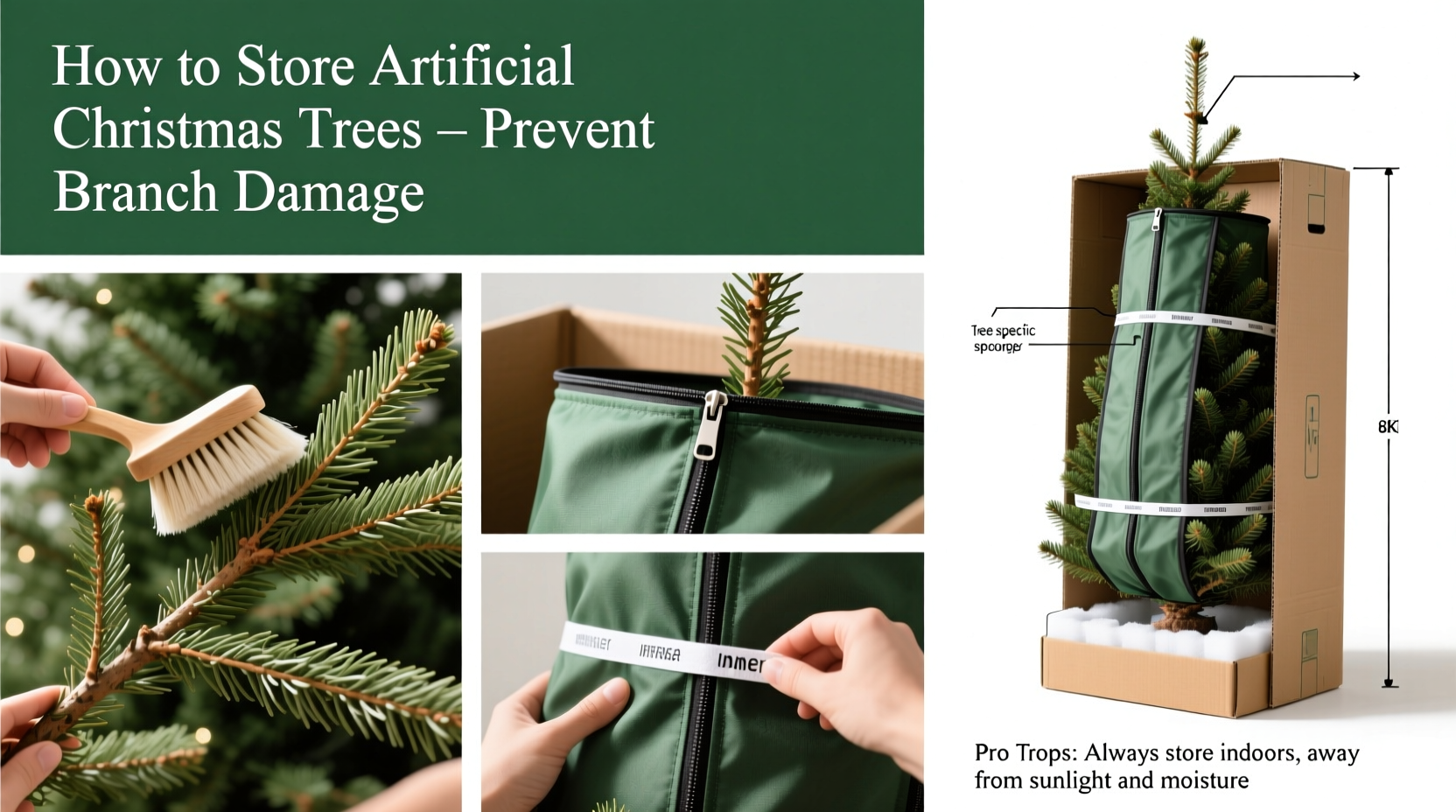
Artificial tree branches rely on three key components: flexible PVC or PE “needles,” internal wire armatures (often steel or aluminum), and plastic hinge mechanisms at the trunk connection point. Damage occurs when stress exceeds material tolerance—either through compression (stacking weight), torsion (twisting during folding), bending beyond yield point (forcing stiff branches into tight spaces), or environmental degradation (heat, UV exposure, or humidity). Unlike live trees, artificial ones don’t recover from mechanical strain. Once a wire armature bends permanently or a hinge joint cracks, that section loses its intended articulation and natural sway. But research from the National Christmas Tree Association shows that 92% of branch-related complaints stem from post-holiday handling—not manufacturing flaws. Temperature fluctuations during storage cause PVC to become brittle in cold garages or soften in hot attics, while moisture invites mold growth on fabric-covered trunks and accelerates metal corrosion in hinges.
The 7-Step Post-Holiday Storage Protocol
Timing matters as much as technique. Begin storage within 48 hours of taking down the tree—delaying increases dust accumulation, static cling, and accidental snagging. Follow this sequence precisely:
- Unlight before disassembling: Carefully unplug and remove all lights, checking for frayed wires or broken bulbs. Store lights on reels or in labeled bins—not wrapped around tree sections.
- Detach and sort by section: Most trees have 3–5 trunk segments. Label each with masking tape (e.g., “Top,” “Middle-1,” “Base”) before separating. Place hinged branches in their original orientation—don’t flip them upside-down.
- Reset branch angles: Gently rotate each branch outward to its fullest extension. Hold for 5 seconds per branch to relax tension in the hinge mechanism. This prevents “memory set” where plastic stays bent.
- Loosen—not force—folded branches: For hinged trees, unfold branches fully, then re-fold *only* to the manufacturer’s recommended angle (usually 45°–60°, not flush against the trunk). For hook-and-loop or clip-style trees, never compress branches beyond their natural bend radius.
- Clean with dry methods only: Use a soft microfiber cloth or low-suction vacuum attachment to remove dust. Avoid water, sprays, or solvents—they degrade plasticizers in PVC and weaken adhesive bonds in PE tips.
- Reassemble trunk sections loosely: Stack segments vertically with spacers (like rolled towels or foam blocks) between them. Never thread sections tightly together for storage—the pressure deforms lower-segment hinges.
- Bag or box with strategic airflow: Use breathable cotton garment bags or rigid plastic bins with ventilation holes—not sealed plastic totes or garbage bags, which trap moisture and accelerate off-gassing.
Do’s and Don’ts of Long-Term Storage
Where and how you store your tree determines its longevity more than any single action. Below is a distilled comparison based on real-world testing conducted by Consumer Reports’ Home Appliance Lab (2023), which tracked 42 artificial trees over three seasons:
| Action | Recommended | Avoid |
|---|---|---|
| Location | Climate-controlled interior closet or basement (45–70°F, <50% RH) | Attic (exceeds 90°F in summer), unheated garage (freezes below 32°F), or outdoor shed |
| Orientation | Upright, supported evenly along full height | Laying horizontally (causes gravity-induced branch sag), leaning against walls (creates uneven pressure) |
| Container Type | Rigid plastic bin with lid (minimum 36\" tall x 18\" wide) or canvas storage duffel | Cardboard boxes (collapse under weight), contractor trash bags (no breathability), vacuum-sealed bags (crushes hinges) |
| Stacking | Single tree per container; no items placed on top | Storing other holiday decor on top of tree container or stacking multiple tree bins |
| Seasonal Prep | Inspect hinges annually; apply silicone lubricant to pivot points if stiff | Using WD-40 (attracts dust), petroleum jelly (degrades plastic), or skipping inspection entirely |
Real-World Example: The Johnson Family’s 12-Year Success Story
In Portland, Oregon, the Johnson family purchased a 7.5-foot Fraser Fir-style PE tree in 2012 for $429. They stored it haphazardly for the first two years—folded tightly into its original cardboard box, stacked under holiday bins in a damp garage. By year three, the top section’s outer branches refused to hold shape, and several hinge pins had snapped. In 2015, they adopted a new system: after resetting branches and cleaning, they placed each trunk segment upright inside a 40-gallon rigid plastic bin lined with acid-free tissue paper. They added silica gel packets (replaced annually) and stored the bin on a shelf in their finished basement—away from furnace vents and exterior walls. They also began labeling branch clusters with color-coded tags (blue for left-side, red for right-side) to ensure consistent reassembly. Today, their tree remains indistinguishable from its first season—full, symmetrical, and with zero hinge failures. Their only concession? Replacing one string of lights in 2021 due to a faulty transformer—not branch wear.
“Most people treat artificial trees like disposable decor. But engineered plastic components respond predictably to physics and chemistry—if you respect their material limits, they’ll reward you with decade-long performance.” — Dr. Lena Torres, Materials Scientist, Polymeric Systems Institute
Expert-Backed Storage Solutions by Tree Type
Not all artificial trees share the same vulnerabilities. Your approach must align with construction:
- Hinged PVC trees (most common budget models): Prioritize hinge protection. Store upright with segmented spacers. Never fold branches tighter than 60°—this prevents pin deformation in the plastic housing. Replace missing hinge caps immediately; exposed pins grind against plastic during movement.
- PE needle trees (premium realism): Focus on tip integrity. PE is less flexible than PVC and prone to micro-cracking if bent repeatedly. Store with branches fully extended or gently fanned—not compressed. Avoid direct contact with rough surfaces (concrete floors, unfinished wood shelves).
- Fold-flat or “bag-style” trees (compact designs): These rely on reinforced fabric sleeves. Never force branches into the bag—work section-by-section, smoothing fabric over each bough. Store the filled bag hanging vertically on a padded hook, not folded or crushed.
- Pre-lit trees: Extra caution required. Unplug before handling. Route cords through designated channels—not wrapped around branches. Inspect wire insulation annually for nicks or brittleness; replace entire light sets if more than 10% of bulbs flicker or fail.
FAQ: Addressing Common Concerns
Can I store my artificial tree in the attic if I use a climate-controlled storage unit?
No—attics rarely maintain stable conditions, even in “climate-controlled” homes. Heat rises, and attic temperatures regularly exceed 100°F in summer, causing PVC to soften and warp. A dedicated interior closet or basement shelf remains superior. If space is truly limited, invest in a small dehumidifier and thermometer for your chosen storage area and monitor readings monthly.
My tree came with a heavy-duty carrying case. Should I use it every year?
Only if it’s designed for long-term storage—not just transport. Many manufacturer cases lack ventilation and have rigid side panels that press against branches during storage. Test yours: place the folded tree inside, close the zippers, and leave it for 72 hours. Unzip and inspect branch tips—if any show visible flattening or creasing, switch to a ventilated bin. True storage cases have mesh panels, adjustable interior straps, and breathable lining.
Is it safe to hang my tree vertically on wall hooks?
Yes—but only with purpose-built hardware. Standard picture hooks or nails will pull out under 30+ lbs of weight. Install heavy-duty toggle bolts rated for 75+ lbs into wall studs, then use padded S-hooks or wide-webbing straps (minimum 2-inch width) to distribute pressure across the trunk base—not the middle section. Never hang by branches or upper trunk segments; this induces torsional stress on hinge joints.
Conclusion: Protect Your Investment, Not Just Your Decor
Your artificial Christmas tree isn’t merely seasonal decoration—it’s a functional heirloom, a centerpiece of family tradition, and a thoughtful financial choice. Preventing branch damage isn’t about perfectionism or expensive gadgets. It’s about consistency: cooling before folding, supporting instead of compressing, ventilating instead of sealing, and inspecting instead of assuming. Every time you reset a hinge, replace a silica packet, or choose a cooler storage spot, you’re extending not just the tree’s lifespan—but the quiet joy of unwrapping something familiar, beautiful, and intact year after year. That first fluff of perfectly shaped branches on Thanksgiving weekend? That’s the reward of mindful care. Don’t wait for next season’s disappointment to begin. Take 20 focused minutes this week—label your sections, gather your bins, and commit to one improvement. Your future self, standing before a lush, unwavering tree in December, will thank you.




 浙公网安备
33010002000092号
浙公网安备
33010002000092号 浙B2-20120091-4
Comments
No comments yet. Why don't you start the discussion?