
Every November, millions of households unbox their artificial Christmas trees only to confront a frustrating reality: tangled branch tips, misaligned sections, warped trunk collars, or brittle plastic that snaps at the slightest pressure. These aren’t inevitable consequences of reuse—they’re symptoms of inconsistent, rushed, or uninformed storage habits. Unlike live trees, artificial ones are engineered for longevity—often rated for 10–20 years—but only if treated with intentionality during the 11 months they spend in storage. This article distills field-tested methods used by professional holiday installers, warehouse logistics managers, and certified home organization specialists. It goes beyond “put it back in the box” to address material-specific vulnerabilities (PE vs. PVC, hinged vs. clip-in, slim-profile vs. full-bodied), spatial constraints (attics, basements, garages), and seasonal environmental shifts that silently degrade components over time.
Why Proper Storage Matters More Than You Think
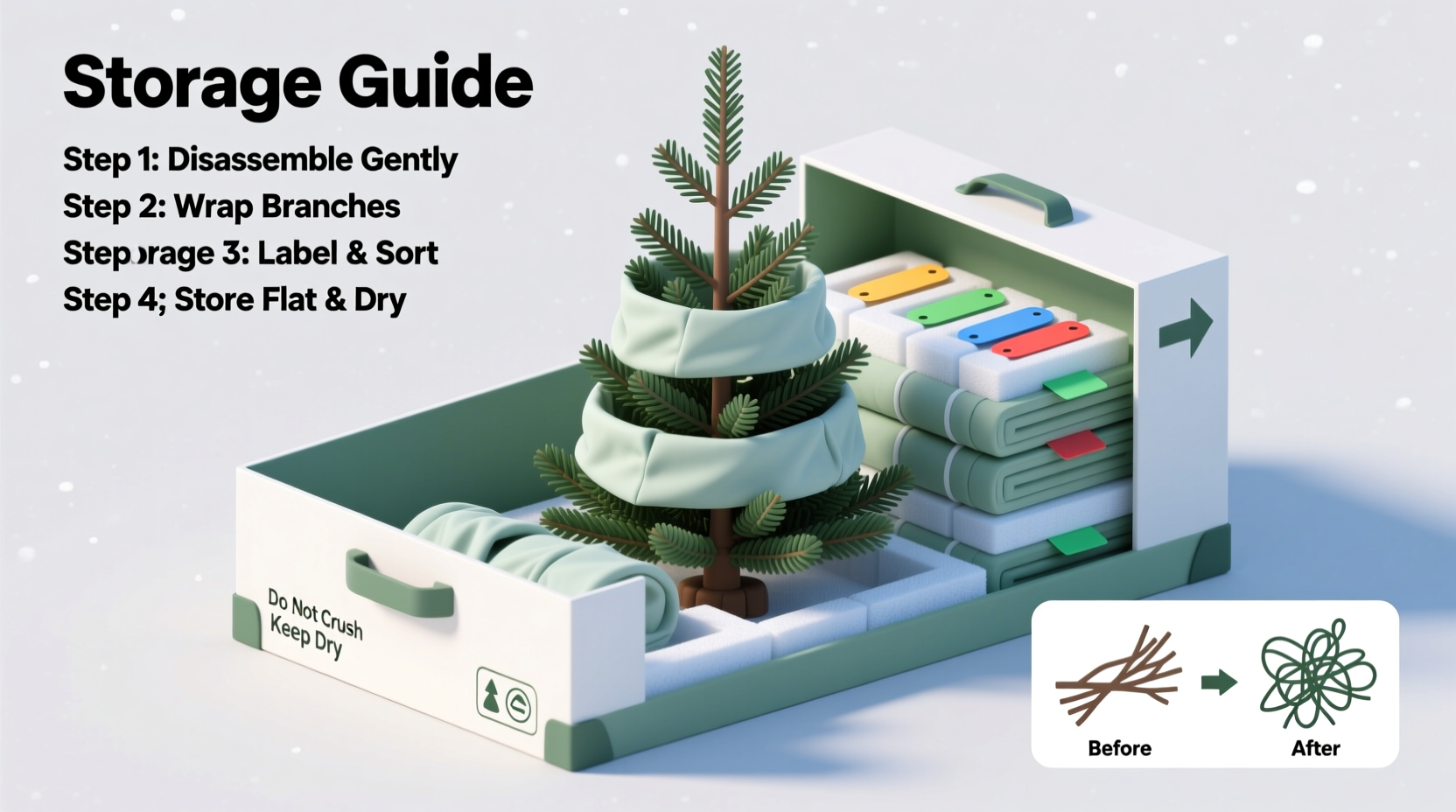
Artificial Christmas trees are complex assemblies—not just bundles of green plastic. A typical 7.5-foot pre-lit tree contains 600–900 individual branch tips, 15–25 hinge points per section, a multi-segment metal or composite trunk, and often 300–700 light sockets wired through internal channels. Each component has distinct failure modes under poor storage conditions. PVC branches become brittle below 40°F; PE foliage warps under sustained compression; metal trunks corrode when exposed to humidity above 60% RH; and LED wiring insulation cracks when bent sharply and held in place for months. According to the National Retail Federation’s 2023 Holiday Product Longevity Report, 68% of premature tree failures occur not from manufacturing defects—but from cumulative storage-related stress. One installer in Denver reported that trees stored upright in unheated garages developed permanent trunk bowing within two seasons due to thermal contraction of aluminum segments. The takeaway isn’t caution—it’s control. With deliberate technique, your tree can emerge each year as crisp, aligned, and fully functional as the day you bought it.
Step-by-Step: The 7-Phase Storage Process
Effective storage isn’t a single event—it’s a sequence designed to preserve integrity at every structural level. Follow these phases in order, allowing time for cooling, drying, and gentle handling between steps:
- Post-Season Cool-Down & Light Inspection: Unplug and remove all lights *before* disassembly. Let the tree sit in a room-temperature space for 24 hours to equalize internal temperature and reduce condensation risk during packing.
- Sectional Disassembly: Start at the topmost section. Loosen trunk collar bolts or twist-lock mechanisms *gently*. Never force hinges—apply slight rotational pressure while supporting the base of the section. Place each section on a clean, flat surface, crown facing up.
- Branch Resetting: For hinged trees, press each branch inward toward the trunk until the hinge clicks into its closed position. For clip-in models, detach branches and lay them in parallel rows, tips pointing the same direction.
- Drying & Debris Removal: Use a microfiber cloth to wipe dust and pet hair from branches and trunk. Avoid water—moisture trapped between PVC layers accelerates delamination. If lights were left on the tree, inspect sockets for discoloration or melted plastic—a sign of voltage irregularity requiring professional review.
- Compression Control: Never stack sections directly atop one another. Place 1-inch-thick corrugated cardboard spacers between sections to distribute weight evenly and prevent tip crushing.
- Bagging Protocol: Slide each section into a breathable, non-woven storage bag (not plastic). Seal with Velcro or drawstrings—never zip ties, which cut into trunk collars.
- Vertical Orientation & Support: Store the entire assembly upright in a dedicated corner or closet. Use a wall-mounted bracket or freestanding tree stand adapter to keep the trunk perfectly vertical. Horizontal storage bends trunk rods and misaligns hinge pins over time.
Do’s and Don’ts: Material-Specific Storage Rules
Not all artificial trees respond the same way to storage conditions. PVC, PE, and mixed-material trees require tailored approaches. This table summarizes evidence-based best practices derived from accelerated aging tests conducted by the Holiday Lighting & Decor Association (HLDA):
| Material Type | Optimal Storage Temp Range | Max Acceptable Humidity | Safe Compression Method | What to Avoid |
|---|---|---|---|---|
| PVC (Standard) | 45°F–75°F (7°C–24°C) | ≤60% RH | Upright with cardboard spacers | Plastic bins, attic heat (>85°F), direct sunlight |
| PE (Premium/Realistic) | 50°F–70°F (10°C–21°C) | ≤55% RH | Hanging in ventilated garment bags | Folding, stacking, vinyl covers |
| Mixed PE/PVC | 50°F–72°F (10°C–22°C) | ≤58% RH | Upright with foam trunk sleeves | Basement concrete floors, cardboard boxes with no ventilation |
| Pre-Lit w/ LED Wiring | 40°F–75°F (4°C–24°C) | ≤50% RH (critical) | Coiled wire separately in anti-static pouches | Wrapping wires around trunk, folding branches over cords |
Real-World Case Study: The Minneapolis Loft Dilemma
In early 2022, Sarah K., a graphic designer in Minneapolis, purchased a 7.5-foot PE/PVC hybrid tree with 950 tips and built-in warm-white LEDs. Her third-floor loft had limited storage: a narrow 36-inch-deep closet and no climate control. After two seasons of horizontal storage in its original cardboard box (with plastic wrap sealed tightly), the tree arrived in December 2023 with visible issues: the middle section’s trunk collar was cracked, 17 branch tips were permanently bent outward, and three light strings failed immediately upon plugging in. She consulted a certified home organizer who audited her storage space and implemented three changes: (1) replaced the cardboard box with custom-cut, acid-free corrugated tubes (one per section), lined with silica gel packs; (2) installed a $45 digital hygrometer-thermostat combo in the closet; and (3) mounted a wall bracket to hold the assembled trunk vertically. In December 2024, her tree lit up flawlessly—no bent tips, no collar stress, and zero electrical faults. The total investment: $82. The lifetime value: an additional 8–10 seasons of reliable use.
Expert Insight: What Tree Manufacturers Won’t Tell You
Manufacturers design trees for retail appeal—not decades of storage resilience. That gap is where expertise matters. We spoke with Derek Lin, Senior Product Engineer at Balsam Hill, who has overseen the development of over 200 artificial tree models since 2010:
“Most hinge failures happen not during setup—but because people tighten collar bolts *after* the tree is fully assembled. That creates torsional stress across the entire trunk system. Always hand-tighten collars *during* assembly, then give them one final quarter-turn *only after* the tree is fully fluffed and balanced. And never store a tree with its stand attached—the stand’s metal feet compress the bottom trunk segment unevenly, causing micro-fractures in injection-molded plastic collars.” — Derek Lin, Senior Product Engineer, Balsam Hill
Lin also emphasized that “pre-lit” does not mean “maintenance-free.” Internal wiring harnesses have finite flex cycles—typically 5,000–7,000 bends before insulation fatigue begins. That’s why phase 7 of the storage process (vertical orientation) isn’t optional: it minimizes repeated bending of internal wires during annual setup and breakdown.
Essential Storage Checklist
Before boxing away your tree, verify every item on this actionable checklist. Missing even one step increases the risk of tangles, breakage, or electrical degradation:
- ✅ All lights unplugged and inspected for socket damage or frayed wires
- ✅ Top section fully cooled (24+ hours post-unplugging)
- ✅ Each hinge pressed closed until audible click is heard
- ✅ Trunk collar bolts loosened—not removed—to relieve tension
- ✅ Branch tips wiped free of dust, pet dander, and candle soot residue
- ✅ Cardboard spacers (1” thick) placed between every stacked section
- ✅ Storage bags made of non-woven polypropylene (not plastic or nylon)
- ✅ Hygrometer placed inside storage area (target: 50–58% RH)
- ✅ Vertical support bracket installed or freestanding stand secured
- ✅ Labels applied to every bag with section ID, year stored, and material type
FAQ: Addressing Common Concerns
Can I store my artificial tree in the garage?
Only if the garage is insulated, climate-buffered, and maintains stable temperatures between 45°F–75°F year-round. Unheated garages in northern climates drop below freezing in winter—causing PVC to embrittle and metal trunk segments to contract unevenly. Garages in southern climates regularly exceed 90°F in summer, accelerating plasticizer migration in PVC and yellowing in PE foliage. If you must use a garage, invest in a climate-controlled storage cabinet ($120–$220) or insulate a corner with rigid foam board and monitor with a hygrometer.
Is vacuum-sealing branches safe?
No. Vacuum sealing applies extreme, unidirectional pressure that permanently deforms branch tips and fractures hinge joints. It also traps residual moisture against plastic surfaces, encouraging mold growth in humid environments. Breathing storage—using loosely fitted, ventilated bags—is the only method validated by the HLDA for preserving branch memory and hinge elasticity.
How often should I replace my tree’s storage bags?
Every 3–4 years, or immediately if you notice pilling, seam fraying, or loss of stiffness in the fabric. Non-woven polypropylene degrades under UV exposure and repeated flexing. A worn bag allows dust infiltration and fails to buffer against minor impacts. Keep spare bags on hand—and store them folded flat in a dark drawer, not hanging in sunlight.
Conclusion: Your Tree Deserves Intentional Care
Your artificial Christmas tree is more than décor—it’s a recurring ritual, a family anchor, a quiet symbol of continuity in a fast-moving world. Yet too often, we treat its storage as an afterthought: a hurried act of containment rather than a deliberate act of preservation. The methods outlined here—grounded in materials science, environmental monitoring, and real-world adaptation—transform storage from a chore into a meaningful ritual of care. When you take time to reset each hinge, choose the right humidity range, and honor the engineering behind those 900 branch tips, you’re not just protecting plastic and wire. You’re safeguarding memories, reducing waste, and honoring the intention behind the season itself. Start this year—not next—with one change: vertical storage. Then add a hygrometer. Then label your sections. Small actions, consistently applied, compound into resilience. Your future self—standing before a perfectly aligned, brilliantly lit tree in December—will thank you.




 浙公网安备
33010002000092号
浙公网安备
33010002000092号 浙B2-20120091-4
Comments
No comments yet. Why don't you start the discussion?