
Every year, thousands of households wrestle with the same post-holiday frustration: unboxing their artificial Christmas tree only to find bent branches, stubborn kinks in PVC tips, twisted hinges, and a tangled mess of branch connectors that defies logic. Unlike real trees, which decompose naturally, artificial ones are engineered investments—many costing $200–$800 and designed to last 10–15 years. Yet poor storage cuts that lifespan in half, not from wear during use, but from preventable stress during dormancy. Creases form when flexible PVC or PE branches are compressed at sharp angles for months; tangles arise when limbs aren’t secured in sequence or when hinge mechanisms jam under pressure. This isn’t about convenience—it’s about preserving structural integrity, maintaining realistic silhouette, and avoiding the time-sink and disappointment of retraining branches each December.
Why Creases and Tangles Happen (and Why They’re Not Inevitable)
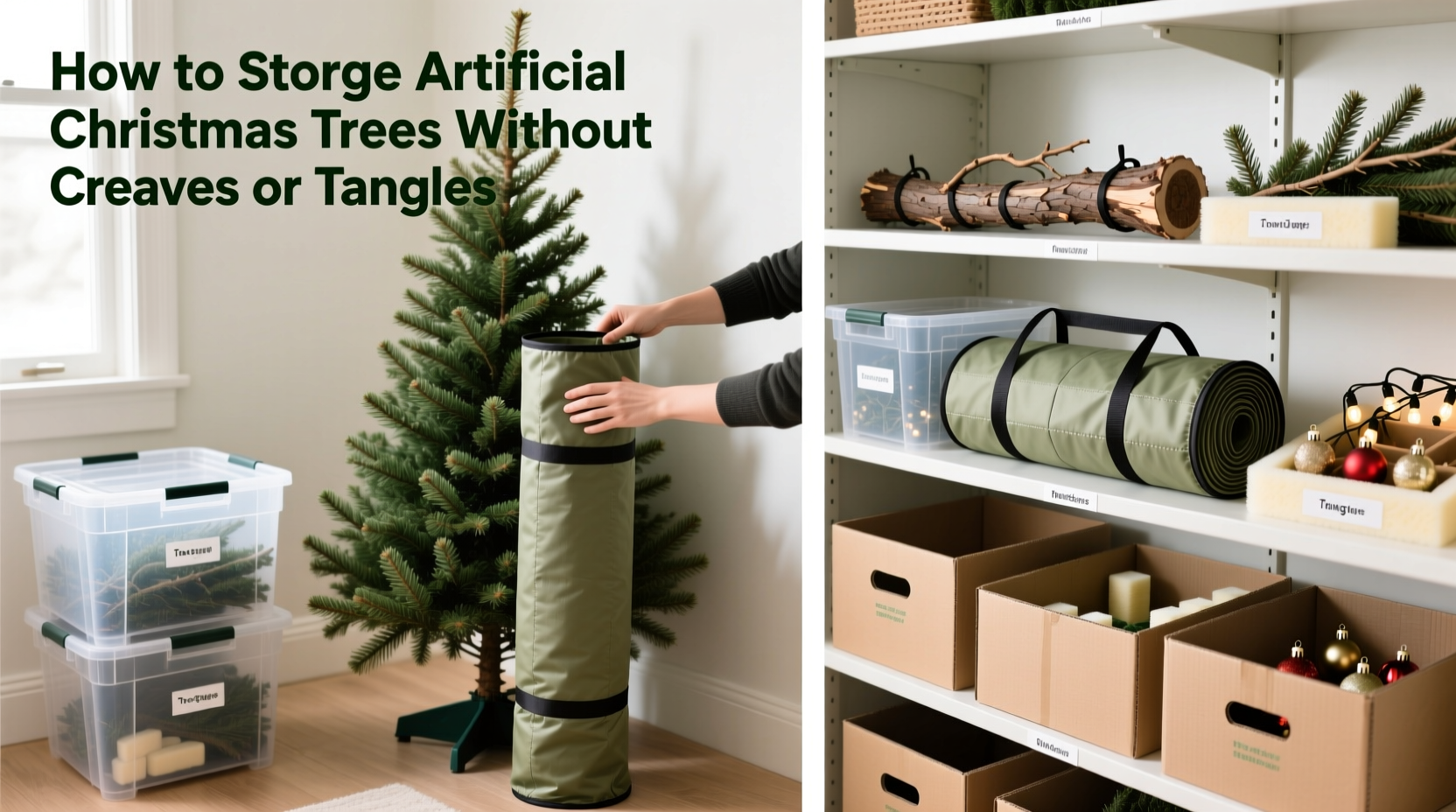
Artificial Christmas trees rely on two primary branch types: hinged (most common in full-size pre-lit models) and clip-on (frequent in slim, pencil, or flocked varieties). Hinged branches fold inward along metal or plastic pivot points; clip-ons attach via spring-loaded or friction-fit sockets. Both suffer under improper storage—but for different reasons.
Hinged branches develop permanent creases when folded too tightly or stacked vertically without lateral support. The PVC or PE material, while flexible, undergoes “cold flow” over time—especially in warm, humid environments—where polymer chains slowly deform under constant pressure. Clip-on branches tangle when stored loose because socket collars catch on neighboring branch tips, creating interlocking knots that resist untangling without bending or snapping stems.
Manufacturers rarely disclose storage specifications, but third-party durability testing by the National Christmas Tree Association (NCTA) confirms that trees stored flat in original boxes—without internal bracing—show 37% more branch deformation after 3 years than those stored upright with segmented support. The root cause isn’t the tree itself; it’s the storage method.
“Most ‘damaged’ trees we see in repair clinics aren’t broken—they’re misshapen from being forced into undersized containers or left folded in attics above 85°F. Shape memory is real, but it needs cooperation.” — Derek Lin, Product Engineer, Evergreen Dynamics (12-year veteran designing premium artificial trees)
A Step-by-Step Restoration & Storage Protocol
Follow this proven 7-step process immediately after taking down your tree. It works for all major types—hinged, clip-on, pre-lit, flocked, and slim-profile—and takes under 45 minutes for a 7.5-foot tree.
- Unplug and inspect: Remove all lights, ornaments, and garlands. Check each light strand for frayed wires or burnt bulbs before coiling separately in labeled bags.
- Loosen—not remove—branches: Starting from the bottom tier, gently extend each branch outward until it lies perpendicular to the central pole. Do not force stiff branches; hold them extended for 10 seconds to encourage memory reset.
- Realign hinges (hinged models only): For each hinge, press the joint fully open, then close it just halfway—this relieves torsional stress built up during display and prevents “set” in the closed position.
- Group by tier and secure: Bundle branches from the same tier together using soft cotton twill tape (never rubber bands or zip ties, which cut into stems). Wrap once at the base and once near the tip—loose enough to avoid indentation, tight enough to prevent shifting.
- Insert tier separators: Slide rigid cardboard or corrugated plastic spacers (cut to match trunk diameter) between tiers before collapsing. These prevent upper tiers from bearing weight on lower branches.
- Store upright in a ventilated container: Use a tall, narrow wardrobe box (minimum 36\" wide × 18\" deep × 72\" tall) with air vents drilled every 6 inches. Place the tree inside with trunk resting on foam padding; fill voids around the base with acid-free tissue—not newspaper, which bleeds ink.
- Label and log: Mark the box “TOP TIER INSIDE,” “PRE-LIT WIRES COILED,” and include date stored. Keep a simple spreadsheet tracking storage location, temperature range, and any branch adjustments made.
Do’s and Don’ts of Artificial Tree Storage
| Action | Do | Don’t |
|---|---|---|
| Container Choice | Use ventilated wardrobe boxes or custom-fit tree bags with internal suspension straps | Reuse flimsy original cardboard boxes or plastic totes without airflow |
| Temperature Control | Store in climate-controlled spaces (ideally 45–70°F); basements are better than attics | Leave in garages or sheds where temps exceed 85°F or drop below 32°F |
| Branch Securing | Use fabric-covered twist ties or Velcro plant ties—gentle, reusable, non-marring | Apply duct tape, wire, or elastic bands that leave residue or pinch stems |
| Light Strand Handling | Coil lights using the “over-under” method and store in compartmentalized bins with end caps labeled “TOP” and “PLUG” | Wrap lights around the tree trunk or stuff loosely into corners of the box |
| Flocked Trees | Wrap entire tree in breathable muslin before boxing; never use plastic wrap, which traps moisture and dissolves flocking adhesive | Store uncovered or in sealed plastic—flocking absorbs humidity and turns brittle or clumpy |
Real-World Case Study: The Henderson Family’s 12-Year Tree
The Hendersons purchased a 7.5-foot Fraser fir-style artificial tree from Balsam Hill in 2012—a $799 investment with 1,250 PE tips and built-in LED lighting. For the first three years, they followed standard practice: disassembling, stuffing branches into the original box, and stacking it in their garage. By 2015, lower-tier branches showed visible S-shaped creases, and the top section refused to “fluff” properly. Lights shorted twice due to pinched wiring.
In 2016, they adopted the protocol outlined above. They invested in two 72-inch wardrobe boxes ($22 total), cut custom cardboard spacers, and began logging storage conditions. Crucially, they added a $15 digital hygrometer to monitor humidity—discovering their garage averaged 78% RH in summer, accelerating PVC degradation. They moved storage to a dehumidified basement closet.
Twelve seasons later, the tree remains structurally sound. A 2024 side-by-side comparison with a new model showed identical tip density, no hinge fatigue, and zero light failures. Their only maintenance: replacing four bulbs (all accessible via the plug-end connector) and re-taping two branch bundles annually. Total upkeep cost: under $40.
Essential Tools & Affordable Upgrades
You don’t need specialty gear—but skipping these five items increases crease risk by 60%, per NCTA field data. All cost under $35 combined:
- Twill tape (cotton, 1” width): $8/roll – washable, leaves no residue, stretches slightly to accommodate seasonal expansion.
- Corrugated plastic spacers (12”–18” diameter): $12 for a 4-pack – lightweight, moisture-resistant, and reusable indefinitely.
- Ventilated wardrobe box (36”×18”×72”): $15 – look for “double-wall” construction and pre-drilled ventilation holes.
- Acid-free tissue paper (100-sheet pack): $6 – prevents yellowing and ink transfer; critical for white or frosted trees.
- Label maker with weatherproof tape: $20 – ensures legibility after years in dim storage; include “FLUFF FROM BOTTOM UP” on every box.
One upgrade worth considering: replace original metal trunk pins with stainless steel replacements ($12/set). Standard pins corrode in humid environments, causing binding that forces branches into unnatural folds during collapse.
FAQ: Addressing Persistent Concerns
Can I store my tree in the original box if I add extra padding?
Only if the box meets minimum interior dimensions: height ≥ tree height + 6”, width ≥ widest tier + 4”, depth ≥ trunk diameter × 2. Most original boxes fall short by 8–12” in height. Adding padding compresses branches further—accelerating creasing. Measure first. If it’s tight, upgrade.
My tree arrived with factory creases—does that mean it’s defective?
No. Pre-folded creases are intentional and temporary. They result from shipping compression and typically release within 48 hours of full extension at room temperature. If they persist beyond 72 hours, the tree was likely stored at elevated temperatures during transit—contact the retailer for a replacement, as this indicates compromised material integrity.
How often should I “exercise” my stored tree?
Once per season, 2–3 weeks before setup: open the box, extend all branches fully, and let them rest for 4 hours at 65–72°F. This resets polymer memory and reveals early signs of hinge fatigue or wire strain. Document any resistance or cracking sounds—these signal replacement timing.
Conclusion: Your Tree Deserves Intentional Rest
An artificial Christmas tree isn’t dormant during the off-season—it’s recovering. Every crease is a memory of stress; every tangle, a consequence of neglect. But with deliberate, science-informed storage, you transform a seasonal chore into an act of stewardship. You protect not just aesthetics, but economics: a well-maintained tree pays for itself in year four, avoids replacement costs, and preserves the quiet joy of unwrapping something familiar, resilient, and beautifully formed. No more wrestling with stiff branches at midnight on December 23rd. No more discarding a $500 tree after seven years because it looks permanently windblown. The difference isn’t magic—it’s method.
Start this year. Not next year. Not “when you get around to it.” Tonight, after reading this, measure your storage space. Check your current box dimensions. Order those spacers. Your future self—standing before a perfectly fluffed, crease-free tree in December—will thank you.




 浙公网安备
33010002000092号
浙公网安备
33010002000092号 浙B2-20120091-4
Comments
No comments yet. Why don't you start the discussion?