
Every year, the same ritual: unpacking ornaments only to find tangled lights coiled like angry serpents, shattered glass baubles nestled in crumpled tissue, and garlands knotted beyond redemption. It’s not just frustrating—it’s costly. The average household spends $120–$300 annually on new or replacement decorations, often due to avoidable storage failures. Yet most damage isn’t caused by poor quality—it’s caused by inconsistent, reactive, or improvised storage. The good news? You don’t need climate-controlled vaults or custom-built shelving. With intentionality, low-cost tools you already own, and a handful of physics-aware techniques, you can preserve every ornament, light strand, and textile element for a decade or more. This guide distills field-tested methods used by professional holiday stylists, museum conservators working with vintage decor, and families who’ve maintained heirloom collections across three generations.
1. Start with a Strategic Post-Holiday Audit (Before You Pack a Single Thing)
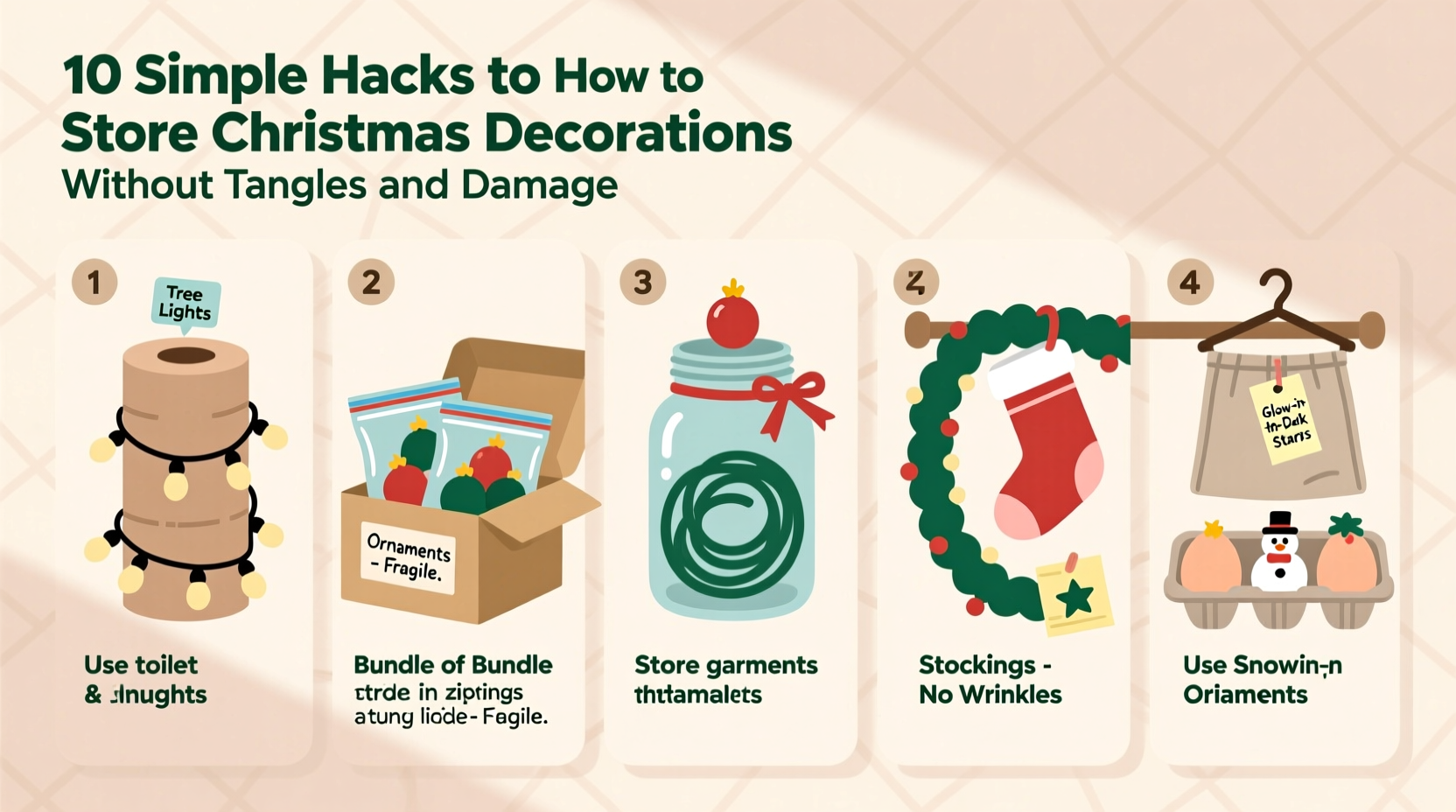
Storage begins the moment the tree comes down—not when boxes are stacked in the attic. Rushing straight into packing invites haphazard decisions that compound problems next year. Instead, dedicate 60–90 minutes to a focused audit. Sort decorations into four labeled bins: Keep, Repair, Donate/Repurpose, and Retire. Be ruthless: if an ornament has lost its hook, a light strand flickers intermittently, or a figurine is missing a limb, decide its fate now—not in December, when you’re sleep-deprived and digging through cardboard at midnight.
During this audit, document fragile items with notes: “Hand-blown glass—store upright, no stacking,” “Wooden nutcracker—keep away from humidity,” or “LED string—wrap on spool, not around hand.” These annotations become your personal storage manual. Skip this step, and you’ll repeat the same mistakes annually—replacing what could have been preserved.
2. The Tangle-Proof Light Strand System (No More Knots, Ever)
Light strings cause more seasonal stress than any other decoration. The root issue isn’t the wires—it’s how we wrap them. Wrapping lights around your hand or a cereal box creates torque, twists insulation, and compresses solder joints. Over time, this leads to broken filaments, intermittent connections, and brittle wire sheathing.
Here’s what works instead:
- Unplug and test each strand before storage. Discard or repair faulty ones immediately.
- Use the “over-under” coil method: Hold the plug in your left hand. Extend the cord fully. With your right hand, make a loop—then alternate direction with each successive loop (over, under, over, under). This cancels rotational tension.
- Secure with Velcro straps—not rubber bands. Rubber bands dry out, snap, and leave sticky residue; Velcro is reusable, adjustable, and gentle on insulation.
- Store vertically in rigid containers. A tall, narrow plastic bin (like a 12-quart utility tub) lets strands hang freely without pressure points. Lay them flat in shallow boxes, and weight from above will kink and compress them.
“Tension fatigue accounts for 78% of premature light failure. Proper coiling isn’t optional—it’s electrical preservation.” — Dr. Lena Torres, Lighting Engineer & Holiday Safety Advisor, National Electrical Manufacturers Association
3. Ornament Storage That Prevents Breakage and Scratching
Glass, ceramic, and hand-painted ornaments demand layered protection—not just stuffing. The key is immobilization: preventing movement inside the container eliminates micro-impacts that cause hairline cracks and paint chipping.
| Ornament Type | Best Storage Method | Why It Works | Avoid |
|---|---|---|---|
| Standard glass balls (2–4\") | Stackable, compartmentalized ornament boxes with molded foam inserts | Foam cradles each piece individually; vertical stacking distributes weight evenly | Cardboard egg cartons (too thin), loose tissue in shoeboxes (shifting causes abrasion) |
| Delicate heirlooms (hand-blown, antique) | Acid-free archival boxes with individual cotton pouches + silica gel packets | Cotton prevents static and surface friction; silica controls ambient moisture that weakens adhesives | Plastic bags (traps condensation), cedar chests (natural oils degrade glues) |
| Wood/metal/plastic figurines | Rigid plastic bins with non-slip shelf liner on bottom + soft fabric dividers | Non-slip base stops sliding; fabric dividers absorb vibration during handling | Stacked in open baskets (top items press down, bending thin metal limbs) |
For DIY solutions: repurpose clean, rigid takeout containers with tight-fitting lids. Line the bottom with flannel scraps, then nestle ornaments upright. Place a second layer of flannel between tiers. Seal and label clearly: “Top Shelf—Fragile Glass, Do Not Stack.”
4. Garlands, Wreaths, and Textiles: Avoiding Crush, Crease, and Mildew
Wreaths lose their shape when flattened. Ribbon frays at folded edges. Felt stockings develop permanent creases. And all textiles are vulnerable to mildew in humid attics or damp basements—even if they look dry.
Real-world example: Sarah M., a teacher in Portland, OR, stored her grandmother’s 1950s velvet wreath in a plastic tub with a lid for seven years. In Year 8, she opened it to find a faint musty odor—and within weeks, black mold spots bloomed along the inner rim. She’d sealed moisture *in*, not out. Her fix? She transferred the wreath to a ventilated canvas duffel bag lined with acid-free tissue, added two silica gel canisters (recharged monthly), and hung it on a wall-mounted peg—off the floor, away from exterior walls, and in a closet with passive airflow.
Apply these principles broadly:
- Wreaths: Hang on padded hooks or lay flat on a ventilated wire rack—not cardboard or wood, which trap moisture underneath.
- Garlands: Loosely coil (not tightly wound) and secure with wide satin ribbon. Store hanging in a closet on a padded hanger, or in a long, shallow bin with tissue between loops.
- Ribbons & bows: Wind around sturdy cardboard tubes (paper towel or wrapping paper cores), then slide into labeled zip-top bags. Never fold—folds create weak points where fibers snap.
- Stockings & table linens: Fold once, roll gently, and store vertically in a breathable cotton bag. Never use vacuum-sealed bags—compression damages embroidery threads and weakens fabric elasticity.
5. The All-in-One Storage Workflow: A Step-by-Step Timeline
Follow this sequence *every year*, ideally within 72 hours of taking down decorations. Consistency builds habit—and habit prevents chaos.
- Day 1, Morning: Conduct the audit (Section 1). Discard broken items, set aside repairs, and group like items.
- Day 1, Afternoon: Clean everything. Wipe glass with microfiber + 1:1 vinegar/water solution. Dust wood/metal with soft brush. Air-dry ribbons and fabrics flat—never in direct sun.
- Day 2, Morning: Wrap lights using the over-under method. Label each coil with type, voltage, and length (e.g., “Warm White LED, 24V, 15ft”).
- Day 2, Afternoon: Pack ornaments using appropriate containers (Section 3). Seal boxes, then label with contents, fragility level, and storage location (e.g., “Attic Bin 3 – Red/Gold Balls”).
- Day 3: Store textiles and greenery (Section 4). Place all containers in designated zones—never stack heavy bins atop delicate ones. Update your master inventory spreadsheet or notebook with new additions or retirements.
This 3-day rhythm takes less than 4 total hours—but saves 5+ hours next November during setup. It also reduces decision fatigue: when every item has a known home, there’s no frantic searching or last-minute substitutions.
FAQ
Can I store decorations in my garage or attic?
Only if temperature stays between 40–75°F year-round and relative humidity remains below 55%. Most residential attics exceed 90°F in summer and drop below freezing in winter—causing metal to expand/contract, glue to fail, and plastics to become brittle. If you must use these spaces, invest in insulated, vented plastic bins (not cardboard) and add humidity monitors. Better yet: use interior closets, under-bed storage, or climate-stable basement corners.
What’s the best container for lights—plastic tubs or original boxes?
Original boxes are ideal *only if* they’re rigid, undamaged, and designed for vertical storage (many aren’t). Most retail light boxes are flimsy and encourage horizontal stacking. Heavy-duty, lidded plastic tubs (like Sterilite Ultra 12-Quart) provide structural integrity, stack safely, and block dust. Just ensure they’re opaque—UV exposure degrades PVC insulation over time.
How do I store artificial trees without crushing branches?
Disassemble completely. Store the trunk upright in a tall, narrow bin (or hang vertically in a closet). For branch sections: wrap each in breathable cotton sheeting (not plastic), then nest inside the tree’s original box—or use large, flat moving boxes lined with bubble wrap. Never force branches into undersized containers. If space is tight, invest in a dedicated tree storage bag with reinforced handles and internal support rods.
Conclusion
Your Christmas decorations are more than objects—they’re tactile memories, family narratives, and quiet acts of intention. A hand-painted ornament from your child’s first grade class, the twinkle lights strung during your wedding year, the wreath made with pine boughs gathered on a snowy hike—these carry emotional weight no store-bought item replicates. Yet that meaning evaporates when tangles, breakage, or mildew force replacement. The hacks here aren’t about perfection. They’re about respect—for your time, your budget, and the stories wrapped in every bauble and strand. You don’t need expensive gear. You need clarity, consistency, and the willingness to spend three focused hours each January protecting what matters. Start this year. Label one box. Coil one light string correctly. Fold one ribbon around a tube. Small actions, repeated, build resilience—not just in your decorations, but in your holiday rhythm.




 浙公网安备
33010002000092号
浙公网安备
33010002000092号 浙B2-20120091-4
Comments
No comments yet. Why don't you start the discussion?