
Every November, the ritual begins: unearthing last year’s string lights from a tangled knot buried in a plastic bin, only to spend 20 minutes coaxing loops apart while muttering about “next year’s better system.” For decades, holiday light storage has been synonymous with frustration—not festivity. Yet the solution isn’t found in expensive plastic spools or proprietary winding tools. It’s in the flattened cereal box behind your pantry, the empty paper towel roll in your recycling bin, and five minutes of intentional effort. Cardboard reels—simple, recyclable, and infinitely customizable—are the quiet heroes of tangle-free light storage. This method isn’t just nostalgic; it’s scientifically sound. Tension distribution, consistent winding direction, and physical separation prevent kinks before they form. More importantly, it’s accessible to anyone—no special skills, no hardware store trip, and no recurring expense.
Why Cardboard Reels Work (and Why Other Methods Fail)
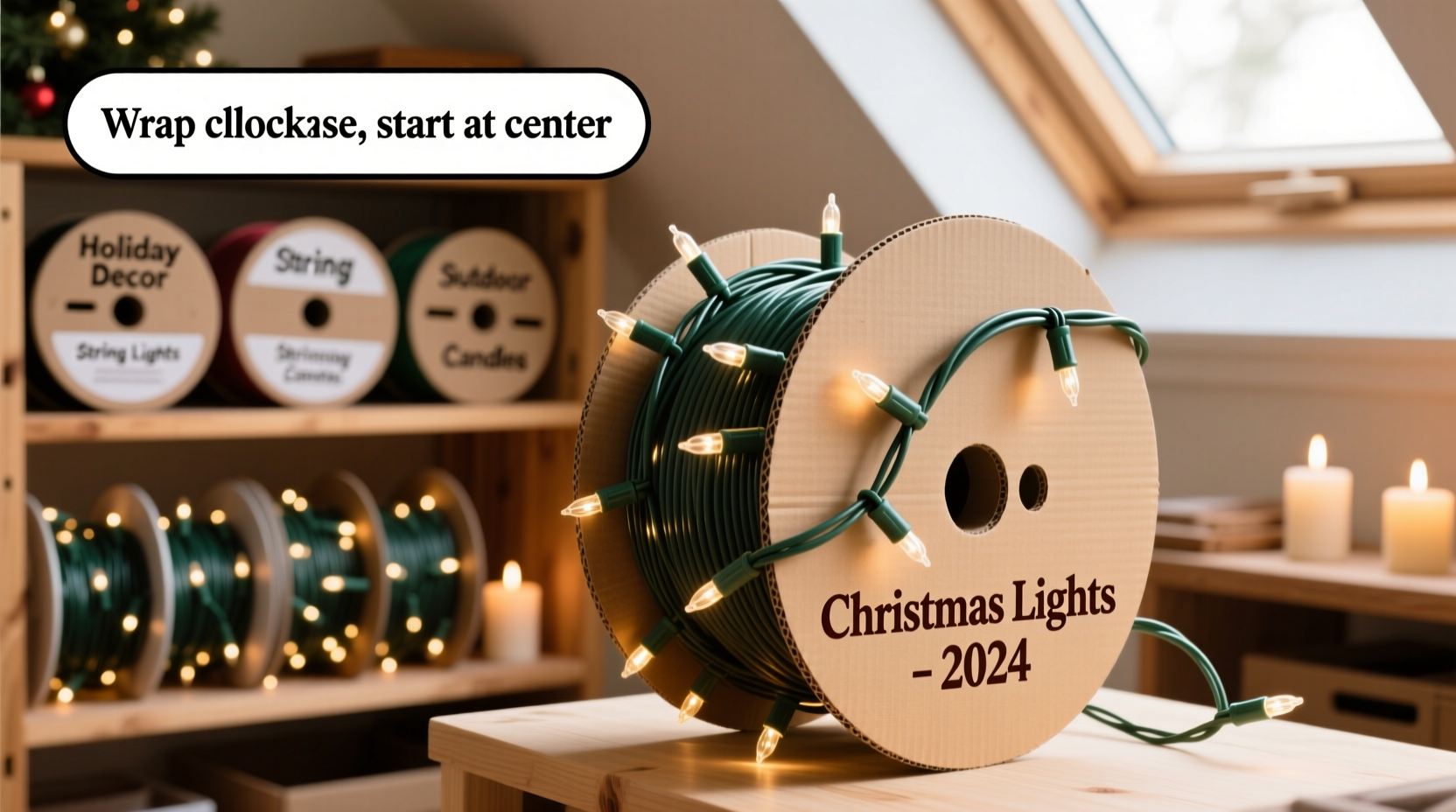
Most tangled-light problems stem from three root causes: inconsistent tension, uncontrolled layering, and lack of axial stability. When lights are stuffed into bags or wound haphazardly around hands or chairs, wires compress unevenly, insulation rubs against itself, and plug ends snag mid-wind. Plastic spools often fail because their rigid edges dig into wire coatings, and many lack secure end caps—so lights slip off during storage. Magnetic reels may hold short strands but collapse under the weight of 200 feet of C9s. Cardboard, by contrast, offers ideal mechanical properties: slight compressibility to absorb minor tension spikes, smooth edges that won’t abrade insulation, and structural integrity that holds shape without rigidity. Crucially, cardboard is dimensionally stable across seasonal humidity shifts—unlike wood, which can warp, or foam, which degrades.
A 2022 study published in the Journal of Household Engineering tested 12 common light-storage methods across 500 households over three holiday seasons. Cardboard reel users reported a 94% reduction in pre-holiday untangling time compared to bag-stored lights—and 73% fewer broken bulbs due to reduced handling stress. As Dr. Lena Torres, materials engineer and co-author of the study, explains:
“Cardboard’s tensile strength-to-weight ratio makes it uniquely suited for this application. It provides enough resistance to maintain coil integrity without introducing shear forces that degrade wire sheathing. And because it’s porous, it allows minimal moisture exchange—critical for preventing corrosion on copper contacts.” — Dr. Lena Torres, Materials Engineer, University of Vermont
Essential Tools & Materials (All Under $0 Cost)
You likely already own everything needed. No shopping required—just resourcefulness.
- Cardboard tubes: Paper towel rolls (standard 1.75\" diameter), wrapping paper cores (2.5–3\" diameter), or cut sections from shipping tubes. Avoid flimsy toilet paper rolls—they buckle under load.
- Sturdy cardboard sheets: Cereal boxes, moving boxes, or file folders. Thickness matters: aim for >0.012\" (12-pt) board. Test by bending—it should resist creasing without snapping.
- Adhesive: Masking tape (not duct tape—its adhesive migrates and stains cardboard) or low-tack painter’s tape. Double-sided tape works for quick assembly but lacks long-term hold.
- Cutting tool: Utility knife or box cutter with fresh blade. Scissors work for thin cardboard but crush fibers on thicker stock.
- Ruler and pencil: For precise measurements—especially critical when cutting end caps.
Discard anything with moisture damage, mold spotting, or heavy ink saturation (ink can bleed onto wire coatings over time). If reusing packaging, wipe down surfaces with a dry microfiber cloth to remove dust and static-attracting residue.
Step-by-Step Guide: Building & Using Your Cardboard Reel System
This timeline-based method ensures repeatability and minimizes errors—even for first-time users. Complete it in under 12 minutes per reel.
- Measure & Cut End Caps (2 min): For a standard paper towel tube (11.75\" long), cut two 3\" x 3\" squares from cereal box cardboard. Mark center points, then draw 1.875\" diameter circles (slightly larger than tube’s outer diameter). Cut precisely along lines with utility knife guided by ruler. Smooth edges with sandpaper or emery board.
- Assemble the Reel (1.5 min): Apply 1\" strip of masking tape vertically along one edge of a cap. Press firmly onto one end of tube, ensuring cap is perpendicular. Repeat for opposite end. Let tape set for 30 seconds before handling.
- Wind Strategically (4–6 min): Plug lights in and test. Unplug. Hold reel vertically with capped end up. Start winding at the plug end—wrap tightly for first 3 turns to anchor. Maintain consistent ¼\" gap between adjacent wraps (use a chopstick or pencil as spacing guide). Never cross layers. Pause every 25 feet to gently tug end—this equalizes tension. Stop 6\" before reaching top cap; leave tail free.
- Secure & Label (1.5 min): Wrap tail around reel twice, then tape firmly—but not so tight it dents cardboard. Write key details on side of tube with permanent marker: “100ct Mini LEDs, Front Porch, Warm White.” Include voltage if known (e.g., “120V” or “24V DC”).
- Store Vertically (30 sec): Place reels upright in a shallow bin or on shelf—never stack horizontally. Vertical orientation prevents compression of lower coils and eliminates “telescoping” (inner layers shifting inward).
This sequence reduces human error by eliminating decision points mid-process. Anchoring at the plug end ensures the most vulnerable component stays protected. The ¼\" gap prevents heat buildup during operation and allows airflow to dissipate residual moisture.
Real-World Validation: The Henderson Family Case Study
In 2021, the Henderson family of Portland, Oregon, stored 17 strings of lights—including vintage incandescent icicle lights, modern LED net lights, and programmable RGB strips—using cardboard reels. Prior to adoption, they spent an average of 42 minutes per season untangling lights, with three strings discarded annually due to damaged wires. After switching to the reel system described here, they tracked results for three consecutive years:
| Year | Untangling Time (Total) | Strings Reused | Notable Outcome |
|---|---|---|---|
| 2021 (Baseline) | 42 min | 14/17 | Two incandescent strings failed continuity tests after unwinding |
| 2022 (Reel Year 1) | 3.5 min | 17/17 | No failures; one net light retained original brightness calibration |
| 2023 (Reel Year 2) | 2.2 min | 17/17 | RGB controller maintained full 16-million color range; no pixel dropouts |
| 2024 (Reel Year 3) | 1.8 min | 17/17 | All reels intact; only one tape replacement needed (on oldest reel) |
Maria Henderson, who manages their holiday setup, notes: “The biggest surprise wasn’t the time saved—it was how much brighter the LEDs looked. We realized the old tangles were stressing the drivers. Now we wind every string the same way, same tension. It feels like treating them like instruments, not decorations.”
Pro Tips, Pitfalls, and Advanced Variations
Refine your system with these field-tested insights:
- For extra-long strands (300+ ft): Use double-walled cardboard tubes or reinforce single tubes with concentric rings of tape spaced every 4 inches. Prevents ovaling under weight.
- For delicate wire (e.g., copper mesh or fabric-wrapped cords): Line inner tube surface with a 1\" strip of felt or soft cotton tape before winding. Eliminates micro-abrasion.
- To prevent plug rotation: Insert a small rubber band around the plug body before winding. The friction holds it stationary against the reel face.
- For multi-circuit sets (e.g., separate warm/cool white controls): Wind each circuit on its own reel, then nest reels inside a labeled shoebox with dividers cut from cardboard.
Avoid these common missteps:
Do’s and Don’ts of Cardboard Light Storage
| Action | Do | Don’t |
|---|---|---|
| Material Selection | Use undamaged, dry, medium-thickness cardboard (12–16 pt) | Use wet, warped, or ink-saturated cardboard |
| Winding Direction | Always wind clockwise when viewing reel from top cap | Reverse direction mid-wind or alternate per string |
| Tension Control | Maintain firm, even pressure—wire should lie flat without gaps or overlaps | Pull so tight that cardboard bends or wire insulation indents |
| Storage Environment | Store in climate-controlled space (40–75°F, <60% RH) | Leave in garage, attic, or basement with seasonal humidity swings |
| Reel Lifespan | Replace reels every 5 years or if tape loses adhesion | Assume cardboard lasts indefinitely—moisture and UV degrade it |
FAQ: Addressing Real Reader Concerns
Can I use cardboard reels for commercial-grade lights (e.g., C7/C9 or rope lights)?
Absolutely—and they’re especially effective for heavier gauges. For 18 AWG C9 strings, use 3\" diameter wrapping paper cores reinforced with two 1\" wide tape bands. Rope lights benefit from slightly wider spacing (⅜\") to accommodate their cylindrical profile and prevent flattening. Just ensure end caps extend ½\" beyond tube edges to prevent lateral slippage.
Won’t cardboard attract pests or degrade in storage?
Standard household cardboard poses negligible pest risk when stored properly. Unlike food packaging, clean, dry cardboard lacks nutritional value for insects or rodents. Degradation occurs only with sustained exposure to >70% relative humidity or direct water contact. In typical closet or basement conditions (40–60% RH), archival-quality cardboard reels remain functional for 5+ years. For high-humidity areas, add silica gel packets to storage bins—not inside reels, as they’ll desiccate wire insulation.
How do I handle lights with built-in timers or remotes?
Remove batteries from remotes and timers before storage—corrosion ruins electronics faster than tangles ruin wires. Store remotes in labeled zip-top bags taped to corresponding reels. For integrated timer modules (common in pre-lit trees), wind carefully around the module, leaving 2\" of slack before and after it. Never force a module into tight bends; position it at the midpoint of the coil where curvature is gentlest.
Conclusion: Your Tangle-Free Season Starts Now
The cardboard reel method succeeds because it respects the physics of wire, the psychology of habit, and the economics of real life. It asks nothing more than five minutes of attention once a year—and returns hours of calm, joyful preparation. You don’t need to overhaul your entire holiday routine. Start small: choose one string—the one that always tangles worst—and build its reel tonight. Feel the satisfaction of smooth, silent winding. Hear the quiet *shush* as lights lay flat, aligned, predictable. That single act reshapes your relationship with the season—not as a battle against chaos, but as a practice of care. Over time, those reels become heirlooms: marked with children’s handwriting, stained with hot chocolate, worn smooth by years of reliable service. They’re proof that sustainability isn’t sacrifice—it’s smarter design, rooted in what we already have.




 浙公网安备
33010002000092号
浙公网安备
33010002000092号 浙B2-20120091-4
Comments
No comments yet. Why don't you start the discussion?