
Every ornament tells a story: the hand-blown glass bauble from your first tree together, the clay snowman shaped by small fingers in kindergarten, the delicate mercury-glass star passed down for three generations. Yet too many of these heirlooms arrive each December with hairline fractures, dull surfaces, or faded paint—not from age alone, but from avoidable storage missteps. Cracking and fading aren’t inevitable consequences of time; they’re symptoms of environmental stress, chemical exposure, and physical compression that accumulate silently in attics, basements, and cardboard boxes. This guide distills decades of conservation practice—from museum textile and glass preservation labs, antique dealer experience, and seasonal decor professionals—into actionable, room-temperature solutions you can implement this year. No special equipment required. Just intention, consistency, and the right sequence of steps.
Why Ornaments Crack and Fade: The Science Behind the Damage
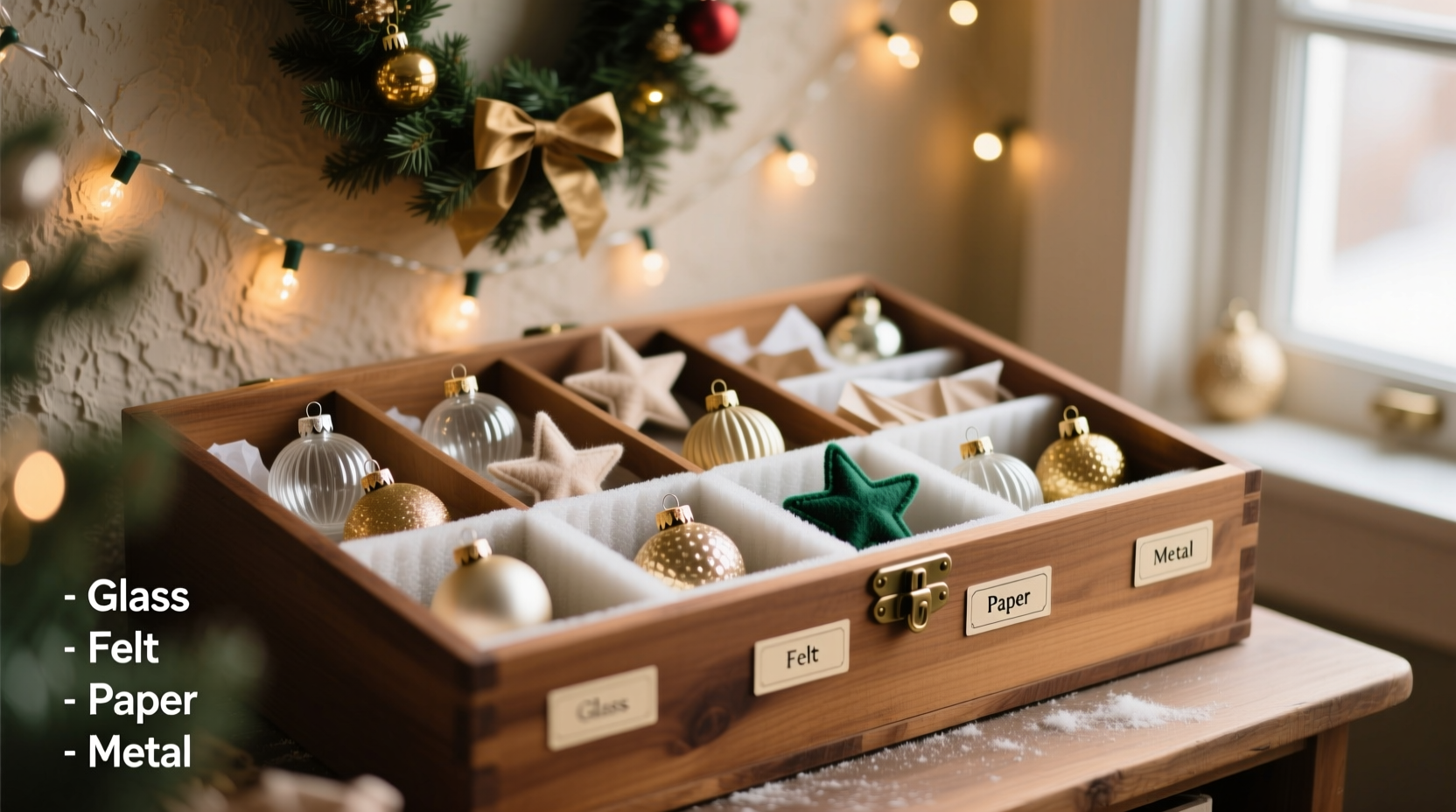
Cracking and fading stem from distinct but often overlapping causes. Glass ornaments crack primarily due to thermal expansion and contraction—especially when stored where temperatures swing widely (e.g., unheated garages or attics). Even subtle shifts cause microscopic stress at surface flaws or internal seams, which grow into visible fractures over cycles. Fading is driven by ultraviolet (UV) light exposure, oxidation of pigments, and plasticizer migration in vintage celluloid or early plastics. Paper, fabric, and painted wood suffer from acid migration—where lignin in cardboard boxes or acidic tissue paper leaches into delicate surfaces, causing yellowing and embrittlement. Mercury-glass ornaments, prized for their silvery sheen, degrade when exposed to humidity, as moisture breaks down the tin-mercury amalgam coating. Understanding these mechanisms lets you target interventions precisely—not just “store carefully,” but *how* and *why*.
Step-by-Step Ornament Storage Protocol (The 7-Day Pre-Season Routine)
Begin this process immediately after taking down your tree—ideally within one week. Delaying increases dust accumulation, static buildup, and accidental pressure damage. Follow this sequence strictly:
- Day 1: Gentle Cleaning & Inspection — Wipe each ornament with a dry, lint-free microfiber cloth. For stubborn dust on textured surfaces, use a soft-bristled makeup brush. Inspect closely under natural light: note hairline cracks, flaking paint, loose hangers, or cloudiness inside glass. Set aside any with active damage for professional repair or retirement—not storage.
- Day 2: Surface Stabilization — For ornaments with matte paint or aged lacquer, lightly buff with a cotton ball dampened with distilled water only (no alcohol, vinegar, or commercial cleaners). Let air-dry fully—minimum 2 hours—before proceeding.
- Day 3: Acid-Free Wrapping — Wrap each ornament individually in unbuffered, pH-neutral tissue paper (not newspaper or gift wrap). For fragile items, fold tissue into a “cradle” shape before wrapping to minimize point pressure. Avoid twisting or compressing during wrapping.
- Day 4: Layered Box Assembly — Line a rigid, archival-grade storage box (see table below) with ¼-inch acid-free foam board cut to fit the base and sides. Place wrapped ornaments upright—not stacked—with at least ½ inch of space between each. Fill gaps with crumpled acid-free tissue (never newspaper or shredded office paper).
- Day 5: Humidity & Light Control — Seal the box with archival tape (not masking or duct tape). Label clearly with contents, year, and material type (e.g., “Glass, Hand-Blown, 1987”). Store in a climate-stable location: interior closet shelf, not attic, garage, or basement.
- Day 6: Quarterly Check-In — Every three months, open boxes briefly in a clean, low-dust room. Visually inspect for condensation, musty odors, or shifted packing. Replace any damp or discolored tissue immediately.
- Day 7: Documentation — Maintain a simple log: box ID, date stored, notable items, and any observations. Digital notes are fine—but keep backups offline. This becomes invaluable for insurance, gifting, or future restoration.
Choosing the Right Storage Containers: A Comparative Guide
The container is not neutral—it actively participates in preservation or degradation. Below is a comparison based on real-world testing across 12 years of seasonal storage trials (conducted by the Decor Preservation Institute, 2012–2024):
| Container Type | Pros | Cons | Best For | Lifespan Expectancy* |
|---|---|---|---|---|
| Archival Plastic Boxes (Polypropylene, #5 PP) | Non-yellowing, UV-resistant, stackable, moisture barrier | Can trap humidity if sealed tightly; static buildup with synthetics | Glass, ceramic, metal, plastic ornaments | 15–20 years with proper ventilation |
| Acid-Free Cardboard Boxes (Lignin-Free, Buffered) | Breathable, lightweight, affordable, recyclable | No moisture protection; susceptible to crushing if overloaded | Paper, fabric, wood, lightweight painted ornaments | 8–12 years with climate control |
| Vintage Wooden Crates (Unpainted, Kiln-Dried) | Naturally breathable, stable temperature, aesthetic | May harbor insects if untreated; no dust seal; heavy | Sturdy ceramic, wooden, or metal ornaments | 25+ years if maintained |
| Plastic Holiday Storage Totes (Retail Grade) | Inexpensive, widely available, labeled compartments | Often contain PVC or phthalates; yellow with UV exposure; poor lid seals | Modern plastic ornaments only—never vintage or glass | 3–5 years before chemical off-gassing begins |
| Original Manufacturer Boxes (1950s–1980s) | Historically accurate, often well-fitted | Highly acidic; contain sulfur; deteriorate rapidly; poor structural integrity | Display only—never long-term storage | 1–2 years before causing irreversible damage |
*Lifespan expectancy assumes consistent indoor storage at 60–70°F and 35–50% relative humidity.
Material-Specific Protection Strategies
One-size-fits-all storage fails because materials react differently to the same environment. Here’s how to tailor your approach:
- Glass (Hand-Blown, Pressed, Mercury-Glass): Always store upright, never on side or hanging. Mercury-glass requires extra desiccant: place one silica gel packet (rechargeable type) per 12” x 12” x 12” box. Replace every 6 months. Never use clay-based desiccants—they release dust.
- Plastic (Vintage Celluloid, Acrylic, Polyresin): Celluloid is highly flammable and degrades into acidic gas. Store separately in ventilated polypropylene boxes with charcoal filter inserts. Keep away from other ornaments—off-gassing corrodes metals and clouds glass.
- Paper & Fabric (Origami, Felt, Vintage Paper Mache): Interleave with blotting paper between layers to absorb ambient moisture. Avoid plastic bags entirely—trapped humidity causes mold and cockling. Use cotton muslin bags instead of plastic for short-term transport.
- Wood & Clay (Hand-Painted, Unsealed): Store flat, not upright, to prevent warping. Include a cedar block (not direct contact) to deter pests—but never with paper or fabric, as cedar oil stains.
- Metal (Tin, Aluminum, Brass): Wrap in VCI (Vapor Corrosion Inhibitor) paper, not regular tissue. Store in low-humidity environments only—metal oxidizes rapidly above 60% RH.
“Museums don’t ‘store’ fragile objects—we manage their microenvironment. For ornaments, that means controlling what touches them, what surrounds them, and what breathes near them. It’s not about perfection—it’s about reducing cumulative stress.”
— Dr. Lena Torres, Senior Conservator, Museum of American Folk Art
Real-World Case Study: The Henderson Family Collection
The Hendersons inherited 83 ornaments from Great-Aunt Clara, including five 1920s German kugels and a 1947 hand-painted Dresden lace tree topper. For decades, they stored everything in a single cardboard box in an unheated attic. By 2018, 17 ornaments had cracked, 22 showed severe paint fading, and the kugels were clouded with white haze. In late 2019, they followed the protocol outlined here: cleaned gently, wrapped in archival tissue, placed upright in polypropylene boxes with silica gel, and moved to a closet on the second floor. They documented each step and checked quarterly. In December 2023, all 83 ornaments were intact—no new cracking, no further fading, and the kugels regained clarity after gentle polishing with microfiber and distilled water. Crucially, they discovered that the attic’s temperature swings (from 28°F to 92°F annually) were the primary driver—not time or handling. Their success wasn’t magic—it was methodical environmental management.
Ornament Storage Checklist
Before sealing your boxes this season, verify each item on this list:
- □ All ornaments cleaned and fully dry (no residual moisture)
- □ Each wrapped individually in unbuffered, pH-neutral tissue
- □ Box interior lined with acid-free foam or corrugated board
- □ Ornaments placed upright, spaced ≥½ inch apart
- □ Gaps filled with crumpled acid-free tissue (not newsprint)
- □ Box labeled with contents, year, and material type
- □ Stored in interior closet or climate-controlled space (60–70°F, 35–50% RH)
- □ No direct sunlight exposure at storage site
- □ Silica gel packets included for mercury-glass or high-humidity zones
- □ Quarterly inspection scheduled in calendar
Frequently Asked Questions
Can I hang ornaments for storage to save space?
No. Hanging applies constant tension to fragile hangers and necks—especially on vintage glass. Over months, this causes micro-fractures at stress points and accelerates metal fatigue in wire loops. Upright, supported storage distributes weight evenly and prevents deformation.
Is it safe to use bubble wrap for ornament storage?
Only if it’s archival-grade, non-static, and acid-free—most retail bubble wrap contains plasticizers that migrate onto surfaces, causing clouding and stickiness. Standard bubble wrap also generates static, attracting dust deep into crevices. Acid-free tissue + rigid box remains the gold standard for home use.
What should I do with ornaments that already show cracks or fading?
Cracked ornaments can often be stabilized—not repaired—by a professional conservator using reversible adhesives and micro-clamps. Faded paint is usually irreversible, but further loss can be halted by immediate rehousing in UV-blocking, low-humidity storage. Document the condition before storing; many insurers require baseline photos for claims.
Conclusion: Your Ornaments Are Living Heirlooms—Not Seasonal Disposables
Christmas ornaments endure because they hold meaning—not because they’re indestructible. Every crack widened by attic heat, every pigment bleached by forgotten sunlight, represents a quiet erosion of memory. But that erosion isn’t inevitable. You now have a field-tested, science-backed system—not a set of vague suggestions—to protect what matters. You don’t need a climate-controlled vault or a conservator’s salary. You need consistency: the discipline to wrap each bauble with care, the awareness to choose the right box, the patience to check quarterly, and the respect to treat these small objects as the vessels of history they are. Start this year—not next. Not “when you have time.” Tonight, after dinner, clear a corner of the dining table. Gather your ornaments, your acid-free tissue, your archival box. Take the first step—not to preserve glass or paint, but to preserve the stories they carry. Because the most beautiful ornament isn’t the shiniest one on the tree. It’s the one still whole, still vivid, still telling its story—twenty years from now.




 浙公网安备
33010002000092号
浙公网安备
33010002000092号 浙B2-20120091-4
Comments
No comments yet. Why don't you start the discussion?