
LED string lights bring warmth, ambiance, and charm to homes year-round. Whether draped over a bed frame, wrapped around a porch railing, or strung across a patio, they’re a staple in modern decor. But once the season ends—or the mood shifts—untangling them during storage retrieval can turn a simple task into a frustrating ordeal. The good news? You don’t need specialized reels or expensive organizers. With just a few common household items and smart wrapping techniques, you can store your lights neatly, protect their wiring, and save time every time you redecorate.
The Problem with Tangled Lights
Tangled LED string lights aren't just annoying—they can lead to damaged wires, broken bulbs, and shortened lifespans. Most people simply coil the cord loosely and drop it into a box or drawer, but this method encourages knots and snags. Over time, repeated tangling weakens solder joints and insulation, increasing the risk of flickering or complete failure.
The root cause isn’t carelessness—it’s technique. When wires are coiled haphazardly, each loop applies pressure unevenly, creating friction points that degrade the internal copper strands. What starts as a minor kink can become a permanent short circuit after several seasons.
Household Items That Work as Light Reels
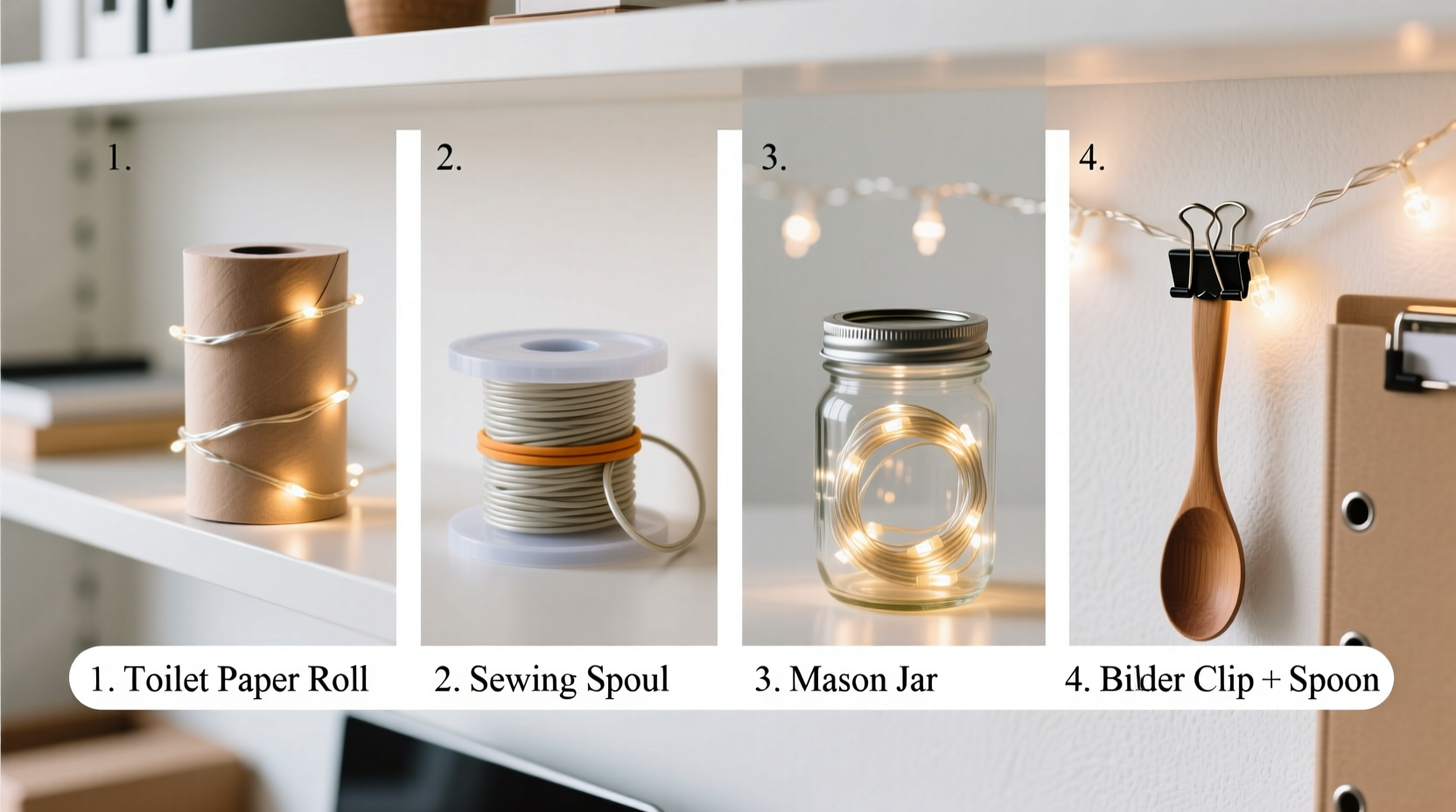
You likely already have several objects at home that make excellent spools for storing LED string lights. The key is choosing something rigid, narrow, and easy to label or stack. Here are five proven options:
- Cardboard toilet paper rolls: Ideal for shorter strands (up to 3 meters). Lightweight and disposable, they prevent over-tightening.
- Paper towel tubes: Longer than toilet rolls, perfect for medium-length strings. Cut to size if needed.
- Clothes hangers: Wire or plastic hangers allow you to wrap lights securely and hang them in closets or garages.
- Binder clips and clipboard boards: Clip one end of the light strand and wrap systematically around a clipboard for flat, tangle-free storage.
- Shoebox flaps: Use the stiff cardboard flaps from shoeboxes as anchors—wrap lights around the box and secure the plug with tape.
These items eliminate the need for commercial reels while offering better control over winding tension and alignment.
Step-by-Step Guide: Wrapping Lights on a Toilet Paper Roll
This method works best for indoor fairy lights up to 50 bulbs. Follow these steps carefully:
- Unplug and inspect: Before storing, check each bulb and segment for damage. Replace any faulty sections.
- Start at the plug end: Hold the plug firmly and begin wrapping from there. This ensures the heaviest part stays secured and accessible later.
- Wrap evenly: Loop the cord around the roll in parallel lines, not overlapping. Keep spacing consistent—about 1–2 cm between rows.
- Avoid tight coils: Don’t stretch or compress the wire. Let it rest naturally to prevent strain on connectors.
- Secure the end: Once fully wrapped, use a small piece of masking tape or rubber band to hold the last loop in place.
- Label the roll: Write the color, length, and voltage (e.g., “Warm White, 3m, Battery”) directly on the cardboard.
- Store upright: Place all rolls vertically in a bin or drawer so they don’t crush each other.
This system keeps lights organized by type and ready for immediate use, reducing setup time significantly.
Using a Clothes Hanger for Long Outdoor Strings
Outdoor LED strings often span 10–20 meters and include heavier-duty wiring. A standard plastic or metal clothes hanger provides an ideal frame for these longer runs.
Here’s how to do it right:
- Lay the hanger flat on a table.
- Clip the plug end to the center bar using a binder clip or hook.
- Begin wrapping the lights side-to-side across the horizontal bar, moving outward toward the shoulders.
- Keep loops wide enough to avoid pinching connectors.
- Once finished, fasten the final section with another clip or twist tie.
- Hang the hanger in a garage, closet, or basement—any dry, shaded area.
Storing lights on a hanger prevents floor contact, reduces dust accumulation, and allows airflow to minimize moisture buildup—a critical factor in preventing corrosion.
“Proper storage isn’t about space—it’s about structure. A consistent winding pattern preserves both function and longevity.” — Marcus Lin, Electrical Systems Technician
Do’s and Don’ts of LED Light Storage
| Do | Don’t |
|---|---|
| Wrap lights starting from the plug end | Start wrapping from the middle or far end |
| Use low-adhesion tape (masking or painter’s) | Use duct tape—it leaves residue and damages insulation |
| Store in a cool, dry place away from rodents | Leave lights in damp basements or attics with temperature swings |
| Label each set clearly | Assume you’ll remember which is which next season |
| Inspect before and after storage | Toss lights into a box without checking for wear |
Real Example: How Sarah Solved Her Holiday Hassle
Sarah, a homeowner in Portland, used to spend two full evenings every December untangling her collection of holiday string lights. She had eight sets—some vintage, others new—stored loosely in a plastic tub. Each year, she’d pull them out to find multiple knots, broken sockets, and mismatched colors due to unlabeled packaging.
Last spring, she decided to reorganize. Using empty paper towel rolls, she wrapped each strand individually, labeling them by location (e.g., “Front Porch – Cool White”) and power source (battery vs. outlet). She stored the rolls upright in a labeled bin with dividers made from cut cardboard.
During the next holiday season, she retrieved each set in under 30 seconds. No untangling. No guesswork. More importantly, three of her older sets—which previously failed annually—worked perfectly because they hadn’t been stressed by improper coiling.
Her total investment? Zero dollars. Time spent? About 45 minutes. Annual return on effort? Several hours saved and fewer replacements needed.
Checklist: Prepare Your Lights for Tangle-Free Storage
✅ Pre-Storage Checklist:
- Test all lights before storing
- Clean dust and debris with a dry microfiber cloth
- Choose a suitable household reel (toilet roll, hanger, etc.)
- Begin wrapping from the plug end
- Keep loops even and non-overlapping
- Secure the end with gentle fasteners
- Label each set clearly
- Store in a dry, rodent-free area
- Keep away from extreme temperatures
- Re-inspect before next use
Frequently Asked Questions
Can I use rubber bands to secure my wrapped lights?
Yes, but sparingly. Thin rubber bands can degrade over time and leave sticky residue. Opt for wide, fabric-covered bands or reusable zip ties instead. If using standard rubber bands, remove them before long-term storage and replace when needed.
What if I don’t have cardboard tubes or hangers?
You can use the back of a picture frame, a ruler, or even the handles of kitchen utensils like wooden spoons. Wrap the lights around dual anchor points to maintain tension control. Just ensure the surface is smooth and won’t pinch wires.
Is it safe to store LED lights in plastic bags?
Only if the lights are completely dry. Trapped moisture inside sealed bags can lead to condensation, promoting corrosion on metal contacts. Instead, use breathable containers like fabric bins or open cardboard boxes. If you must use plastic, leave the bag partially open or add silica gel packets.
Why Proper Storage Matters Beyond Convenience
Tangle-free storage isn’t just about saving time—it’s a form of preventative maintenance. LEDs are energy-efficient and long-lasting, but their lifespan depends heavily on handling. According to lighting engineers, mechanical stress accounts for over 60% of early failures in decorative LED strings.
When wires are bent sharply or twisted repeatedly, microscopic fractures develop in the conductive pathways. These may not cause immediate failure but grow over cycles of expansion and contraction. Eventually, they result in intermittent connections or dead segments.
By using structured wrapping methods with household items, you reduce physical stress, maintain circuit integrity, and extend usable life—often doubling or tripling how many seasons a set lasts.
Final Thoughts and Action Plan
Storing LED string lights without tangling doesn’t require buying new gear or learning complex systems. It requires intention. By repurposing everyday objects—rolls, hangers, clips—and applying consistent wrapping habits, you transform chaos into order.
The next time you take down your lights, resist the urge to ball them up and toss them aside. Spend ten extra minutes doing it right. Label, wrap, and store with purpose. That small effort will compound every season, giving you faster setups, fewer replacements, and greater enjoyment of your favorite lighting displays.
Your future self—standing in a dark room during next year’s holiday rush—will thank you.




 浙公网安备
33010002000092号
浙公网安备
33010002000092号 浙B2-20120091-4
Comments
No comments yet. Why don't you start the discussion?