
The boho Christmas tree is more than a seasonal trend—it’s a tactile, soulful expression of warmth, imperfection, and intentionality. Unlike traditional trees defined by symmetry and uniformity, the boho tree celebrates organic shapes, earthy palettes, and handmade authenticity. At its heart lie two signature elements: hand-knotted macramé ornaments and ethically sourced feathers—each carrying centuries of craft tradition and symbolic resonance. This approach doesn’t just decorate a space; it invites presence, slows down the holiday rush, and honors material integrity. Done thoughtfully, it results in a tree that feels like a living heirloom—not a disposable prop.
Understanding the Boho Aesthetic Beyond Trendiness
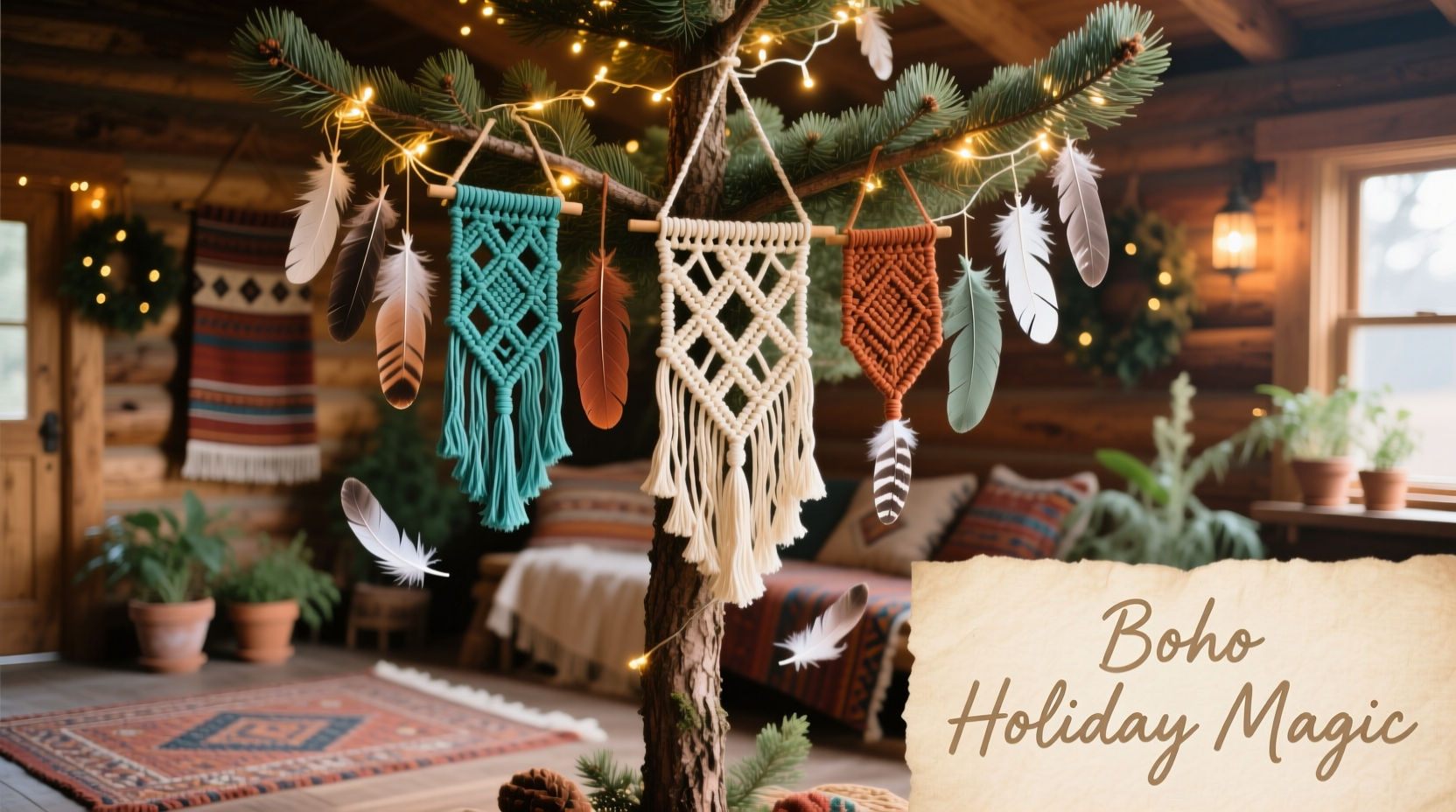
Boho (short for “bohemian”) isn’t about clutter or randomness. Its foundation rests on three quiet pillars: texture layering, intentional asymmetry, and narrative-driven objects. A successful boho tree avoids visual noise by curating rather than accumulating. It favors matte over glossy, raw over polished, and aged over new—without sacrificing cohesion. Think of it as *curated wildness*: a pine branch wrapped in undyed cotton cord, a single pheasant feather tucked behind a dried eucalyptus sprig, or a macramé star suspended at an unexpected angle—not because it’s off-center, but because it draws the eye to where the light catches its knotwork.
This aesthetic also carries cultural weight. Macramé traces back to 13th-century Arabic weavers and was later revived by 1970s counterculture as a symbol of self-reliance and slow making. Feathers appear across Indigenous North American, Māori, and West African traditions as emblems of truth, flight, and spiritual connection. When used respectfully—especially feathers—boho styling becomes an act of homage, not appropriation.
“True boho design begins with reverence—for materials, makers, and meaning. When you hang a macramé ornament, you’re not just adding texture. You’re holding space for patience, repetition, and human hands.” — Lena Torres, Textile Historian & Founder of The Knot Archive
Your Ethical Sourcing Checklist
Before gathering supplies, pause to consider origin and impact. Boho style loses its integrity when built on exploitation or ecological harm. Prioritize transparency—not just aesthetics.
- Macramé cords: Choose 100% unbleached cotton, recycled sari silk, or hemp. Avoid polyester blends—they lack breathability and contradict boho’s natural ethos.
- Feathers: Acceptable sources include backyard poultry (molted during seasonal shedding), certified ethical farms (e.g., those supplying feathers for fly-fishing or millinery), or vintage craft collections. Avoid peacock, owl, eagle, or migratory bird feathers unless accompanied by CITES documentation.
- Tree base & structure: Opt for a real, locally grown Nordmann fir or Fraser fir—cut within 50 miles if possible—or a high-quality, FSC-certified artificial tree made from recycled materials.
- Additional accents: Dried citrus slices (baked at low heat), cinnamon sticks, raw wood beads, and hand-dyed wool pom-poms reinforce the palette without synthetic dyes.
A Step-by-Step Styling Timeline (60–90 Minutes Total)
Resist the urge to rush. Boho styling thrives on rhythm—not speed. Follow this timed sequence to build depth and balance without overwhelm.
- 0–10 min: Ground & Anchor
Fluff your tree thoroughly. Then, wrap the trunk loosely with 2–3 yards of undyed cotton rope, securing ends with hidden knots at the back. Tuck in small sprigs of dried lavender or rosemary at intervals—this creates olfactory warmth and visual rootage. - 10–25 min: Layer the Backdrop
Hang 3–5 large macramé pieces first: a sunburst wall-hanging repurposed as a topknot, a cascading plant hanger draped asymmetrically over one lower third, and 2–3 oversized tassels spaced along the mid-section. These establish vertical rhythm and negative space. - 25–45 min: Feather Integration
Select 7–12 feathers varying in size (3”–10”) and tone (ivory, taupe, charcoal, amber). Attach each with thin, invisible fishing line tied to sturdy inner branches—not the outer tips. Angle them slightly upward to mimic natural lift. Cluster no more than three per zone; let others stand alone for emphasis. - 45–70 min: Texture Weaving
Weave in secondary elements: wrap small branches with jute twine, tuck bundles of dried wheat or pampas grass into dense zones, and nestle wooden bead garlands with irregular spacing. Alternate between matte and subtle sheen—e.g., a raw wood bead next to a beeswax-dipped pinecone. - 70–90 min: Final Calibration
Step back. Turn off overhead lights. Illuminate only with warm-white fairy lights (LED, battery-operated preferred for safety). Adjust any piece that competes visually. Remove anything that feels “inserted”—not integrated. Your tree should look like it grew this way.
Macramé Ornament Guide: Types, Placement & Meaning
Not all macramé works equally on a tree. Scale, density, and symbolism matter. Below is a practical reference for selecting and positioning key pieces.
| Macramé Type | Ideal Size | Best Placement Zone | Design Note |
|---|---|---|---|
| Sunburst (radial knot) | 8–12” diameter | Top ⅓—centered or slightly off-axis | Represents illumination and expansion; pairs beautifully with a single large feather radiating from center |
| Cascading tassel | 6–18” length | Lower third—hung from side branches | Adds grounded movement; use uneven lengths (e.g., 6”, 12”, 16”) for organic flow |
| Geometric pendant (triangle, hexagon) | 4–7” wide | Middle section—clustered in groups of 3 | Introduces subtle geometry without rigidity; knot edges should be slightly frayed for softness |
| Miniature dreamcatcher | 3–5” diameter | Mid-to-upper branches—nestled among foliage | Use only if culturally appropriate (Ojibwe-inspired designs require Indigenous collaboration; otherwise, opt for abstract woven circles) |
| Asymmetrical knot cluster | Irregular, 5–9” footprint | Front-facing mid-zone—slightly tilted | Most authentically boho; evokes spontaneity and hand-guided process |
Real Example: Maya’s Portland Tree (2023)
Maya Rodriguez, a ceramicist and fiber artist in Portland, OR, transformed her 7-foot Noble fir after years of rejecting “perfect” decor. She began with what she already owned: leftover hemp cord from weaving classes, molted turkey feathers from a neighbor’s free-range flock, and vintage brass rings salvaged from a dismantled chandelier. Over two evenings, she knotted five tassels—each with a different knot sequence (square, spiral, diagonal) and varied fringe lengths. Instead of hanging them evenly, she grouped three on the left lower quadrant and placed the largest sunburst off-center at the crown, tilting it 12 degrees left. She added no glitter, no plastic, no red/green contrast—only ivory, rust, charcoal, and raw wood tones. Guests consistently remarked how “calming” the tree felt—not festive in a loud sense, but deeply hospitable. “It doesn’t shout ‘Christmas,’” she says. “It whispers ‘come closer.’” Her tree stayed up until February, with feathers and cords carefully stored in breathable linen bags for reuse.
Feather Ethics & Styling Best Practices
Feathers are potent—but they carry responsibility. Their inclusion must reflect respect, not decoration-as-extraction. Here’s how to align practice with principle:
- Never harvest from wild birds—even “found” feathers on trails may belong to protected species or disrupt local ecology.
- Choose molted, not plucked. Naturally shed feathers have soft, rounded shafts and intact barbules. Plucked ones show broken quills and fraying.
- Limit quantity. Three well-placed feathers read as intentional; twelve scattered reads as arbitrary. Let silence do some of the work.
- Pair thoughtfully. A dark raven feather gains dignity beside a raw wood bead; a pale goose feather softens next to rough burlap ribbon. Avoid pairing with overly shiny or synthetic elements—they mute feather’s quiet elegance.
FAQ
Can I mix macramé with traditional ornaments like glass balls?
Yes—if done with restraint. Limit glass to 2–3 matte-finish baubles in clay or milk glass (avoid high-gloss chrome or neon colors). Place them near macramé anchors—not scattered throughout—to preserve textural harmony. Think of them as punctuation, not prose.
How do I keep feathers from shedding or flattening?
Store feathers flat in acid-free boxes with silica gel packets to prevent moisture curling. On the tree, avoid direct airflow from heaters or fans. If a feather droops, gently steam it 6 inches away with a garment steamer—never iron or spray water directly.
What if I can’t knot? Are there beginner-friendly alternatives?
Absolutely. Start with pre-knotted macramé kits designed for ornaments (many use simple lark’s head + square knot combos). Or repurpose thrifted macramé plant hangers—cut sections and re-tie with brass jump rings. Skill grows through doing, not perfection. Your first tassel doesn’t need to rival a master artisan’s—it needs to feel true to your hands.
Conclusion: Your Tree Is an Invitation
A boho Christmas tree styled with macramé and feathers is never finished—it’s tended. It asks you to notice the slant of a feather in afternoon light, the way hemp cord softens with handling, the quiet pride in choosing materials that honor land and labor. It resists the pressure to perform festivity and instead offers sanctuary: a place where imperfection is honored, slowness is sacred, and beauty lives in the handmade, the ethical, and the deeply felt. This season, don’t just decorate a tree—cultivate presence. Gather your cords, source your feathers with care, and trust your intuition over algorithms. Let your tree breathe, lean, and shimmer in its own unrepeatable way. And when guests pause before it, whispering “How did you make it feel so alive?”—you’ll know the answer isn’t in the knots or the quills. It’s in the attention you gave, and the intention you carried, all along.




 浙公网安备
33010002000092号
浙公网安备
33010002000092号 浙B2-20120091-4
Comments
No comments yet. Why don't you start the discussion?