
In a living room with limited natural light or deep-toned decor, a traditional Christmas tree can easily get lost in the shadows. Rather than fighting the darkness, embrace it—transform your space by designing a tree that thrives in low light. By relying exclusively on reflective and luminous materials, you can create a radiant holiday centerpiece that appears to float in the dimness, catching every flicker of candlelight and ambient glow. This approach isn’t just practical—it’s poetic. A luminous tree becomes a beacon of warmth and celebration, especially when surrounded by dark walls, furniture, or heavy drapery.
The key is to eliminate matte finishes and opaque decorations entirely. Instead, focus on surfaces that bounce light back into the room and materials that emit their own gentle radiance. When done well, such a tree doesn’t just illuminate—it enchants.
Selecting the Right Tree Base
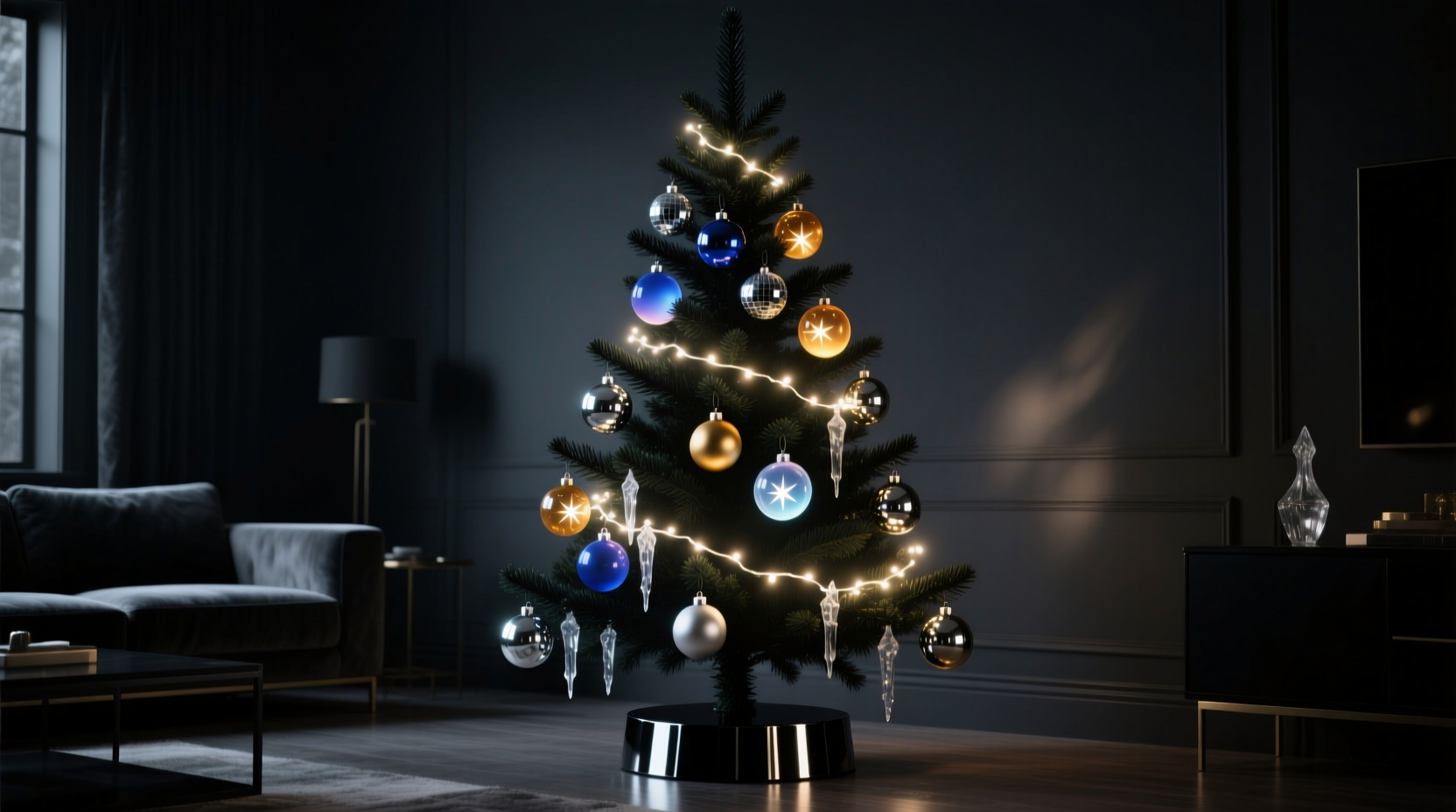
The foundation of any effective luminous display is the tree itself. For a dark room, artificial trees often outperform real ones due to their ability to incorporate built-in lighting and reflective tips. Look for models with frosted or snow-dusted branches, as these mimic ice crystals and scatter light more effectively than bare green needles.
Flocked trees, particularly those with a silvery or iridescent finish, are ideal. The flocking acts like thousands of tiny mirrors, amplifying even the faintest light sources. Some premium models feature micro-prismatic coatings on branch tips, designed specifically to refract LED light in multiple directions—a subtle but powerful enhancement for low-light spaces.
Lighting: The Core of Luminosity
Lights are not just an addition—they are the engine of your design. In a dark room, string lights must do more than decorate; they must serve as primary illumination. Choose warm-white or cool-white LEDs based on your desired mood: warm for cozy intimacy, cool for a crisp, icy elegance.
Opt for high-density strands (at least 100 bulbs per foot for tabletop trees, 300+ for floor models). Wrap lights in a spiral pattern from trunk to tip, ensuring no branch is left in shadow. For maximum impact, layer multiple sets—one focused on inner branches for depth, another outlining the silhouette for definition.
Consider integrating different types of lighting:
- Fairy lights – Ultra-thin wires with closely spaced bulbs blend seamlessly into foliage.
- Battery-operated twinkle lights – Can be tucked deeper into the tree without visible cords.
- Pick lights – Individual bulb-on-stem units that allow precise placement in darker zones.
- Glowing icicle strands – Hang vertically to simulate melting frost, adding vertical rhythm and extra sparkle.
“Lighting isn’t decoration—it’s architecture. In a dark space, every bulb shapes perception.” — Lena Torres, Lighting Designer & Holiday Installation Artist
Reflective Ornaments: Materials That Matter
Ornaments should function like tiny lanterns or mirrors. Prioritize materials with high reflectivity and avoid anything absorbent or textured in a way that traps light.
Best choices include:
- Mirrored glass balls – Available in mercury, chrome, or rainbow finishes, these bounce ambient light dynamically.
- Polished metal – Copper, silver, or brushed nickel ornaments catch directional light and shimmer with movement.
- Cut crystal – Prong-set pendants or faceted globes disperse light into rainbows under direct illumination.
- Holographic film – Lightweight ornaments made from diffractive polyester create shifting color effects.
- Acrylic with metallic backing – Durable, lightweight, and capable of intense reflection without fragility.
Avoid velvet, felt, wood, ceramic, or hand-blown glass with matte glazes. These may look festive in bright rooms but will appear dull or disappear entirely in darkness.
Do’s and Don’ts of Ornament Selection
| Action | Do | Don't |
|---|---|---|
| Material Choice | Use mirrored, metallic, or prismatic surfaces | Use fabric-covered or unglazed ceramics |
| Color Palette | Stick to silver, white, gold, icy blue, or violet | Use deep red, forest green, or black |
| Placement | Distribute large reflectors at varying depths | Cluster all shiny items on outer edges |
| Size Variation | Mix small sparkles with statement pieces | Use only one size or shape |
Incorporating Active Glow Elements
Beyond reflected light, integrate elements that generate their own luminescence. These ensure visibility even when ambient light is minimal—such as during evening gatherings or candlelit dinners.
Options include:
- Glow-in-the-dark pinecones – Coated with non-toxic phosphorescent paint, they charge under lights and emit soft green-blue light after dark.
- LED-embedded ornaments – Battery-powered baubles with internal pulsing or steady LEDs. Some even respond to sound or motion.
- Fiber-optic treetoppers – Replace traditional stars or angels with illuminated versions that project light upward.
- Electroluminescent wire (EL wire) – Flexible, thin cords that glow along their entire length. Weave through branches for linear highlights.
For safety and subtlety, ensure all active elements use low-voltage power sources and are UL-listed for indoor use. Avoid blinking patterns that feel chaotic; instead, opt for slow fades or steady glows that enhance serenity.
Step-by-Step Guide: Building Your Luminous Tree
Follow this sequence to ensure maximum radiance and visual balance:
- Position the tree in the darkest corner or farthest point from overhead lighting to emphasize its role as a standalone light source.
- Install base lighting using two full sets of warm-white LEDs. Wrap one set tightly around inner branches, the other loosely over the exterior canopy.
- Add pick lights to shadowed areas—especially near the trunk or lower backside—where standard wrapping might leave gaps.
- Hang large reflective ornaments first, spacing them evenly across quadrants. Use mirrored balls (3–4 inches) as anchor points.
- Layer smaller accents like holographic stars, metallic snowflakes, or faceted crystals. Focus on areas between major reflectors to maintain continuity.
- Weave in EL wire or fiber-optic strands along primary branches to create glowing “veins” that guide the eye.
- Insert glow elements such as phosphorescent pinecones or battery-powered LED pods into mid-level foliage.
- Top with an illuminated finial—a star with internal LEDs or a rotating prism that casts moving reflections onto the ceiling.
- Test in darkness: Turn off all room lights. Adjust placement of any dim zones by adding fairy lights or repositioning reflectors.
- Introduce secondary reflectors nearby—a mirrored tray, glass coffee table, or polished console—to amplify the tree’s glow throughout the space.
Real Example: The Midnight Parlor Transformation
Sophie M., a designer in Portland, faced a challenge each holiday season: her elegant, charcoal-gray living room swallowed her Christmas tree whole. After years of frustration, she committed to a radical shift—no color, no texture, only light.
She chose a 7-foot flocked tree with iridescent tips and wrapped it with 600 warm-white fairy lights. Instead of traditional ornaments, she used only mirrored glass spheres in graduated sizes. She added 12 LED-embedded snowflake ornaments powered by coin batteries and wove 15 feet of blue EL wire in a spiral ascent from base to crown.
For active glow, she placed phosphorescent deer figurines beneath the tree skirt and hung glow-in-the-dark icicles on the lowest branches. The final touch was a rotating crystal topper that cast dancing dots across the ceiling.
At a holiday gathering, guests reported feeling as though the tree was “breathing light.” With no other lamps on, it provided enough illumination to navigate the room. Sophie now receives requests to consult on similar designs for urban lofts and basement lounges.
Expert Insight: The Psychology of Light in Dark Spaces
“In environments with low luminance, humans instinctively seek points of focus. A luminous tree becomes more than decor—it’s a psychological anchor. It signals safety, celebration, and presence.” — Dr. Arun Patel, Environmental Psychologist, University of Michigan
This emotional resonance is why luminous trees work so well in dark rooms. They don’t just compensate for lack of light—they transform it into an asset. The contrast between surrounding darkness and central brilliance enhances perceived magic, making the tree feel almost supernatural in its glow.
FAQ
Can I use candles with a luminous tree?
Real candles are not recommended, especially near artificial materials or EL wire. However, flameless LED candles can be safely placed around the base or within nearby decor to complement the tree’s glow without risk.
Will this style work in a child-friendly home?
Yes, with adjustments. Use shatterproof acrylic instead of glass ornaments, secure all wiring, and choose glow elements with enclosed batteries. Many modern luminous decorations are designed with families in mind—look for certifications like ASTM F963 (toy safety standard).
How do I store luminous decorations properly?
Remove batteries before storage to prevent leakage. Keep glow-in-the-dark items away from prolonged sunlight to preserve phosphor quality. Store EL wire straight or loosely coiled—never bent sharply. Use anti-static bags for sensitive electronics.
Checklist: Building Your Reflective & Luminous Tree
- ☐ Choose a flocked or frosted artificial tree with light-reactive coating
- ☐ Acquire high-density LED string lights (warm or cool white)
- ☐ Select exclusively reflective ornaments (mirrored, metallic, crystal)
- ☐ Incorporate at least three types of active glow elements (LED baubles, EL wire, glow paint)
- ☐ Plan ornament distribution for even light dispersion
- ☐ Install illuminated topper or finial
- ☐ Test tree in complete darkness and adjust weak spots
- ☐ Add secondary reflectors (mirror, glass surface) nearby
- ☐ Secure all cords and battery packs out of sight
- ☐ Create a charging routine for glow-in-the-dark pieces if needed
Conclusion: Let Darkness Enhance the Glow
Styling a Christmas tree for a dark living room isn’t a limitation—it’s an invitation to innovate. By abandoning conventional color palettes and embracing pure luminosity, you craft a display that transcends decoration. It becomes an experience: a quiet pulse of light in the winter hush, a focal point that draws people in, not despite the shadows, but because of them.
The most memorable holiday moments happen not under bright fluorescents, but in the gentle radiance of something carefully lit. Your tree can be that moment incarnate. Start with reflection. Build with light. Finish with wonder.




 浙公网安备
33010002000092号
浙公网安备
33010002000092号 浙B2-20120091-4
Comments
No comments yet. Why don't you start the discussion?