
For city dwellers in studios, one-bedrooms, or micro-lofts, the traditional 6-foot floor-standing Christmas tree isn’t just impractical—it’s often impossible. Limited square footage, low ceilings, narrow doorways, and shared walls make conventional holiday styling feel like a logistical puzzle. Yet the desire for warmth, tradition, and festive presence remains strong. The solution isn’t downsizing your spirit—it’s rethinking spatial logic. Vertical space—walls, doorframes, shelves, and even ceiling height—is underutilized real estate in most small apartments. When leveraged intentionally, it transforms constraints into creative opportunity. This guide details actionable, tested methods for styling a Christmas tree that honors both aesthetics and apartment realities—without sacrificing scale, sentiment, or safety.
Why vertical thinking changes everything
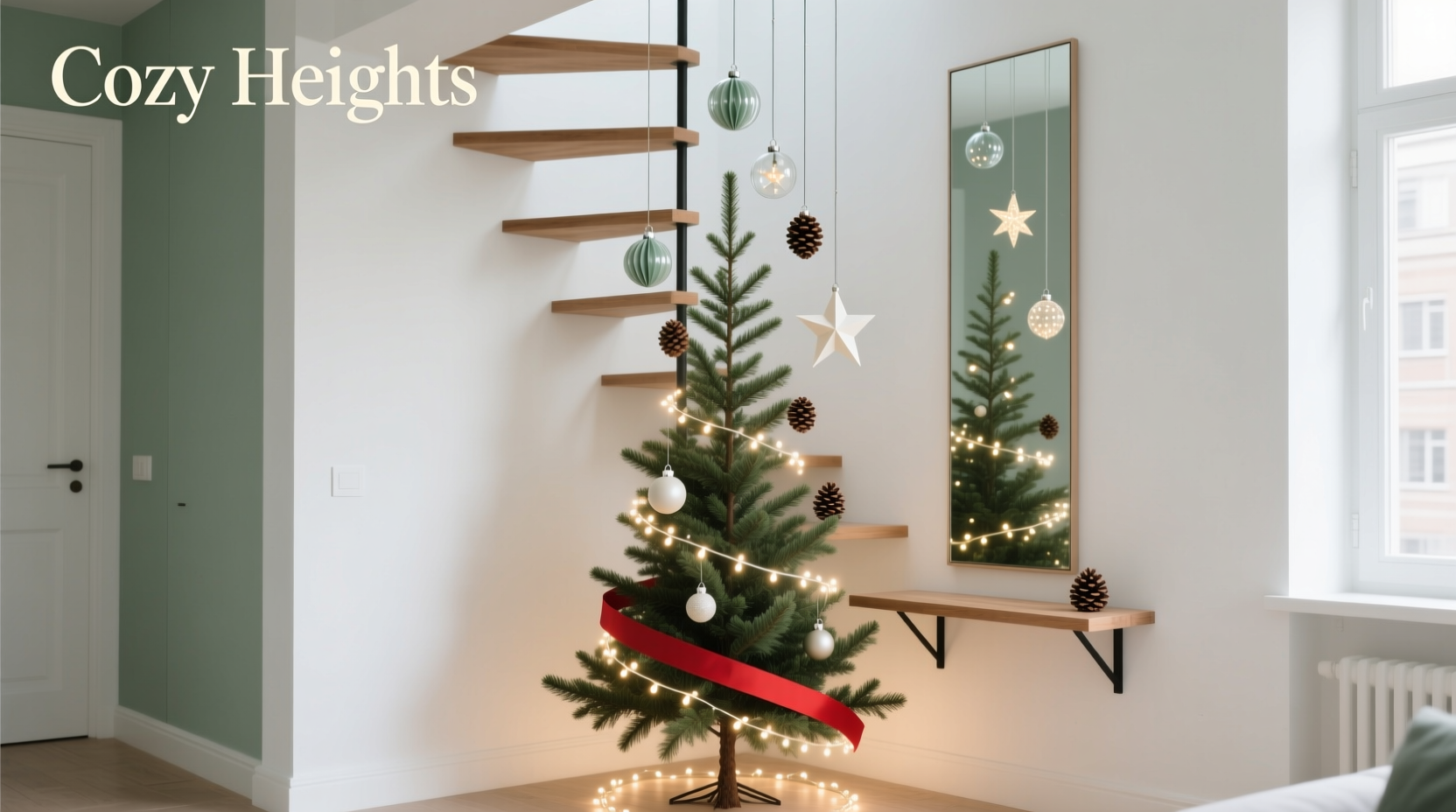
Most small-apartment residents default to “smaller tree” as the only fix. But reducing height and girth often backfires: a stunted 3-foot artificial tree can look sparse, disproportionate, or even sad against high ceilings and minimalist walls. More importantly, it abandons the emotional resonance of verticality—the upward lift, the sense of aspiration, the natural rhythm of branches reaching skyward. Human psychology responds strongly to vertical lines: they suggest growth, celebration, and continuity. A well-executed vertical tree doesn’t just occupy less floor space—it commands attention *upward*, drawing the eye and creating visual relief from horizontal clutter (sofas, desks, kitchen islands). Interior designers working in compact urban spaces consistently report that clients feel more “at home” during the holidays when vertical elements anchor the room—not because they’re taller, but because they reintroduce balance and intentionality.
“Verticality is the single most effective spatial tool in tight quarters. A thoughtfully anchored wall-mounted tree doesn’t shrink your holiday—it expands your perception of what’s possible.” — Lena Torres, NYC-based spatial designer and founder of Compact Living Studio
5 vertical space hacks—with materials, measurements, and safety notes
These aren’t theoretical concepts. Each method has been field-tested in real studio apartments (under 400 sq ft) with standard 8- to 9-foot ceilings, rental-friendly lease terms, and everyday furniture layouts. All prioritize structural integrity, fire safety, and visual cohesion.
1. Wall-Mounted Slim Profile Tree
A custom-cut plywood or MDF base (18–24 inches wide × 6–7 feet tall) serves as the trunk. Branches are built from lightweight PVC pipe segments or bent willow rods, secured at staggered angles with industrial-strength adhesive and concealed screws. Lights are embedded *within* the branch structure—not draped over it—to avoid bulk. Finish with matte white or warm wood-toned paint; hang with heavy-duty French cleats rated for 50+ lbs. Requires no floor footprint and sits flush against the wall—ideal beside a window, behind a sofa, or flanking a bookshelf.
2. Doorframe Suspended Tree
Install two adjustable tension rods (rated for 30+ lbs each) across the top of an interior doorway—no drilling required. Hang a lightweight metal or woven rattan frame shaped like a tapered triangle (approx. 48\" tall × 24\" wide at base) from S-hooks. Drape garlands of dried citrus slices, eucalyptus, and mini pinecones, then tuck in clusters of ornaments on thin wire stems. The frame stays invisible; only the layered greenery and sparkle read as “tree.” Works best on solid-core doors with sturdy trim.
3. Shelf-Stacked Tiered Tree
Repurpose existing floating shelves (minimum three tiers, spaced 12–16 inches apart). On each shelf, place a circular foam or wire ring (12\", 18\", and 24\" diameters respectively), covered in faux pine boughs secured with floral tape. Nest smaller ornaments inside each ring’s center, and suspend delicate glass or wooden baubles from the shelf above using clear monofilament. The effect is a cascading, sculptural silhouette—grounded by function, elevated by repetition.
4. Ceiling-Hung Miniature Canopy Tree
For apartments with exposed beams or recessed ceiling anchors (verify load capacity first), suspend three to five miniature pre-lit trees (18–24 inches tall) from aircraft-grade nylon cord. Arrange them in a loose triangular formation, varying heights slightly (e.g., 72\", 68\", 70\" from floor). Wrap cords around discreet black hooks painted to match ceiling color. Add subtle fairy lights between units for ambient glow. This creates a “floating forest” effect—surprising, elegant, and entirely floor-free.
5. Corner-Integrated Tower Tree
Build or purchase a freestanding, narrow tower unit (max 12\" deep × 10\" wide × 72\" tall) designed for corner placement. Line interior with mirrored acrylic panels to amplify light and perceived depth. Insert slim, hinged branch arms that fold flat against the unit when not in use. Ornaments hang from internal wires, and a single strand of warm-white LEDs runs vertically down the back channel. Doubles as display shelving year-round.
Do’s and Don’ts: Small-Apartment Tree Styling
| Action | Do | Don’t |
|---|---|---|
| Anchoring | Use toggle bolts rated for plaster/drywall, or renter-friendly adhesive anchors (e.g., Command Strips rated for 16+ lbs per strip) | Nail directly into drywall without backing or use suction cups on textured surfaces |
| Materials | Choose flame-retardant faux branches, UL-listed LED lights, and ornaments made of wood, felt, or shatterproof acrylic | Use real pine boughs (fire risk, sap, shedding), glass bulbs near walkways, or non-UL electrical components |
| Scale | Prioritize height-to-width ratio > 2.5:1 (e.g., 60\" tall × 22\" wide); embrace asymmetry and negative space | Force symmetry or full coverage—clutter reads as overwhelming in tight rooms |
| Lighting | Layer light sources: base (warm white), mid-level (amber twinkle), canopy (cool white accent)—creates dimension | Rely solely on one string of lights or use multicolor sets that compete with artwork or decor |
| Storage | Disassemble modular pieces into flat packs; label all hardware; store in vacuum-sealed bags under bed | Leave assembled units upright in closets—wastes vertical storage and invites dust buildup |
Real example: Maya’s 380-sq-ft Brooklyn studio
Maya, a graphic designer living in a converted 1920s walk-up, faced three challenges: her only wall large enough for a tree was shared with neighbors (no nails below head height), her 8’2” ceiling had no accessible joists, and her L-shaped sofa left just 22 inches of open floor space along the longest wall. She rejected a tabletop tree—“It looked like a prop, not a centerpiece.” Instead, she installed two heavy-duty French cleats (anchored into wall studs, verified with a stud finder) 6 inches apart, spanning 62 inches horizontally. From these, she hung a custom-built vertical tree: a 60-inch-tall birch-plywood “trunk” with laser-cut branch cutouts filled with preserved boxwood and seeded eucalyptus. Ornaments were limited to 12 handmade ceramic stars (each 2.5 inches), hung at varying depths on clear wire. A single 12-watt LED strip ran up the trunk’s rear edge, casting soft upward light. Total assembly time: 3.5 hours. Total floor footprint: zero. Neighbors commented on the “sculptural elegance”; Maya called it “the first holiday where my apartment felt spacious *because* of the tree—not in spite of it.”
Step-by-step: Building your wall-mounted vertical tree (4-hour project)
- Measure & Plan (30 min): Identify wall section with accessible studs (use stud finder). Confirm height clearance (min. 60\" from floor to base of ceiling molding). Sketch layout: trunk width (18–22\"), total height (60–72\"), and branch projection (max 10\" from wall).
- Build Trunk (90 min): Cut ¾\" birch plywood to dimensions. Sand edges smooth. Paint with matte white or warm gray. Drill ¼\" pilot holes every 8\" along centerline for future branch mounting.
- Construct Branches (120 min): Cut ¼\" flexible PVC pipe into 12–18\" lengths. Heat gently with heat gun to bend into gentle arcs. Insert into pilot holes; secure with epoxy + finishing nails. Cover nail heads with wood filler.
- Attach Greenery (45 min): Wrap branches with faux pine tips (choose “slim profile” variety). Secure every 4\" with U-shaped floral pins—no hot glue (melts in sun, fails over time). Tuck in battery-powered micro-LEDs along inner curve of each branch.
- Mount & Style (45 min): Attach French cleat to wall (level critical). Hang trunk. Hang ornaments using ornament hangers with 12\" clear wire—vary lengths intentionally. Step back. Adjust spacing until rhythm feels organic, not rigid.
FAQ
Can I use a vertical tree if I have pets or small children?
Absolutely—and often more safely than floor trees. Wall-mounted and ceiling-hung options eliminate tipping hazards and chewing access. For doorframe or shelf trees, ensure all wiring is fully concealed and ornaments are securely fastened with closed-loop hangers (not open hooks). Avoid anything with dangling ribbons or strings longer than 6 inches.
What if my landlord prohibits wall modifications?
Several solutions require zero permanent alteration: tension-rod doorframe trees, freestanding corner towers with weighted bases, and shelf-stacked designs use existing furniture. For wall-mounting, opt for heavy-duty removable anchors (e.g., Sugru Mouldable Glue + screw-in hooks) that leave no residue when removed properly. Always document original wall condition with dated photos before installation.
How do I keep the look cohesive with modern, minimalist decor?
Limit your palette to three core elements: one natural material (wood, rattan, linen), one metallic (brushed brass, matte black iron), and one texture (felt, wool, matte ceramic). Skip tinsel, oversized bows, and multi-colored lights. Instead, use tonal variation—e.g., sage, olive, and charcoal greenery; cream, oat, and parchment ornaments. Let negative space breathe: aim for 40% visual “empty” area within the tree’s silhouette.
Conclusion: Your space is not a limitation—it’s your design brief
Styling a Christmas tree in a small apartment isn’t about compromise. It’s about precision, intention, and respect—for your space, your lifestyle, and the quiet power of seasonal ritual. Vertical space hacks work because they align with how people actually live in compact homes: eyes move upward past clutter, hands reach for shelves before floors, and meaning is carried in gesture, not volume. A wall-mounted tree becomes part of your architecture. A doorframe suspension turns routine passage into a moment of pause. A tiered shelf arrangement makes holiday joy part of daily function. These aren’t shortcuts—they’re thoughtful recalibrations. You don’t need more room to celebrate deeply. You need the right framework to let light, memory, and warmth rise where they belong.




 浙公网安备
33010002000092号
浙公网安备
33010002000092号 浙B2-20120091-4
Comments
No comments yet. Why don't you start the discussion?