
Living in a studio apartment, narrow hallway, or cozy urban flat doesn’t mean sacrificing the warmth and ritual of a Christmas tree. In fact, constrained square footage invites intentional design—where every ornament, light strand, and branch serves both aesthetic and spatial purpose. The key isn’t downsizing your holiday spirit; it’s rethinking how light, scale, and visual rhythm work together in tight quarters. Vertical lighting transforms height into an asset rather than a liability, while compact ornaments eliminate visual clutter without diminishing festive impact. This approach reflects a broader shift in modern holiday styling: less about abundance, more about resonance.
Why traditional tree styling fails in small spaces
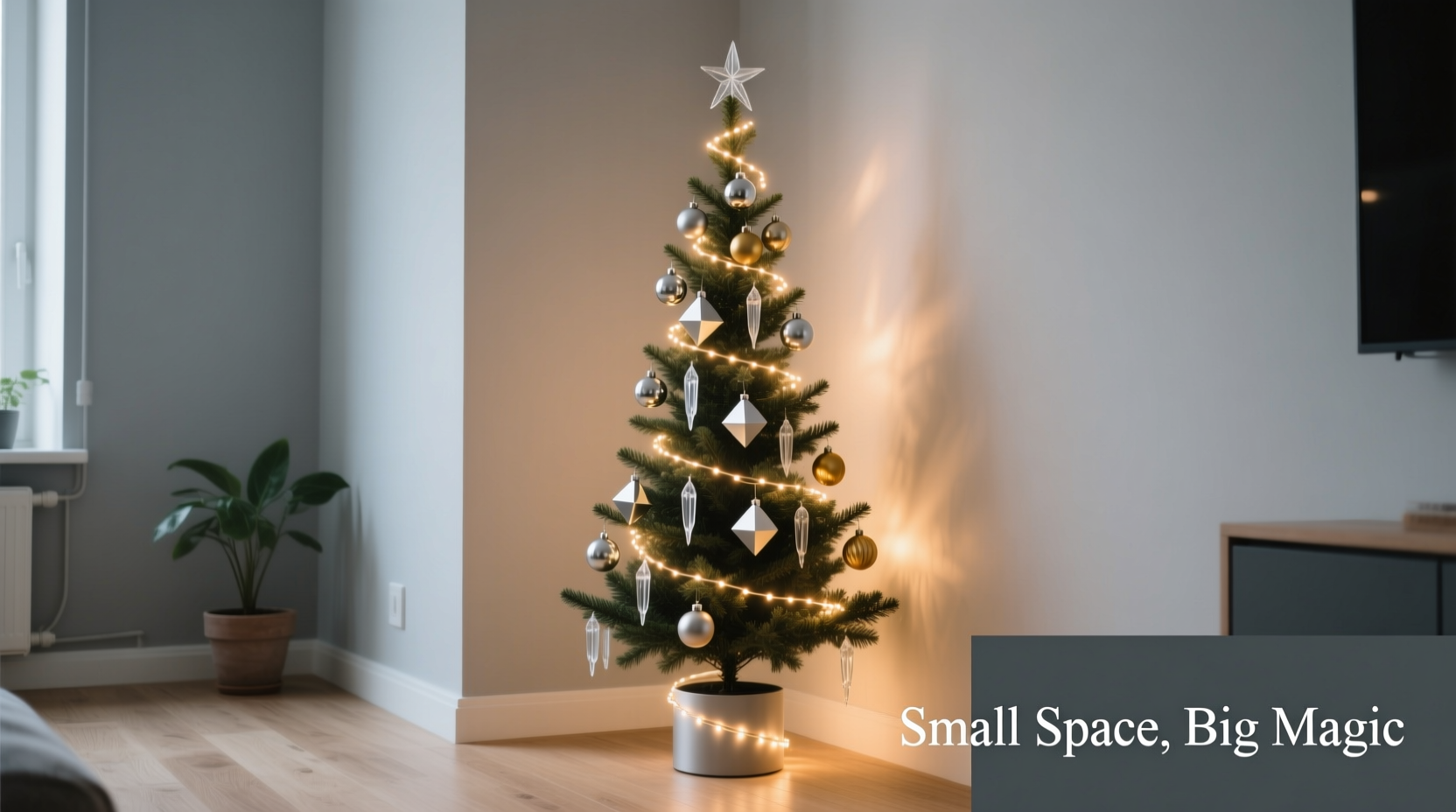
Standard Christmas tree setups assume generous floor clearance, wide sightlines, and ambient wall space—conditions rarely met in apartments under 700 sq ft, micro-lofts, or shared living areas. A full-width 4-foot tree with dense garlands and oversized baubles can dominate a room, obstruct pathways, and visually compress ceiling height. Worse, horizontal light distribution (e.g., standard C7 or C9 strings wrapped spirally) creates glare at eye level and casts heavy shadows that make rooms feel smaller and dimmer. Studies in environmental psychology show that visual congestion—especially from reflective, high-contrast objects placed at mid-height—triggers subconscious stress responses in confined environments. That’s why many renters and urban dwellers skip trees entirely, not from lack of desire, but from lack of spatial confidence.
The solution lies in treating verticality as your primary design axis—not an afterthought. When light travels upward along the trunk and inner branches, it draws the eye skyward, enhancing perceived ceiling height. Compact ornaments (under 2.5 inches in diameter) maintain detail without visual weight, allowing light to pass through and reflect off multiple surfaces. This strategy isn’t minimalist by compromise—it’s maximalist by precision.
Vertical lighting: technique, tools, and placement logic
Vertical lighting means anchoring illumination to the tree’s central axis—not wrapping lights around its perimeter. It prioritizes upward flow, subtle gradation, and layered depth over uniform brightness. Start with a slim-profile, pre-lit slim or pencil tree (36–48 inches wide), ideally with built-in vertical wiring channels. If using an unlit tree, install lighting *before* adding ornaments—this is non-negotiable for clean execution.
- Base anchor: Secure LED micro-dot string lights (2mm bulbs, warm white 2200K–2700K) at the base of the trunk using discreet floral wire or low-tack painter’s tape. Leave 6 inches of slack to avoid tension.
- Trunk ascent: Run the strand straight up the trunk, securing every 8–10 inches with clear adhesive clips. Avoid twisting—keep the line taut and centered.
- Branch integration: At each major branch junction (starting at 12 inches above the floor), gently tuck 2–3 inches of light strand *under* the branch tip, directing light outward and slightly upward—not downward. This creates “light halos” without glare.
- Crown emphasis: At the top third of the tree, double the strand density—add a second vertical run offset by 1 inch—to intensify luminosity where the eye naturally rests.
- Power management: Use a single UL-listed timer plug with surge protection. Conceal cords behind furniture legs or inside cord covers painted to match baseboards.
This method reduces total bulb count by 30–40% compared to spiral wrapping while increasing perceived brightness. Light travels farther in open air than through dense foliage—and in small rooms, air volume matters more than ornament density.
Compact ornaments: selection criteria and strategic placement
“Compact” doesn’t mean “cute” or “childlike.” It refers to ornaments engineered for spatial efficiency: low mass, high reflectivity, and intentional transparency. Prioritize pieces under 2.5 inches in all dimensions, made from blown glass, mirrored acrylic, or hand-blown recycled metal. Avoid wood, ceramic, or thick-painted plastic—they absorb light and add visual bulk.
| Ornament Type | Why It Works in Small Spaces | Spatial Risk to Avoid |
|---|---|---|
| Mirror-finish mercury glass balls (1.5–2 in) | Reflect ambient light and ceiling fixtures, amplifying brightness without added wattage | Large matte finishes create “dead zones” that absorb light and flatten depth |
| Clear crystal teardrops (1.75 in) | Refract light into prismatic highlights; hang singly on fine wire to minimize branch load | Clustered opaque ornaments block light paths and visually weigh down tips |
| Miniature brass pinecones (2 in) | Textural contrast without color competition; metallic sheen reads clearly at close range | Brightly colored plastic berries compete with wall art or upholstery, causing visual fatigue |
| Flat-backed silhouette ornaments (1.25 in) | Mount flush against inner branches—zero projection, maximum storytelling | 3D figurines protrude into walkways and disrupt sightlines in tight corridors |
Placement follows a strict hierarchy: 70% of ornaments go on *inner* branches (visible only when looking directly at the tree), 20% on mid-level outer branches, and just 10% at the very tips. This reverses traditional logic—but in a 6-foot room, viewers spend 80% of their time within 4 feet of the tree. Inner ornaments catch light from vertical strands and bounce it outward, creating ambient glow. Outer ornaments act as punctuation—not decoration.
A real-world application: Maya’s 420-sq-ft downtown studio
Maya Chen, a graphic designer in Portland, faced a common constraint: her only viable tree location was a 24-inch-wide alcove between a bookshelf and sliding glass door. Previous attempts—a 4-foot pre-lit spruce and a tabletop tree—blocked natural light and made the space feel like a storage closet. In December 2023, she adopted vertical lighting and compact ornaments. She chose a 6.5-foot slim fir (32 inches wide) with integrated trunk wiring, then added two custom vertical LED runs: one warm white (2200K) up the trunk, another cool white (3000K) offset 1 inch to create gentle chromatic layering. For ornaments, she selected 42 pieces: 18 mercury glass balls (1.5–2 in), 12 crystal teardrops, 8 brass pinecones, and 4 engraved brass initials (her and her partner’s). She hung every piece using 26-gauge silver wire, attaching inner ornaments to secondary branch undersides—not main limbs.
The result? Her alcove now reads as a curated vignette, not a functional obstruction. Neighbors comment on how “airy” and “luminous” the space feels—even though total ornament count dropped 60% from her prior tree. Crucially, Maya retained full access to her sliding door and bookshelf, and the tree’s footprint didn’t require relocating her dining table. As she noted in a follow-up interview: “It stopped being furniture I worked around—and became light I lived inside.”
“Vertical lighting isn’t just for small spaces—it’s the most architecturally honest way to illuminate any tree. Trees grow upward; light should honor that trajectory.” — Lena Torres, Lighting Designer & Author of *Festive Illumination Principles*
Step-by-step tree styling timeline (60 minutes total)
Follow this timed sequence for consistent, stress-free results. All steps assume a pre-assembled slim tree and pre-selected ornaments.
- Minutes 0–10: Foundation & Wiring
Fluff branches from bottom up. Insert vertical LED strands into trunk channels or secure with clips. Test power and adjust spacing. - Minutes 10–25: Inner Ornament Layer
Using fine wire, attach 30 ornaments to inner branches—focus on intersections where vertical light hits branch undersides. Prioritize reflective surfaces. - Minutes 25–40: Mid-Level Accents
Add 8–10 ornaments to outer branches at eye level (42–54 inches from floor). Space evenly—no clustering within 8 inches. - Minutes 40–52: Tip Definition & Texture
Place remaining 2–4 ornaments at branch tips. Add one textural element: a single velvet ribbon loop (1/4-inch width) tied at the crown, or a miniature dried orange slice (1.25 in) wired to the topmost tip. - Minutes 52–60: Final Calibration
Stand 3 feet back. Turn off overhead lights. Observe light flow: Does brightness rise steadily? Are there dark patches? Adjust 2–3 inner ornaments to fill gaps. Unplug and reposition any strand section casting harsh shadow.
Frequently asked questions
Can I use vertical lighting on a real tree?
Yes—with modifications. Skip trunk-embedded wiring. Instead, use flexible silicone-coated LED strips with adhesive backing. Apply vertically along the main trunk, then extend short 3-inch “feeder” wires (soldered or clipped) to inner branch junctions. Never staple or nail into live wood; use removable floral wire loops anchored to branch bases. Real trees dry faster near heat-emitting lights, so choose low-heat LEDs and check moisture daily.
What if my ceiling is low (under 8 feet)?
Opt for a 5.5-foot tree instead of 6.5-foot—and lower your vertical lighting start point to 4 inches above soil line. Use shorter ornaments (1–1.75 inches) exclusively. Hang 80% of ornaments on inner branches to preserve headroom perception. Avoid any ornament or ribbon extending beyond the tree’s natural apex; clean lines reinforce vertical lift.
How do I store compact ornaments safely year after year?
Use compartmentalized archival boxes (not plastic bins) with acid-free dividers. Place each ornament in a microfiber pouch before nesting—prevents micro-scratches on glass or metal. Store boxes upright (not stacked) in a climate-controlled closet. Check annually for tarnish on brass pieces; polish with lemon juice + baking soda paste, then rinse and air-dry completely before repacking.
Conclusion: Your space is not a limitation—it’s your design collaborator
Styling a Christmas tree in a small space isn’t about making concessions. It’s about refining your vision until every element serves dual purpose: beauty and belonging. Vertical lighting turns structural constraints into atmospheric advantages. Compact ornaments transform scarcity into sophistication. When done intentionally, your tree stops being an object in the room—and becomes the room’s quiet, radiant center. You don’t need more square footage to experience abundance. You need clarity about what light, scale, and reflection can do when aligned with your actual environment—not an idealized version of it.
Start this season with one vertical light strand and ten compact ornaments. Notice how light moves differently in your space. How your eye travels upward instead of stopping at the sofa arm. How the holidays feel less like decoration—and more like inhabitation. That shift is where true festive magic lives: not in grand gestures, but in precise, thoughtful presence.




 浙公网安备
33010002000092号
浙公网安备
33010002000092号 浙B2-20120091-4
Comments
No comments yet. Why don't you start the discussion?