
Studio apartments under 500 square feet—with ceiling heights often between 7'6\" and 8'6\"—pose a unique holiday challenge: how to welcome the warmth, tradition, and visual joy of a Christmas tree without compromising headroom, walkability, or fire safety? Many residents default to skipping the tree altogether—or worse, forcing a standard 7-foot pre-lit model into a cramped corner, where its top brushes the ceiling, its base crowds the sofa, and its lights glare off reflective surfaces. But a well-chosen, thoughtfully styled tree doesn’t need vertical dominance to deliver emotional resonance. It needs intentionality. This guide distills proven spatial intelligence, interior design principles, and real-world adaptations used by urban stylists, tiny-home decorators, and fire-safety-certified rental advisors. Every recommendation is tested for practicality—not just aesthetics—and grounded in measurable constraints: floor-to-ceiling clearance, outlet access, furniture flow, and NYC/Chicago/Seattle-style lease restrictions.
1. Prioritize Proportion Over Tradition
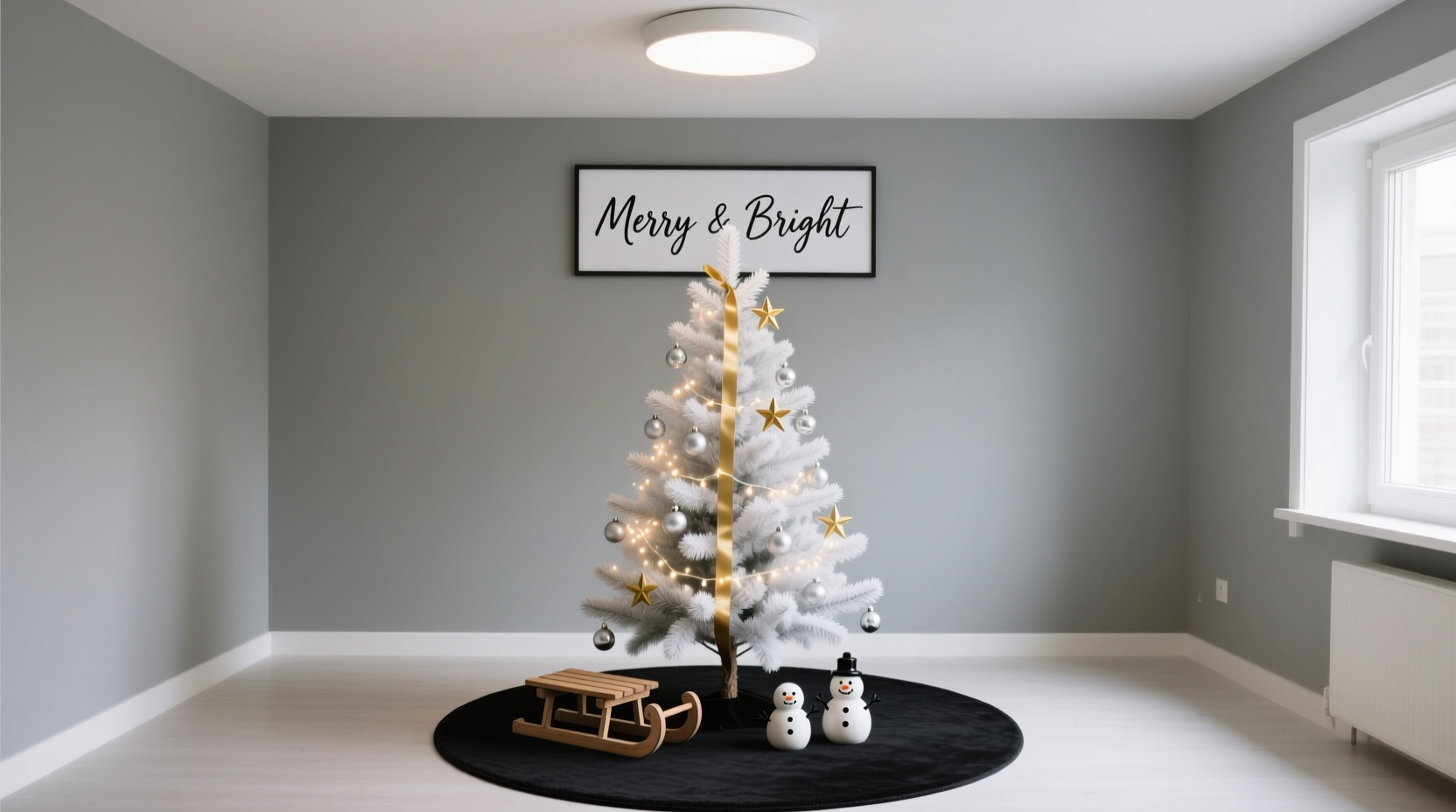
The first misconception to discard is that “a Christmas tree must be tall.” In fact, most traditional trees (6–7.5 feet) are designed for suburban living rooms with 9-foot ceilings and 3-foot clearance above the top branch. In a studio with 8-foot ceilings, even a 6-foot tree leaves only 4–6 inches of breathing room—enough for dust accumulation, heat buildup from lights, and accidental contact during daily movement. The solution isn’t compromise—it’s recalibration.
Begin by measuring your exact ceiling height *at the intended location*. Then subtract 12–18 inches—not just for ornament clearance, but for airflow, light dispersion, and safety margin. If your ceiling measures 8'2\" (98 inches), your ideal maximum tree height is 72–80 inches (6–6'8\"). That range accommodates most tabletop and slim-profile floor trees while preserving critical overhead space.
Opt for proportional silhouettes: slim, pencil, or tapered profiles reduce footprint width without shrinking visual impact. A 6' slim tree typically occupies only 20–24 inches of floor diameter versus 36–42 inches for a full-profile tree of the same height—freeing up vital circulation space around your bed, kitchenette, or workspace.
2. Choose the Right Tree Type—And Why Real Isn’t Always Better
In studios, tree selection hinges less on authenticity and more on dimensional efficiency, weight, and maintenance logistics. Fresh-cut trees introduce moisture, sap, needle drop, and disposal complications—especially problematic when building management prohibits curbside pickup or requires bagged removal through narrow hallways.
Artificial trees dominate studio-friendly solutions—not because they’re inherently superior, but because they offer predictable dimensions, consistent density, and zero seasonal decay. Look for models labeled “hinged” or “easy-assemble” with segmented trunks and pre-attached branches. Avoid “full-branch” trees requiring individual limb insertion; those demand floor space and time rarely available in compact living.
| Tree Type | Pros for Studios | Cons to Consider |
|---|---|---|
| Slender Artificial (6–6'6\") | Low footprint (≤22\" base), lightweight (12–18 lbs), flame-retardant materials, reusable for 8+ years | Limited branch tip count may require strategic ornament placement for fullness |
| Tabletop Tree (30–42\") | Fits on bookshelves, desks, or sideboards; zero floor footprint; ideal for renters with strict no-floor-decor policies | May feel diminutive if used as sole focal point; requires elevated surface with structural integrity |
| Flat-Panel or Wall-Mounted Tree | No floor or ceiling clearance needed; fully customizable height; doubles as year-round art | Lacks three-dimensional presence; limited lighting integration; requires secure wall anchoring |
| Real Noble Fir (4'–5') | Natural scent and texture; biodegradable; supports local farms | Needs daily watering; drops needles for 3–4 weeks; heavy when hydrated (25–35 lbs); disposal requires planning |
When selecting artificial, prioritize PVC or PE tips over older PVC-only models—they mimic natural texture better and hold ornaments more securely. And always verify the stand’s stability: look for weighted bases (≥8 lbs) or screw-in floor anchors compatible with hardwood, tile, or concrete subfloors—never rely on friction alone.
3. Strategic Placement: Beyond the “Obvious Corner”
Most studio dwellers instinctively place the tree in the farthest corner from the entryway—assuming it maximizes distance from traffic. But corners often create dead zones: they obstruct sightlines, trap heat from HVAC vents, and make ornamenting awkward due to limited rear access. Instead, adopt a “zone-based” approach aligned with your studio’s functional layout.
Identify your primary activity zones: sleeping (bed platform), living (sofa/chairs), working (desk), and cooking (kitchenette). Your tree should anchor a transition zone—not compete with it. For example:
- If your bed occupies one wall and sofa faces it, position the tree perpendicular to both—centered along the shorter wall between them. This creates a visual pause rather than a barrier.
- If your kitchenette is galley-style along one wall, avoid placing the tree directly opposite the sink; steam and splatter can damage lights and wiring. Instead, use the wall beside your refrigerator—a cooler, drier zone with natural shadow depth.
- Never place a tree within 36 inches of a heating vent, stove, or space heater. NFPA 101 (Life Safety Code) mandates minimum 3-foot clearance from all heat sources—a non-negotiable in rental units where insurance voids apply for violations.
“Urban trees succeed not by filling space, but by defining it. A 5' tree placed mid-wall with symmetrical sconces flanking it reads as intentional architecture—not an afterthought.” — Lena Torres, Interior Designer & Tiny Space Specialist, Brooklyn Studio Collective
4. Lighting, Ornaments & Visual Tricks for Height Illusion
With limited vertical real estate, perception becomes your most powerful tool. Strategic lighting and ornamentation redirect the eye upward—even when physical height is constrained.
Lighting Strategy
Use warm-white LED micro-bulbs (not cool white) to enhance coziness and minimize glare on reflective surfaces like glass tables or stainless appliances. String lights *inside* the tree—not just wrapped around branches—to create layered depth. Start at the trunk and spiral outward, ensuring inner branches glow softly. Add 2–3 vertical accent strands running from base to tip, secured with floral wire (not tape, which degrades). These “light lines” trick the eye into perceiving greater height.
Ornament Hierarchy
Apply the 60-30-10 rule: 60% of ornaments should be small (1.5–2.5\"), 30% medium (3–4\"), and 10% large (5–6\"). Distribute size intentionally: place largest ornaments at eye level (48–60\" from floor), medium ones slightly above and below, and smallest clustered near the trunk base and very top. This creates focal rhythm—not top-heaviness.
Height-Illusion Tactics
- Vertical ribbon cascades: Use 1.5\" wide velvet or satin ribbon in a single rich tone (burgundy, forest green, charcoal). Cut 12–15 pieces, each 36–48\" long. Attach one end near the trunk at the base, then drape diagonally upward to the next branch—repeating until reaching the tip. Ribbons catch light and draw the gaze skyward.
- Mirror adjacency: Place a narrow floor mirror (24\" wide × 60\" tall) 12–18 inches behind the tree. Its reflection doubles the tree’s presence and adds implied height without physical intrusion.
- Ceiling-mounted accents: Hang 3–5 miniature pinecone or wood-bead garlands from ceiling hooks (rated for 10+ lbs) directly above the tree’s top third. They extend the visual line beyond the physical crown.
5. Real-World Adaptation: Maya’s 420-Sq-Ft Studio in Chicago
Maya Chen, a graphic designer and lifelong Chicago renter, faced a classic studio dilemma: her 7'10\" ceiling, combined with a Murphy bed that swings down 18 inches from the wall, left zero vertical margin above her designated “living zone.” Her initial 6' tree brushed the ceiling when fully assembled—and wobbled dangerously when she walked past it.
She pivoted using three key adjustments: First, she chose a 5'8\" slim-profile artificial tree with a weighted steel base (14 lbs) and hinged construction—assembly took 12 minutes. Second, instead of corner placement, she centered it on the 10-foot wall between her desk and sofa, anchoring it with two drywall anchors rated for 50 lbs each. Third, she installed a 22\" wide × 62\" tall leaning mirror behind it, angled slightly forward to reflect both tree and adjacent string lights.
The result? Her tree became a deliberate design node—not background decor. Guests consistently comment on its “surprising presence,” and Maya reports zero heat buildup or tripping incidents. Crucially, her building manager approved the setup during her annual inspection: no exposed wiring, no obstruction of egress paths, and all electrical cords routed beneath a rubber cord cover flush against the baseboard.
6. Step-by-Step Setup Timeline (Under 90 Minutes)
Follow this sequence to avoid backtracking and maximize efficiency:
- Day -1 (Prep): Measure ceiling height and clear floor space. Confirm outlet access within 6 feet of intended location. Test all lights on tree and extension cord.
- Day 0, Minute 0–10: Assemble stand and secure to floor using anchors or weighted base. Verify levelness.
- Minute 10–25: Insert trunk sections and attach bottom ⅓ of branches. Fluff gently.
- Minute 25–45: Add middle ⅓ branches, rotating tree 90° after each section to ensure balanced density.
- Minute 45–65: Install lights using inward-spiral method. Then add ribbon cascades and top ornament.
- Minute 65–85: Place mirror or wall accents. Route and conceal cords with cord covers or paint-matched tape.
- Minute 85–90: Do final safety sweep: check for loose wires, confirm 36\" clearance from heat sources, verify tree stability with gentle push test.
7. FAQ
Can I use a 7-foot tree if I trim the top?
No. Trimming the top destabilizes branch structure, exposes raw PVC or PE tips (creating sharp edges), and voids manufacturer fire-safety certifications. More critically, it compromises the tree’s engineered weight distribution—increasing tip-over risk. Stick to factory-rated heights.
What’s the safest way to store my tree year-round in a studio?
Disassemble completely. Store trunk sections vertically in a closet corner (not stacked horizontally, which warps joints). Place branches in breathable cotton storage bags—not plastic, which traps moisture and encourages mold. Keep the stand separate in a labeled bin with included hardware. Avoid under-bed storage unless you have ≥12\" clearance; compressed branches lose shape over time.
Do battery-operated lights eliminate electrical concerns?
They reduce cord clutter but introduce new considerations: lithium batteries require temperature-controlled storage (not near radiators or windows), and most battery packs last only 6–12 hours per charge. For all-night ambiance, plug-in LEDs remain safer and more reliable—especially when paired with a surge-protected power strip mounted low to the wall.
Conclusion
A Christmas tree in a studio apartment with low ceilings isn’t a concession—it’s an invitation to design with clarity, care, and quiet confidence. When every square foot carries intention, the tree stops being just decoration and becomes a declaration: that beauty thrives within boundaries, that warmth expands regardless of cubic volume, and that tradition adapts without losing meaning. You don’t need cathedral ceilings to create a space that feels sacred at Christmastime. You need precision in proportion, honesty about constraints, and the willingness to let simplicity speak louder than scale.
Start today—not with a trip to the lot, but with a tape measure and a notebook. Sketch your wall dimensions. Note your outlet locations. Identify one zone where stillness feels possible. Then choose one adaptation from this guide—the ribbon cascade, the mirror trick, the 5'8\" slim profile—and commit to it fully. That single decision, executed with attention, will ripple through your entire season: calmer mornings, warmer evenings, and a sense of grounded joy that no ceiling height can diminish.




 浙公网安备
33010002000092号
浙公网安备
33010002000092号 浙B2-20120091-4
Comments
No comments yet. Why don't you start the discussion?