
In recent years, the traditional red-and-green Christmas tree has given way to more refined, contemporary interpretations. One of the most striking trends is the monochrome Christmas tree—a minimalist yet luxurious approach that emphasizes cohesion, texture, and sophistication. By stripping away color clutter and focusing on a single hue or grayscale palette, you create a centerpiece that feels both festive and timeless. This method isn’t about minimalism at the expense of warmth; it’s about intentionality. When done well, a monochrome tree radiates elegance, calm, and modern charm.
The appeal lies in its versatility. Whether your home leans toward Scandinavian minimalism, industrial loft style, or mid-century modern, a monochrome tree can be tailored to complement your space. It also allows for creative exploration of materials—glass, metal, matte ceramics, frosted ornaments, and even paper—that might get lost in a busier, multicolored display. The result? A tree that doesn’t just celebrate the season but enhances your interior design year-round.
Choose Your Monochrome Palette Thoughtfully
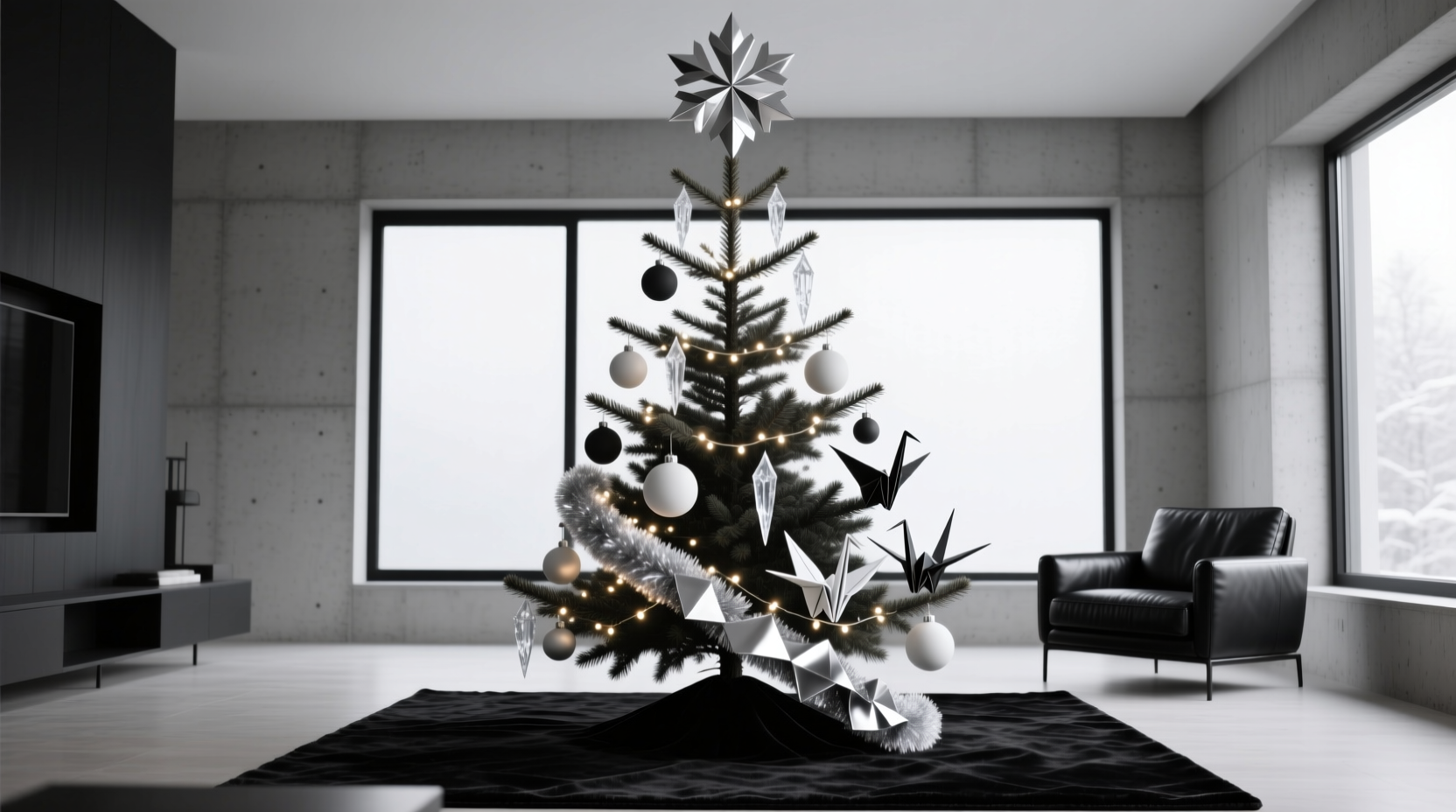
Monochrome doesn’t mean only black and white. While those are classic choices, the term refers to variations of a single base color. For a modern Christmas tree, consider palettes such as:
- Winter White & Silver: Crisp whites paired with metallic silver accents evoke snow-covered branches under moonlight.
- Charcoal & Gold: Deep gray or black with warm gold finishes adds drama without sacrificing warmth.
- Icy Blue Gradients: From pale sky to steely navy, this cool-toned scheme feels fresh and serene.
- All Black: Bold and fashion-forward, an all-black tree uses texture and sheen to create depth.
The key is consistency. Select one dominant tone and build layers through shades, finishes, and textures. Avoid introducing contrasting colors unless they’re neutral (like natural wood or woven rattan).
Build Depth with Texture and Finish Variation
A common mistake when styling a monochrome tree is relying solely on color while neglecting material diversity. Without contrast in texture, the tree can appear flat or sterile. The solution? Mix finishes deliberately.
Start with your tree itself. A premium artificial tree with varied needle lengths and subtle color gradation (e.g., frosted tips or dual-tone greens) provides a dynamic base. Then layer in ornaments that differ in surface quality:
- Matt ceramic spheres
- High-gloss lacquered balls
- Frosted glass with etched patterns
- Metallic wireframes or geometric shapes
- Felt or wool handmade ornaments
- Translucent acrylic or resin pieces
This tactile variety ensures the eye keeps moving across the tree, discovering new details with each glance. Even within a single color—say, white—you can have satin, glossy, ribbed, brushed, or glittered surfaces that catch light differently.
“Texture is the secret weapon of monochrome design. It turns simplicity into sophistication.” — Lena Park, Interior Stylist & Author of *Minimal Holiday Living*
Step-by-Step Guide: Styling Your Monochrome Tree
Follow this sequence to achieve a balanced, professional-looking tree that feels curated rather than chaotic.
- Prep the space and tree. Position your tree away from walls to allow viewing from all angles. Fluff every branch meticulously—this takes time but makes a dramatic difference in fullness.
- Add a cohesive ribbon or garland. Choose a wide satin or velvet ribbon in your base color. Loop it vertically from top to bottom in wide spirals. Alternatively, use a strand of uniform beads or pearls for a subtler effect.
- Install lighting first. Use warm-white LED lights (avoid cool blue tones). For monochrome trees, more lights are better—aim for 100 bulbs per foot of tree height. Weave them deep into the branches for an inner glow.
- Place large ornaments near the base. Start with 3–5 oversized statement pieces (8–10 cm diameter) at lower levels. Space them evenly to anchor the design.
- Distribute medium ornaments outward. Work in sections, placing 5–7 cm ornaments along outer limbs. Vary heights and depths—don’t line them up like soldiers.
- Fill gaps with small accents. Use 2–4 cm balls, stars, or abstract shapes to fill visual holes. Tuck some deeper into the tree for surprise glimmers.
- Add specialty pieces last. Include unique items like origami cranes, miniature sculptures, or hand-blown glass art. Limit these to 3–5 per tree to maintain focus.
- Crown the tree. Choose a modern topper: a geometric star in brushed metal, a twisted loop, or a cluster of small orbs. Avoid anything too ornate or traditionally figurative.
Do’s and Don’ts: Common Pitfalls to Avoid
To maintain a clean, modern look, steer clear of habits that unintentionally introduce clutter or dissonance.
| Do | Don’t |
|---|---|
| Use odd numbers of key elements (e.g., 3 large ornaments) | Match every ornament exactly—variation adds interest |
| Incorporate natural elements like dried citrus slices or eucalyptus sprigs (in theme) | Add colorful tags, bows, or novelty items that break the palette |
| Limit treetopper height to avoid overwhelming proportions | Place all ornaments at the same depth—use layering |
| Repeat a signature shape (e.g., spheres, cubes) for rhythm | Over-light the tree with flashing or multicolor LEDs |
Real Example: A Monochrome Tree in a Downtown Loft
Jessica, a graphic designer in Chicago, wanted a Christmas tree that reflected her love of clean lines and architectural forms. Her open-plan loft features concrete floors, exposed beams, and a mostly neutral palette. She chose a charcoal-gray tree (a rare black-flocked artificial model) and styled it entirely in matte black, gunmetal, and brushed nickel.
She began with 400 warm-white micro-lights woven tightly through the branches. Then, she used only three ornament types: 6 matte black ceramic spheres (ranging from 4–9 cm), 10 gunmetal geometric frames (tetrahedrons and cubes), and 5 hand-folded black paper stars suspended on clear fishing line at varying depths. For greenery, she tucked in small sprigs of preserved eucalyptus painted matte black.
The result was a sculptural centerpiece that felt festive without being loud. Guests often mistook the tree for an art installation until they noticed the subtle twinkle of lights. Jessica reported that the tree took less time to decorate than her previous colorful versions—because decisions were limited by the strict palette.
Essential Checklist for a Polished Finish
Before declaring your tree complete, run through this checklist to ensure every detail aligns with a modern aesthetic:
- ✅ All lights are tested and fully embedded—not just draped on the surface.
- ✅ Ornaments are distributed in a balanced, asymmetrical pattern.
- ✅ No visible hooks or wires—use clear ornament hangers or integrated loops.
- ✅ Tree skirt complements the theme (e.g., faux fur in white, linen in charcoal, or metallic fabric).
- ✅ Topper is securely fastened and proportionate to tree height.
- ✅ Floor around the tree is clean and free of stray needles, packaging, or tools.
- ✅ Viewed from multiple rooms, the tree maintains its impact without clashing with existing decor.
FAQ: Common Questions About Monochrome Trees
Can a monochrome tree still feel festive?
Absolutely. Festivity comes from context, not just color. Lighting, texture, and thoughtful arrangement create atmosphere. Many find monochrome trees more calming and enduring than high-contrast alternatives, making them feel special in a different, more intimate way.
What if I want to include family heirlooms?
You can integrate sentimental ornaments—if they fit the palette. Paint vintage glass balls to match your scheme using spray paint designed for glass. Alternatively, display non-conforming heirlooms on a nearby shelf or in a shadow box, keeping the tree itself unified.
Is a monochrome tree suitable for homes with children?
Yes, but consider safety and engagement. Use unbreakable materials like acrylic or felt. You might also designate a “memory branch” where kids can hang one or two personal crafts in the theme color, preserving individuality without disrupting the overall look.
Final Touches: Elevating the Experience
A monochrome tree shines brightest when the surrounding environment supports its aesthetic. Consider these finishing moves:
- Pair the tree with a simple side table holding a single candle in a matching holder.
- Play ambient instrumental music or nature sounds instead of traditional carols to enhance the serene mood.
- Use a diffuser with a crisp scent like pine, bergamot, or snow lotus—avoid overly sweet fragrances.
- If displaying gifts beneath, wrap them in textured paper that echoes the tree: kraft with black ribbon, white linen tape, or metallic foil in silver or graphite.
The goal is cohesion. Your tree shouldn’t stand out as a holiday island but feel like a natural extension of your living space—one enhanced for the season, not transformed beyond recognition.
Conclusion: Embrace Simplicity with Confidence
Styling a Christmas tree with monochrome decor is not about restriction—it’s about refinement. It challenges the notion that holidays must be loud, bright, and overloaded. Instead, it offers a quieter kind of joy: one found in symmetry, texture, and mindful curation. In a world saturated with sensory noise, a modern monochrome tree stands as a gesture of calm, intention, and enduring style.
Whether you live in a high-rise apartment, a minimalist bungalow, or simply crave a change from tradition, this approach invites you to celebrate differently. Start small—a single color, a few textured ornaments—and let your confidence grow. The result will be more than a decorated tree. It will be a statement.




 浙公网安备
33010002000092号
浙公网安备
33010002000092号 浙B2-20120091-4
Comments
No comments yet. Why don't you start the discussion?