
A gothic Christmas tree isn’t about darkness for its own sake—it’s about reverence, contrast, texture, and theatrical elegance. It rejects saccharine cheer in favor of solemn beauty: the rich velvet of dried pomegranates, the quiet gleam of tarnished silver, the hypnotic pulse of ultraviolet light across matte-black ornaments. This aesthetic honors centuries-old winter traditions—Yule logs, evergreen resilience, candlelit mystery—while speaking to contemporary sensibilities of intentionality and mood-driven design. Done well, it feels less like a seasonal trend and more like a ritual: grounded, atmospheric, deeply personal.
The Foundational Palette: Why Black Lights and Deep Reds Work Together
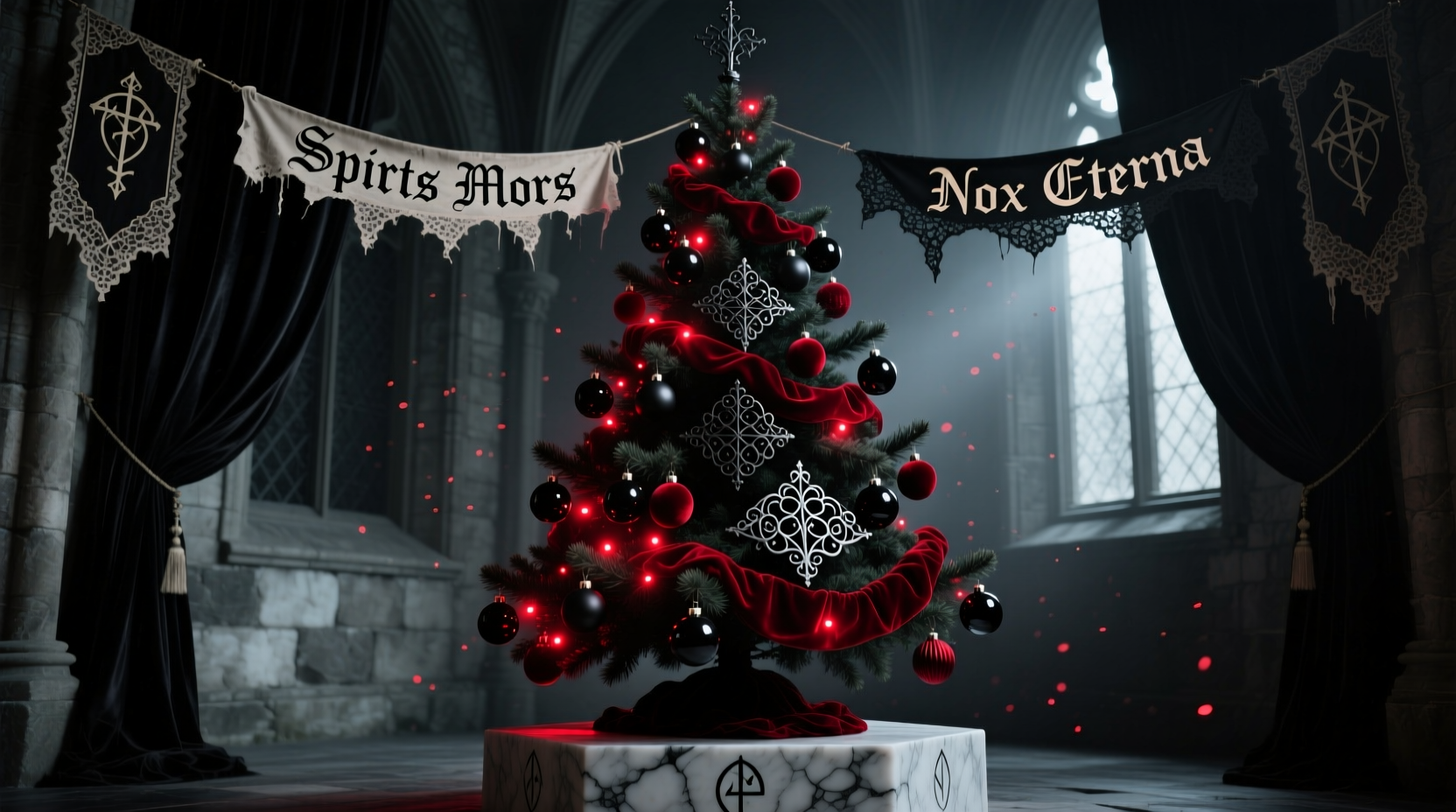
Black lights (UV-A lamps, 365–400 nm wavelength) don’t just illuminate—they transform. They activate phosphorescent and fluorescent pigments, turning otherwise subtle elements into luminous focal points. Deep reds—think burgundy, oxblood, garnet, and dried-rose—contain organic dyes and mineral-based pigments that fluoresce with startling intensity under UV. Unlike neon pinks or electric blues, these reds glow with warmth and depth, avoiding artificiality while amplifying their inherent richness.
This synergy is rooted in physics and psychology. Red light has the longest visible wavelength; under UV, its fluorescence appears as a soft, radiant halo—not harsh or clinical. Black, meanwhile, isn’t merely an absence of color here—it’s a canvas. Matte black absorbs ambient light but reflects UV selectively, allowing only the glowing accents to emerge from shadow. The result is chiaroscuro in three dimensions: drama without clutter, intensity without glare.
Ornament Selection: Texture, Material, and Intentional Imperfection
Gothic ornamentation avoids uniformity. Think layered history—not showroom perfection. Prioritize materials that interact meaningfully with light and shadow: hand-blown glass with subtle bubbles or swirls, matte ceramic with crackle glaze, tarnished brass with verdigris patina, and velvet-wrapped spheres stitched by hand. Avoid glossy plastics, mirrored balls, or anything overly symmetrical.
Deep red elements should dominate—but not monochromatically. Layer them with tonal variation: a blood-red satin ribbon beside a rust-dyed silk scrap; a blackened steel pinecone next to one dipped in hematite powder. Even “black” shouldn’t be flat. Include charcoal wool, slate-gray felt, oxidized iron, and matte onyx beads—all absorb light differently, creating micro-shadows that add dimension.
| Material | UV Reaction | Placement Strategy | Why It Works |
|---|---|---|---|
| Matte black ceramic | No glow (absorbs UV) | Base layer—clustered near trunk and lower branches | Anchors the tree visually; creates negative space for glowing elements to breathe |
| Fluorescent burgundy glass | Strong, warm glow | Mid-canopy, spaced evenly—not clustered | Acts as primary light source; mimics distant stained-glass windows |
| Tarnished silver mercury glass | Subtle shimmer (reflects UV, not fluoresces) | Interwoven with reds at eye level | Adds cool contrast and vintage authenticity; catches ambient light without competing |
| Dried pomegranates & rose hips | Faint amber halo (natural fluorescence) | Scattered singly along outer tips | Brings organic irregularity and subtle scent; nods to medieval apothecary traditions |
| Black velvet bows (hand-tied) | No glow, deep absorption | At branch junctions—never centered | Creates rhythm and structure; frames glowing ornaments like picture frames |
Lighting Architecture: Beyond “Just Add Black Lights”
Most gothic trees fail at lighting—not because of poor bulbs, but because of poor architecture. A single black light bar behind the tree creates flat, washed-out glow. True gothic illumination requires layered, directional sources:
- Backlighting: Mount two 365nm UV strip lights vertically along the wall behind the tree, 18 inches apart, aimed slightly inward. This creates a soft, enveloping halo—no hotspots.
- Canopy Accenting: Weave six to eight individual 365nm UV fairy lights (with warm-dim LEDs, not cold-blue) *within* the tree’s mid-to-upper branches, hidden beneath foliage. These act as “hidden stars”—visible only when you step close.
- Ground-Level Uplighting: Place a single adjustable UV spotlight (25° beam angle) on the floor, angled up at the lowest 24 inches of the trunk. This illuminates textured bark, wrapped rope, or stacked black books—adding narrative weight.
- Ambient Control: Turn off all overhead lighting. Rely solely on the tree’s glow + one warm-toned floor lamp (2700K) placed 6 feet away, casting long, soft shadows—not on the tree, but on surrounding walls.
This system ensures the tree doesn’t “pop” unnaturally. Instead, it emerges gradually—from shadow into revelation—as viewers move around it. The effect is immersive, not theatrical.
A Real Example: The Brooklyn Brownstone Tree (2023)
In December 2023, interior designer Lena Voss styled a 7.5-foot Fraser fir for a client’s historic Brooklyn brownstone. The home featured original plaster moldings, coal-fire mantels, and leaded glass windows—none of which could be compromised by tape, nails, or adhesive residue. Lena’s solution was both pragmatic and poetic:
She wrapped the trunk in unbleached linen rope stained with iron acetate (creating natural blackening), then secured it with matte black twine. Instead of hanging ornaments directly on branches, she used 12-inch lengths of blackened copper wire bent into gentle S-curves—each holding one fluorescent red glass orb and one dried lotus pod. The wires were anchored to sturdy branch forks using tiny, reversible brass pins (no drilling). For lighting, she installed recessed UV strips inside the existing crown molding above the tree, angled downward at 15 degrees—leveraging architecture instead of adding hardware.
The result? A tree that appeared to grow from the floorboards, glowing with quiet intensity. Guests described it as “like walking into a Caravaggio painting.” Crucially, every element was removable in under 45 minutes—with zero damage to historic woodwork.
“The gothic tree isn’t about rejecting joy—it’s about deepening it through restraint. When you remove visual noise, what remains is resonance.” — Silas Thorne, Set Designer & Gothic Aesthetic Consultant, author of Midnight Decor: Ritual and Restraint in Modern Interiors
Step-by-Step Styling Timeline (90 Minutes Total)
Follow this timed sequence for consistent, stress-free execution:
- Minutes 0–10: Prep & Base
Unbox and fluff tree. Wrap trunk in black burlap or matte fabric (secured with hidden black clips). Lay down a black velvet or heavy wool tree skirt—no ruffles, no lace. - Minutes 10–25: Structural Layering
Attach black velvet bows (6–8 total) at major branch junctions using discreet black floral wire. Then, weave in black-dyed eucalyptus stems and dried black calla lilies—tucked *under*, not over, branches for depth. - Minutes 25–45: Ornament Placement (The 3-2-1 Rule)
Place ornaments in descending density: 3 per lower third (mostly matte black), 2 per middle third (mix of red glass + tarnished silver), 1 per upper third (only glowing reds + one antique cameo per quadrant). Never hang two identical ornaments on the same branch. - Minutes 45–70: Lighting Integration
Install UV strips behind tree first. Then carefully thread canopy fairy lights—pulling each strand taut before securing with black wire ties. Finally, position floor spotlight and test angles. Adjust until trunk texture is visible but not harshly lit. - Minutes 70–90: Final Refinement
Step back. Remove any ornament that “jumps out” rather than integrates. Add 3–5 dried pomegranates at outer tips—place them so they catch UV light only from *one side*, creating asymmetrical halos. Drape one 8-foot length of black silk organza loosely over the top third, pinned only at the apex—letting it cascade naturally.
FAQ
Can I use real candles on a gothic tree?
No—never. Real flames contradict the controlled, atmospheric intent of gothic styling and pose unacceptable fire risk, especially with dried botanicals and dark fabrics. Instead, use flicker-effect LED tealights in matte black ceramic holders nestled in the tree skirt. Their warm, unsteady glow reads as candlelight without hazard.
Won’t black lights harm my eyes or fade nearby art?
Standard 365nm UV-A bulbs pose minimal risk with typical holiday exposure (under 4 hours/day). However, they *will* accelerate fading of watercolors, untreated paper, and some pigments. Keep the tree at least 6 feet from framed art, and avoid pointing UV strips toward walls with delicate prints. For high-value spaces, opt for low-intensity 395nm bulbs—they produce less fluorescence but are gentler on surroundings.
What if my space has no outlet behind the tree?
Use a single, high-output UV spotlight (with adjustable stand) placed 3 feet behind the tree, angled upward at 45 degrees. Pair it with battery-operated UV fairy lights woven into branches (choose models with 100+ hour battery life). Hide batteries inside hollow ornaments or within the tree skirt’s folds—never in plain sight.
Conclusion
A gothic Christmas tree is an act of quiet defiance—in a season saturated with forced brightness, it chooses depth over dazzle, texture over gloss, resonance over repetition. It asks nothing of the viewer except presence. When lit correctly, it doesn’t shout; it hums—a low, steady frequency of color, shadow, and memory. You don’t need inherited antiques or a vault of vintage ornaments to begin. Start with one matte black ceramic sphere, one length of tarnished wire, one 365nm UV bulb. Place them with attention. Watch how light pools in the curve of a bowl, how red deepens where velvet folds, how black becomes dimensional when pierced by a single point of glow.
This isn’t decoration. It’s curation. It’s care made visible. And it begins—not with perfection—but with the courage to let darkness hold space for light to mean something.




 浙公网安备
33010002000092号
浙公网安备
33010002000092号 浙B2-20120091-4
Comments
No comments yet. Why don't you start the discussion?