
Bookshelves are more than storage—they’re curated expressions of identity, memory, and taste. When holiday season arrives, the instinct to add festive charm is natural. But cramming in a mini Christmas tree often triggers a quiet crisis: a beloved first edition vanishes behind tinsel, a dog-eared poetry collection gets nudged into shadow, or your carefully arranged nonfiction stack becomes an afterthought to pine-scented clutter. The problem isn’t the tree—it’s the assumption that festivity and function must compete. In reality, thoughtful styling turns the bookshelf into a dynamic stage where literature and tradition coexist with intention. This isn’t about compromise; it’s about spatial intelligence, visual hierarchy, and honoring both your books and your joy.
1. Assess Your Shelf Architecture First—Not the Tree
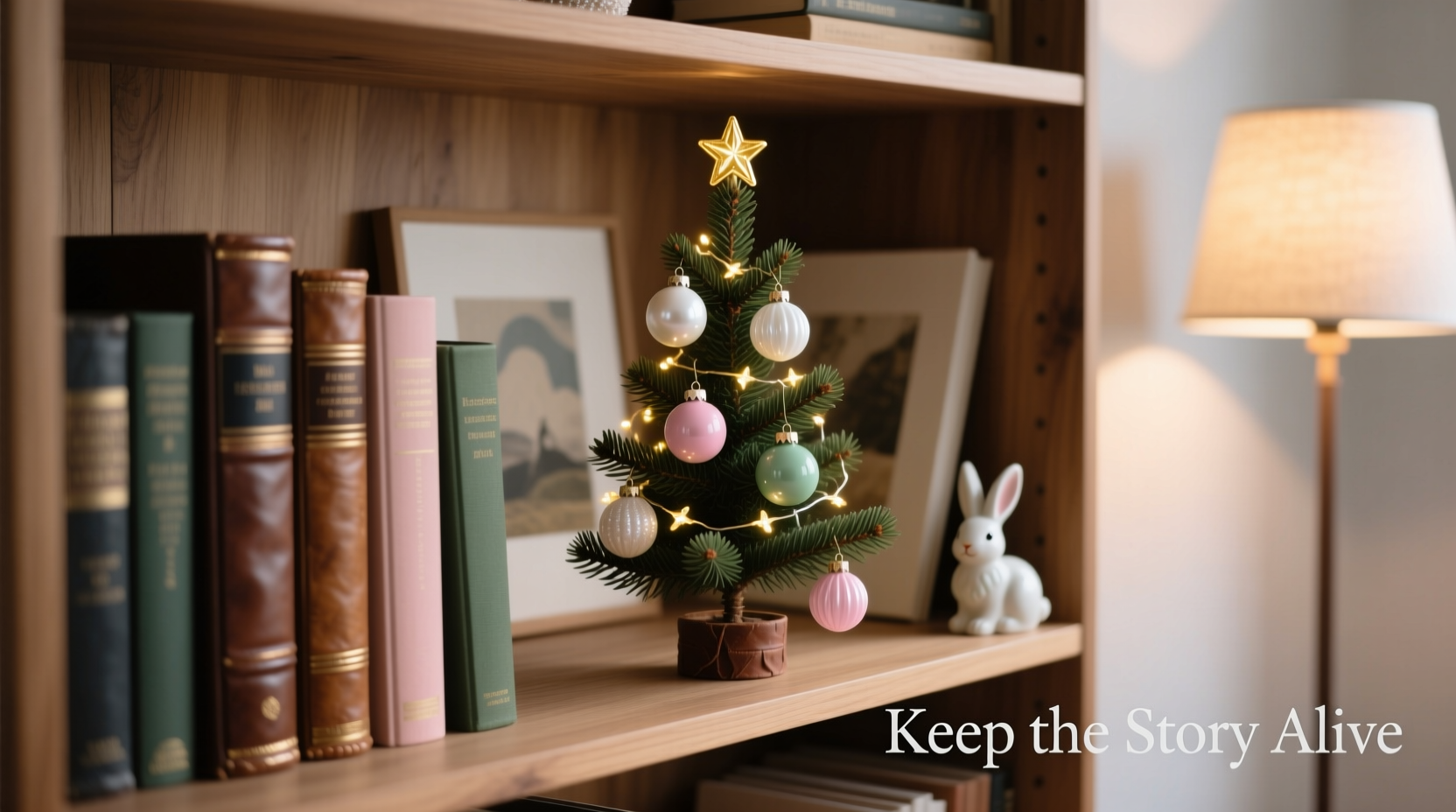
Before selecting ornaments or untangling lights, treat your bookshelf like an architect would: map its dimensions, sightlines, and structural logic. Measure height, depth, and shelf spacing—not just in inches, but in *visual weight*. A 9-inch-deep shelf holds far more compositional flexibility than a shallow 6-inch ledge. Note which shelves house your most cherished volumes: Are they clustered on eye-level shelves (typically 48–66 inches from the floor)? Do certain spines face forward intentionally? Is there built-in asymmetry—a floating shelf, a recessed nook, or a staggered layout—that can be leveraged?
Crucially, identify “anchor zones”: sections where books are dense, uniform, or thematically grouped (e.g., all blue-spined classics, or a vertical row of travel memoirs). These areas benefit most from *negative space*—a deliberate pause that lets the eye rest and the shelf breathe. That pause is where your mini tree belongs—not as an intrusion, but as a punctuation mark.
2. Choose the Right Tree: Scale, Shape, and Structure Matter
A “mini” tree isn’t defined by height alone. It’s defined by proportion relative to your books. Most standard hardcover novels range from 7.5 to 9 inches tall and 1 to 1.5 inches deep. A 12-inch-tall tree with a 10-inch-wide base will dominate even a generous shelf. Instead, prioritize *slim-profile* silhouettes: pencil trees, tapered firs, or tiered wire-frame designs that maximize verticality while minimizing frontal depth.
Material also dictates visibility. Frosted glass or mirrored bases reflect surrounding spines rather than obscuring them. Wire or open-branch metal trees create literal transparency—light passes through, and spines remain legible behind the form. Avoid dense, bushy faux-fir trees unless they’re under 8 inches tall and placed on a shelf with ample headroom above the books.
Consider stability and footprint. A weighted base prevents tipping, but a wide base eats into shelf real estate. Opt for trees with narrow, centered stems (under 2 inches wide) that sit cleanly between book stacks—not atop them.
| Tree Type | Ideal Height | Max Shelf Depth Needed | Visibility Impact on Books |
|---|---|---|---|
| Slim Pencil Fir (wire or PVC) | 10–14 in | 4.5 in | Low—spines visible behind branches |
| Tiered Metal Frame (3–4 tiers) | 12–16 in | 3.5 in | Very low—open structure preserves sightlines |
| Mini Flocked Pine (dense foliage) | 8–10 in | 6 in | Moderate—best only on top shelf or with short books |
| Glass-Base LED Tree (clear acrylic stem) | 10–12 in | 3 in | Negligible—base reflects adjacent spines |
| Living Mini Norfolk Pine (in ceramic pot) | 10–12 in | 5 in | Medium—requires careful placement to avoid casting shadows |
3. Strategic Placement: Five Proven Positions That Preserve Spine Visibility
Placement isn’t about finding “empty space”—it’s about creating intentional relationships between tree, books, and viewer. Here’s how professionals approach it:
- The Shelf-End Anchor: Position the tree at the far left or right end of a shelf, aligned with the outer edge of the book block. This frames the collection without interrupting its flow. Works best when adjacent books are uniform in height and color—creating a clean “book wall” that the tree complements, not competes with.
- The Vertical Gap Bridge: Identify a natural height gap—e.g., a 2-inch space between a tall art book and a shorter novel. Nestle the tree’s base into that gap, letting its height extend upward *between* book stacks, not in front of them. The tree becomes a vertical connector, not a barrier.
- The Back-Row Reveal: Pull forward 2–3 key books from the front row. Place the tree directly behind them, centered in the newly created aperture. Viewers see the tree *through* the intentional gap—like a vignette in a picture frame. Only works with sturdy, upright books that won’t topple.
- The Top-Shelf Float: Reserve the highest shelf exclusively for decor. Keep it clear of books entirely—or limit it to 1–2 small, decorative volumes (e.g., a slim poetry chapbook or vintage cookbook). This transforms the top shelf into a dedicated “holiday ledge,” freeing lower shelves for uninterrupted reading.
- The Dual-Level Stack: On a shelf with variable-depth books, group taller volumes (10+ inches) on one side and shorter ones (6–8 inches) on the other. Place the tree on the shorter side, ensuring its peak stays below the tallest adjacent spine. The height differential creates layered depth—not obstruction.
Each method respects the bookshelf’s primary purpose: showcasing books. The tree enhances, rather than eclipses, that purpose.
4. Styling Tactics That Prioritize Legibility Over Opulence
Festive doesn’t mean frenetic. Ornamentation should amplify, not obscure. Start with lighting: warm-white micro-LED string lights (with battery packs hidden behind books or in hollow bases) add glow without glare. Avoid large, reflective baubles—they catch light and cast distracting reflections across nearby spines.
Ornaments should be minimal, thematic, and scale-appropriate. Three to five elements suffice: a single matte-gold star at the apex, two tiny wooden birds nestled mid-branch, and one miniature brass bell dangling from the lowest tier. All should be under 1 inch in diameter. Larger ornaments force you to widen the tree’s footprint or tilt it forward—both compromising spine visibility.
Grounding matters. Skip bulky trays or oversized stands. Instead, use a 2-inch-diameter ceramic disc, a slice of stained walnut, or a small brass coaster—all flush with the shelf surface. This keeps the tree’s visual “footprint” tight and unobtrusive.
“Good shelf styling obeys the 70/30 rule: 70% of the visual field should remain unoccupied by decor so books retain their narrative authority. The tree isn’t the protagonist—it’s the thoughtful footnote.” — Lena Torres, Interior Stylist & Literary Space Consultant
5. Real-World Application: How Maya Reclaimed Her Philosophy Shelf
Maya, a philosophy professor and lifelong bibliophile, faced this exact dilemma last December. Her prized oak bookshelf held first editions of Arendt, Fanon, and de Beauvoir—spines she’d arranged chronologically and by hue (deep blues and burgundies on the left, earthy greens and ochres on the right). She loved the idea of a mini tree but hated how previous attempts buried her copy of The Human Condition.
She measured: her middle shelf was 11 inches deep, with books averaging 8.5 inches tall. She chose a 12-inch-tall tiered copper wire tree (3.2 inches deep at its widest point) and positioned it using the *Back-Row Reveal* technique. She gently pulled forward three slim, dark-blue paperbacks—Political Emotions, Justice and the Politics of Difference, and On Revolution—creating a 4-inch aperture. She centered the tree behind them, angled slightly toward the room (not the books), and wrapped it with 24 warm-white micro-LEDs. She added only two ornaments: a tiny hammered-copper dove and a single matte-black acorn.
The result? Visitors noticed the tree immediately—but also remarked, unprompted, on the elegance of her book arrangement. Her copy of The Human Condition remained fully visible, its gold lettering catching ambient light beside the tree’s gentle glow. “It stopped being about hiding the tree,” she said, “and started being about revealing the books more clearly.”
6. The Essential Pre-Styling Checklist
Before unwrapping a single ornament, run through this actionable checklist:
- ✅ Measure shelf depth, height, and book heights on target shelf
- ✅ Identify your 3 most visually important spines on that shelf
- ✅ Select a tree with max depth ≤ 40% of your shelf’s depth
- ✅ Test placement using painter’s tape or a folded index card as a mock footprint
- ✅ Ensure at least 1 inch of clearance between tree tip and shelf above
- ✅ Verify all chosen ornaments fit within a 1-inch diameter (no exceptions)
- ✅ Confirm lighting power source is concealed and cord-free (battery-operated only)
- ✅ Remove dust from spines and shelf surface before final placement
7. FAQ: Practical Questions from Book-Loving Homeowners
Can I use a live mini tree on my bookshelf?
Yes—but with strict caveats. Norfolk pines thrive indoors but grow slowly and require consistent indirect light and humidity. Place it on the top shelf or a shelf with southern exposure, away from heating vents. Use a waterproof liner beneath its pot and rotate weekly to prevent leaning. Never place it in front of books needing light-sensitive preservation (e.g., antique paperbacks).
What if my bookshelf has adjustable shelves? Should I move them?
Only if it serves clarity—not convenience. Lowering a shelf to “make room” for a tree often compresses spines and creates awkward gaps. Instead, raise one shelf slightly (by ½ inch) to create a dedicated 12-inch “tree zone” on the top level, keeping all book-holding shelves at optimal, unaltered heights. Adjustable shelves exist to accommodate books—not to contort around decor.
How do I keep the tree looking fresh without constant rearranging?
Build maintenance into your routine. Every Sunday, spend 90 seconds: dust the tree with a soft makeup brush (never a cloth—it catches on branches), check battery levels, and gently re-center any ornaments that have shifted. Most importantly, *reassess book alignment*: nudge forward any spines that drifted backward during tree handling. Consistency preserves both aesthetics and readability.
Conclusion
Your bookshelf isn’t a blank canvas waiting for seasonal decoration—it’s a living archive, a tactile library of ideas you return to daily. A mini Christmas tree shouldn’t ask you to turn away from that archive. It should invite you deeper into it: drawing the eye along a row of spines, highlighting a favorite cover, or framing a beloved title like a museum placard. When styled with spatial respect and visual discipline, the tree doesn’t compete with your novels—it converses with them. It whispers, “This space holds both wonder and wisdom,” and lets each have its due. So this year, measure twice, place once, and choose ornaments not for their sparkle, but for their silence. Let your books breathe. Let your tree shine—without stealing the spotlight.




 浙公网安备
33010002000092号
浙公网安备
33010002000092号 浙B2-20120091-4
Comments
No comments yet. Why don't you start the discussion?