
Living in a compact urban apartment doesn’t mean sacrificing the warmth and intentionality of the holiday season. In fact, smaller spaces invite a more thoughtful, curated approach to festive decor—especially when it comes to the centerpiece: the Christmas tree. A minimalist tree isn’t about austerity; it’s about resonance. It’s choosing fewer, higher-integrity elements that reflect your values, aesthetics, and daily reality. For renters navigating tight floor plans, shared HVAC systems, limited storage, and narrow doorways, the traditional 7-foot flocked fir with 200 ornaments simply isn’t viable—or desirable. Instead, minimalist styling prioritizes scale, material honesty, spatial harmony, and ease of assembly and takedown. This article distills real-world experience from interior stylists, tiny-home designers, and urban dwellers who’ve mastered the art of meaningful minimalism during December—not as a design trend, but as a sustainable, joyful practice.
Why Minimalism Works Better in Small Spaces
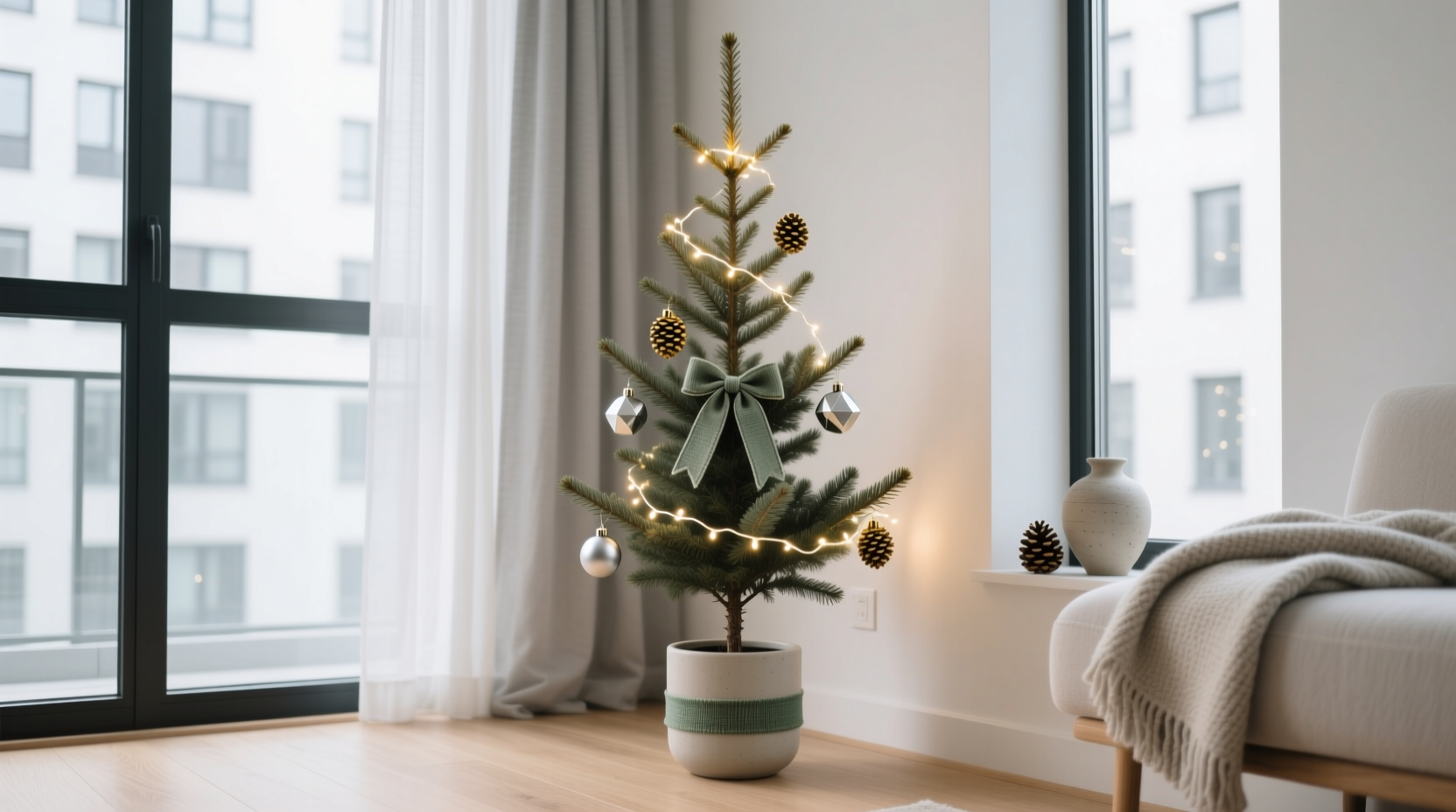
Minimalist Christmas styling isn’t just visually cohesive—it’s functionally intelligent. In apartments under 700 square feet, every object competes for air, light, and psychological bandwidth. A densely decorated tree can visually shrink a room, obscure sightlines, and make navigation feel congested—especially near doorways, kitchen islands, or sofa seating zones. Research from the Environmental Design Research Association shows that visual clutter increases cognitive load by up to 35%, raising stress markers even during celebratory periods. Conversely, a restrained tree acts as an anchor rather than an obstacle: its clean silhouette defines vertical space without dominating it, its subtle textures add warmth without visual noise, and its intentional composition invites pause—not distraction. Crucially, minimalism aligns with urban living realities: reduced fire risk (fewer flammable materials), lower energy use (no string lights overload), easier recycling (single-material ornaments), and simplified post-holiday cleanup. As architect and small-space specialist Lena Torres notes, “A minimalist tree isn’t less festive—it’s more *present*. It doesn’t shout ‘Christmas’ at you; it breathes with your apartment.”
Choosing the Right Tree: Scale, Form, and Material
The foundation of minimalist styling is selecting a tree that respects your spatial constraints—not just in height, but in volume, density, and maintenance needs. Avoid the instinct to “go small” with a 3-foot pre-lit artificial tree covered in glittery mini-balls. That often reads as cramped, not curated. Instead, prioritize proportion, silhouette, and tactile integrity.
| Tree Type | Ideal Height Range | Key Advantages | Small-Apartment Considerations |
|---|---|---|---|
| Nordic Slim Fir (real) | 4.5–6 ft | Natural asymmetry, soft needle texture, low-pollen varieties available | Requires weekly watering; choose a pot with casters for easy relocation; avoid near heat vents |
| Feather-Branch Artificial (PE + PVC blend) | 5–5.5 ft | Ultra-slim profile (24–28” base width), realistic taper, lightweight frame | Look for models with hinged branches and 3–4 section poles—faster setup, fits in closet or under-bed storage |
| Flat-Panel or Wall-Mounted Tree | 4–5 ft tall × 12–18” deep | Takes zero floor space; doubles as art; no water mess or shedding | Ensure wall anchors are rated for drywall + ornament weight; best for studios or loft bedrooms |
| Single-Stem Branch Arrangement | 3.5–4.5 ft | Fully customizable; uses foraged or sustainably sourced branches; zero plastic | Secure in a weighted ceramic or concrete planter; refresh every 7–10 days with fresh cut stems |
Avoid trees with dense, bushy profiles—even at 4 feet—unless your ceiling height exceeds 9 feet. A 5-foot slim tree with 35–45-degree branch angles creates upward lift and preserves sightlines across open-plan layouts. Also skip pre-strung lights unless they’re warm-white, non-flickering LEDs with a single on/off switch (no remotes or apps). Complexity contradicts minimalism.
The Minimalist Ornament System: Less Is Anchored, Not Empty
Minimalist ornamentation rejects the “more is merrier” mindset. Instead, it follows a three-tiered system: anchor, rhythm, and accent. This ensures visual balance without redundancy.
- Anchor (1–3 pieces): A singular, sculptural element placed at the tree’s apex or central third—e.g., a hand-thrown ceramic star, a brushed-brass geometric topper, or a single preserved eucalyptus pod. It should be substantial enough to hold attention but not dominate scale.
- Rhythm (5–9 pieces): Identical or tonally matched ornaments spaced evenly along 3–4 primary branch planes. These create cadence—not randomness. Think matte black glass spheres, undyed wool felt cones, or raw-edge walnut discs. All must share the same finish (all-matte, all-satin) and sit at consistent depth (approx. 4–6 inches from branch tip).
- Accent (0–2 pieces): One subtle textural contrast—e.g., a single dried orange slice suspended mid-tree, or a single brass pinecone nestled where two branches intersect. Never more than two. Its purpose is invitation, not decoration.
This system eliminates decision fatigue and prevents “ornament drift”—the common habit of adding one more “just because” until the tree feels busy. It also simplifies storage: group anchors in acid-free tissue, rhythm pieces in rigid compartment boxes, accents in labeled muslin pouches. No plastic bags. No tangled hooks.
Lighting with Intention: Warmth Without Glare
Lighting is where most minimalist trees fail—not from too little, but from poor quality or misplacement. Skip multicolor strings, blinking modes, or cool-white LEDs. Instead, commit to warm-white (2200K–2400K), non-dimmable, constant-output micro-LEDs with insulated copper wire. Why? Cool light casts shadows that read as harsh in small rooms; flicker—even imperceptible—increases eye strain; and dimmable circuits add unnecessary complexity.
Placement matters more than quantity. Use only 50–70 bulbs for a 5-foot tree. Start at the trunk and weave inward—not outward—so light emanates from the core, mimicking natural bioluminescence. Space bulbs 4–5 inches apart along inner branch junctions, avoiding tips entirely. The goal is gentle ambient glow—not illumination. Test after installation: stand 6 feet away in normal room lighting. If you can clearly see individual bulbs or wiring, reposition.
“True minimalism in lighting isn’t about reducing wattage—it’s about refining direction, color temperature, and emotional resonance. A well-lit minimalist tree should feel like candlelight seen through frosted glass: present, but never insistent.” — Aris Thorne, Lighting Designer & Author of Quiet Light
Step-by-Step Setup Timeline (Under 90 Minutes)
Follow this timed sequence to avoid overwhelm and ensure cohesion. All steps assume a pre-selected tree and ornament system.
- Prep (10 min): Clear floor space within 24” of intended location. Lay down a neutral woven rug or felt mat (not plastic) to define the zone and protect flooring. Assemble tree stand and fill with water (for real trees) or secure base plate (for artificial).
- Frame (15 min): Assemble tree sections, ensuring branch tips face upward at consistent 30–45° angles. Gently fluff—not fan—branches to preserve natural taper. Do not overextend.
- Light (20 min): Starting at the base trunk, wrap lights inward along main branch forks. Use twist-ties (not clips) to secure at junctions. Hide plug ends inside lowest branch cluster.
- Ornament (25 min): Hang rhythm ornaments first—use a measuring tape to maintain even spacing. Then place anchor. Finally, add accent. Step back every 5 minutes to assess balance.
- Final Breath (10 min): Turn off overhead lights. Observe tree in ambient room light only. Remove any ornament that draws attention *away* from the overall form. Wipe dust from bulbs and ornaments with a dry microfiber cloth.
Real Example: Maya’s 420-Sq-Ft Studio in Portland
Maya, a graphic designer and renter since 2020, lives in a converted 1920s studio with 8’2” ceilings, exposed brick, and a Murphy bed. Her previous “mini” tree—a 3.5-ft pre-lit spruce with 80 ornaments—made her living area feel like a department store display. In 2023, she collaborated with a local stylist to redesign her approach. She chose a 5-ft feather-branch artificial tree in “natural green” (not blue-green), with a slim 26” base. Her ornament system: three hand-blown matte-black glass orbs (rhythm), a single oxidized copper star (anchor), and one preserved magnolia leaf dipped in beeswax (accent). Lights: 60 warm-white micro-LEDs, hand-wrapped. She installed a recessed floor outlet behind the tree to hide cords. Total setup time: 78 minutes. Post-holiday takedown took 22 minutes—tree disassembled into four parts, stored vertically in a hall closet. “It doesn’t scream ‘Christmas,’” she says, “but when I walk in after work, the light catches the copper star just right, and I exhale. That’s what I wanted.”
Do’s and Don’ts for Long-Term Minimalist Practice
| Do | Don’t |
|---|---|
| Rotate ornaments seasonally—store half each year to prevent visual fatigue | Use ornaments with glued-on glitter, rhinestones, or plastic coatings (they degrade, shed, and contradict material honesty) |
| Choose a tree stand with built-in water level indicator (for real trees) or anti-tip bracket (for artificial) | Place tree directly on hardwood without protection—even minimal rugs prevent micro-scratches and slippage |
| Wipe ornaments with vinegar-water solution (1:3) once per season to restore matte finishes | Hang ornaments on branch tips—they sag, break, and disrupt silhouette |
| Use command strips with reinforced backing for wall-mounted trees (test weight capacity first) | Introduce scented elements (cinnamon sticks, pine-scented sprays)—they compete with personal fragrance and can trigger allergies in shared buildings |
FAQ
Can I use a fake tree and still keep it minimalist?
Absolutely—if you select intentionally. Prioritize PE (polyethylene) branch tips over PVC for realism, choose a monochrome palette (no “frosted” or “snow-dusted” finishes), and avoid pre-attached bows, berries, or garlands. The minimalism lies in editing, not origin.
What if my apartment has strict no-real-tree policies?
Opt for high-fidelity artificial alternatives: look for brands using recyclable aluminum trunks and PE branches certified by OEKO-TEX® Standard 100 (non-toxic dyes). Pair with foraged accents—dried lotus pods, river-smoothed stones, or unbleached linen ribbons—to reintroduce organic texture without violating lease terms.
How do I explain this aesthetic to family members used to traditional trees?
Frame it as curation, not compromise: “This tree reflects how I live year-round—intentional, calm, and rooted in what truly brings me joy. It’s not less festive; it’s more focused. And it leaves room for us to gather, talk, and be together—not navigate around decorations.”
Conclusion
A minimalist Christmas tree in a small apartment is more than decor—it’s a declaration of presence. It says you value clarity over clutter, authenticity over accumulation, and quiet resonance over loud spectacle. It acknowledges spatial limits not as constraints, but as invitations to refine what matters: the warmth of light on a handmade ornament, the quiet symmetry of a well-proportioned silhouette, the ease of a ritual that takes less than 90 minutes and brings more peace than pressure. You don’t need vaulted ceilings or walk-in closets to celebrate meaningfully. You need discernment, consistency, and the courage to leave space—space for light, for breath, for connection. Start this year with one anchor piece. Choose one rhythm set. Place them with care. Notice how the room settles around them. That stillness? That’s the heart of the season.




 浙公网安备
33010002000092号
浙公网安备
33010002000092号 浙B2-20120091-4
Comments
No comments yet. Why don't you start the discussion?