
In a season often defined by excess, a minimalist Christmas tree offers a breath of calm elegance. Stripping away clutter doesn’t mean sacrificing beauty—it means focusing on intentionality, balance, and refined detail. By limiting your decor to just three ornament types and using monochrome ribbons, you create a cohesive, sophisticated aesthetic that feels both modern and timeless. This approach is not only visually striking but also sustainable, budget-friendly, and easier to store year after year.
Minimalism in holiday decor isn’t about deprivation; it’s about curating what matters. When done well, a restrained palette draws attention to texture, form, and placement—elements often lost in more maximalist displays. Whether your taste leans Scandinavian, industrial, or modern farmhouse, this method adapts seamlessly. The result? A tree that feels intentional, serene, and deeply personal.
The Philosophy Behind Minimalist Holiday Design
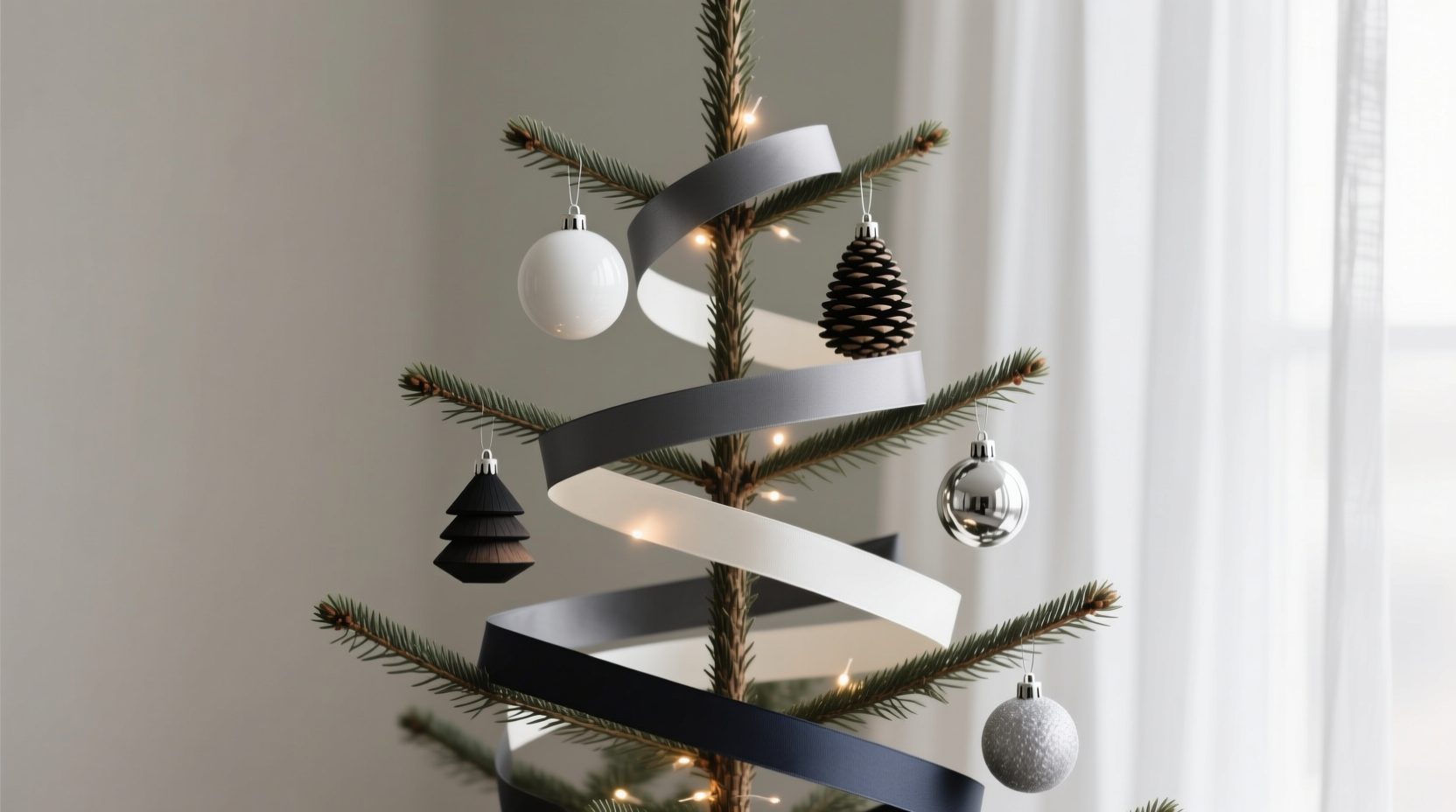
Minimalism in interior design emphasizes quality over quantity, space over stuff, and harmony over chaos. Applied to Christmas trees, this means selecting fewer pieces that carry greater visual weight. Instead of covering every branch with ornaments, you allow negative space to become part of the composition. This breathing room lets each element shine.
Using only three ornament types forces thoughtful selection. Each must contribute something unique—whether through shape, texture, or reflective quality—while still belonging to the same visual family. Monochrome ribbons unify the design, adding movement and softness without introducing competing colors.
“Restriction breeds creativity. When you limit your palette, you start seeing possibilities you’d otherwise overlook.” — Clara Nguyen, Interior Stylist & Author of *Quiet Spaces*
This curated simplicity also makes decorating faster and less stressful. No more last-minute trips to the store for “just one more thing.” With a clear framework, you can achieve a polished look in under an hour—even if you’re starting from scratch.
Selecting Your Three Ornament Types: Purpose and Balance
The key to a compelling minimalist tree lies in the strategic choice of three distinct yet complementary ornament types. Think of them as characters in a small ensemble: each has a role, and together they tell a story.
1. Anchor Ornaments (Volume & Shape)
These are your largest or most structurally bold pieces—items that establish presence. Examples include:
- Large matte spheres (4–5 inches)
- Geometric shapes like cubes or cylinders
- Oversized paper stars or folded origami forms
Place these deeper within the tree to build volume and prevent the center from feeling hollow. They act as visual anchors, grounding the design.
2. Texture Ornaments (Tactile Interest)
Since color is limited, texture becomes your primary tool for depth. These ornaments catch light differently and invite closer inspection. Consider:
- Felted wool balls
- Rattan or woven wood beads
- Linen-wrapped globes
- Cork or burlap stars
Scatter these throughout the mid-layers of the tree. Their organic imperfections contrast beautifully with smoother elements, adding warmth and humanity.
3. Accent Ornaments (Light & Reflection)
These catch and reflect ambient light, creating subtle sparkle without glitter overload. Choose sparingly:
- Clear glass drops with silver edging
- Mirrored discs
- Brushed metal cones
- Frosted acrylic icicles
Position near lights or at outward-facing branch tips where they’ll catch glimmers. Too many will break the minimalist mood, so limit to 6–10 pieces depending on tree size.
Working with Monochrome Ribbons: Form, Flow, and Placement
Ribbons are often overlooked in minimalist schemes, but when used intentionally, they elevate the entire design. Monochrome ensures continuity, while variation in width, sheen, and drape adds dimension.
Choosing Ribbon Varieties
Select two ribbon types in the same tonal family—for example, charcoal gray and light slate—to add nuance without breaking the monochrome rule. Recommended combinations:
| Effect | Ribbon Type | Best For |
|---|---|---|
| Soft flow | Satin or silk ribbon (1.5–2 inch width) | Gentle draping from top to bottom |
| Structure | Grosgrain or woven cotton tape | Crisp bows on outer branches |
| Sparkle | Tinsel-edged organza or metallic-thread blend | Subtle shimmer under lights |
| Texture | Burlap or linen tape | Rustic-modern contrast |
Application Techniques
How you apply ribbon determines its impact:
- Spiral Draping: Begin at the topmost branch and spiral downward, letting the ribbon follow the tree’s natural cone shape. Use a single continuous length (10–15 feet) for large trees.
- Cluster Bows: Place small bows (3–4 inches) at junctions of major branches. Limit to 5–7 per tree to avoid overcrowding.
- Cross-Branch Ties: Use short lengths to tie adjacent branches together, enhancing fullness and directing eye movement inward.
Step-by-Step Guide: Styling Your Tree in Under 60 Minutes
Follow this sequence for a balanced, professional-looking result:
- Prep the Tree
Fluff branches evenly, working from bottom to top. Rotate as you go to ensure fullness on all sides. If using lights, choose warm white LEDs for soft glow. - Add Anchor Ornaments
Starting at the interior, place 6–8 large anchor ornaments deep within the structure. Space them irregularly but balanced—avoid symmetry for a more organic feel. - Weave in Texture Ornaments
Distribute 12–18 textured pieces across middle and outer layers. Vary heights and depths. Let some hang lower for rhythm. - Apply Ribbon
Begin spiral draping from the top. Let the ribbon fall naturally—don’t pull tight. Add 3–5 bows at focal points, such as where major limbs emerge. - Insert Accent Ornaments
Place reflective pieces near lights or at eye level. Ensure they’re visible from multiple angles but not clustered. - Final Adjustments
Step back 6–8 feet. Look for gaps, imbalances, or areas of visual heaviness. Gently reposition one or two elements if needed. Trim any exposed wire.
“A minimalist tree should feel complete, not empty. If you’re asking ‘Is that all?’—it’s not finished. If you’re thinking ‘That’s perfect’—you’ve nailed it.” — Marcus Bell, Set Designer & Holiday Stylist
Real Example: Elena’s Urban Apartment Tree
Elena, a graphic designer in Portland, wanted a holiday presence that matched her monochrome living space—no red, no green, no clutter. Her 6-foot pre-lit tree had been stored for years, forgotten in the basement.
She chose three ornament types: 7 large matte black spheres (anchor), 15 cream felted wool balls (texture), and 8 brushed brass teardrops (accent). Her ribbon was a 2-inch-wide charcoal satin, spiraled from top to bottom with three small bows at mid-level.
The result transformed her corner. Neighbors assumed she hired a decorator. “It feels luxurious,” she said, “but I spent under $40 and did it on a Tuesday night.” The restraint made the space feel larger, calmer, and more intentional during a busy season.
Common Mistakes to Avoid
Even with a simple formula, pitfalls exist. Watch for these:
- Overloading the exterior: Placing all ornaments on the outer edges creates a shell-like effect, making the tree feel hollow inside.
- Ignoring scale: Using too many large ornaments overwhelms a small tree; tiny ones disappear on large ones.
- Matching everything exactly: Uniformity kills interest. Mix slight variations in size, finish, or texture within your monochrome range.
- Skipping the ribbon test: Drape first before cutting. Some ribbons curl or twist unexpectedly once released.
Frequently Asked Questions
Can I use white instead of black for a minimalist tree?
Absolutely. White, ivory, or off-white schemes feel airy and wintry. Pair matte white ornaments with pale gray ribbons and frosted glass accents for a snow-dusted effect. Just ensure contrast through texture—otherwise, the tree may appear washed out.
What if my tree already has colored lights?
If your lights aren’t white, embrace them as part of the design. For example, warm white works best with neutral palettes. Cool white or blue-tinted lights can clash with warm textures. If stuck with colored lights, consider layering sheer monochrome fabric over the tree base to mute their effect, or save this styling for next year.
How do I store these ornaments for reuse?
Use compartmentalized boxes to keep types separate. Wrap delicate pieces in tissue. Label clearly. Store ribbons on cardboard spools or rolled with rubber bands to prevent kinks. Keep in a climate-stable area—avoid attics or garages where temperature swings degrade materials.
Checklist: Your Minimalist Tree Styling Plan
- ☐ Choose a monochrome palette (e.g., charcoal, cream, brass)
- ☐ Select three ornament types: one anchor, one texture, one accent
- ☐ Buy 10–15 feet of main ribbon + extra for bows
- ☐ Prep tree: fluff branches, add lights if needed
- ☐ Hang anchor ornaments deep inside the tree
- ☐ Distribute texture ornaments across layers
- ☐ Spiral ribbon from top to bottom
- ☐ Add 3–5 bows at strategic points
- ☐ Place accent ornaments near light sources
- ☐ Step back and refine spacing
- ☐ Take a photo to review balance
- ☐ Store remaining pieces properly for next year
Conclusion: Less Is More, Especially at Christmas
A minimalist Christmas tree isn’t a compromise—it’s a statement. In choosing fewer, better things, you reclaim the quiet joy of the season. There’s no pressure to impress, no tangled mess of decorations, no post-holiday guilt over waste. Just clarity, calm, and beauty in its simplest form.
You don’t need a mansion or a decorator to create elegance. You need vision, restraint, and the courage to stop when it feels right. Start small this year. Try the three-ornament rule. Let monochrome ribbons guide the eye. See how little it takes to make something truly memorable.




 浙公网安备
33010002000092号
浙公网安备
33010002000092号 浙B2-20120091-4
Comments
No comments yet. Why don't you start the discussion?