
Minimalism during the holidays isn’t about scarcity—it’s about intention. A minimalist Christmas tree doesn’t mean stripping away joy; it means curating presence. When you limit yourself to just three ornament types, every piece earns its place. You eliminate visual noise, deepen cohesion, and invite quiet reverence into your space. This approach works especially well in modern apartments, Scandinavian-inspired homes, open-plan living areas, or for anyone who finds traditional tinsel-laden trees overwhelming. More importantly, it’s sustainable: fewer ornaments mean less storage, less dusting, and longer-lasting pieces you’ll cherish for years—not just one season.
The Philosophy Behind the Three-Ornament Rule
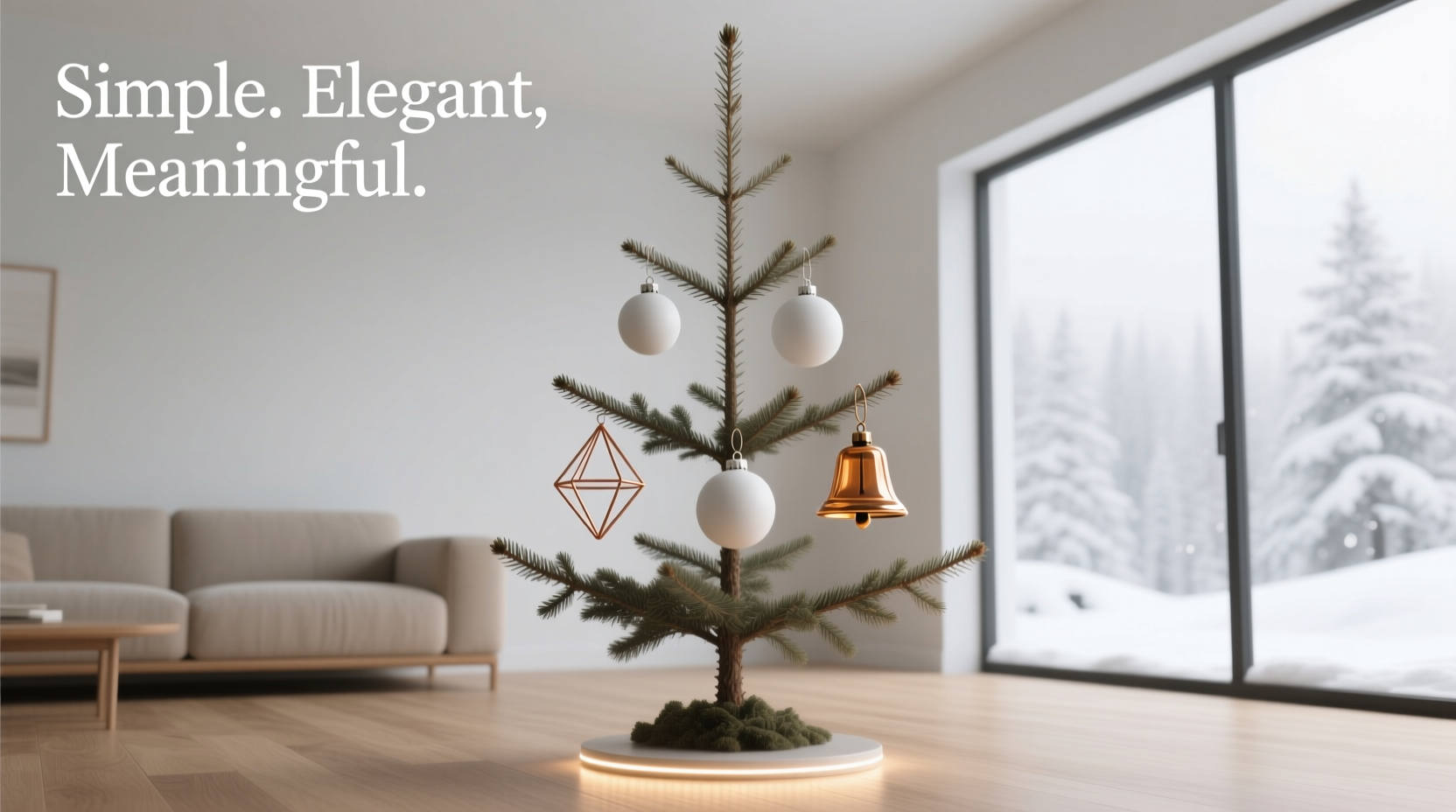
Before selecting materials or arranging branches, understand the principle: restraint creates resonance. Designers like Ilse Crawford emphasize that “calm spaces allow people to breathe—and feel.” A tree styled with 47 baubles in six colors competes for attention. A tree adorned with 28 carefully chosen ornaments across three harmonizing families tells a single, coherent story. The number three is psychologically potent—it’s the smallest number needed to establish rhythm (think: repetition, variation, resolution). In ornament terms, that translates to a base layer (texture), a unifying element (form or material), and an intentional accent (light or contrast).
This isn’t arbitrary minimalism. It’s edited abundance—like a chef choosing three perfect ingredients for a dish instead of dumping in everything in the pantry. And unlike maximalist trees that rely on volume for impact, a three-ornament tree gains strength from negative space: the gaps between branches become part of the composition, not something to fill.
Selecting Your Three Ornament Types: Criteria That Matter
Not all threes are equal. A successful minimalist tree hinges on thoughtful selection—not just counting categories. Avoid arbitrary groupings like “red balls, gold stars, and pinecones.” Instead, build your trio around shared qualities: material integrity, dimensional harmony, and tonal continuity. Below is a proven framework used by interior stylists for residential and boutique holiday installations.
| Category | Role in the Trio | Recommended Examples | What to Avoid |
|---|---|---|---|
| Textural Anchor | Provides organic weight and tactile depth—usually matte, natural, or handmade. Forms the visual “ground” of the tree. | Dried orange slices, unfinished wood discs, hand-thrown ceramic orbs, raw linen-wrapped spheres | Glossy plastic, uniform mass-produced items, anything synthetic-feeling |
| Unifying Form | Repeats a single shape across varying scale or finish—creates rhythm without monotony. Often metallic or reflective. | Hand-blown glass orbs (all round, but in three subtle sizes), brushed brass teardrops, hammered copper cones | Mixed shapes (stars + bells + angels), high-gloss chrome, anything overly ornate or detailed |
| Luminous Accent | Introduces gentle light, movement, or subtle contrast—never dominant, always supporting. Often the smallest quantity. | Hand-tied dried eucalyptus sprigs, vintage-style warm-white LED string lights (with visible filament bulbs), matte black velvet ribbons cut into identical 12-inch lengths | Battery-operated flickering candles, glitter-coated items, blinking LEDs, anything that draws attention *away* from the trio |
Note: Color is secondary to material and form. A cohesive trio might be entirely monochromatic (e.g., oat, charcoal, and bone) or use a restrained two-tone palette (e.g., matte black + brushed brass, ivory + raw oak). What binds them is shared texture language—not matching hues.
A Step-by-Step Styling Process (No Ladder Required)
Styling isn’t hanging—it’s choreographing light, weight, and breath. Follow this seven-step sequence. Total time: 45–60 minutes. No ladder needed if your tree is under 7 feet (work top-down, using branch leverage).
- Prep the tree: Fluff branches outward and upward—not downward. Gently bend inner branches toward the center to create depth. Remove any pre-attached hooks or tinsel. Wipe dust from needles with a dry microfiber cloth.
- Install lighting first: Use warm-white LED string lights with visible filaments (200–300 bulbs for a 6.5-ft tree). Wrap lights *spiral-wise*, starting at the base and moving upward—keeping 4–6 inches between wraps. Tuck bulbs deep into the branch structure so light glows *from within*, not just on the surface.
- Place Textural Anchors: Begin with your largest ornaments (e.g., 4–5\" wood discs or ceramic orbs). Place 12–15 pieces total—two-thirds near the bottom third of the tree, spaced at least 8\" apart. Let them hang freely; don’t force symmetry. Their weight should settle naturally into the branch forks.
- Add Unifying Forms: Introduce your middle-size ornaments (e.g., 2.5–3.5\" glass orbs). Distribute 20–25 evenly—but not mathematically. Cluster two or three of the same size in one zone, then skip two branches before placing the next cluster. Vary height: some sit deep in the foliage, others perch lightly on outer tips.
- Weave in Luminous Accents: Now add your smallest elements (e.g., 8–10 eucalyptus sprigs or velvet ribbons). Tuck each *between* existing ornaments—not beside them. Let them drape vertically, following the natural fall of the branch. Never tie tightly; use gentle wire loops or floral pins that grip without piercing.
- Edit ruthlessly: Stand back 6 feet. Turn off overhead lights. Look for “hot spots”—areas where ornament density feels heavy—or “voids” where branches look bare. Remove *one* ornament from each hot spot. Add *one* luminous accent to each void. Repeat until your eye moves slowly, not jarringly.
- Final grounding: Place a simple, unbleached linen tree skirt (no ruffles or lace). Add one low-profile object beneath the skirt: a single large river stone, a stack of three aged hardcover books in neutral tones, or a small brass tray holding three dried pomegranates. This completes the visual root system.
Real Example: The Oslo Apartment Tree
In a 42m² Oslo apartment with floor-to-ceiling north-facing windows and pale oak floors, architect Lena Voss faced a challenge: her 6.5-ft Nordmann fir looked washed out against cool gray walls. She rejected traditional red-and-green schemes as visually “loud” in low light. Instead, she built a trio around Nordic material honesty: Textural Anchor = hand-carved birch bark cones (32 pieces, varying heights); Unifying Form = mouth-blown glass orbs in frosted white (28 pieces, 2\", 2.75\", and 3.5\"); Luminous Accent = 14 sprigs of preserved silver brunia, tied with undyed hemp cord.
She installed warm-white filament lights first, then placed birch cones deep in the lower branches—letting their rough texture absorb ambient light. Glass orbs were clustered in threes at eye level, catching window glow at dawn and dusk. Brunia sprigs were tucked only on the tree’s front-facing plane, creating delicate shadow patterns on the wall behind. Neighbors commented not on “how few” ornaments there were—but on how the tree seemed to “breathe with the room.” Six months later, Lena reused the birch cones as drawer liners and the glass orbs as bathroom shelf accents—proof that minimalist choices extend beyond December.
“Three isn’t a limit—it’s a lens. When you commit to three, you stop decorating and start editing. That’s where true style begins.” — Sofia Rasmussen, Copenhagen-based stylist and author of *Nordic Calm*
Common Pitfalls & How to Avoid Them
Even experienced decorators stumble when embracing minimalism. Here’s what to watch for—and why it undermines the effect:
- Mixing finishes within one category: Using both polished and brushed brass in your “Unifying Form” breaks visual continuity. Choose one finish—and stick to it across all pieces in that type.
- Over-spacing ornaments: Leaving more than 10 inches between pieces creates isolation, not airiness. Minimalism needs proximity to read as intentional grouping—not accidental sparseness.
- Ignoring scale hierarchy: All three ornament types must vary in size. If your Textural Anchors and Unifying Forms are nearly identical in diameter, the eye can’t parse depth. Maintain at least a 1.5x size difference between your largest and smallest type.
- Forgetting the trunk: A bare trunk reads as unfinished. Wrap it loosely with a single strand of your Luminous Accent (e.g., eucalyptus or velvet ribbon) or a strip of natural jute twine. No tape—just gentle knots.
- Using “minimalist” as an excuse for haste: Rushing placement leads to top-heavy distribution. Spend 15 minutes on step three (Textural Anchors) alone. Their placement sets the entire tree’s gravity.
FAQ
Can I use heirloom ornaments in a three-type tree?
Absolutely—if they fit one of your three categories *by material and intent*, not sentiment alone. A tarnished silver bell from 1948 belongs in the “Unifying Form” category only if you have other metal pieces sharing its weight, finish, and simplicity. If it’s ornately carved or brightly enameled, it disrupts the trio. Sentiment matters—but editing honors it more than display ever could.
What if my tree is artificial? Does this method still work?
Yes—and often better. High-quality artificial trees (especially PVC or PE tip-branched models) offer consistent branch structure, making spacing and depth control easier. Just ensure the tree has layered, irregular branching—not uniform “ladder” tiers. Before decorating, wipe branches with a damp cloth to remove factory dust, which dulls light reflection.
How many ornaments total should I use for a standard 6.5-foot tree?
Between 55 and 75 pieces total—distributed across your three types in a 2:2:1 ratio. For example: 25 Textural Anchors, 25 Unifying Forms, 12 Luminous Accents. Never exceed 80. Density diminishes minimalism; precision amplifies it.
Conclusion: Your Tree Is Ready When It Feels Like a Pause
A minimalist Christmas tree doesn’t shout “Merry Christmas!”—it whispers “Breathe.” It asks nothing of your guests except presence. When done well, it becomes a silent collaborator in your home’s rhythm: softening sharp angles, warming cool surfaces, anchoring busy rooms. You’ll know it’s complete not when the last ornament is hung—but when you pause mid-room, catch your breath, and feel the space settle around you.
This isn’t decoration as decoration. It’s design as care—for your eyes, your energy, your values. You’ve chosen clarity over clutter, intention over impulse, and quiet joy over forced cheer. That choice matters far beyond the holidays. It’s practice in living deliberately.
So unbox your three types. Light your filament strings. Place your first birch cone or ceramic orb—not with urgency, but with attention. Let the tree teach you how much meaning lives in restraint.




 浙公网安备
33010002000092号
浙公网安备
33010002000092号 浙B2-20120091-4
Comments
No comments yet. Why don't you start the discussion?