
Scandinavian Christmas design isn’t about subtraction—it’s about reverence. It honors the quiet strength of pine boughs, the warmth of candlelight reflected in hand-blown glass, and the dignity of objects chosen not for abundance but for meaning. In a cultural tradition rooted in hygge, lagom, and kos, the tree becomes a focal point of calm—not chaos. That means no glitter storms, no cascading ribbons, no plastic snowflakes clinging like static. Instead: space, texture, restraint, and three ornament types—exactly three—that work in concert, not competition. This approach isn’t a compromise; it’s a recalibration. It asks you to slow down, select deliberately, and let natural materials speak for themselves. And yes—it is entirely possible to create a tree that feels deeply festive, emotionally resonant, and unmistakably Nordic, using nothing more than wood, ceramic, and glass—and absolutely no tinsel.
The Philosophy Behind the Three-Type Rule
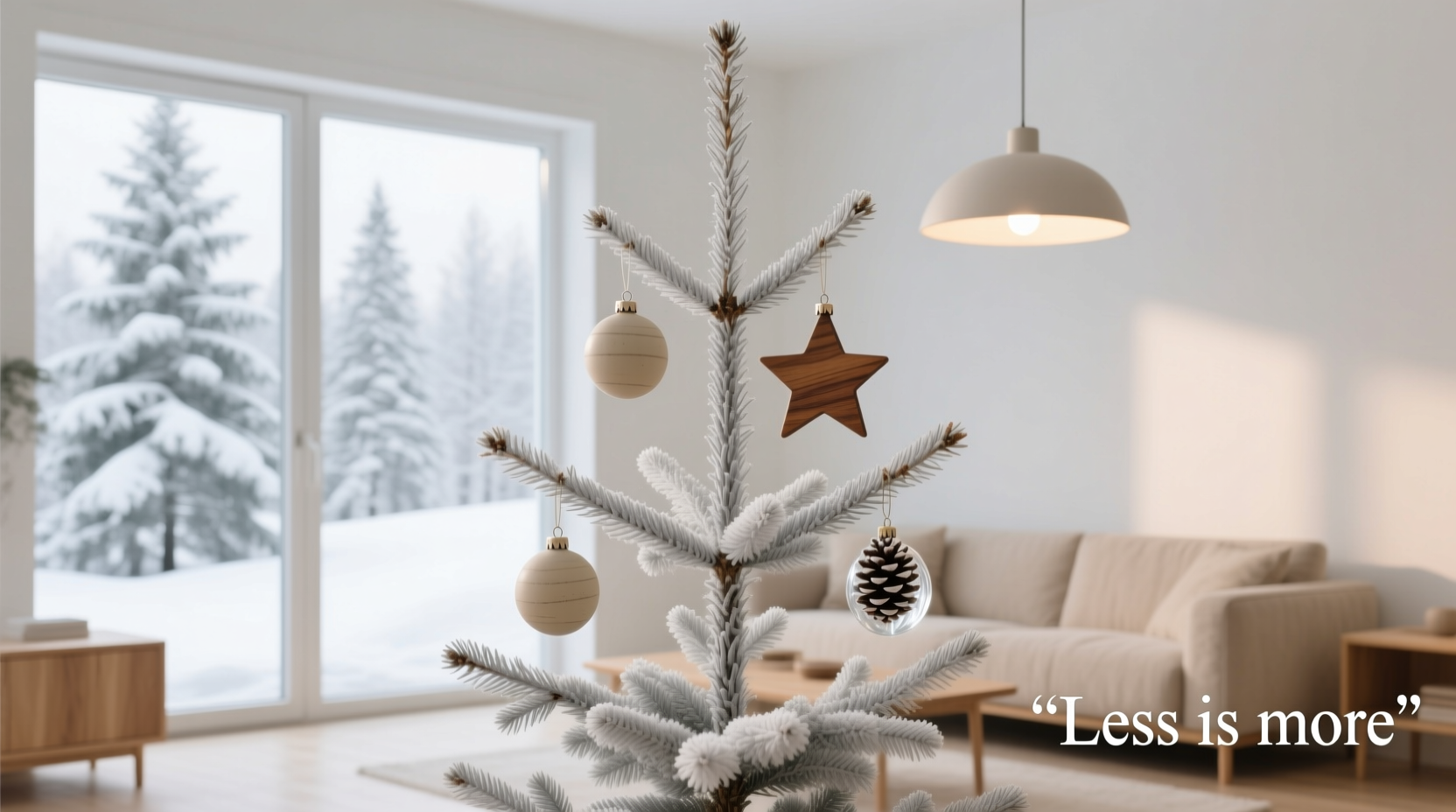
Scandinavian design principles don’t begin with aesthetics—they begin with ethics. “Less but better” (a phrase often attributed to Dieter Rams, but long embedded in Nordic craft culture) applies as much to holiday decor as to furniture or architecture. When we limit ornamentation to three types, we’re not imposing scarcity—we’re practicing curation. Each type serves a distinct sensory and symbolic role:
- Wood grounds the tree in nature—warm, tactile, imperfect. It echoes the forest floor, the log fire, the handmade toy.
- Ceramic introduces subtle weight and quiet refinement—matte, unglazed, or softly glazed in oatmeal, ash grey, or pale sage. It speaks to the potter’s wheel, to domestic ritual, to enduring form.
- Glass brings luminosity and fragility—the delicate shimmer of candlelight catching on blown spheres or teardrops. It recalls vintage Swedish Julgransbelysning (Christmas tree lighting), where light was never flashy, but gentle and diffused.
This triad creates visual rhythm without repetition: organic grain against smooth curve, matte surface against reflective surface, earthy tone against translucent clarity. Crucially, all three materials share one quality: they age gracefully. A chipped ceramic bauble gains character; a scratched wooden star tells a story; a cloudy glass orb softens the light further. That’s intentional—not a flaw to hide, but a mark of use and belonging.
Your Three Ornament Types—Defined & Sourced
Not all wood, ceramic, or glass ornaments qualify. Authentic Scandinavian minimalism rejects mass-produced imitations. Below is a precise specification—not a shopping list, but a material standard.
| Ornament Type | Acceptable Forms & Materials | Strictly Avoid |
|---|---|---|
| Wood | Unfinished or lightly oiled birch, ash, or pine; laser-cut silhouettes (reindeer, stars, hearts); hand-turned beads or spools; small carved birds or mushrooms; thin dowel rods sliced into discs (sanded edges only) | Painted wood, lacquered finishes, resin “wood-look” items, glued laminates, anything with visible screws or plastic hangers |
| Ceramic | Hand-thrown, unglazed stoneware; matte-glazed porcelain in muted tones (no white unless bone-dry, no black unless charcoal-smoked); small footed bowls repurposed as hanging ornaments; tiny pinch pots with looped clay handles | Glossy glazes, metallic finishes, stamped patterns, factory-molded shapes (e.g., uniform snowmen), plastic-coated ceramics |
| Glass | Antique or reproduction mouth-blown glass orbs (4–7 cm diameter); hand-pulled glass icicles with irregular taper; frosted or milk-glass spheres; simple glass bells with brass or cotton cord hangers | Mirror-finish glass, faceted crystals, LED-lit ornaments, plastic “glass” alternatives, anything with synthetic glitter coating |
Note the consistent emphasis on imperfection: uneven thickness in glass, subtle warping in ceramic, grain variation in wood. These aren’t inconsistencies—they’re signatures of human making. As Danish ceramicist Lene Bjerregaard observes:
“Perfection is sterile. In Scandinavian craft, the slight wobble in the rim, the faint bloom in the glaze, the whisper of tool marks—these are where the soul lives. Your tree should feel made, not manufactured.”
A Step-by-Step Styling Sequence (No Tinsel, No Exceptions)
Styling happens in deliberate stages—not all at once. Rushing invites clutter. Follow this exact sequence, allowing at least 30 minutes between steps for reflection and adjustment.
- Prepare the Tree: Use a fresh Nordmann fir or Norway spruce—its dense, horizontal branching provides ideal structure. Trim lower branches only if necessary for stability; retain as much natural fullness as possible. Never flock or spray. Let the tree breathe for 24 hours after setup before decorating.
- Add Lighting First—Then Pause: String warm-white LED fairy lights (2700K colour temperature only) evenly from base to tip, hiding wires deep within branches. Use 100 bulbs per 1.8m tree. Turn them on. Sit with the lit tree for 10 minutes. Observe where light pools, where shadows fall, where branches recede. This is your map.
- Hang Wood Ornaments (35% of total count): Begin at the lowest third of the tree. Place larger pieces (stars, birds) near trunk intersections; smaller discs or beads toward branch tips. Space them generously—minimum 15 cm between pieces. Prioritise asymmetry: cluster three on one side of a major branch, leave the opposite side bare.
- Add Ceramic Ornaments (35% of total count): Work upward, focusing on the middle third. Hang ceramic pieces slightly deeper into the canopy than wood—letting their weight pull them forward gently. Choose varying heights on the same branch: one low, one mid, one high. Never align ceramics horizontally across the tree; instead, create diagonal rhythms.
- Place Glass Ornaments Last (30% of total count): Reserve these for the upper third and outermost tips. Hang them so they catch light *from below*—not from the front. Use clear monofilament or undyed cotton cord (never wire). Rotate each glass piece once after hanging to ensure its most luminous angle faces inward toward the lights.
After all ornaments are placed, step back. Turn off room lights. Observe only the tree’s glow. If any area feels “busy,” remove *one* ornament from that zone—not two, not three. Wait five minutes. Reassess. Repeat until the eye rests easily, moving slowly—not scanning.
Real Example: The Lund Family Tree in Malmö
In December 2023, interior architect Sofia Lund and her husband Elias—a woodworker—styled their 2.1m Nordmann fir using exactly this method. They owned no ornaments beyond what Sofia had inherited from her grandmother: 12 hand-carved wooden stars (birch, sanded but unsealed), 9 ceramic pinch pots (made by a local ceramist in Lund, glazed in oatmeal and moss), and 15 vintage Swedish glass orbs (1950s, milk-glass with faint blue undertones). They added no new purchases.
Sofia began on a Sunday morning. She strung lights Friday evening, then waited. On Saturday, she hung the wood—spending 45 minutes placing just 12 pieces, removing and repositioning seven of them. Sunday morning: ceramics. She hung nine, then removed three, realising they competed with the tree’s natural symmetry. Sunday afternoon: glass. She hung all 15—but replaced the cord on six because the original twine was too yellow. By Monday evening, the tree felt complete: serene, anchored, alive with soft light. Neighbours commented not on how “bare” it looked, but on how “deep” it felt—how it seemed to hold silence. As Sofia wrote in her journal: “It didn’t look like less. It looked like more attention.”
Essential Do’s and Don’ts
These distinctions separate thoughtful minimalism from accidental emptiness.
- Do vary ornament size within each type—e.g., wood stars ranging from 4cm to 9cm—but keep proportions harmonious (no single piece dominates visually).
- Do use natural hangers only: undyed cotton cord, thin leather thong, or twisted raffia. Knots should be visible and simple—not hidden.
- Do allow negative space to function as an active element. Empty branches aren’t “missing” anything—they’re breathing.
- Don’t mix metal finishes (brass, copper, nickel). Choose one—preferably unlacquered brass—and use it exclusively for hanger rings or tiny accents.
- Don’t hang ornaments at uniform heights. Scandinavian trees lean slightly—literally and visually. Embrace gentle imbalance.
- Don’t clean ornaments with polish, vinegar, or commercial sprays. Dust wood with a dry horsehair brush; wipe ceramic with a barely damp linen cloth; mist glass with distilled water and buff with silk.
FAQ
Can I use dried citrus or cinnamon sticks as one of my three types?
No. While natural, dried botanicals introduce scent, decay, and textural inconsistency that disrupts the material purity of wood-ceramic-glass. They belong in wreaths or table settings—not the tree. Save them for garlands or simmer pots.
What if my tree is artificial? Can I still follow this method?
Yes—with caveats. Choose a high-quality Nordmann-style artificial tree with PVC or PE tips that mimic real needle density and matte texture. Avoid shiny, uniform green plastic. Ensure branch tips are flexible enough to hold natural-fibre hangers. The philosophy holds—but authenticity deepens when paired with living wood.
How many ornaments do I actually need?
Calculate based on height: 30–35 ornaments per 1.8m tree. For a 2.1m tree: 40–45. Distribute as follows: 14–16 wood, 14–16 ceramic, 12–13 glass. Fewer is always better than more. A perfectly balanced 28-ornament tree reads as richer than a crowded 60-ornament one.
Conclusion: The Quiet Power of Enough
A minimalist Scandinavian Christmas tree styled with only three ornament types and zero tinsel doesn’t signal austerity—it declares presence. It says: I chose this wood because it came from a forest I walked through last autumn. I kept this ceramic bowl because my daughter pressed her thumb into its wet clay. I saved this glass orb because it held candlelight in my childhood living room. There is no hierarchy in the trio—wood does not dominate ceramic, glass does not outshine wood. They coexist, each amplifying the other’s quiet virtues. This tree asks nothing of you but attention. It rewards you with stillness. In a season saturated with noise, speed, and surplus, choosing three—and only three—is a radical act of care. Not just for your home, but for your own nervous system.
So gather your wood, your ceramic, your glass. Unplug the tinsel bin. Light your tree—not to dazzle, but to dwell. Then stand back. Breathe. Notice how the light pools in the curve of a bowl, how grain catches in a sliver of birch, how frost seems to bloom inside a sphere. That is the moment the tree stops being decoration—and begins being tradition.




 浙公网安备
33010002000092号
浙公网安备
33010002000092号 浙B2-20120091-4
Comments
No comments yet. Why don't you start the discussion?