
Curly bangs add a playful, romantic touch to any hairstyle, but they come with a unique challenge: managing volume without sacrificing definition. When styled incorrectly, curly bangs can quickly turn into a poofy halo that overwhelms the face. The key to taming this effect lies not in avoiding moisture or curl-enhancing products—but in mastering your tools, especially the hair dryer diffuser. With the right technique, you can achieve soft, bouncy bangs that frame your face beautifully, stay defined, and avoid the dreaded puff.
The diffuser isn’t just an attachment; it’s a precision instrument for curly hair care. When used correctly, it supports natural curl formation while minimizing disruption to the hair’s cuticle. But misuse—like aggressive scrunching, high heat, or improper positioning—can lead to lift at the roots and separation of curls, both culprits behind poofiness. This guide breaks down the science, strategy, and step-by-step execution of diffusing curly bangs for polished, intentional results.
Understanding Why Curly Bangs Get Poofy
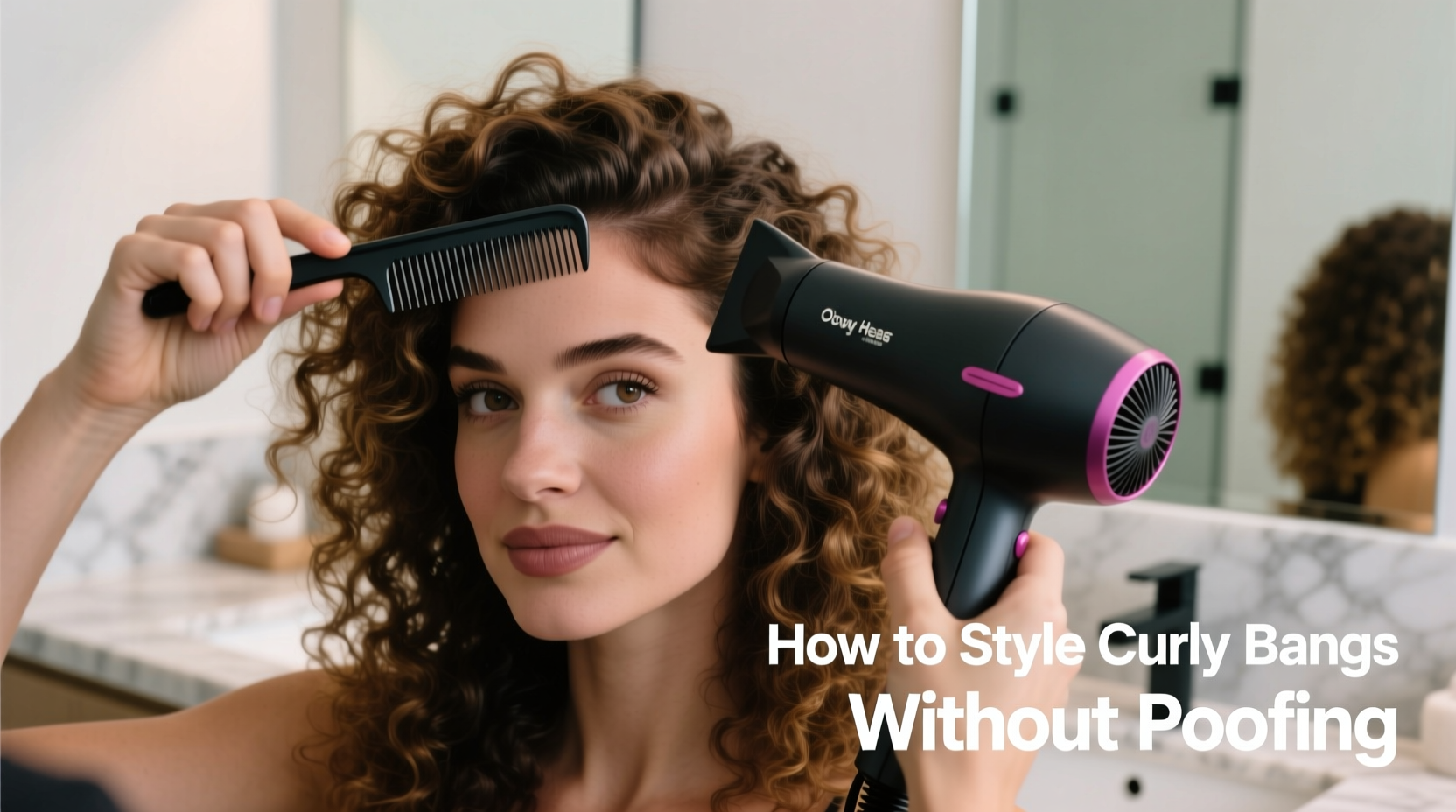
Poofiness in curly bangs is rarely due to one single factor. It’s typically the result of multiple small missteps compounding during styling. Understanding the root causes helps prevent them before they start.
- Over-lifting at the roots: Tilting your head forward or downward while diffusing lifts the roots excessively, creating volume where you don’t want it.
- Disrupting curl clumps: Rough handling or constant repositioning breaks up forming curl clusters, leading to frizz and separation.
- Using too much product: Heavy creams or gels applied unevenly can dry inconsistently, causing some sections to expand more than others.
- Drying too fast on high heat: High temperatures cause rapid evaporation, which disrupts the curl pattern and increases frizz.
- Diffusing from the wrong angle: Pointing the diffuser upward under the bangs encourages lift and expansion instead of elongation and control.
Curly hair thrives on gentle, consistent routines that support its natural structure. Bangs, being shorter and more exposed, are especially sensitive to airflow direction and tension. The goal isn’t to eliminate volume entirely—but to direct it intentionally, keeping shape close to the forehead while preserving bounce.
The Right Tools: Choosing Your Diffuser and Products
Not all diffusers are created equal. A wide, shallow bowl with long, flexible prongs works best for curly bangs because it allows targeted airflow without disturbing surrounding hair. Look for models labeled “wide-mouth” or “curly-hair optimized.” Avoid compact diffusers designed primarily for smoothing straight hair—they often concentrate heat too intensely.
Your product selection matters just as much. For bangs, lightweight is key. Heavy butters may weigh down longer curls, but on short front sections, they can create stiffness or uneven drying. Opt for a lightweight mousse or curl-enhancing milk combined with a light gel for hold.
“Bangs need a delicate balance—enough hold to define, but enough flexibility to move naturally. I recommend layering a mousse first, then sealing with a light gel.” — Dana Reyes, Curl Specialist & Educator at Curly Method Studio
| Product Type | Best For Bangs? | Why |
|---|---|---|
| Lightweight Mousse | Yes | Adds volume without heaviness; enhances curl formation evenly |
| Medium-Hold Gel | Yes (in small amounts) | Locks in shape without crunch when diffused properly |
| Heavy Cream or Butter | No | Tends to dry unevenly on short lengths, increasing puff |
| Leave-In Conditioner (lightweight) | Limited use | Moisturizes but can reduce definition if over-applied |
Step-by-Step: Diffusing Curly Bangs Without Poofiness
Follow this precise sequence to style your curly bangs with minimal disruption and maximum definition. The process takes less than 5 minutes but makes a dramatic difference in outcome.
- Prep on damp hair: After washing, gently squeeze out excess water from your bangs with a microfiber towel or cotton T-shirt. Do not rub.
- Apply product: Dispense a dime-sized amount of mousse into your palm. Add 3–4 drops of light gel. Rub hands together and apply using a “raking” motion from root to tip, ensuring even distribution.
- Smooth into position: Use fingertips to gently coax bangs into their desired part or side-sweep. Let them settle into their natural fall.
- Position your head: Keep your head upright or slightly tilted back. This aligns the hair shaft vertically, encouraging elongation rather than lift.
- Attach diffuser and set settings: Use low heat and medium airflow. High heat creates frizz; low airflow prevents disruption.
- Diffuse from above: Place the diffuser cup over your bangs from the top-down, cradling them gently. Do not lift or scrunch. Hold in place for 30 seconds.
- Use the “hover” method: After initial setting, remove the diffuser and hover it 2–3 inches above the bangs. Let warm air flow down onto the hair without touching it. This dries without disturbing forming curls.
- Check progress: After 2–3 minutes, test for dryness. If still damp, repeat hovering in 30-second intervals.
- Final cool shot: Once nearly dry, switch to cool air for 15 seconds to set the curl pattern and reduce puff.
- Do not touch: Resist the urge to run fingers through until completely dry. Touching resets the curl formation and invites frizz.
Real Example: From Puffy to Polished in One Wash Day
Samantha, a 28-year-old with 3A/3B curls, struggled for years with her curtain bangs turning into a voluminous cloud by midday. She loved the look but hated constantly pinning them back. After switching from a flat paddle brush and blow dryer to a diffuser-only routine, she noticed immediate improvement.
Her previous method involved applying heavy cream, combing through, and drying with a concentrator nozzle—straightening the roots and disrupting the curl pattern. Now, she applies mousse and light gel, rakes her bangs into place, and uses the hover technique described above. Her bangs now dry with soft S-waves that frame her face without expanding outward.
“I used to think my hair was just too fluffy for bangs,” she said. “But once I stopped fighting the curl and started supporting it, everything changed. They actually look better after eight hours than they did at the start.”
Common Mistakes and How to Avoid Them
Even with the right tools, small errors can sabotage your results. Here are frequent pitfalls and their fixes:
- Mistake: Scrunching aggressively with the diffuser.
Solution: Eliminate scrunching entirely for bangs. Use still placement or hovering instead. - Mistake: Using high heat to speed up drying.
Solution: Low heat preserves curl integrity. Accept that slower drying yields better definition. - Mistake: Applying product only to ends.
Solution: Bangs need root application to set shape early. Missed roots lead to undefined, puffy growth points. - Mistake: Touching hair while drying.
Solution: Set a timer and walk away. Interference introduces friction and separates curls. - Mistake: Diffusing from underneath.
Solution: Always approach from above or directly in front. Upward airflow = unwanted lift.
“The biggest myth about curly bangs is that they’re high-maintenance. In reality, they’re low-touch—if you let them be. Stop manipulating, start trusting the process.” — Jamal Peters, Celebrity Curl Stylist
Checklist: Perfect Curly Bangs Routine
Keep this checklist handy for your next wash day:
- ✅ Use a microfiber towel to blot bangs—no rubbing
- ✅ Apply lightweight mousse + light gel mix with fingers
- ✅ Rake into desired direction; avoid combing
- ✅ Position head upright or slightly reclined
- ✅ Attach wide-bowl diffuser; set to low heat, medium airflow
- ✅ Cradle bangs from above for initial 30 seconds
- ✅ Switch to hover method 2–3 inches away
- ✅ Use cool shot at the end
- ✅ Do not touch until fully dry
- ✅ Optional: Lock in with a rice-water spray for shine
Frequently Asked Questions
Can I diffuse curly bangs every day?
Yes, but only if you’re using low heat and proper technique. Daily high-heat exposure can lead to dryness and increased frizz over time. If possible, alternate with air-drying days using a light hooded dryer to maintain consistency.
What if my bangs are too short to cup in the diffuser?
Use the hover method exclusively. Position the diffuser just above the bangs and let warm air flow down. You can also use your free hand to gently shield the forehead area to prevent excessive lift from airflow.
How do I fix poofy bangs after they’ve dried?
Once dry, avoid rewetting unless necessary. Instead, apply a tiny drop of argan oil or curl serum to tame flyaways. Gently press—do not comb—to smooth without disrupting the curl pattern. Prevention is always better than correction.
Mastering the Details for Lasting Results
Styling curly bangs without poofiness isn’t about suppressing curls—it’s about guiding them. The diffuser, when used with intention, becomes an ally in shaping, not just drying. Success comes from patience, consistency, and understanding how small changes in angle, heat, and timing affect the final look.
Over time, you’ll develop a feel for your hair’s rhythm. Some days may require less product, others a bit more diffusion. The key is to observe, adjust, and trust the process. Healthy curly bangs aren’t perfectly uniform; they’re harmonious with your face, expressive, and effortlessly elegant.




 浙公网安备
33010002000092号
浙公网安备
33010002000092号 浙B2-20120091-4
Comments
No comments yet. Why don't you start the discussion?