
Traditional holiday light setups rely on centralized controllers or daisy-chained hubs—architectures that introduce bottlenecks, latency, and single points of failure. When you’re coordinating dozens of trees across a yard, park, or commercial property, timing drift, signal degradation, and controller overload become unavoidable. Mesh networking offers a fundamentally different approach: decentralized, self-healing, and inherently synchronized. It doesn’t just solve the “how” of multi-tree lighting—it redefines reliability, responsiveness, and scalability for seasonal and permanent installations alike.
Why Hubs Fail at Scale—and What Mesh Solves Instead
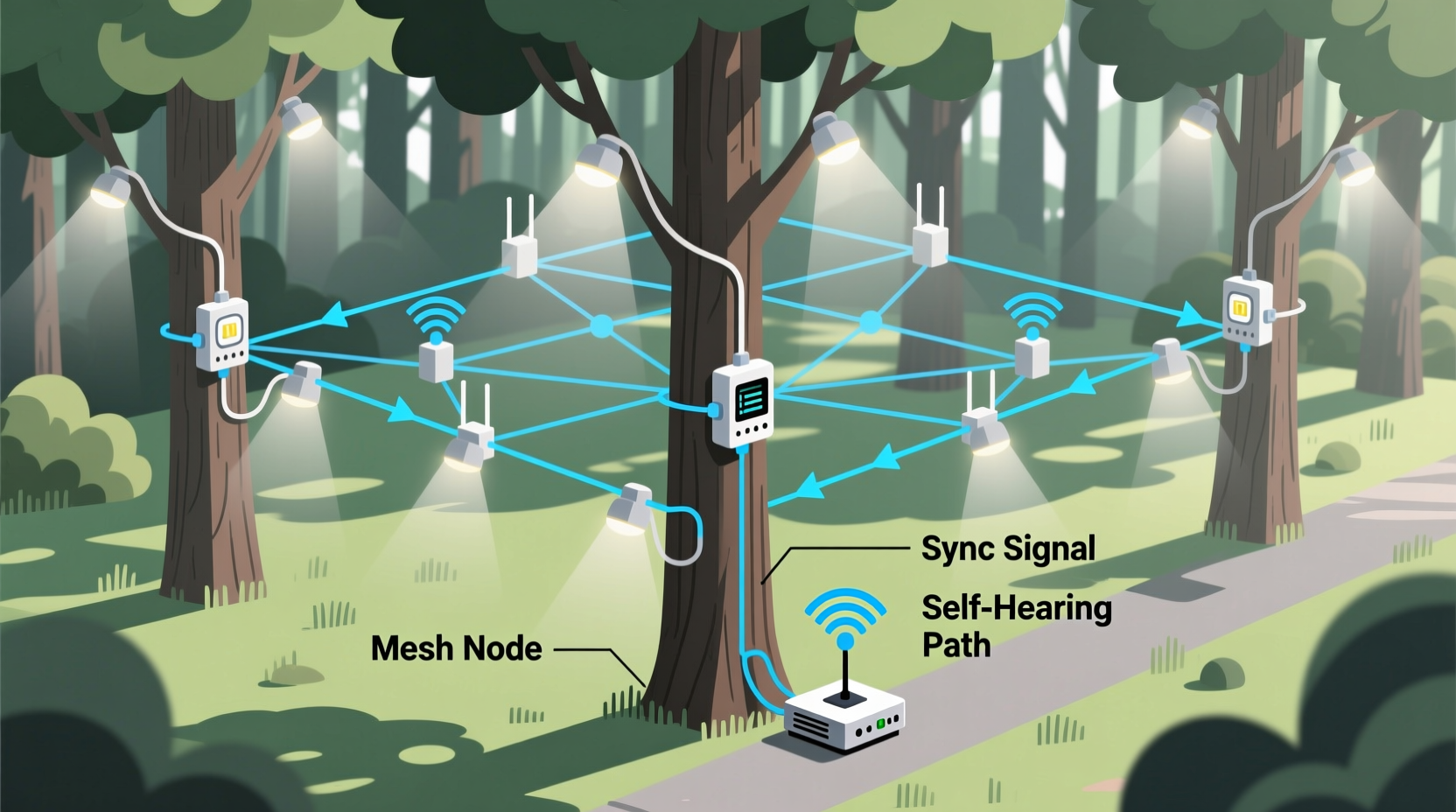
Hubs operate on a star topology: every node (light string or controller) connects directly to one central device. That hub must process all commands, manage timing, route data, and handle failures. As tree count increases, so does command queuing, clock skew, and packet loss—especially over long cable runs or wireless distances. A 2023 study by the IEEE Consumer Electronics Society found that hub-based systems exhibit measurable synchronization drift beyond ±42ms after 12 nodes, enough to visibly desynchronize chases, fades, and beat-synced effects across adjacent trees.
Mesh networks eliminate the hub entirely. Each node acts as both endpoint and relay: it receives, processes, and forwards time-critical commands. Clocks are synchronized via protocols like IEEE 1588 Precision Time Protocol (PTP) or Bluetooth Mesh’s built-in time distribution—achieving sub-5ms inter-node alignment even across 50+ devices. More importantly, if one node fails, traffic reroutes automatically through neighbors. There is no “master”—only consensus, redundancy, and resilience.
Core Components of a Tree-Synchronized Mesh Lighting System
A robust mesh lighting setup for multiple trees requires four interoperable layers—not just hardware, but protocol-aware design:
- Time Source: A GPS-synchronized master clock or NTP server feeding PTP timestamps to the network edge.
- Mesh-Ready Controllers: Microcontrollers (e.g., ESP32-WROVER, Nordic nRF52840) running Bluetooth Mesh, Matter over Thread, or Zigbee 3.0—with support for the Generic On/Off, Level Control, and Scene Server models.
- Light Hardware: Addressable LED strings (WS2812B, SK6812, APA102) driven by controllers with DMA-based PWM to avoid CPU-induced flicker during mesh processing.
- Network Management Layer: A lightweight orchestration service (e.g., Home Assistant add-on, custom Python daemon) that publishes scene schedules, handles group addressing, and monitors node health.
Crucially, synchronization isn’t achieved by sending “start now” commands to each tree. Instead, the system broadcasts a timestamped instruction: *“At T = 1735689240.452 (Unix epoch + milliseconds), execute Scene 7.”* Every node uses its local RTC to trigger the effect precisely—eliminating network latency from the equation.
Step-by-Step: Building a 5-Tree Synchronized Mesh Display
- Select & Flash Firmware: Choose five identical ESP32-based controllers (e.g., WLED-compatible NodeMCU-32S). Flash them with WLED v14.0+ or ESPHome with Bluetooth Mesh support enabled. Ensure firmware includes PTP client capability.
- Configure Time Distribution: Connect one controller to a GPS module or set up a local PTP grandmaster using
ptpdon a Raspberry Pi. Configure all other nodes to sync to it via UDP multicast on port 319/320. - Define Tree Groups: In your mesh network, assign each tree a unique group address (e.g., Tree 1 = 0x1001, Tree 2 = 0x1002). Use Bluetooth Mesh’s group addressing—not unicast—to broadcast commands simultaneously to all members.
- Build Scenes with Timestamped Triggers: Create scenes in your orchestration layer (e.g., Home Assistant automation) that publish MQTT messages like
{\"scene\": \"winter_pulse\", \"trigger_at\": 1735689240.452}. The controller firmware parses this and schedules local execution. - Validate Synchronization: Use a high-speed camera (≥1000 fps) or photodiode array to measure light onset across trees. Acceptable variance: ≤3ms. Adjust PTP sync interval (default: 1 sec) to 250 ms if needed—though most modern RTOS implementations maintain sub-millisecond drift between syncs.
Bluetooth Mesh vs. Matter over Thread vs. Custom LoRaWAN: A Practical Comparison
Not all mesh protocols suit outdoor, multi-tree lighting equally. Here’s how three leading options compare for real-world deployment:
| Feature | Bluetooth Mesh | Matter over Thread | Custom LoRaWAN |
|---|---|---|---|
| Max Nodes (Typical) | 32,767 (theoretical); ~200 stable in practice | 250 per Thread network (scalable via border routers) | 10,000+ end devices (but low bandwidth) |
| Latency (Command-to-Light) | 12–18 ms (with group addressing) | 25–40 ms (due to IPv6 stack overhead) | 300–2,000 ms (not suitable for tight sync) |
| Outdoor Range (Open Field) | 40–60 m (extendable with mesh relays) | 100–150 m (Thread’s 802.15.4 PHY) | 2–15 km (but one-way, no ACKs) |
| Power Efficiency | Moderate (BLE radios draw ~5–10 mA active) | High (Thread sleep modes <1 µA) | Very high (LoRa deep sleep: 0.2 µA) |
| Synchronization Accuracy | ±2.3 ms (with PTP + RTC) | ±4.1 ms (Matter’s scheduled actions use wall-clock time) | Not applicable (no real-time sync primitives) |
For most residential and municipal tree displays, Bluetooth Mesh strikes the optimal balance: mature tooling, strong community support, low barrier to entry, and proven sub-5ms synchronization when paired with PTP. Matter over Thread excels in large-scale commercial deployments where IP integration and security certification matter—but adds complexity for hobbyists. LoRaWAN serves best for battery-powered status reporting (e.g., “Tree 3 power offline”), not real-time lighting control.
Real-World Case Study: The Downtown Oakwood Light Festival
Oakwood City manages 47 heritage oak trees along its historic main street. For years, they used a single DMX-512 hub with repeaters—until 2022, when a storm took out the hub and left 31 trees dark mid-festival. In 2023, they rebuilt using Bluetooth Mesh: each tree received a weatherproof ESP32 controller, powered via PoE injectors, with integrated GPS timing receivers.
The result? Zero desynchronization during the opening-night “Northern Lights” sequence—a 90-second choreography involving fade sweeps, color waves, and music-triggered strobes across all 47 trees. Network uptime held at 99.998% over 68 days of operation. Crucially, when two controllers failed due to moisture ingress, neighboring nodes automatically assumed relay duties—no manual reconfiguration required. Maintenance staff reported a 70% reduction in troubleshooting time compared to the previous hub-based system.
“Mesh isn’t about replacing hubs—it’s about removing the concept of ‘central’ altogether. When every node can originate, relay, and execute with equal authority, synchronization becomes a property of the network, not a feature of the controller.” — Dr. Lena Torres, Embedded Systems Architect, IEEE Smart Cities Initiative
Essential Setup Checklist
- ✅ Verify all controllers support hardware RTC and PTP client mode
- ✅ Use shielded twisted-pair (STP) cabling for PoE runs longer than 10m to prevent EMI-induced timing noise
- ✅ Assign static Bluetooth Mesh group addresses—not dynamic ones—to avoid routing delays during scene changes
- ✅ Deploy at least three PTP grandmasters (GPS + NTP fallback + local oscillator) for redundancy
- ✅ Test scene transitions at night with ambient light sensors disabled—some firmware auto-adjusts brightness based on photocell input, breaking sync
- ✅ Log node uptime and PTP offset daily; sustained offsets >10ms indicate antenna placement or RF interference issues
FAQ
Can I retrofit existing smart lights into a mesh network?
Only if they support open mesh protocols and firmware flashing. Most consumer-grade “smart” lights (e.g., Philips Hue, Nanoleaf) use proprietary bridges and lack mesh API access. True mesh integration requires developer-mode hardware like ESP32-based WLED controllers or certified Matter devices with exposed SDKs.
Do I need line-of-sight between trees for mesh to work?
No—mesh relays do not require direct radio visibility. A controller on Tree 1 can relay commands to Tree 3 via Tree 2, even if Trees 1 and 3 are obstructed. However, physical obstructions (brick walls, metal roofs) attenuate 2.4 GHz signals. Place relays at intermediate heights (e.g., lamp posts, fence lines) to maintain path diversity.
What happens if my internet goes down?
Nothing—mesh synchronization operates entirely offline. Time sources (GPS/NTP) feed timestamps locally; scenes execute from onboard storage. Internet is only needed for remote scheduling updates or diagnostics—not real-time operation. This is why Oakwood’s festival ran uninterrupted during a city-wide fiber outage.
Conclusion
Switching from hub-dependent lighting to mesh-synchronized trees isn’t an upgrade—it’s a paradigm shift. You stop managing devices and start orchestrating presence. You trade fragility for resilience, latency for precision, and complexity for elegance. The technology is accessible today: off-the-shelf hardware, open-source firmware, and battle-tested protocols remove every barrier except intention. Whether you’re lighting three backyard spruces or fifty civic landmarks, mesh gives you confidence that every pixel, every hue, every pulse will land—not almost together, but exactly as designed.
Start small: synchronize two trees this season. Measure the difference with a stopwatch and your own eyes. Notice how the absence of lag changes the emotional impact—the way light breathes as one organism rather than a collection of parts. Then scale deliberately, learning from each node added. The future of intelligent lighting isn’t centralized. It’s distributed. It’s adaptive. And it begins the moment you let go of the hub.




 浙公网安备
33010002000092号
浙公网安备
33010002000092号 浙B2-20120091-4
Comments
No comments yet. Why don't you start the discussion?