
Reading faster while maintaining or even improving understanding isn’t a myth—it’s a skill that can be developed with deliberate practice. In an age of information overload, the ability to process written content efficiently is a powerful advantage. Whether you're studying, researching, or simply trying to keep up with industry news, learning to speed read effectively can save hours each week. The key lies not in skimming mindlessly, but in training your brain to absorb meaning more rapidly and accurately.
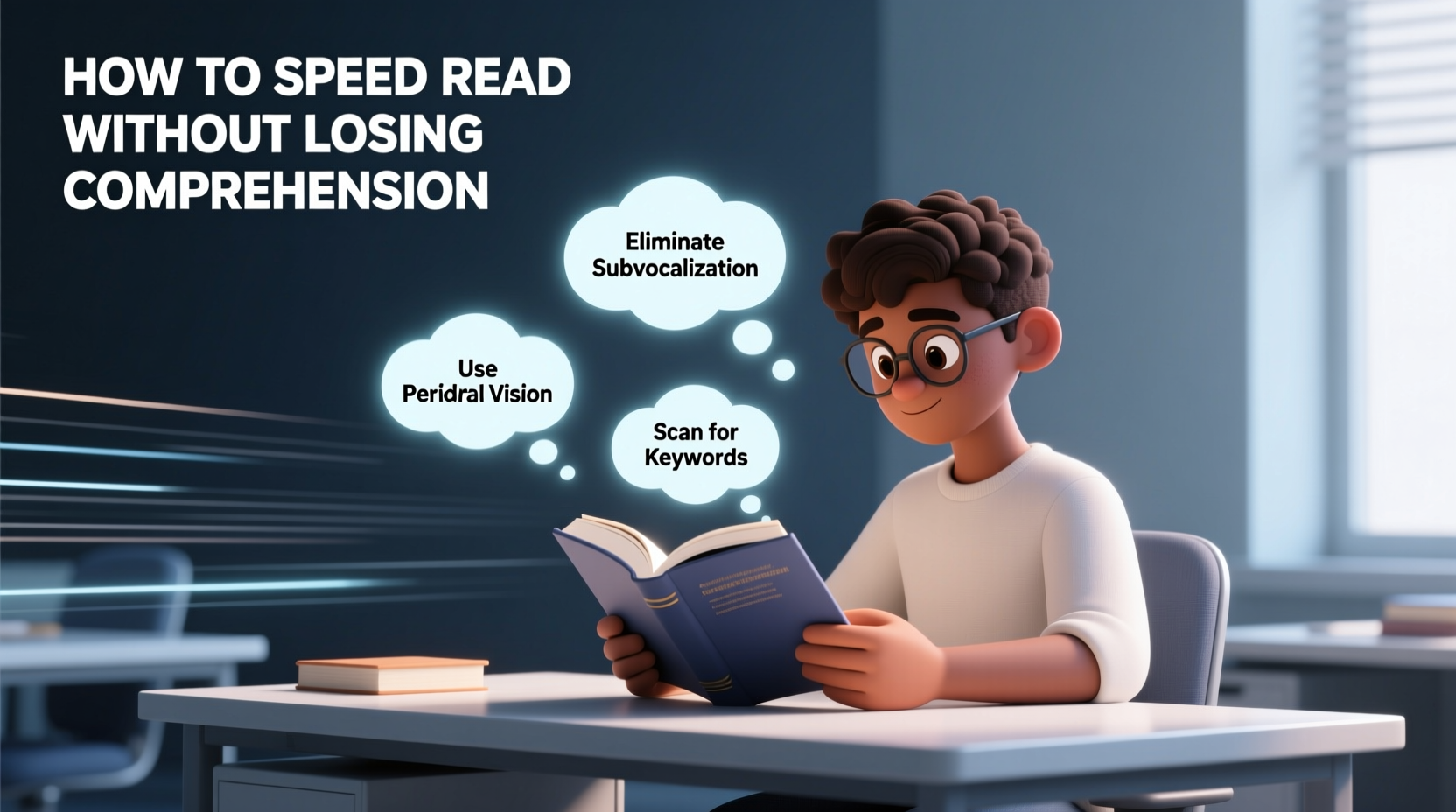
True speed reading isn’t about racing through text at breakneck speed. It’s about eliminating inefficiencies in your reading habits—habits like subvocalization (mentally “saying” words), regression (rereading lines), and fixation on individual words. When these are reduced, your eyes and mind can move through material more fluidly, allowing for both increased speed and sustained comprehension.
Understanding the Mechanics of Reading
Most adults read between 200 and 300 words per minute (wpm) with average comprehension. Skilled readers can reach 400–500 wpm. Speed readers often exceed 700 wpm, with top performers reading over 1,000 wpm while retaining key information. But raw speed means nothing if you don’t understand what you’ve read.
The human eye doesn’t move smoothly across text. Instead, it makes rapid movements called saccades, pausing briefly at certain points (fixations). During these fixations, your brain processes clusters of words. Traditional reading involves many small saccades and frequent regressions, which slow you down. Speed reading trains your eyes to take in larger chunks of text per fixation and reduces unnecessary backtracking.
Comprehension depends on two factors: decoding (recognizing words) and processing (understanding meaning). Speed reading enhances both by retraining visual tracking and cognitive focus. The goal is to shift from word-by-word decoding to phrase-based or thematic absorption.
Step-by-Step Guide to Self-Teaching Speed Reading
Speed reading is a learnable skill, not an innate talent. With consistent effort, anyone can improve their reading velocity and retention. Follow this structured approach to build proficiency over time.
- Assess Your Baseline Speed and Comprehension
Start by measuring your current reading rate. Choose a 500-word article you haven’t read before. Time yourself reading it, then answer a few comprehension questions. Use the formula: (words read / minutes) = wpm. Aim for at least 70% accuracy on recall to ensure valid comprehension. - Eliminate Subvocalization
This is the habit of silently pronouncing each word in your head. While helpful for beginners, it limits reading speed because speech is slower than thought. To reduce subvocalization:- Try humming softly or holding a finger lightly on your lips while reading to disrupt inner speech.
- Practice focusing on phrases instead of single words.
- Use a metronome or audio guide to increase pacing beyond speaking speed.
- Use a Pointer to Guide Your Eyes
A physical guide—like your finger, a pen, or a cursor on screen—helps maintain steady rhythm and reduces regression. Move the pointer slightly faster than your natural pace to push your eyes forward. Over time, your brain adapts to the accelerated flow. - Expand Your Peripheral Vision
Train your eyes to capture multiple words at once. Practice with short lines of text, attempting to read entire phrases in one glance. Gradually increase line length. One effective drill is to place a dot in the center of a sentence and try to see the first and last words simultaneously. - Increase Chunk Size
Instead of reading “The / cat / sat / on / the / mat,” train yourself to see “The cat sat / on the mat.” This reduces the number of fixations per line. Begin with two-word chunks, then progress to three or four. - Practice Active Previewing
Before deep reading, skim headings, subheadings, first sentences, and summaries. This primes your brain for context, making deeper reading faster and more focused. You’ll already know where the text is going, so your mind can process details more efficiently. - Set Incremental Goals
Increase your target speed by 25–50 wpm every week. At each level, ensure comprehension remains above 70%. Use timed drills daily—just 10–15 minutes—to reinforce new habits.
Strategies to Maintain High Comprehension
Speed without understanding is wasted effort. The best speed readers use cognitive techniques to retain meaning, not just consume words.
- Engage with the Material: Ask questions as you read. What is the main argument? How does this connect to what I already know? Active engagement strengthens memory and focus.
- Summarize After Each Section: Pause briefly after paragraphs or sections and mentally summarize the key point. This reinforces retention and checks comprehension.
- Use the “Pace-Slow-Pace” Method: Read introductory and concluding paragraphs at higher speeds to grasp structure, then slow down slightly for complex middle sections. This balances efficiency with depth.
- Leverage Prior Knowledge: The more familiar you are with a topic, the faster you can read it. Build background knowledge before tackling dense material.
“Speed reading isn’t about reading every word—it’s about extracting meaning efficiently. The brain can process ideas much faster than the mouth can speak.” — Dr. Mark Seidenberg, Cognitive Scientist and Author of *Language at the Speed of Sight*
Do’s and Don’ts of Speed Reading Practice
| Do | Don’t |
|---|---|
| Practice daily for 10–20 minutes | Try to master it in one session |
| Use diverse materials (articles, books, reports) | Stick only to easy or familiar texts |
| Test comprehension regularly | Ignore retention in favor of speed |
| Start with shorter texts and build up | Begin with dense academic papers |
| Adjust speed based on text difficulty | Force the same pace across all content |
A Realistic Case Study: From Struggling Student to Efficient Reader
Jamal, a graduate student in public policy, was overwhelmed by weekly reading lists exceeding 200 pages. He spent hours reading but retained little, often rereading passages multiple times. Frustrated, he decided to experiment with speed reading techniques over a six-week period.
He began by measuring his baseline: 240 wpm with 65% comprehension. Using a pointer and a digital metronome app, he practiced chunking and reducing subvocalization for 15 minutes daily. He started with news articles, gradually moving to academic abstracts.
By week three, he reached 400 wpm with 72% comprehension. He used previewing to identify key sections and saved deep reading only for critical arguments. By week six, he was consistently reading at 550 wpm with 75% retention, verified through self-quizzing and discussion participation.
The real benefit wasn’t just speed—it was confidence. Jamal reported feeling less anxious about readings and more engaged in class. He reclaimed nearly 10 hours per week, which he redirected toward writing and research.
Essential Tips for Long-Term Success
Checklist: Building Your Speed Reading Routine
- ☐ Measure current reading speed and comprehension
- ☐ Choose a consistent practice time (e.g., morning or post-work)
- ☐ Select a variety of texts (news, essays, nonfiction)
- ☐ Use a pointer (finger, pen, or mouse) during practice
- ☐ Practice chunking: aim to read 3–5 words at a time
- ☐ Reduce subvocalization with humming or mental distraction
- ☐ Preview text structure before deep reading
- ☐ Summarize key points after each section
- ☐ Test comprehension weekly with recall questions
- ☐ Increase target speed by 25–50 wpm monthly
Frequently Asked Questions
Can you really read 1,000 words per minute and still understand?
At extremely high speeds (1,000+ wpm), comprehension shifts from verbatim recall to gist extraction. Top speed readers retain core ideas, themes, and structures rather than every detail. For most practical purposes—such as reviewing articles or preparing for discussions—this level of understanding is sufficient. However, for mastering complex technical material, slower, focused reading is still necessary.
Does speed reading work for fiction or only nonfiction?
Speed reading is most effective with expository or informational texts where the goal is knowledge acquisition. Fiction, especially literary works rich in language and nuance, benefits from slower, immersive reading. That said, you can apply light speed techniques to familiar genres (e.g., mystery or romance) to breeze through plot-driven sections while reserving deeper attention for pivotal scenes.
How long does it take to become a proficient speed reader?
With consistent daily practice, most people see noticeable improvement within 3–4 weeks. Reaching 500–600 wpm with solid comprehension typically takes 6–8 weeks. Mastery—reading flexibly across genres at high speeds with strong retention—can take several months of dedicated effort. Progress varies based on starting level, practice consistency, and material complexity.
Maintaining Balance: When to Speed Read and When to Slow Down
Speed reading is a tool, not a default mode. The most effective readers are flexible. They accelerate through familiar concepts, summaries, or redundant explanations, but slow down for novel ideas, data-heavy sections, or emotionally resonant passages.
Think of it like driving: on a clear highway, you cruise at high speed. In heavy traffic or bad weather, you reduce pace for safety. Similarly, adjust your reading speed based on content density, purpose, and personal familiarity. The goal is intelligent efficiency—not uniform haste.
For example, when reading a scientific paper, you might speed-read the introduction and conclusion to grasp the hypothesis and findings, then slow down significantly for the methodology and results sections. This selective pacing maximizes both time savings and depth of understanding.
Conclusion: Take Control of Your Reading Efficiency
Learning to speed read without losing comprehension is one of the most impactful skills you can develop for personal and professional growth. It requires patience, discipline, and smart practice—but the payoff is substantial. Hours once lost to slow, inefficient reading can be reclaimed for thinking, creating, and doing.
Start today. Pick a short article, set a timer, and apply one technique—use a pointer, suppress subvocalization, or practice chunking. Measure your speed and test your recall. Repeat tomorrow. Small, consistent actions compound into remarkable results.




 浙公网安备
33010002000092号
浙公网安备
33010002000092号 浙B2-20120091-4
Comments
No comments yet. Why don't you start the discussion?