
Introducing a new skincare product can feel like a fresh start — until your face erupts in blemishes. Suddenly, you're left wondering: Is this a sign the product is working, or is it damaging your skin? The confusion between purging and breaking out is one of the most common dilemmas in modern skincare. While both result in acne-like flare-ups, their causes, implications, and solutions are fundamentally different. Understanding which process your skin is undergoing can mean the difference between sticking with an effective treatment or abandoning something that could have transformed your complexion.
Understanding Purging vs. Breakouts
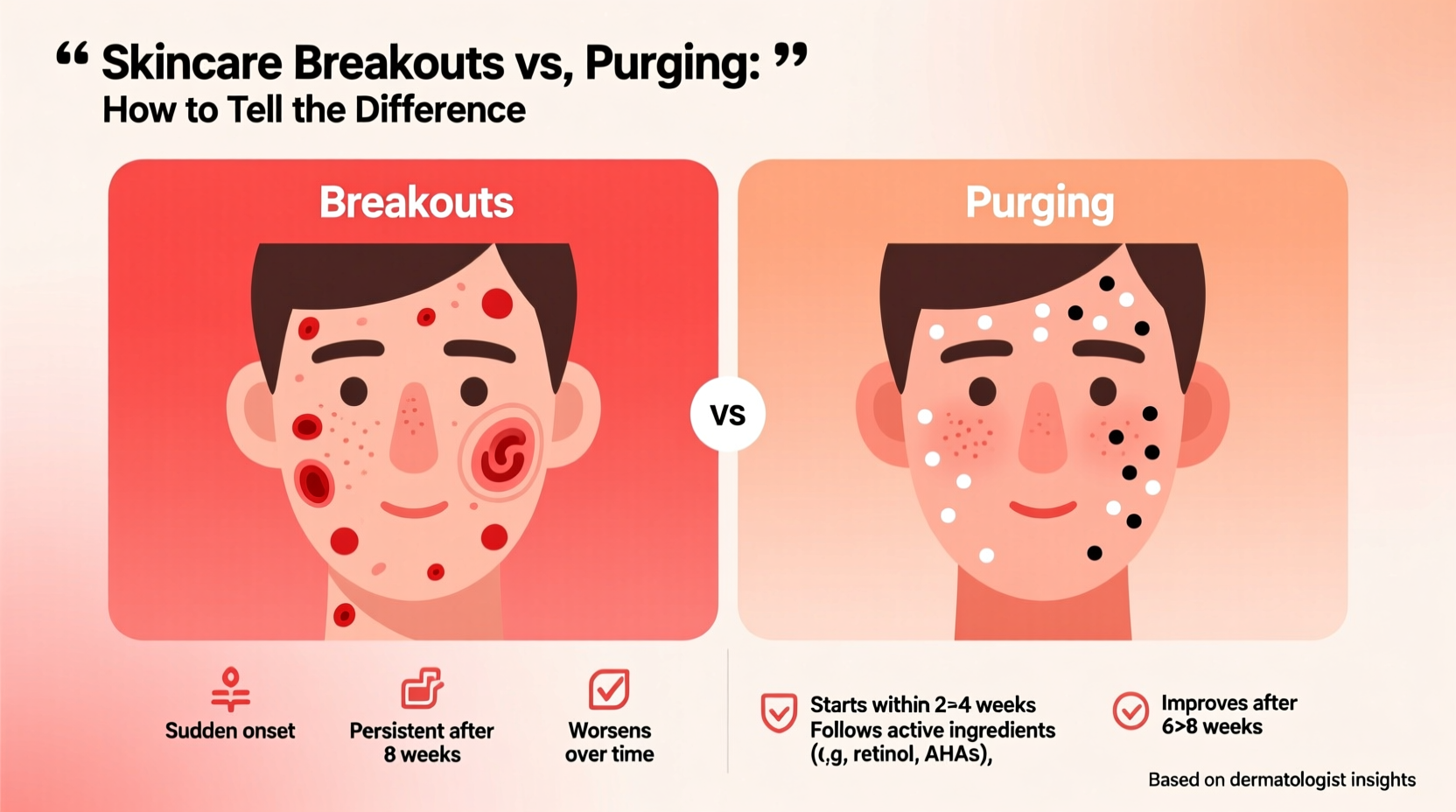
Purging and breakouts may look similar at first glance — red bumps, whiteheads, even cystic lesions — but they stem from entirely different mechanisms.
Purging occurs when an active ingredient accelerates skin cell turnover, pushing trapped debris, oil, and dead cells to the surface faster than usual. This temporary reaction typically happens only in areas where you already experience breakouts and resolves within a few weeks.
Breakouts, on the other hand, are caused by irritation, clogged pores, or allergic reactions to ingredients that don’t belong in your regimen. These often appear in new areas of the face, persist beyond four to six weeks, and may worsen over time.
“Purging is a short-term detox; breakouts are a long-term mismatch.” — Dr. Lena Patel, Board-Certified Dermatologist
Key Differences Between Purging and Breaking Out
To determine what’s happening under the surface, consider these core distinctions:
| Factor | Purging | Breaking Out |
|---|---|---|
| Trigger | Cell-turnover actives (e.g., retinoids, AHAs/BHAs, vitamin C) | Comedogenic or irritating ingredients (e.g., silicones, fragrances, heavy oils) |
| Location | Areas where you normally get acne | New areas (e.g., jawline, cheeks, forehead) |
| Duration | 2–6 weeks | Continues or worsens past 6 weeks |
| Skin Feel | Mild redness, slight sensitivity | Itching, burning, inflammation |
| Lesion Type | Small whiteheads, blackheads, minor papules | Cysts, pustules, deep nodules |
One crucial insight: not every active ingredient causes purging. Only those that increase cellular exfoliation do. Hydrating serums, moisturizers, and sunscreen won’t purge — but they can definitely cause breakouts if poorly formulated for your skin type.
Timeline: What to Expect When Starting New Products
The body doesn’t respond to skincare changes overnight. A clear timeline helps distinguish between normal adjustment and problematic reactions.
- Days 1–7: Skin begins adapting. Mild dryness or tightness may occur. No significant breakouts expected unless sensitive to fragrance or alcohol.
- Weeks 2–4: Peak purging window for actives like retinol or glycolic acid. Blemishes emerge in familiar zones. Texture may improve even as surface clarity dips.
- Weeks 5–6: Purging should subside. If lesions continue forming or spread, reassess ingredient compatibility.
- After Week 6: Clear improvement indicates success. Persistent or worsening acne signals intolerance or incorrect product use.
This progression assumes consistent, correct usage. Over-application or combining multiple strong actives can mimic purging but is actually irritation-driven damage.
Real Example: A Case Study in Misdiagnosis
Sophia, 28, started using a popular retinol serum after reading glowing reviews. By day 10, her T-zone erupted in tiny bumps. She assumed it was purging and waited. By week five, the congestion had spread to her cheeks — a zone she’d never struggled with before. The lesions were inflamed and tender.
She consulted a dermatologist who reviewed her full routine. The culprit wasn’t the retinol — it was a silicone-based primer she’d added simultaneously. “She was purging slightly from the retinol,” the doctor noted, “but the widespread cystic acne came from occluded pores due to dimethicone buildup.”
After discontinuing the primer and scaling back retinol frequency, Sophia’s skin cleared within three weeks. Her experience underscores a critical point: isolate variables when assessing reactions.
How to Respond: A Step-by-Step Guide
If you're experiencing unexpected acne after starting a new product, follow this methodical approach:
- Pause all new products except cleanser and moisturizer. Simplify to basics for 3–5 days to assess baseline irritation.
- Review ingredient lists. Identify potential comedogenic ingredients (e.g., coconut oil, lanolin, certain silicones) or known irritants (e.g., alcohol denat, synthetic fragrance).
- Reintroduce one product at a time. Wait 7–10 days between additions to monitor responses.
- Track location and lesion type. Use notes or photos to document where and how breakouts appear.
- Evaluate duration. If acne persists past six weeks without improvement, discontinue the suspect product.
- Adjust application method. For actives, try buffering (applying over moisturizer) or reducing frequency to every third night.
This process minimizes confusion and prevents compounding issues from layering too many changes at once.
Checklist: Is It Purging or a Breakout?
- ✅ Are the breakouts appearing in your typical acne zones?
- ✅ Did you recently introduce a cell-turnover booster (retinoid, AHA, BHA)?
- ✅ Are the blemishes small and resolve within a few days each?
- ✅ Have you seen gradual texture improvement despite surface imperfections?
- ✅ Is the flare-up lasting less than six weeks?
- ❌ Are new areas of your face breaking out?
- ❌ Do you feel stinging, itching, or excessive redness?
- ❌ Are the lesions deep, painful, or filled with pus?
- ❌ Has your skin not improved after two months?
- ❌ Did you add multiple new products at once?
If you answered “yes” to most of the first five and “no” to the latter five, you’re likely purging. If the reverse is true, you’re probably experiencing a negative reaction.
Common Mistakes That Worsen Both Conditions
Even with accurate diagnosis, missteps in management can prolong recovery.
- Over-exfoliating: Using acids or scrubs alongside retinoids amplifies irritation and compromises the moisture barrier.
- Picking or squeezing: Increases inflammation and risk of post-inflammatory hyperpigmentation (PIH), especially in deeper skin tones.
- Skipping moisturizer: Believing oily skin doesn’t need hydration leads to rebound sebum production.
- Layering too many actives: Combining vitamin C, niacinamide, and retinol without spacing can overwhelm the skin.
- Ignoring sunscreen: Actives increase photosensitivity. UV exposure worsens pigmentation and delays healing.
Frequently Asked Questions
Can moisturizers or sunscreens cause purging?
No. Moisturizers and sunscreens do not increase cell turnover, so they cannot trigger purging. However, they can clog pores and lead to breakouts, especially if they contain comedogenic ingredients like coconut oil or heavy silicones. Look for labels marked “non-comedogenic” or “oil-free” if you’re acne-prone.
Should I stop using a product if my skin is purging?
Not necessarily. Mild purging usually resolves within four to six weeks. Instead of stopping completely, consider reducing frequency (e.g., using retinol every other night) or buffering with a moisturizer. Discontinue immediately if you experience severe redness, peeling, or pain.
Is there a way to prevent purging altogether?
You can't eliminate purging entirely if you're using effective exfoliants, but you can minimize it. Start with lower concentrations, build tolerance slowly, and maintain a strong skin barrier with ceramides, hyaluronic acid, and gentle cleansing. Well-hydrated, resilient skin handles actives better.
Expert Insight: Building a Sustainable Routine
“The biggest mistake people make is treating skin like a battlefield instead of an ecosystem. You don’t win by attacking every issue at once — you win by listening, adjusting, and supporting its natural rhythm.” — Dr. Marcus Lin, Clinical Dermatologist and Skincare Educator
Skincare isn’t about rapid fixes. It’s about consistency, observation, and patience. Your skin communicates through texture, tone, and reactivity. Learn its language. When introducing new products, think of yourself as a researcher: hypothesize, test, observe, conclude.
Conclusion: Take Control of Your Skin Journey
Distinguishing between purging and breaking out empowers you to make informed decisions rather than reacting emotionally to breakouts. Remember: purging is temporary and localized; breakouts are persistent and often widespread. With careful tracking, strategic simplification, and respect for your skin’s limits, you can navigate even the most frustrating transitions.
Your skin deserves more than guesswork. Start today by auditing your current routine, identifying actives, and noting where and how blemishes appear. Adjust one variable at a time. Protect your barrier. And above all, trust the process — because clear, healthy skin isn’t built overnight, but through deliberate, intelligent care.




 浙公网安备
33010002000092号
浙公网安备
33010002000092号 浙B2-20120091-4
Comments
No comments yet. Why don't you start the discussion?