
In a world overflowing with choices, distractions, and competing demands, the ability to distinguish what truly matters from what merely seems urgent is not just useful—it’s essential. Many people spend years reacting to noise, chasing goals that don’t align with their values, or making decisions based on fear rather than insight. The result? Burnout, regret, and a quiet sense of misalignment. But clarity is possible. By developing a disciplined approach to evaluating priorities, you can make decisions that reflect your deepest intentions and lead to lasting fulfillment.
Clarify Your Core Values
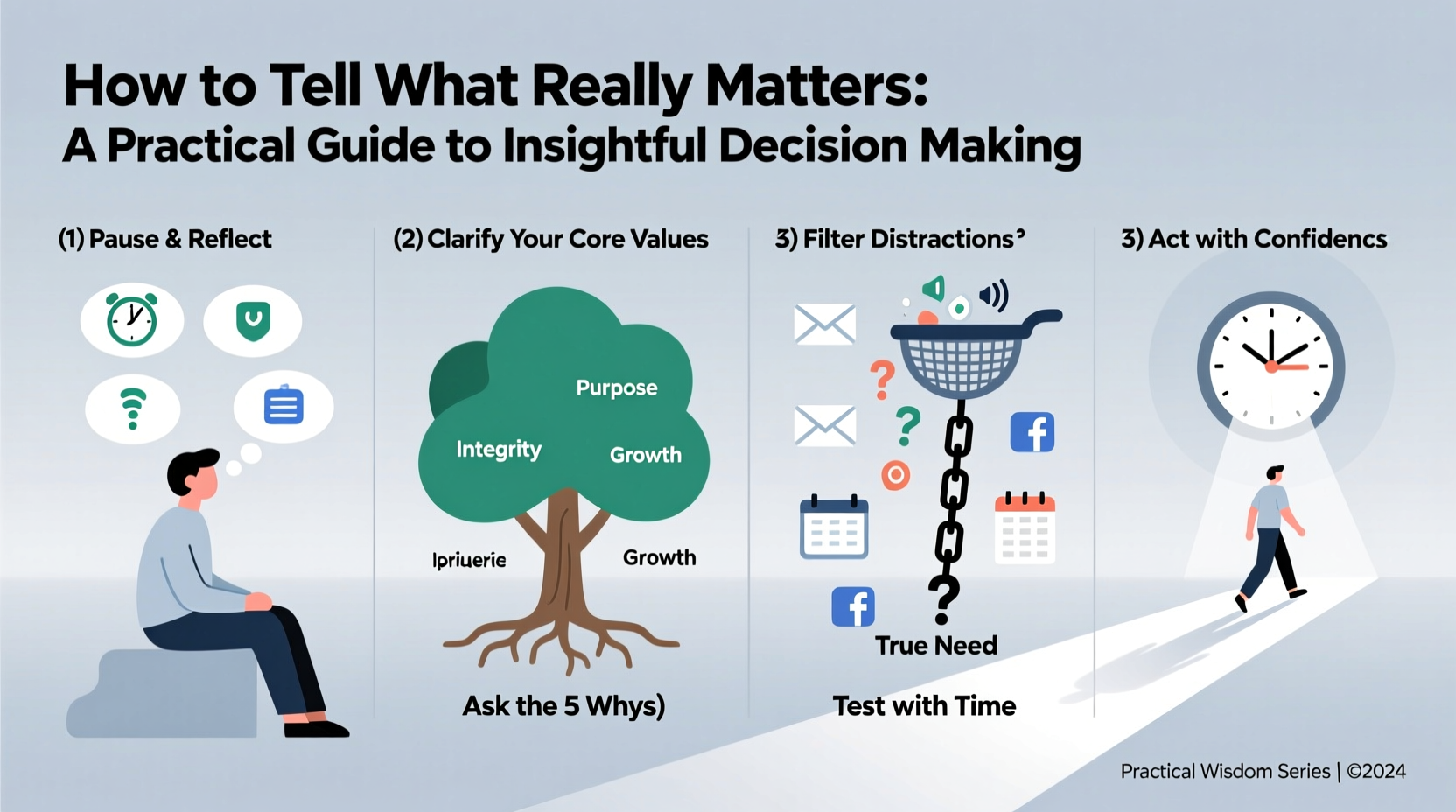
Before you can determine what matters, you must know who you are at your core. Values are the compass for meaningful decision-making. They act as internal filters—when faced with a choice, asking “Does this align with my values?” cuts through confusion.
Start by reflecting on moments when you felt deeply satisfied or proud. What underlying principles were present? Was it integrity, creativity, connection, growth, service? List your top five values and define them in your own words. For example, “family” might mean “consistent presence and emotional availability,” while “growth” could mean “daily progress toward mastery.”
When values are clearly defined, decisions become less about trade-offs and more about alignment. Choosing a job, ending a relationship, or investing time becomes easier when filtered through a lens of authenticity.
The 70% Rule: Deciding Without Perfection
Many people delay decisions waiting for certainty. But insight doesn’t require perfect information—it requires sufficient direction. Enter the 70% Rule: if you have about 70% of the information needed and a clear sense of how the choice aligns with your values, move forward.
This principle, popularized in entrepreneurial circles, applies equally to personal life. Waiting for 100% clarity often means missing opportunities or staying stuck. Insightful decision-making isn’t about eliminating risk; it’s about managing it wisely.
“Insight isn’t the absence of doubt. It’s action taken despite uncertainty, grounded in purpose.” — Dr. Lena Reyes, Cognitive Behavioral Psychologist
How to Apply the 70% Rule
- Identify the decision you’re facing.
- List what you know, what you’ve assumed, and what remains unknown.
- Evaluate how each option aligns with your core values.
- If alignment is strong and risks are understood, proceed—even if some details remain unclear.
Use the Regret Minimization Framework
Popularized by Amazon founder Jeff Bezos, the Regret Minimization Framework asks one powerful question: “At age 80, will I regret not doing this?” This long-term perspective shifts focus from short-term comfort to long-term significance.
Consider a real example: Sarah, a mid-level manager, was offered a role leading a nonprofit abroad. The pay was lower, the location unfamiliar, and her family hesitant. Instead of crunching numbers alone, she visualized her older self. Would 80-year-old Sarah regret passing up the chance to serve meaningfully? The answer was yes. She took the role—and found it reshaped her sense of purpose.
This framework works because it bypasses immediate fears (failure, discomfort, judgment) and connects decisions to legacy. It doesn’t guarantee success, but it increases the likelihood of choosing what truly matters.
Mini Case Study: Career Crossroads
James worked in finance for 12 years. Stable income, respected title, predictable path. But he felt increasingly disconnected. When invited to co-found an education startup, he hesitated. Using the Regret Minimization Framework, he asked himself: “Will I look back and wish I’d tried?” He did. He left his job. The startup eventually failed—but James said later, “I don’t regret it. I learned more in those 18 months than in a decade of safety.”
Filter Inputs with the Circle of Influence
Not all inputs deserve equal weight. To avoid decision fatigue and external noise, apply Stephen Covey’s concept of the Circle of Influence. Focus only on factors within your control or influence—your effort, preparation, communication, mindset. Let go of what you can’t change—market trends, others’ opinions, unpredictable outcomes.
Create a simple table to assess any major decision:
| Factor | Within My Control? | Action Step |
|---|---|---|
| My level of preparation | Yes | Dedicate 5 hours/week to skill development |
| Employer’s hiring timeline | No | Stay informed, but don’t obsess |
| Feedback from mentor | Somewhat | Request meeting and clarify expectations |
| Industry downturn | No | Focus on adaptability and networking |
By narrowing attention to actionable items, you preserve energy for what truly matters—your response, not the circumstance.
Checklist: Making Insightful Decisions
Next time you face a significant choice, use this checklist to stay grounded:
- ✅ Have I identified my core values relevant to this decision?
- ✅ Am I acting from alignment, not pressure or fear?
- ✅ Have I applied the 70% Rule—do I have enough clarity to move?
- ✅ Would my future self regret not taking this step?
- ✅ Are my efforts focused on my Circle of Influence?
- ✅ Have I consulted trusted advisors without outsourcing my judgment?
- ✅ Can I accept potential failure as part of growth?
Frequently Asked Questions
How do I know if a decision is truly important or just feels urgent?
Ask: “Will this matter in 5 years?” Urgent tasks demand immediate attention but lack long-term impact—like replying to a non-critical email. Important decisions shape identity, relationships, or direction—like setting boundaries or changing careers. Use the “5-Year Test” to separate urgency from significance.
What if my values conflict in a decision?
Value conflicts are common—e.g., choosing between career advancement (achievement) and family time (connection). In such cases, rank your values by context. Ask: “Which value is non-negotiable here?” Then seek integrative solutions—can you pursue the opportunity part-time? Negotiate remote work? Trade-offs are inevitable, but clarity reduces guilt.
Can small decisions reveal what matters?
Absolutely. Daily habits are mirrors of values. Consistently skipping workouts may signal that health isn’t prioritized. Delaying tough conversations might reveal a value for peace over honesty. Track your time and energy for one week—you’ll see where your true commitments lie, regardless of stated goals.
Cultivate Decision Wisdom Over Time
Insightful decision-making isn’t a one-time skill—it’s cultivated through reflection, experience, and honesty. Keep a decision journal. After each major choice, write down: your reasoning, expected outcome, actual result, and emotional state. Over time, patterns emerge. You’ll notice which triggers lead to poor choices (stress, approval-seeking) and which conditions foster wisdom (quiet, reflection, consultation).
Like a muscle, discernment strengthens with use. The more you practice filtering noise, anchoring to values, and embracing imperfect action, the more naturally you’ll gravitate toward what truly matters.




 浙公网安备
33010002000092号
浙公网安备
33010002000092号 浙B2-20120091-4
Comments
No comments yet. Why don't you start the discussion?