
Christmas tree wires pose a unique hazard for puppies: they’re thin, taut, often hidden beneath branches, and emit faint warmth or subtle vibrations that spark curiosity. Unlike furniture or shoes, wires combine danger (electrocution, burns, internal injury) with high novelty value. Traditional corrections—yelling, spraying water, or pulling the puppy away—often backfire by increasing arousal or creating fear-based associations with the tree itself. Positive reinforcement training doesn’t rely on suppression; it builds a reliable alternative behavior rooted in choice, confidence, and clear communication. This approach respects your puppy’s developmental stage (most under six months lack full impulse control), aligns with modern canine learning science, and strengthens your bond during a chaotic season.
Why Wires Fascinate—and Endanger—Puppies
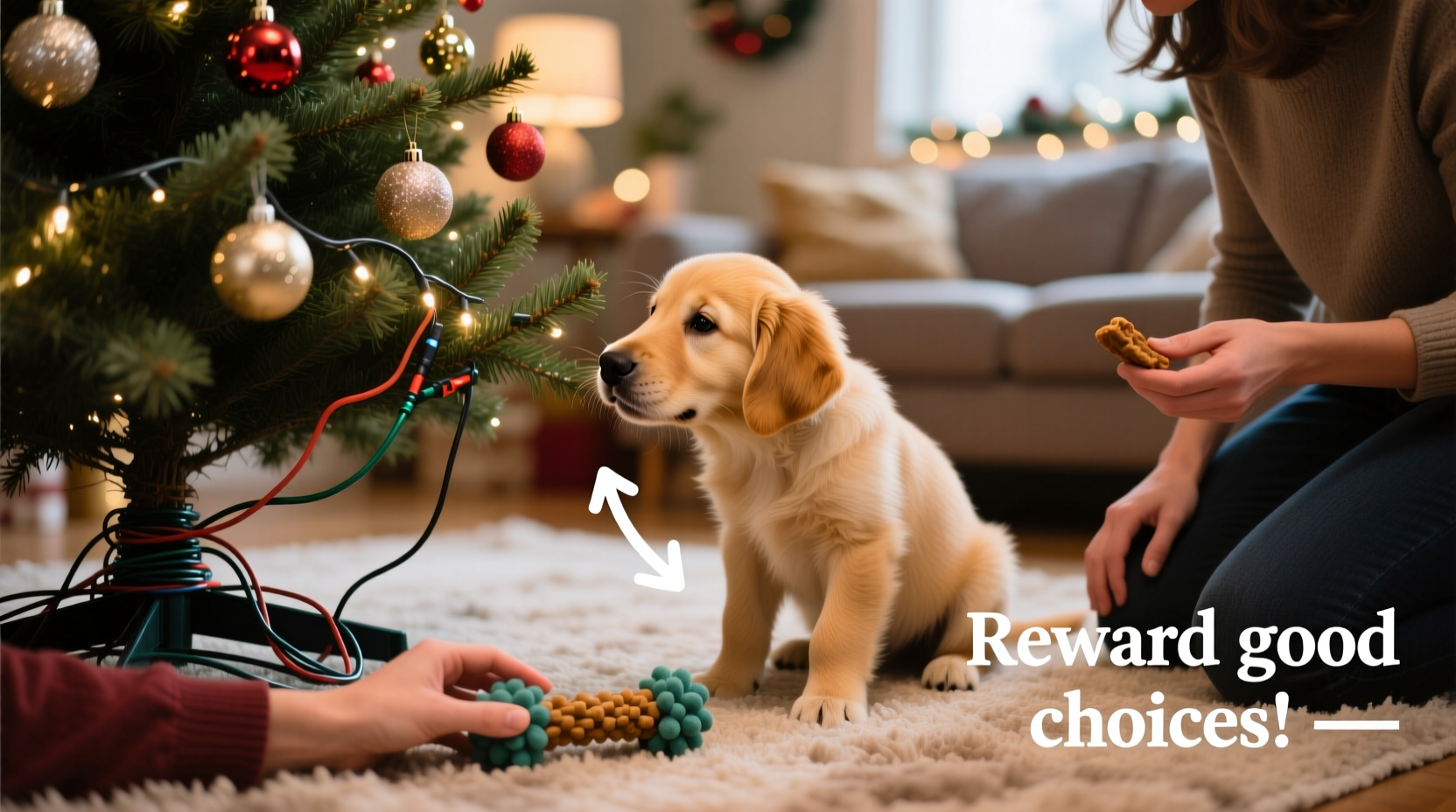
Puppies explore the world through their mouths. Between 3 and 6 months, teething peaks, but even older puppies retain strong oral investigation drives. Christmas tree wires amplify this instinct for three reasons: texture (smooth, cool, slightly springy), movement (swaying when bumped), and location (running along baseboards or under low-hanging branches—exactly where curious noses and paws go). A 2022 study published in Frontiers in Veterinary Science found that 73% of household electrical injuries in dogs under one year involved chewed cords near seasonal decorations—with tree lights accounting for 41% of those incidents.
More critically, punishment-based responses rarely teach what *to do* instead. If you startle a puppy mid-chew, they may associate the tree—not the wire—with danger, leading to avoidance, anxiety, or redirected chewing elsewhere. Positive reinforcement flips the script: you reward the puppy for noticing the wire *and choosing something safer*. That distinction transforms training from damage control into proactive relationship-building.
The Core Principles of Wire-Safe Positive Reinforcement
Effective training rests on four non-negotiable pillars:
- Anticipation over reaction: Set up success *before* the puppy approaches the tree—not after they’ve latched on.
- Clarity in cues: Use consistent, simple verbal markers (“Yes!” or a clicker) to signal *exactly* when the desired behavior occurs.
- High-value reinforcement: Reserve special treats (e.g., freeze-dried liver, tiny cheese cubes) exclusively for wire-related training—not daily kibble.
- Environmental management: Reduce temptation so the puppy can succeed 90% of the time; training happens in the gaps between management.
This isn’t permissiveness—it’s precision. You’re not letting the puppy “figure it out.” You’re engineering opportunities for them to make the right choice, then reinforcing that choice generously and immediately.
Step-by-Step Wire Safety Protocol (Days 1–14)
This phased plan assumes your puppy is already familiar with basic cues like “leave it” and “come,” but adapts them specifically for wire contexts. Adjust timing based on your puppy’s focus span—most sessions should last 60–90 seconds, repeated 3–5 times daily.
- Day 1–2: Wire Desensitization (No Tree Yet)
Unplug and lay a single strand of holiday light cord on the floor in a low-traffic area. Sit nearby with treats. When your puppy glances at the cord, mark (“Yes!”) and treat. Do *not* wait for sniffing or touching. Repeat until they look at the cord, then immediately look at you for a reward—this builds a “wire = food opportunity” association. - Day 3–5: Introduce the Tree Base (Unlit, Unplugged)
Set up the bare tree stand and wrap cord loosely around its base. Place your puppy on a short leash or mat 6 feet away. Reward sustained attention on you while the cord is visible. Gradually decrease distance by 12 inches every two sessions—only if your puppy remains relaxed and chooses you over the cord. - Day 6–8: Controlled Exposure with Plugged-In Lights (Low Risk)
Use battery-operated LED lights (no outlet, no shock risk) wrapped around the lower 12 inches of the trunk. Sit with your puppy on a mat. Toss a treat *away* from the tree each time they glance toward the lights—reinforcing redirection before engagement. If they move toward the lights, gently guide them back to the mat with the leash and immediately reward stillness. - Day 9–12: Real-Wire Integration (Plugged In, Protected)
Install cord protectors (rigid plastic sleeves) over all accessible wiring. Place your puppy on a 6-foot long line anchored to furniture. Let them explore *within reach* while you watch. The instant they orient toward the protected wire, mark and toss a treat *toward their bed or chew toy*. This teaches: “Look at wire → get rewarded for going to your safe spot.” - Day 13–14: Proofing & Generalization
Practice near other cords (lamps, chargers) using the same cue-and-reward sequence. Add mild distractions (soft music, another person walking nearby). If your puppy consistently chooses their chew toy over the wire 8/10 times, add 12 inches of leash length—but only if reliability holds.
Do’s and Don’ts: Wire Training Decision Matrix
| Action | Do | Don’t |
|---|---|---|
| When puppy approaches wire | Calmly say “Let’s go” and lead them to their chew mat; reward on arrival | Yell “No!” or grab their collar—this heightens arousal and links the tree with stress |
| Using barriers | Install a 24-inch baby gate in a U-shape around the tree base (allows viewing but blocks access) | Rely solely on bitter apple spray—puppies habituate quickly, and it doesn’t teach an alternative behavior |
| Treat timing | Mark the *exact moment* they turn away from the wire—even a 10-degree head turn | Wait until they’re fully disengaged and sitting; the connection between action and reward is lost |
| Chew alternatives | Offer frozen Kongs stuffed with pumpkin + yogurt, or elk antlers for heavy chewers | Give rawhide or synthetics near the tree—they create scent trails and increase proximity temptation |
Mini Case Study: Luna, 14-Week-Old Australian Shepherd Mix
Luna lived in a downtown apartment with floor-to-ceiling windows and a 7-foot pre-lit tree. Her owner, Maya, tried citronella spray and scolding—both escalated Luna’s fixation. On Day 1 of positive reinforcement training, Luna received 12 treats just for looking at a coiled extension cord from across the room. By Day 4, she’d learned to trot to her “chew zone” (a rug with three designated toys) whenever Maya said “Tree time!”—triggered by the sight of Maya picking up the cord organizer. Key breakthrough: Maya stopped trying to prevent *all* interest in the wire and instead reinforced *any* micro-behavior that moved Luna away from it—even blinking while facing the tree earned a treat. Within 10 days, Luna would lie on her mat 4 feet from the tree, watching lights blink, tail thumping softly. No shocks. No vet visits. Just consistency and clarity.
“Puppies don’t chew wires because they’re ‘bad’—they chew because their brains are wired to explore, and we haven’t yet shown them a more rewarding path. Positive reinforcement doesn’t eliminate curiosity; it redirects it toward safety and partnership.” — Dr. Sarah Lin, DVM, DACVB, Board-Certified Veterinary Behaviorist
FAQ: Addressing Real Concerns
What if my puppy ignores treats near the tree?
That signals the environment is too overwhelming—or your treats aren’t valuable enough in that context. First, test treat appeal away from the tree: offer kibble, then cheese, then freeze-dried beef. Whichever earns immediate, eager licking is your wire-training currency. Second, increase distance: start training from 12 feet away, not 3. Third, reduce stimulation—turn off other lights, close the door to the room, and practice during calm morning hours. Never force proximity.
Can I use a crate as part of this training?
Yes—but only as a voluntary safe space, not punishment. Place the crate near (not inside) the tree area with a cozy bed and indestructible chew. Toss treats into it throughout the day. When you see your puppy enter voluntarily, mark and reward. Over time, they’ll associate the crate with comfort *near* the tree, making it a natural retreat when wires catch their eye. Never crate a puppy *because* they looked at a wire—that undermines trust.
How long does this take? Will my puppy ever be fully “safe” around wires?
Most puppies show reliable alternative choices within 10–14 days of consistent daily practice. However, “fully safe” requires lifelong management: even adult dogs retain oral curiosity, especially during boredom or stress. Your goal isn’t perfection—it’s building a robust default response (“When I see wires, I go to my mat”) that holds up 90% of the time. Continue occasional maintenance sessions through January, then monthly “refreshers” year-round. Remember: management (cord covers, gates) and training are partners—not substitutes.
Conclusion: Building Trust, One Wire at a Time
Training your puppy not to chew Christmas tree wires isn’t about guarding ornaments or protecting electronics. It’s about honoring their biology while guiding them toward safety with kindness and intelligence. Every time you mark a glance away from a cord and deliver a treat, you’re telling your puppy, “I see you. I understand your curiosity. And I’ll help you choose well.” That message resonates deeper than any correction ever could. This season, let your tree stand not just as a symbol of celebration—but as quiet proof of the thoughtful, patient, joyful partnership you’re cultivating. Your puppy isn’t learning to avoid wires. They’re learning to trust you, to read your cues, and to believe that good choices lead to good things.




 浙公网安备
33010002000092号
浙公网安备
33010002000092号 浙B2-20120091-4
Comments
No comments yet. Why don't you start the discussion?