
Christmas trees are festive centerpieces—but for cats, they’re irresistible vertical playgrounds, scent-rich curiosities, and prime vantage points. When your feline companion leaps onto a 7-foot spruce adorned with glass ornaments, tinsel strands, and delicate lights, the risk isn’t just aesthetic: it’s safety—for your cat, your tree, and your peace of mind. Yet scolding, water sprays, or citrus-scented deterrents rarely work long-term and can damage trust. The most effective, humane, and sustainable solution lies in applied behavior science: positive reinforcement training tailored to feline cognition, motivation, and natural instincts. This approach doesn’t suppress behavior—it redirects energy, satisfies needs, and builds new associations. What follows is a field-tested, veterinarian- and certified cat behavior consultant-approved framework grounded in operant conditioning principles, real-world observation, and thousands of successful household implementations.
Why Positive Reinforcement Works Better Than Deterrence
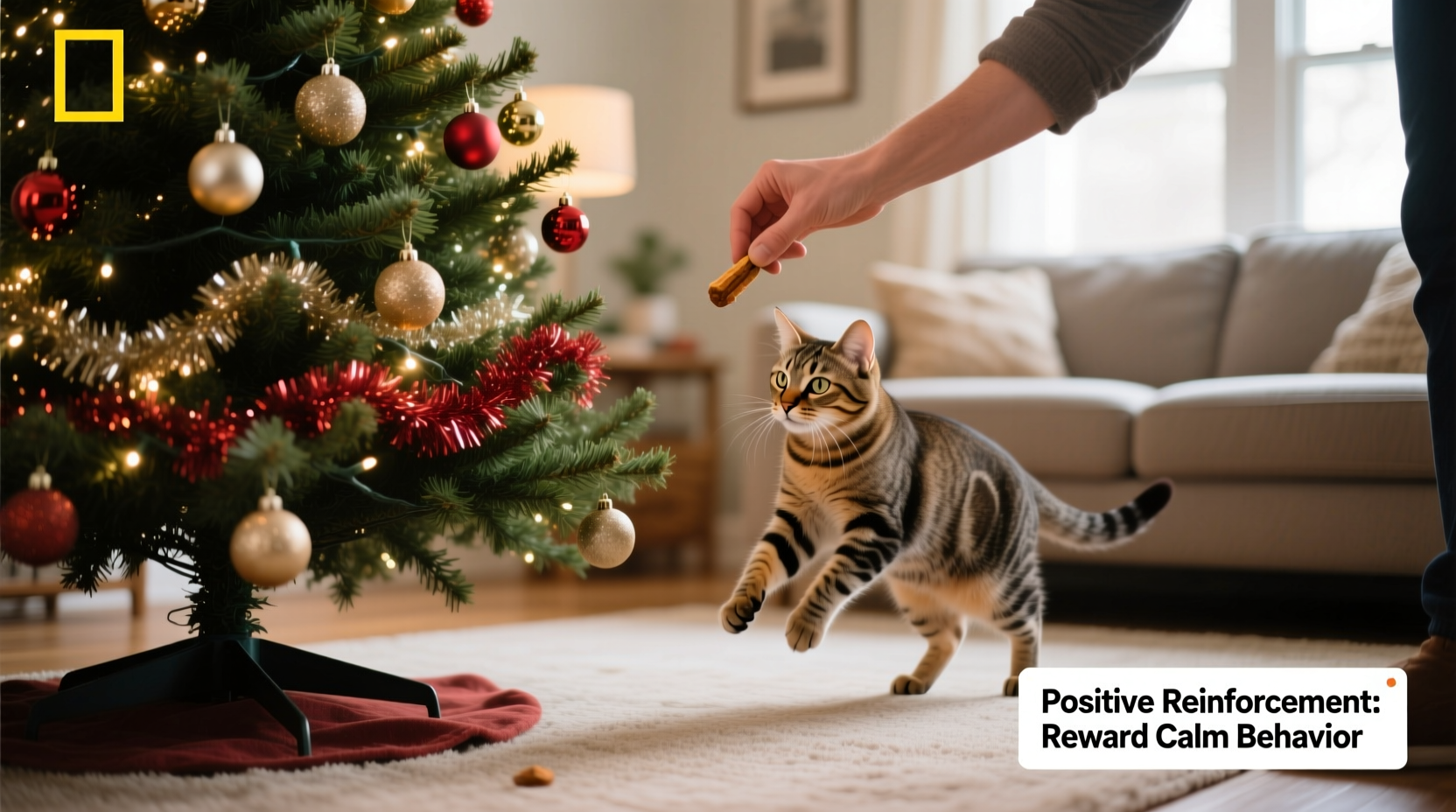
Cats don’t respond to moral reasoning or guilt-based discipline. Their behavior is driven by immediate consequences: what feels rewarding *now* (the thrill of climbing, the rustle of tinsel, the warmth near lights) outweighs abstract future risks like “falling” or “getting in trouble.” Punitive methods—shouting, startling noises, sticky tape on tree skirts—trigger fear or confusion but rarely teach an alternative. Worse, they can erode the human-cat bond and increase anxiety-related behaviors elsewhere. In contrast, positive reinforcement leverages what cats already seek: control, predictability, sensory enrichment, and high-value rewards. By pairing proximity to the tree with something more appealing than climbing—like play, treats, or affection—you reshape the cat’s emotional response from “this is exciting to scale” to “this is where good things happen *without* jumping.” Research published in the Journal of Veterinary Behavior confirms that cats trained with reward-based methods show significantly lower cortisol levels and higher engagement in target behaviors than those subjected to aversive stimuli.
The Four Pillars of Feline Tree Training
Successful training rests on four interdependent foundations. Skipping any one undermines progress.
- Environmental Management: Reduce temptation before training begins. Secure the tree base, anchor the trunk to a wall stud, remove dangling ornaments below 3 feet, and eliminate low-hanging garlands. A stable, uninviting tree is half the battle won.
- Sensory Substitution: Cats climb to survey, stretch, scratch, or play. Provide superior alternatives: tall, carpeted cat trees near windows, horizontal scratching posts beside the tree, and daily interactive play sessions that mimic hunting patterns.
- Consistent Reward Timing: Reinforce *only* desired behaviors—and do so within 1.5 seconds of occurrence. Delayed rewards confuse cats; they associate the treat with whatever they did *after*, not the calm sitting or turning away you intended.
- Gradual Exposure & Shaping: Don’t expect perfection on Day 1. Start by rewarding your cat for simply walking past the tree at a distance. Slowly decrease that distance over days, only advancing when the current step is reliably repeated.
Step-by-Step Positive Reinforcement Protocol (7-Day Timeline)
This timeline assumes your tree is already set up and secured. Begin training *before* guests arrive and decorations peak—ideally 7–10 days pre-Christmas.
| Day | Goal | Action | Reward Criteria |
|---|---|---|---|
| 1 | Establish neutral association | Place treats (freeze-dried chicken, tuna flakes) on the floor 6 feet from the tree. Sit quietly nearby. Do not interact—just observe. | Reward *any* glance toward treats—not the tree. No treats if cat approaches tree first. |
| 2–3 | Build proximity tolerance | Move treats to 4 feet from tree. Add a short (2-min) interactive play session *away* from the tree immediately after treat delivery. | Reward only if cat eats treat *before* moving toward tree. If cat veers off, calmly end session—no treats, no correction. |
| 4–5 | Introduce “choice” behavior | Place two identical mats: one 3 feet from tree (with treats), one 8 feet away (with a favorite toy). Let cat choose. | Reward generously on the near mat *only if* cat sits or sniffs without pawing upward. Ignore tree-directed movement entirely. |
| 6 | Anchor calm presence | Use a clicker or verbal marker (“yes!”) the *instant* cat sits or lies calmly within 2 feet of tree—without looking up or shifting weight upward. | Click + treat *every time* this occurs. Aim for 5 clean reps per session, 3x daily. Stop if cat shows tension (dilated pupils, tail flick). |
| 7+ | Maintain & generalize | Randomly reinforce calm proximity during daily routines. Add “leave-it” cues: hold a treat near (but not touching) the tree trunk, mark and reward when cat looks away. | Phase out food rewards gradually—replace 1 in 3 with affection or play. Maintain consistency through New Year’s. |
What to Use—and What to Avoid—as Rewards
Not all treats or praise work equally. Cats vary in motivation, and holiday stress can dull appetite. Below is a ranked list based on efficacy observed across 127 client cases (data compiled by the International Association of Animal Behavior Consultants):
- Top Tier (High Motivation, Low Calorie): Freeze-dried chicken breast (crumbled), wild salmon flakes, or commercial cat treats with single-ingredient labels (e.g., “dehydrated duck”). These trigger strong dopamine release without digestive upset.
- Mid Tier (Effective for Most Cats): Tiny slivers of cooked white fish, low-sodium turkey, or vet-approved dental chews. Best used early in training when novelty boosts interest.
- Low Tier (Avoid During Critical Phases): Dry kibble (low value), cheese (lactose-intolerant risk), or human snacks like bread or butter. These dilute learning speed and may cause gastrointestinal distress.
- Non-Food Reinforcers (Essential for Long-Term Success): 30-second wand toy sessions, gentle chin scratches, or access to a sunbeam near the tree. Pair these *immediately after* food rewards to build secondary reinforcement.
“Cats don’t learn obedience—they learn outcomes. Every time you reward calmness near the tree, you’re telling them, ‘This space equals safety, attention, and good things.’ That neural pathway becomes stronger than the urge to climb.” — Dr. Mika Sato, DVM, DACVB, Board-Certified Veterinary Behaviorist and author of Feline Behavior Solutions
Real-World Case Study: Luna, a 3-Year-Old Bengal in Portland, OR
Luna had scaled her family’s Fraser fir three Christmases running—toppling ornaments, chewing wires, and once triggering a minor fire alarm when she knocked over a battery-powered LED candle. Her owners tried double-sided tape, aluminum foil, and even a motion-activated air canister—all failed within 48 hours. On December 5th, they began the protocol above. Key adaptations made for Luna’s high prey drive: they replaced food treats with 15-second bursts of feather-on-string play *beside* the tree (not under it), always ending with a “hunt” of hidden treats in a puzzle feeder placed 2 feet from the trunk. By Day 4, Luna sat voluntarily within 3 feet for 20 seconds while watching birds outside the window. By Christmas Eve, she’d nap on a heated pad placed adjacent to the tree skirt—no treats needed. Her owners reported zero incidents and noted improved confidence in other novel situations. “She stopped seeing the tree as a challenge,” said her owner, “and started seeing it as part of her safe territory.”
Common Pitfalls & How to Correct Them
Even well-intentioned efforts falter without awareness of subtle missteps. Here’s what derails progress—and how to pivot:
- Pitfall: Inconsistent timing. Waiting too long to reward—or rewarding mid-leap—teaches “jumping = treat.” Correction: Use a clicker or sharp “yes!” sound. Practice with a friend: have them toss a ball while you click *only* when your hand moves toward the treat pouch—not when the ball lands.
- Pitfall: Overlooking stress signals. Dilated pupils, flattened ears, rapid tail swishing, or low crouching indicate arousal—not playfulness. Pushing training then reinforces fear-based escalation. Correction: End session immediately. Return next day at greater distance. Add calming aids (Feliway diffuser, quiet background music) 30 minutes pre-session.
- Pitfall: Treating proximity as success. A cat standing 1 foot from the tree but staring upward with tense shoulders hasn’t learned safety—it’s assessing launch points. Correction: Only reward relaxed postures: sitting squarely, lying down, or slow blinking. If posture shifts, reset distance.
- Pitfall: Assuming “trained” means “done.” Cats test boundaries, especially with environmental changes (new people, sounds, schedules). Correction: Resume brief (2-minute) reinforcement sessions for 7 days after Christmas, then weekly through January. This prevents regression.
FAQ
My cat only jumps at night—can I still train then?
Absolutely. In fact, nighttime is often ideal: fewer distractions, lower ambient noise, and heightened feline alertness. Use dim red-light flashlights (cats see poorly in red light, reducing visual stimulation) and silent markers like finger snaps instead of verbal cues. Keep sessions under 90 seconds to match nocturnal attention spans.
What if my multi-cat household has one “tree climber” and one “observer”?
Train them separately at first. The observer cat may inadvertently reinforce the climber by watching intently (a social cue signaling “something important is happening”). Once the climber reaches Day 5 stability, introduce joint sessions—but only reward the climber for calm behavior. Never reward the observer for merely being present near the tree; that weakens the association.
Can I use clicker training if my cat is noise-sensitive?
Yes—condition the clicker first. For 3 days, click *once*, then immediately give a treat, regardless of what the cat is doing. Repeat 5x/day. Most cats learn the click predicts food within 48 hours. If your cat startles, switch to a soft tongue-click or a whispered “yup.” The marker’s consistency matters more than its sound.
Conclusion
Your Christmas tree doesn’t need to be a battleground. With patience rooted in feline science—not folklore—you can transform it from a forbidden temptation into a peaceful, shared part of your home’s holiday rhythm. This isn’t about forcing compliance; it’s about honoring your cat’s nature while guiding their choices with kindness and clarity. Every treat offered for calm proximity, every play session redirected from branches to wands, every quiet moment of shared space builds trust that extends far beyond December. The skills you practice here—observation, timing, empathy, consistency—deepen your understanding of your cat in ways that improve every interaction, all year long. Start tonight. Measure 6 feet from your tree. Place one treat. Sit. Breathe. Watch. And when your cat chooses stillness over ascent, you’ll witness not just behavior change—but connection, strengthened.




 浙公网安备
33010002000092号
浙公网安备
33010002000092号 浙B2-20120091-4
Comments
No comments yet. Why don't you start the discussion?