
In today’s remote work era, many bird owners face a unique challenge: their otherwise beloved parrot chooses the worst possible moment to scream—right in the middle of an important Zoom meeting. While vocalization is natural for parrots, excessive screaming during virtual calls can be disruptive, embarrassing, and stressful for both owner and bird. The good news is that with patience, consistency, and the right techniques, it’s entirely possible to reduce or eliminate this behavior. This guide outlines proven, science-backed training strategies to help your parrot stay calm when you’re on camera.
Understanding Why Parrots Scream
Before addressing the solution, it's essential to understand the root causes of screaming. Parrots are highly social, intelligent birds that rely on vocal communication. In the wild, they use loud calls to maintain contact with flock members across long distances. When kept as pets, this instinct doesn’t disappear—it simply shifts context.
Common reasons your parrot may scream during Zoom calls include:
- Attention-seeking: If your bird has learned that screaming gets your attention—even negative attention—they’ll repeat the behavior.
- Stress or anxiety: The sight of you sitting still, staring at a screen, and speaking in a formal tone can confuse or unsettle your parrot.
- Environmental triggers: Background noises from other participants, sudden laughter, or music can startle your bird into vocalizing.
- Boredom: A lack of stimulation makes your parrot more likely to engage in disruptive behaviors.
- Flock separation anxiety: Your parrot sees you as part of its flock. When you're focused elsewhere, it may scream to re-establish connection.
“Parrots don’t misbehave out of malice—they communicate through behavior. Understanding the 'why' behind the scream is the first step toward changing it.” — Dr. Irene Pepperberg, Avian Cognition Researcher
Effective Training Methods to Reduce Screaming
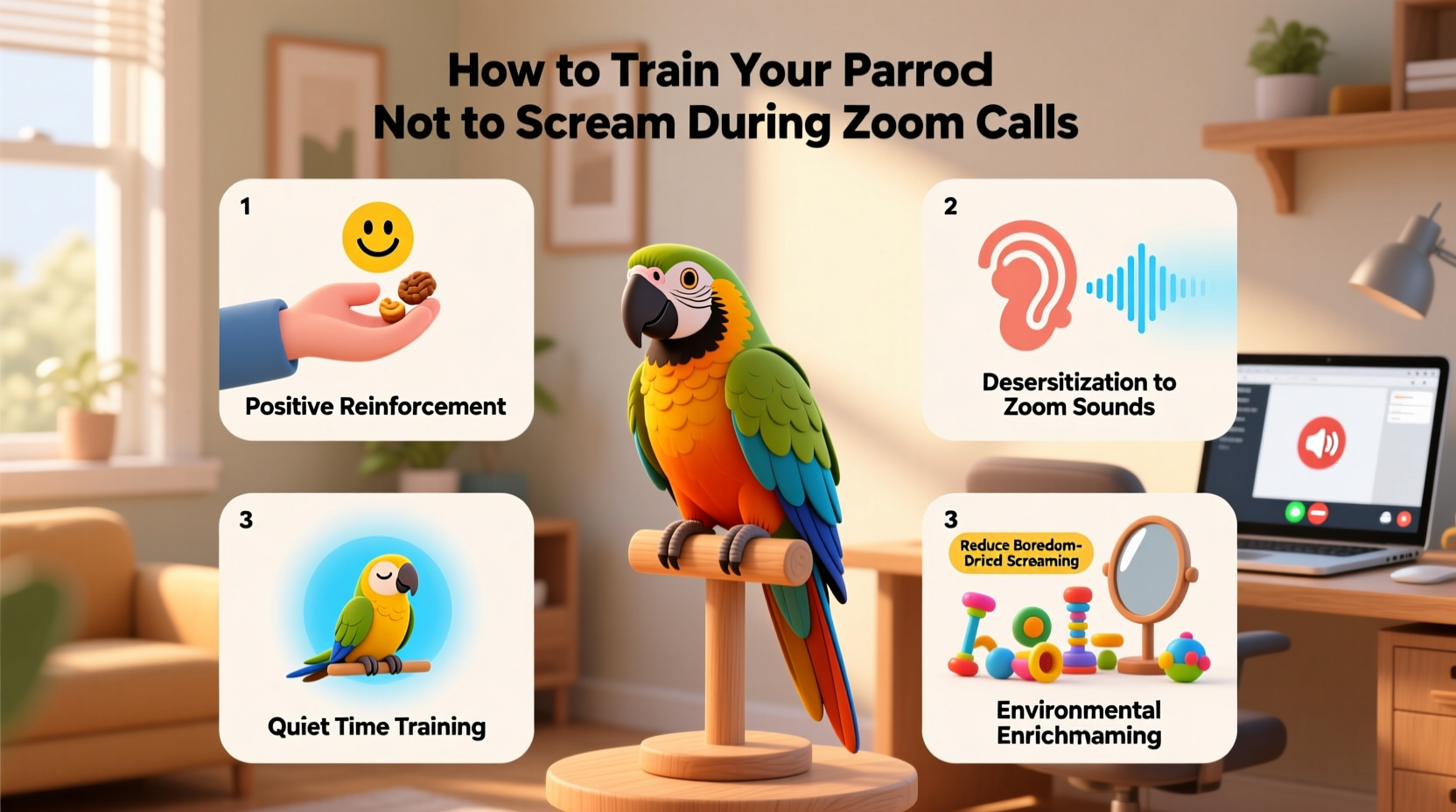
Training a parrot requires consistency, timing, and positive reinforcement. Below are five evidence-based methods to gradually reduce unwanted vocalizations during video calls.
1. Reinforce Quiet Behavior with Positive Rewards
The most effective way to modify behavior is to reward what you want to see more of. Instead of reacting to screams, focus on reinforcing moments of silence.
Here’s how:
- Identify times when your parrot is quietly perched or engaged in self-play.
- Immediately offer a high-value treat (e.g., a sunflower seed or piece of fruit) along with verbal praise like “Good quiet!”
- Repeat consistently throughout the day so your bird associates silence with rewards.
2. Create a Predictable Pre-Zoom Routine
Parrots thrive on routine. By establishing a consistent signal before your Zoom calls, your bird learns what to expect and adjusts its behavior accordingly.
Example routine:
- 15 minutes before your call: Move your parrot to a separate room with enrichment toys.
- Give a special “worktime” toy filled with treats.
- Use a specific phrase like “Mommy’s working now” each time.
Over time, your parrot will associate the phrase and location with downtime and reduced interaction.
3. Use Distraction and Enrichment Strategically
A bored parrot is a loud parrot. During your work hours, ensure your bird has engaging activities that occupy its mind and body.
Effective enrichment tools include:
- Puzzle feeders that require problem-solving to access food.
- Foraging toys where treats are hidden under paper or wood shavings.
- Audio enrichment: Play recordings of calm forest sounds or gentle bird chatter.
- Durable chew toys made from safe woods or palm fiber.
4. Desensitize to Zoom Call Stimuli
If your parrot reacts specifically to the sound of your voice on calls or background noise, desensitization can help. This involves gradually exposing your bird to recorded snippets of Zoom-like environments at low volume, then increasing intensity over time while rewarding calm behavior.
Steps:
- Record a short clip of a typical Zoom meeting (your voice, keyboard clicks, etc.).
- Play it at a very low volume while offering treats.
- Gradually increase volume over days as long as your parrot remains calm.
- Stop if screaming occurs and retry at a lower level later.
5. Avoid Reinforcing the Screaming
Even well-meaning reactions can reinforce screaming. Turning around, saying “No!”, or giving eye contact—even briefly—can be perceived as attention, which encourages repetition.
Instead:
- Stay completely neutral when your parrot screams.
- Do not make eye contact or speak until the bird is quiet.
- Wait 3–5 seconds of silence before acknowledging your bird.
| Behavior | What to Do | What NOT to Do |
|---|---|---|
| Parrot screams during call | Stay silent, avoid eye contact, continue meeting | Yell “Stop!”, turn to look, or react emotionally |
| Parrot is quiet for 30 seconds | Reward with treat and praise after call ends | Ignore the good behavior |
| Pre-call preparation | Move bird to quiet room with toys | Leave bird unattended near computer |
Step-by-Step Timeline for Training Success
Behavior change takes time. Here’s a realistic four-week plan to reduce screaming during Zoom calls:
- Week 1: Observe and record when your parrot screams. Identify patterns (time of day, triggers, duration). Begin rewarding quiet moments with treats.
- Week 2: Introduce a pre-Zoom routine. Move your bird to a designated area 10–15 minutes before calls. Provide a new foraging toy.
- Week 3: Start desensitization training using recorded audio. Play low-volume meeting sounds while offering treats.
- Week 4: Simulate a mock Zoom call with a friend while your parrot is nearby but distracted. Reward calmness. Gradually reintegrate if needed.
By the end of this cycle, most parrots show noticeable improvement—especially when training is consistent and household members follow the same rules.
Mini Case Study: Reducing Screaming in a Home Office Setting
Sarah, a marketing consultant in Portland, struggled daily with her 7-year-old African Grey, Jasper, who would shriek every time she joined a client call. Initially, she tried covering the cage, which only increased his anxiety. After consulting an avian behaviorist, she implemented a structured plan:
- She moved Jasper’s cage to a quieter bedroom adjacent to her office.
- Installed a bird-safe baby monitor to keep an eye on him.
- Introduced a “Zoom Basket” filled with rotating puzzle toys available only during work hours.
- Began rewarding quiet behavior with almond pieces and soft praise.
Within three weeks, Jasper’s screaming dropped by 80%. By week six, he remained quiet during 90% of calls. Sarah noted, “He finally learned that being calm gets him what he wants—attention and treats—on his terms.”
Checklist: How to Prepare Your Parrot for Zoom Calls
Use this checklist weekly to maintain progress:
- ✅ Rotate enrichment toys to prevent boredom
- ✅ Conduct at least two 5-minute training sessions reinforcing quiet behavior
- ✅ Test audio desensitization clips once per week
- ✅ Ensure cage placement minimizes exposure to screen glare and loud audio
- ✅ Confirm all family members know not to respond to screaming
- ✅ Schedule 15 minutes of pre-call bonding to meet your parrot’s social needs early
FAQ
How long does it take to train a parrot not to scream?
Results vary by species, age, and history. Most owners see improvement within 2–4 weeks of consistent training. Full behavioral change may take 2–3 months. Patience and daily practice are key.
Is it okay to cover my parrot’s cage during calls?
Covering can help some birds feel secure, but it may backfire if your parrot associates it with abandonment. Use it cautiously and only if your bird shows calm body language (relaxed feathers, closed eyes). Never use it as punishment.
Can I use a spray bottle to stop screaming?
No. Spraying water is considered aversive and can damage trust. It may suppress screaming temporarily but often leads to fear, aggression, or redirected behaviors. Positive reinforcement is safer and more effective long-term.
Conclusion
Training your parrot not to scream during Zoom calls isn’t about silencing a natural communicator—it’s about guiding that communication into more appropriate channels. By understanding your bird’s needs, reinforcing desired behaviors, and creating a supportive environment, you can enjoy productive meetings without sacrificing your parrot’s well-being.
Start small: pick one strategy from this guide and implement it consistently for a week. Track changes in frequency and intensity of screaming. Over time, these efforts compound into lasting harmony between your professional life and your feathered companion’s instincts.




 浙公网安备
33010002000092号
浙公网安备
33010002000092号 浙B2-20120091-4
Comments
No comments yet. Why don't you start the discussion?