
Parrots are among the most intelligent birds in the animal kingdom, capable of mimicking human speech with astonishing clarity. Yet, many owners find themselves frustrated when their bird repeats phrases in a flat, mechanical tone—like a malfunctioning voice assistant. While it’s easy to fall into the trap of rote repetition, true vocal training goes beyond mere mimicry. It involves building context, emotional connection, and natural rhythm into your parrot’s speech. The goal isn’t just to hear your bird say “Hello!” but to understand when and why it says it—and to do so in a way that sounds authentic, not artificial.
This guide explores proven, humane methods to teach your parrot to speak with intention and expression. By focusing on engagement, timing, and environmental enrichment, you can move past robotic repetition and foster communication that feels alive and responsive.
Understanding Parrot Vocalization: Why Tone Matters
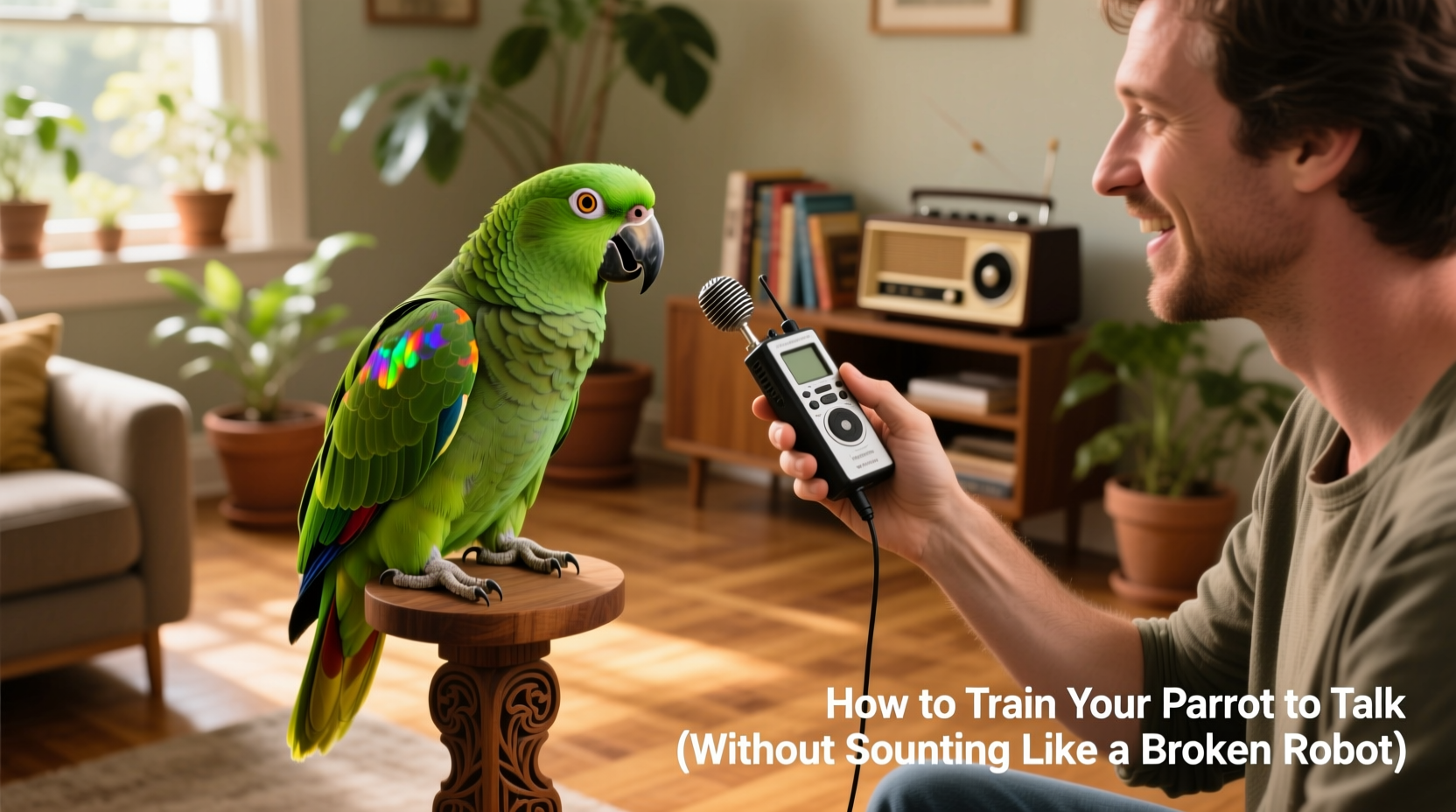
Unlike recording devices, parrots don’t simply store and replay audio. They process sounds socially and emotionally. In the wild, parrots use vocalizations to maintain flock cohesion, signal danger, or express excitement. When a domesticated parrot speaks, it often does so in response to cues—emotional states, routines, or interactions. If training relies solely on repetition without emotional or contextual anchoring, the result is a stilted, unnatural delivery.
Dr. Irene Pepperberg, renowned avian cognition researcher and author of *The Alex Studies*, explains:
“Parrots assign meaning to sounds based on experience. When we treat speech as a conditioned reflex, we limit their potential. But when we engage them in meaningful interaction, their vocalizations become part of a dynamic communication system.” — Dr. Irene Pepperberg, Avian Cognitive Scientist
This insight shifts the focus from “teaching words” to “fostering dialogue.” A parrot trained through association and reinforcement will not only speak more clearly but also modulate tone, pause appropriately, and even initiate conversation.
Step-by-Step Guide to Natural-Sounding Speech Training
Training a parrot to speak naturally requires patience, consistency, and an understanding of avian learning patterns. Follow this structured approach to encourage expressive, fluid speech.
- Choose Words with Contextual Relevance
Create a shortlist of high-frequency, emotionally relevant phrases such as “Good morning,” “Want a snack?” or “Time to play.” These should align with daily routines so your parrot associates the word with a real-world event. - Model Natural Speech Patterns
Speak slowly and clearly, using varied intonation. Avoid exaggerated enunciation. Say “Good morning, sweetie!” with warmth—not like a robot repeating “GOOD MORNING” in monotone. Your parrot learns prosody (rhythm, stress, and intonation) from your delivery. - Pair Words with Actions
Say “Want a nut?” just before offering a treat. Use “Bye-bye!” during departures. This builds associative memory. Over time, your parrot may begin saying “bye-bye” when you pick up your keys—even if you don’t prompt it. - Respond to Attempts Immediately
When your parrot makes even a faint approximation of a word (“buh” for “bird”), respond enthusiastically: “Yes! Bird! That’s right!” Immediate feedback reinforces effort and encourages refinement. - Limit Repetition Sessions to 5–7 Minutes
Birds have short attention spans. Multiple brief sessions throughout the day are far more effective than one long drill. End each session on a positive note, even if progress seems minimal. - Encourage Turn-Taking
After your parrot says a word, pause and wait. Sometimes they’ll repeat it; other times, they’ll make a new sound. Reward conversational flow by responding as if in dialogue: “You said ‘hello’! Hello back!”
Common Mistakes That Create Robotic Speech
Many well-intentioned owners unknowingly train their parrots to sound mechanical. Recognizing these pitfalls is the first step toward more natural communication.
| Mistake | Why It’s Harmful | Better Approach |
|---|---|---|
| Repeating words 10+ times in a row | Teaches mindless mimicry without comprehension | Use the word once in context, then reinforce when the bird responds |
| Using electronic recordings | Lacks social bonding and emotional cues | Interact live—your presence matters more than perfect pronunciation |
| Only rewarding exact replicas | Discourages experimentation and gradual improvement | Reward approximations and build from there |
| Ignoring body language | Forces performance under stress | Train when the bird is relaxed and attentive |
| Overloading with too many words | Causes confusion and fragmented speech | Master 2–3 phrases before introducing new ones |
Real Example: From Monotone to Meaningful – Luna the African Grey
Luna, a 4-year-old African Grey, was brought to a behavioral trainer by her owner, Mark, who complained that she “just squawks random words like a glitchy speaker.” She could say “I love you,” “No,” and “What’s that?” but delivered them in a flat, rapid-fire sequence regardless of context.
The trainer observed that Mark had been playing recorded phrases on loop while at work, hoping for passive learning. However, Luna showed no social engagement during these sessions. The new approach focused on interaction:
- Mark stopped using recordings and began speaking directly to Luna during feeding and playtime.
- He used “What’s that?” only when showing her a new object, pairing it with eye contact and finger-pointing.
- “I love you” was reserved for calm cuddle moments, spoken softly.
- Sessions were limited to three 5-minute windows per day.
Within six weeks, Luna began using “What’s that?” when Mark held up unfamiliar items—even without prompting. She started saying “I love you” spontaneously during quiet moments, often in a soft, drawn-out tone that mirrored Mark’s affectionate delivery. Her speech gained rhythm, pauses, and emotional inflection. No longer a broken robot, Luna had become a conversational partner.
Checklist: Building Natural Speech Habits
Use this checklist weekly to evaluate and refine your training approach:
- ✅ I use only live, face-to-face interaction for speech training
- ✅ Each phrase is tied to a specific daily routine or emotion
- ✅ I respond immediately when my parrot attempts a word
- ✅ I vary my tone and volume to model natural speech
- ✅ I keep sessions short and end positively
- ✅ I avoid overloading with new words before mastery
- ✅ I observe body language and stop if the bird seems stressed
- ✅ I reward effort, not just perfection
Enhancing Clarity Through Environmental Enrichment
Vocal development doesn’t happen in isolation. A mentally stimulated parrot is more likely to experiment with sound. Incorporate these enrichment strategies to support expressive speech:
- Mirror Play: Some parrots enjoy talking to their reflection. Place a safe, shatterproof mirror nearby during training to encourage self-directed vocal practice.
- Sound Discrimination Games: Play two different phrases (“Wanna go out?” vs. “Hungry?”) and reward the bird only when it responds to the correct one. This sharpens auditory processing.
- Background Noise Control: Train in a quiet room free from TV or radio interference. Too much ambient sound makes it harder for parrots to isolate target words.
- Interactive Toys with Voice Modules: Devices that repeat a phrase when activated can be useful—but only if introduced after the bird already understands the word in context.
FAQ: Common Questions About Parrot Speech Training
Can all parrots learn to talk naturally, or is it species-dependent?
While African Greys, Amazon parrots, and some Cockatoos are known for advanced mimicry, any parrot species capable of vocal learning can develop clearer, more expressive speech with proper training. Smaller birds like Budgies may have smaller vocabularies, but they can still learn to use words contextually and with variation in tone.
My parrot repeats words in the middle of the night—how do I stop this?
Nocturnal vocalization often stems from attention-seeking or anxiety. Avoid reacting at night, as any response (even yelling “Be quiet!”) reinforces the behavior. Instead, ensure your parrot gets enough mental stimulation during the day and cover the cage at bedtime to signal sleep time. If the bird calls out “Hello?” at 3 a.m., wait until morning to respond enthusiastically—this teaches that greetings are daytime events.
How long does it take to see improvement in tone and clarity?
Most owners notice subtle changes in delivery within 4–6 weeks of consistent, interactive training. Full contextual use—where the bird initiates appropriate phrases—can take several months. Progress varies by individual, age, and prior experience. Patience and emotional consistency are key.
Conclusion: Speak With, Not At, Your Parrot
Training a parrot to talk without sounding like a broken robot isn’t about perfecting mimicry—it’s about cultivating communication. When you treat your bird as a thinking, feeling participant in conversation, its speech evolves from mechanical noise to meaningful expression. This transformation doesn’t require special gadgets or endless repetition. It demands presence, empathy, and a willingness to listen as much as you speak.
Start today: choose one phrase, tie it to a moment of genuine interaction, and respond with warmth when your parrot tries. Over time, you won’t just hear words—you’ll recognize personality in every syllable. The goal isn’t a flawless recording. It’s a relationship voiced in shared language.




 浙公网安备
33010002000092号
浙公网安备
33010002000092号 浙B2-20120091-4
Comments
No comments yet. Why don't you start the discussion?