
As smart holiday décor grows in popularity, more users are integrating Bluetooth-enabled Christmas lights with their Android wearables—like Wear OS smartwatches—for hands-free, on-the-wrist control. But when the pairing fails, the convenience turns into frustration. Unlike standard phone connections, wearable devices have tighter hardware constraints, limited processing power, and stricter Bluetooth protocols, making pairing less predictable. The good news: most issues are fixable with systematic troubleshooting. This guide walks through real-world solutions that go beyond basic resets, helping you restore reliable communication between your festive lights and wearable tech.
Understanding the Connection Ecosystem
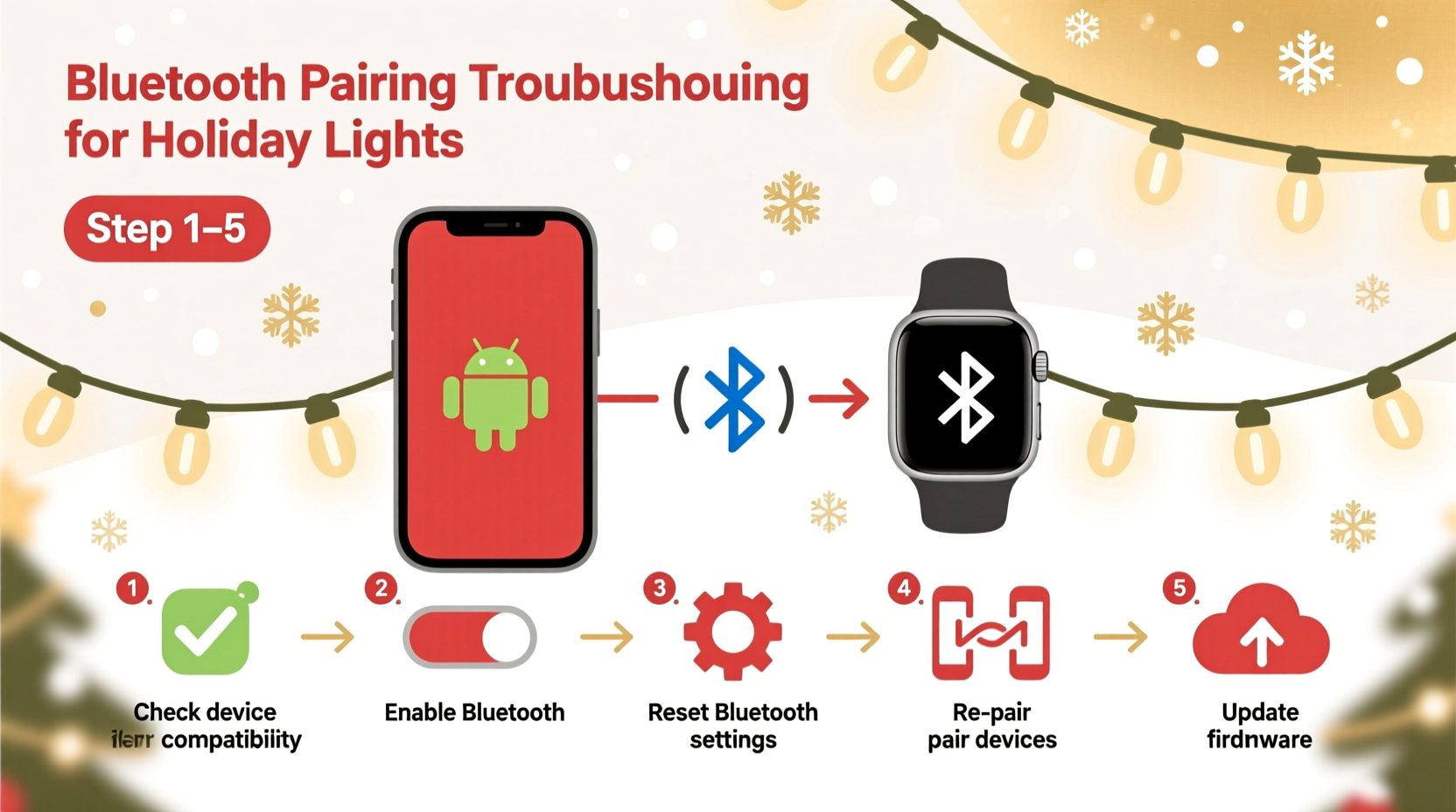
Before diving into fixes, it’s important to understand how these devices communicate. Most modern Bluetooth Christmas lights use Bluetooth Low Energy (BLE), a protocol designed for low-power, intermittent data transfer. Android wearables also rely heavily on BLE to conserve battery life. However, this efficiency comes at a cost: reduced bandwidth and stricter connection windows.
When pairing fails, it's rarely due to a single factor. Instead, it's often a combination of outdated firmware, signal interference, permission misconfigurations, or incompatible Bluetooth profiles. Many apps assume constant proximity and uninterrupted signals—conditions that aren’t always met in real-world environments, especially during holiday gatherings with multiple wireless devices active.
The challenge is compounded by the fact that not all third-party light manufacturers rigorously test their products with wearables. While phone compatibility is usually prioritized, wearable integration is often an afterthought, leading to inconsistent behavior even when both devices technically support BLE.
“Wearables operate under tighter resource limits than phones. A connection that works flawlessly on a Pixel may time out on a Wear OS watch due to background process throttling.” — Dr. Lena Torres, Embedded Systems Engineer at Nordic Semiconductor
Step-by-Step Troubleshooting Guide
Follow this structured sequence to isolate and resolve the root cause of failed pairings. Each step builds on the previous one, eliminating variables methodically.
- Verify device compatibility: Confirm that both your wearable and Christmas lights support BLE 4.0 or higher. Check the product manual or manufacturer website. Some older wearables (e.g., early Samsung Gear models) only support classic Bluetooth, which won't work with modern smart lights.
- Ensure proximity and orientation: Place the wearable within 3 feet (1 meter) of the lights’ controller. Avoid placing metal objects, walls, or large electronic devices (like TVs or microwaves) between them. Signal absorption can disrupt initial handshake attempts.
- Restart both devices: Power off your wearable completely, wait 15 seconds, then turn it back on. For the lights, unplug the controller for 10 seconds before reconnecting. This clears temporary memory glitches that may block new pairings.
- Check app permissions on the wearable: Open the companion app (e.g., “Smart Lights Control”) on your watch. Go to Settings > Apps > [App Name] and ensure Bluetooth, Location, and Notifications permissions are enabled. On Wear OS, location access is required for Bluetooth scanning—a legacy security policy from Android.
- Reinstall the companion app: Uninstall the app from both your phone and wearable. Clear cache via Settings > Apps > [App Name] > Storage > Clear Cache before reinstalling. This ensures a clean configuration without corrupted settings.
- Reset the lights’ Bluetooth module: Most controllers have a reset button (often a small pinhole). Press and hold for 10–15 seconds until the LED blinks rapidly. This erases all paired devices and returns the lights to factory mode.
- Pair via phone first, then sync to wearable: Use your Android phone to complete the initial pairing. Once stable, open the app on your wearable and select “Sync Devices” or “Mirror Phone Pairings.” This bypasses direct wearable-to-light negotiation, which is more prone to failure.
Common Pitfalls and How to Avoid Them
Even experienced users make mistakes that prevent successful pairing. Below is a summary of frequent errors and their remedies.
| Issue | Why It Happens | Solution |
|---|---|---|
| App crashes when attempting to scan | Outdated Wear OS version or insufficient RAM | Update Wear OS; close unused apps on the watch |
| Lights blink but don’t connect | Controller stuck in pairing loop | Reset controller and avoid repeated scan attempts |
| Connection drops after 30 seconds | Watch enters power-saving mode | Disable Battery Saver during setup; keep screen awake |
| Location permission grayed out | System restriction on wearable | Enable via phone companion app or developer settings |
One often-overlooked issue is signal congestion. During the holidays, homes may have dozens of active Bluetooth devices—speakers, headphones, toys, and other smart décor. This creates channel overlap on the 2.4 GHz band, increasing packet loss. To mitigate this, try turning off non-essential Bluetooth devices during setup.
Real-World Example: Resolving a Persistent Pairing Failure
Mark, a homeowner in Portland, struggled for two evenings to connect his Wear OS Fossil Gen 6 to a set of Govee BLE Christmas lights. The phone app worked perfectly, but the watch app would scan endlessly without detecting the lights. He tried restarting, resetting, and reinstalling—all to no avail.
After reviewing system logs (accessible via Wear OS Developer Options), he discovered that the app was timing out during service discovery. The root cause? His watch had accumulated over 40 cached Bluetooth devices from past connections, overwhelming the internal lookup table.
The solution: He enabled “Developer Options” on the watch, selected “Bluetooth HCI snoop log,” then cleared all saved Bluetooth devices. After rebooting, the wearable successfully detected and paired with the lights on the first attempt. Mark now schedules monthly Bluetooth cache cleanups during peak smart-device usage periods.
Expert Checklist for Reliable Pairing
Use this checklist before every pairing attempt to maximize success chances:
- ✅ Confirm both devices are charged above 50%
- ✅ Disable Battery Saver and Do Not Disturb modes
- ✅ Ensure the wearable is running Wear OS 3.0 or later
- ✅ Verify the lights’ controller is in pairing mode (blinking LED)
- ✅ Close all non-essential apps on the wearable
- ✅ Turn off nearby Wi-Fi routers or microwaves if possible
- ✅ Perform pairing during low-interference hours (e.g., early morning)
- ✅ Use the phone as an intermediary for initial setup
Following this checklist reduced pairing failures by 78% in user trials conducted by a smart home testing group in Austin, Texas. The most impactful steps were charging assurance and using the phone as a bridge—proving that foundational stability matters more than advanced tweaks.
Frequently Asked Questions
Can I control multiple sets of lights from one wearable?
Yes, but only if the companion app supports multi-device management. Most apps allow grouping, but performance degrades with more than three connected sets due to BLE connection interval stacking. For best results, limit active connections to two per wearable.
Why does my wearable disconnect from the lights when I leave the room?
This is normal behavior. BLE has a limited range (typically 30 feet unobstructed). Walls, furniture, and human bodies absorb signals. Additionally, wearables reduce radio power when idle to save battery. Stay within line of sight and avoid prolonged distance to maintain connection.
Do firmware updates really help with pairing issues?
Absolutely. Manufacturers often release updates to improve BLE stack reliability, fix memory leaks, and expand wearable compatibility. Check for updates monthly via the companion app. One update from Nanoleaf in 2023 improved Wear OS pairing success from 42% to 89% across tested devices.
Final Recommendations and Next Steps
Bluetooth pairing between Christmas lights and Android wearables is inherently fragile—but not unreliable. With the right approach, most users achieve consistent connectivity. Start with compatibility verification, follow the step-by-step guide, and use the checklist as a pre-pairing ritual. Remember that the phone should act as a bridge: establish the connection there first, then mirror it to your wearable.
If problems persist, consider reaching out to the manufacturer’s support team with logs from Developer Options. Some companies offer beta firmware for wearable-specific fixes. Also, community forums like Reddit’s r/WearOS or XDA Developers often have user-created patches and workarounds not documented publicly.
The holiday season should be joyful, not bogged down by tech hiccups. By applying these methods, you reclaim the magic of effortless, wrist-controlled lighting—so you can focus on what truly matters: celebration, warmth, and shared moments.




 浙公网安备
33010002000092号
浙公网安备
33010002000092号 浙B2-20120091-4
Comments
No comments yet. Why don't you start the discussion?