
The Christmas tree is often the centerpiece of holiday decor—a luminous symbol of warmth, tradition, and celebration. But its impact multiplies when it’s not just illuminated in isolation, but integrated into a thoughtfully lit environment. Ambient lighting, when used intentionally, can elevate your tree from a standalone decoration to the heart of a glowing, immersive atmosphere. Rather than relying solely on strings of lights wrapped tightly around branches, consider how surrounding illumination can shape mood, depth, and visual harmony in your space.
Ambient lighting refers to the general level of brightness in a room—soft, diffused illumination that eliminates harsh contrasts and creates a welcoming environment. When paired with the focused sparkle of a Christmas tree, it allows the tree to shine without glare or competition. The goal isn’t to outshine the tree, but to frame it, support it, and allow its natural radiance to unfold within a balanced setting.
Understanding Light Layers: Ambient, Task, and Accent
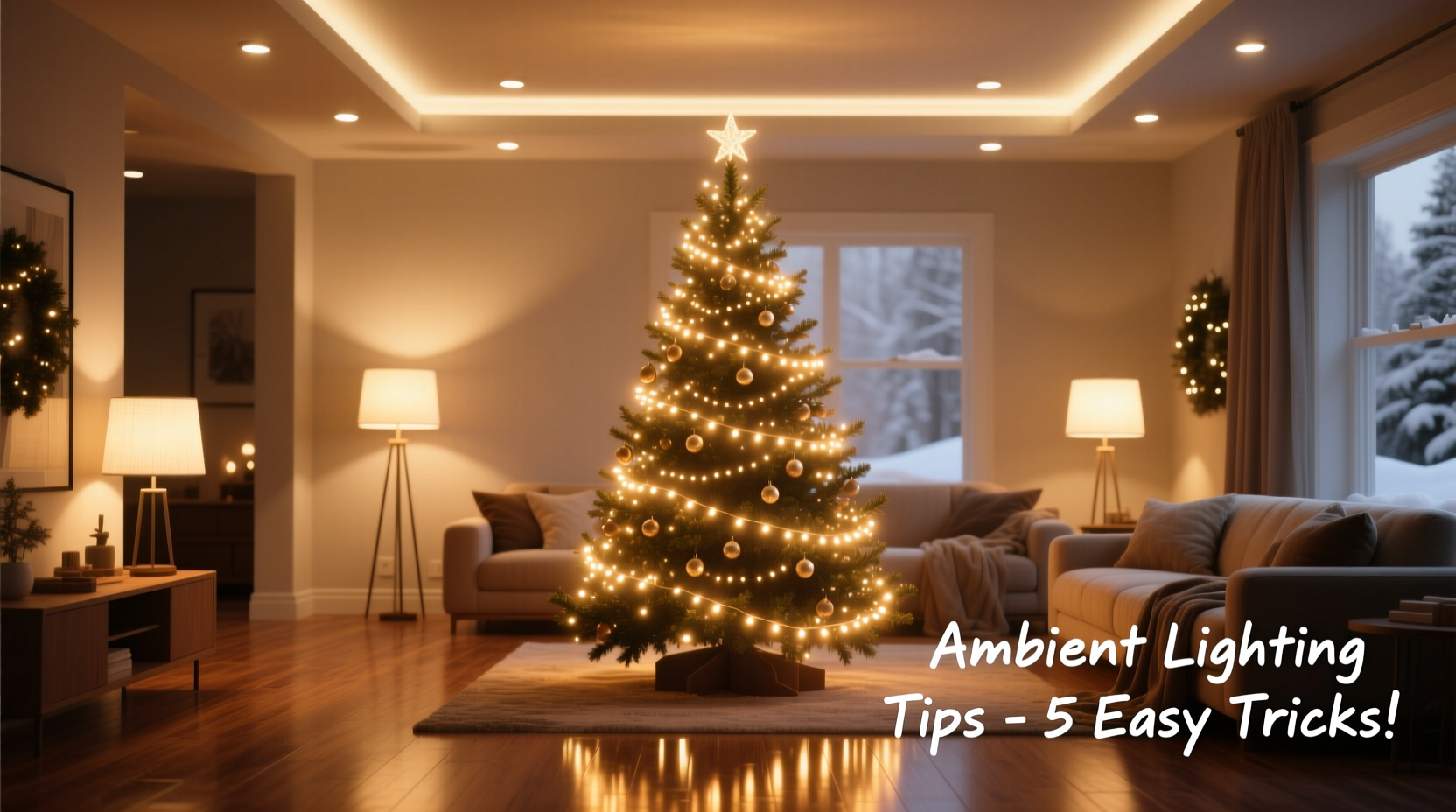
Effective interior lighting relies on layering three types: ambient, task, and accent. For holiday styling, the Christmas tree functions primarily as an accent light source—eye-catching and decorative. Ambient lighting forms the foundation, ensuring the room feels comfortable and cohesive. Task lighting, while less relevant here, might include reading lamps or kitchen fixtures that remain functional beneath the festive glow.
To properly complement your tree, ambient lighting should be subtle enough not to distract, yet sufficient to prevent the tree from appearing like a lone beacon in darkness. A room lit only by a Christmas tree can feel theatrical but unbalanced. Conversely, a brightly lit room diminishes the tree’s magic. The sweet spot lies in dim, warm-toned ambient light that supports rather than competes.
Choosing the Right Color Temperature
Color temperature, measured in Kelvin (K), dramatically affects how your tree appears. Cool white light (5000K–6500K) casts a bluish tone that can make warm-colored ornaments look dull and the overall scene feel sterile. Warm white (2700K–3000K), on the other hand, mimics candlelight and enhances golds, reds, and wood tones—ideal for supporting a traditional tree palette.
For optimal synergy, match your ambient lighting to the color temperature of your tree lights. If your tree uses vintage Edison-style bulbs or warm LED strands, ensure nearby lamps, sconces, and ceiling fixtures emit a similar warmth. This consistency prevents jarring transitions between light sources and reinforces a unified aesthetic.
“Lighting is emotional design. The warmth of a bulb can evoke nostalgia just as strongly as the scent of pine.” — Lena Torres, Interior Lighting Consultant
Strategic Placement of Ambient Fixtures
Where you place ambient lights determines how they interact with your tree. The objective is indirect illumination—bouncing light off walls, ceilings, and reflective surfaces to create soft washes of brightness.
- Cove lighting along the ceiling perimeter delivers a gentle upward glow that lifts the entire room without drawing attention to fixtures.
- Floor lamps with fabric shades placed behind or beside the tree cast diffused pools of light, adding depth and preventing shadow-heavy corners.
- Wall sconces at eye level provide mid-room brightness and can highlight adjacent decor like wreaths or artwork, tying the tree into a broader narrative.
- Dimmable overhead fixtures with warm bulbs offer centralized control. Lower them to 20–30% brightness to maintain presence without overpowering.
Avoid placing bright downlights or track lighting directly over the tree. These tend to flatten its dimensionality and wash out delicate ornament details.
Step-by-Step Guide: Creating a Balanced Glow Around Your Tree
Follow this sequence to integrate ambient lighting with your Christmas tree for maximum visual harmony:
- Assess your current lighting setup. Turn off all lights, then turn on only your intended ambient sources. Is the room comfortably visible? Are there dark zones near the tree?
- Position floor and table lamps. Place one lamp to the side or behind the tree, angled slightly toward the wall. This creates reflected light that wraps around the tree.
- Install dimmers. If not already present, replace standard switches with dimmer controls for ambient fixtures. This allows real-time adjustment based on time of day or activity.
- Add string lighting beyond the tree. Drape warm-white fairy lights along mantels, bookshelves, or windowsills to extend the festive theme and balance brightness across the room.
- Test at night. View the space after dark. Walk around the room—does the tree remain the focal point? Does the ambient light feel supportive, not distracting?
- Refine with reflectors. Place a mirrored tray under a nearby lamp or angle a decorative mirror to bounce more soft light toward the tree without adding fixtures.
Using Smart Lighting for Dynamic Control
Smart bulbs and lighting systems offer precision unmatched by traditional setups. With apps and voice commands, you can schedule ambient lights to gradually dim as evening progresses, syncing with the moment you typically turn on the tree.
Some advanced systems allow synchronization between ambient and tree lights. For example, Philips Hue or LIFX can be programmed so that when the tree lights are activated, ambient fixtures automatically lower to a preset warm level. You can even set “scene modes” like “Cozy Evening” or “Holiday Gathering,” which adjust multiple lights simultaneously for instant ambiance.
Consider grouping ambient lights in the same room as the tree into a single zone. This ensures uniform adjustments and simplifies control during frequent use.
Mini Case Study: The Urban Apartment Living Room
Sophie, a designer in Chicago, faced a challenge common to city dwellers: a small open-concept living area where the Christmas tree stood in front of a large window. During winter evenings, the dark glass turned into a mirror, reflecting the tree’s lights confusingly and creating visual clutter.
Her solution was strategic ambient lighting. She added two fabric-shaded floor lamps—one behind the sofa and one in the corner—to the right of the tree. Both used 2700K smart bulbs set to 25% brightness. She also installed adhesive LED strip lighting under her media console, aimed downward to create a subtle base glow.
The result? The room gained even illumination without competing with the tree. Reflections in the window softened, and the tree appeared grounded within the space rather than floating in darkness. Guests consistently commented on the “cinematic warmth” of the setting.
Do’s and Don’ts: Ambient Lighting for Christmas Trees
| Do | Don't |
|---|---|
| Use warm-white bulbs (2700K–3000K) for ambient fixtures | Use cool-white or daylight bulbs near the tree |
| Dim ambient lights to 20–40% when tree is illuminated | Leave ceiling lights at full brightness |
| Place lamps to bounce light off walls and ceilings | Point bright lights directly at the tree |
| Incorporate smart controls for easy adjustments | Rely solely on hardwired, non-dimmable fixtures |
| Extend theme with subtle string lights elsewhere | Overload other areas with competing displays |
Enhancing with Natural and Reflective Elements
Nature and reflective surfaces play a silent but powerful role in ambient lighting. Real trees emit a softer, more organic glow than artificial ones due to their textured foliage. Paired with low ambient light, the interplay of shadow and sparkle feels dynamic and alive.
Introduce materials that enhance diffusion and reflection:
- Mirrors placed opposite or beside the tree double its glow subtly.
- Polished wood furniture reflects warm tones, reinforcing coziness.
- Glittered or metallic decor on nearby shelves catches both tree and ambient light, creating secondary points of interest.
- Candles (real or flameless) add flicker and intimacy. Cluster tea lights on a coffee table or mantle to increase ambient movement.
Avoid high-gloss floors or glass tables directly in front of the tree—they can create distracting hotspots. Instead, use area rugs with subtle sheen or textured finishes to absorb and scatter light gently.
Checklist: Preparing Your Ambient Lighting for Christmas
Before turning on your tree this season, go through this checklist to ensure ambient lighting complements rather than competes:
- ☐ Replace any cool-white bulbs in nearby fixtures with warm-white (2700K–3000K)
- ☐ Install dimmer switches or smart bulbs for ambient lights
- ☐ Position floor or table lamps to provide indirect illumination near the tree
- ☐ Test lighting at night to evaluate balance and reflections
- ☐ Add string lights to adjacent features (mantel, shelves, windows) using the same color temperature
- ☐ Clean lampshades and fixtures to maximize light output
- ☐ Consider motion-activated or scheduled lighting for convenience
FAQ
Can I use colored ambient lighting with my Christmas tree?
Colored ambient lighting can work if used sparingly and strategically. For example, a faint blue glow on a cove ceiling might enhance a winter wonderland theme. However, most designers recommend keeping ambient light neutral or warm-white to avoid distorting the true colors of ornaments and tree lights. If using color, limit it to accent zones away from the tree.
How dim should ambient lighting be compared to the tree?
Ambient lighting should be approximately 20–40% of full brightness when the tree is on. The tree should remain clearly brighter, but the room should never feel dark or shadowy. A good test: you should be able to comfortably read a greeting card without straining, but your eyes naturally return to the tree as the focal point.
Is it necessary to change lighting if I have an artificial tree?
Artificial trees often reflect light more uniformly than real ones, sometimes creating a “flat” appearance. Ambient lighting becomes even more important here to add depth and break up monotony. Use layered lighting to simulate the organic variation found in natural trees. Soft shadows and background glow help artificial trees feel more lifelike.
Conclusion: Let the Glow Speak for Itself
The most memorable holiday spaces aren’t those overloaded with lights, but those where every element works in harmony. Your Christmas tree deserves to be seen in its best light—not just from within, but from the environment that surrounds it. By mastering ambient lighting, you’re not just illuminating a room; you’re crafting an experience. One that feels intimate, intentional, and enduring.
Start simple: adjust one lamp, install a dimmer, reposition a mirror. Small changes yield profound results when guided by the principle of support over spectacle. This season, let your tree glow not because it’s the only light in the room—but because everything around it knows how to let it shine.




 浙公网安备
33010002000092号
浙公网安备
33010002000092号 浙B2-20120091-4
Comments
No comments yet. Why don't you start the discussion?