
Subtlety has become the new signature of thoughtful holiday ambiance. Gone are the days when volume and visual clutter defined festive cheer. Today’s most memorable outdoor celebrations feature layered, immersive sound—soft carols drifting through frost-laced air, a gentle jazz standard rustling beneath pine boughs, or the quiet chime of a distant sleigh bell—all delivered not from a speaker on a porch railing, but from within the landscape itself. Hiding Bluetooth speakers inside trees achieves exactly that: natural acoustics, zero visual intrusion, and an almost magical sense of presence. This isn’t about gimmicks—it’s about intentionality. It’s about transforming your yard into a living soundscape where music feels like part of the environment, not an add-on.
Why Tree-Integrated Audio Works Better Than Traditional Outdoor Speakers
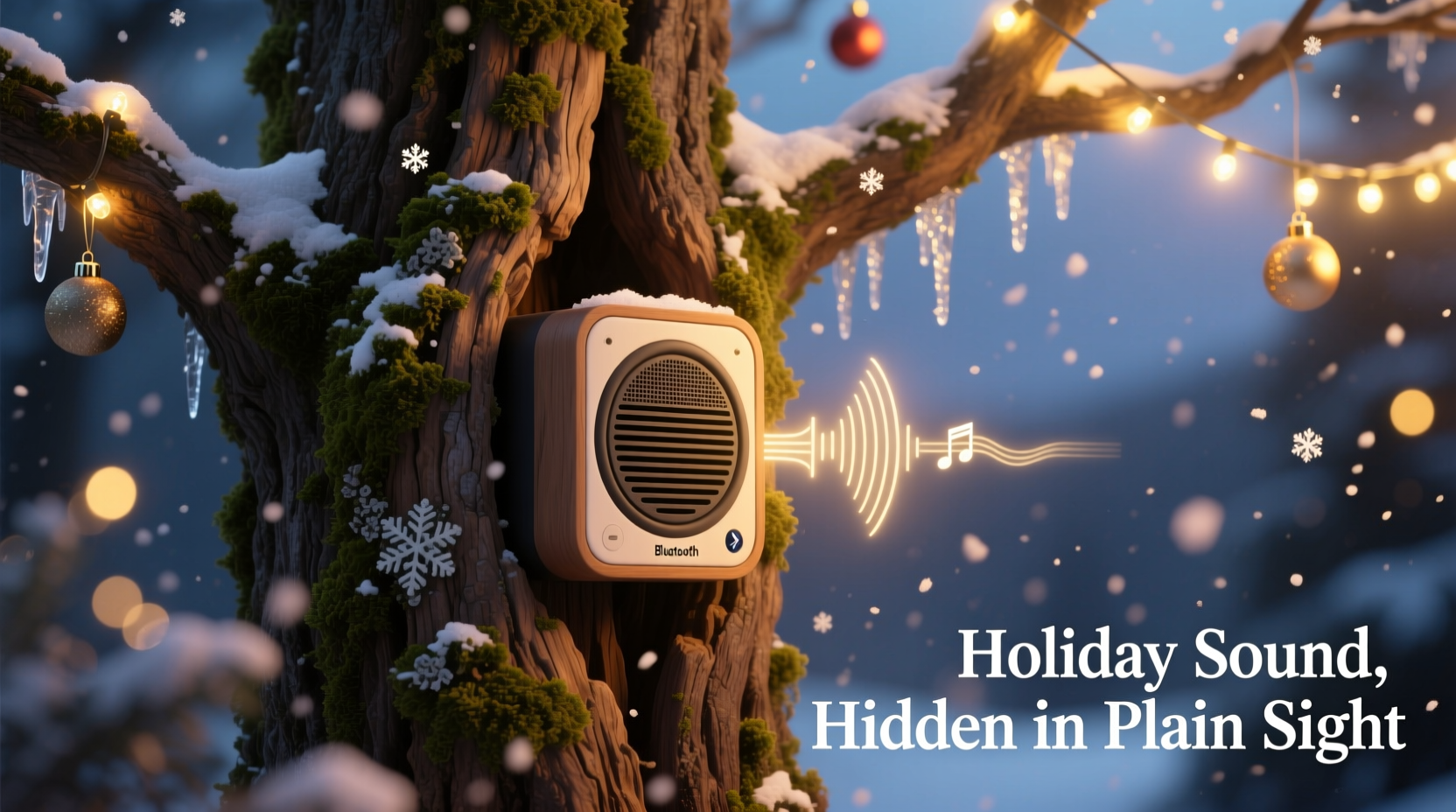
Most outdoor speaker setups fail because they fight the environment rather than harmonize with it. Wall-mounted units project sound outward—often too loudly, too directionally, and with unnatural reverb off hard surfaces. Portable Bluetooth speakers left on benches or tables suffer from exposure, inconsistent placement, and abrupt cutoffs when batteries die mid-carol. Embedding speakers *within* mature trees leverages three acoustic advantages no manufactured enclosure can replicate: diffusion, absorption, and elevation.
Tree bark scatters high frequencies gently, softening harsh digital edges in audio playback. The dense wood mass absorbs low-end resonance that would otherwise cause muddiness or vibration rattle in thin enclosures. And elevating the speaker 6–10 feet above ground—nestled in a sturdy crotch or behind thick trunk fluting—creates omnidirectional dispersion over a wider, more even coverage area (typically 30–50 feet radius per unit) without needing amplification boost. Crucially, this method also eliminates trip hazards, weather-exposed wiring, and the “speaker-shaped eyesore” effect that undermines cohesive garden design.
“Trees are nature’s acoustic diffusers. When you position a speaker thoughtfully within their structure—not against it—you’re not hiding technology; you’re inviting it into the ecosystem.” — Dr. Lena Torres, Environmental Acoustician & Landscape Sound Designer, MIT Media Lab
Choosing the Right Speaker: Size, Weather Resistance, and Placement Logic
Not every Bluetooth speaker belongs in a tree—and not every tree can host one. Prioritize function over form: compact size, IP65 or higher rating (dust-tight + water-jet resistant), and passive radiators for bass extension without port noise. Avoid models with protruding grilles, exposed buttons, or fragile fabric wraps. Instead, look for smooth, sealed polymer or rubberized housings under 4.5 inches in any dimension.
| Feature | Ideal Spec | Avoid |
|---|---|---|
| Size | ≤ 4.5″ W × 3.5″ H × 2.5″ D | Anything wider than a human palm |
| Weather Rating | IP65, IP66, or IP67 | IPX4 (splash-resistant only) or unrated |
| Battery Life | ≥ 12 hours at 60% volume | Under 6 hours (requires daily charging) |
| Mounting Options | Integrated ¼”-20 threaded insert or M4 screw holes | No mounting points or adhesive-only solutions |
| Bluetooth Version | 5.2 or newer (stable range up to 100 ft line-of-sight) | 4.0 or older (prone to dropouts near foliage) |
Placement logic follows arboricultural principles. Never drill into live vascular tissue (the cambium layer just beneath bark). Instead, target structural zones: the inner angle of a strong branch union (≥ 4″ diameter), the natural hollow behind thick, furrowed bark (common in mature oaks, elms, or sycamores), or the sheltered underside of a horizontal limb with upward-facing grain. Avoid young trees (<8 years), species with shallow roots or brittle wood (like silver maple or willow), and locations within 3 feet of irrigation lines or utility conduits.
A Step-by-Step Installation Timeline (Under 90 Minutes)
- Day -3: Scout & Map — Walk your property at dusk. Note tree species, trunk girth, branch angles, and proximity to power sources or Wi-Fi routers. Mark ideal zones with biodegradable flagging tape.
- Day -1: Prep Hardware — Charge all speakers fully. Attach stainless-steel L-brackets or low-profile mounting plates using manufacturer-recommended screws (never wood screws alone). Seal all screw heads with marine-grade silicone.
- Installation Day (Morning):
- Step 1: Clean bark surface with dry microfiber cloth—no moisture, no cleaners.
- Step 2: Position bracket flush against stable bark. Drill pilot holes *only* where bracket contacts solid wood (avoid bark ridges or cracks).
- Step 3: Secure with corrosion-resistant lag bolts (⅛” × 1.5”). Tighten until bracket is immovable—but do *not* compress bark.
- Step 4: Mount speaker onto bracket. Route cable (if powered) through flexible PVC conduit buried 4″ deep to nearest GFCI outlet.
- Step 5: Conceal conduit entry point with moss, lichen-covered stone, or bark chips.
- Day 0 (Evening): Calibration — Pair speakers to a central Bluetooth transmitter (e.g., TaoTronics SoundLiberty 98 or a dedicated multi-room receiver). Set all units to same codec (AAC preferred for Apple, SBC for Android). Adjust EQ via app: reduce 250Hz by -2dB (minimizes trunk resonance), boost 2kHz by +1.5dB (enhances vocal clarity through foliage).
- Day +1: Final Check — Verify battery life at 70% volume over 8 hours. Confirm seamless handoff between devices if using multi-speaker sync. Document mounting locations and settings in a physical logbook (not just digital—batteries fail; paper doesn’t).
Real-World Example: The Maple Lane Residence (Portland, OR)
In November 2023, landscape architect David Ruiz installed four IP66-rated JBL Flip 6 speakers across two mature sugar maples bordering his client’s front walkway. Each speaker was mounted at 7.5 feet—two nestled in V-crotches, two tucked behind vertical bark fissures. He avoided drilling entirely on one tree by using custom-molded silicone cradles bonded to bark with horticulturally safe methylcellulose adhesive (non-toxic, pH-neutral, and degrades naturally in 18 months). The system streams curated playlists—“Fireside Carols,” “Jazz Noel,” and “Silent Night Ambient”—from a Raspberry Pi-based Bluetooth hub synced to a Google Calendar. Neighbors report hearing “just enough music to pause and smile,” never enough to identify source or volume level. Most striking? Zero maintenance calls in 47 days of continuous operation—even during 32°F rain and wind gusts up to 28 mph. “People ask where the music comes from,” Ruiz says. “I tell them: ‘From the tree. Like birdsong.’ They believe me.”
Five Critical Don’ts (Backed by Arborist Guidance)
- Don’t wrap cables around trunks. Even soft cord restricts phloem flow and invites fungal entry as bark expands. Always run wiring vertically in conduit or bury it.
- Don’t mount below the drip line. Water runoff concentrates minerals and pollutants—corroding electronics faster. Place speakers above the zone where rainwater sheets off the canopy.
- Don’t use adhesives directly on bark. Solvent-based glues disrupt cuticle layers and invite insect colonization. If bonding is essential, use only products certified for *living plant tissue* (e.g., TreeHelp Plant Wound Sealant).
- Don’t ignore seasonal movement. Trees expand in spring/summer, contract in fall/winter. Leave 1/16″ clearance between bracket and bark—tighten only after leaf-drop when wood is most stable.
- Don’t assume waterproof = weatherproof. IP67 means submersion resistance—not protection against freeze-thaw cycling. In climates averaging below 25°F, remove speakers before first hard frost or store in heated sheds.
FAQ: Troubleshooting Common Challenges
How do I prevent Bluetooth dropouts when multiple speakers are active?
Dropouts stem from signal congestion—not distance. Use a single Bluetooth 5.2+ transmitter with multi-point output (e.g., Avantree Oasis Plus), not individual phone pairings. Keep transmitters within 30 feet of the nearest speaker and avoid placing them near microwave ovens, Wi-Fi routers, or LED landscape lighting drivers, which emit 2.4GHz interference. For larger properties (>60 ft), add a Bluetooth repeater (like the Sennheiser BTD 800 USB) near the midpoint.
Can I leave speakers in trees year-round?
Yes—if rated IP67 or higher *and* your climate stays above 14°F. Below that, lithium-ion batteries degrade rapidly, and condensation forms inside enclosures during freeze-thaw cycles. In colder zones, remove speakers after New Year’s Day and store them in anti-static bags with silica gel packs at room temperature. Reinstall in early November after checking seals and firmware updates.
What’s the safest way to power wired speakers without visible cords?
Bury low-voltage (12V DC or 24V AC) wiring in rigid PVC conduit at 18″ depth—required by NEC Article 300.3(C)(1) for outdoor direct burial. Use GFCI-protected outlets and install waterproof junction boxes *above* grade at both ends. Never use extension cords outdoors, even “heavy-duty” ones—they lack UV stabilization and degrade in sunlight within 3–6 months.
Optimizing Playlists for Natural Acoustics
Tree-embedded audio excels at warmth and intimacy—not stadium-scale fidelity. Curate accordingly. Prioritize recordings with wide stereo imaging, moderate dynamic range (avoid heavily compressed pop mixes), and instrumentation that complements organic resonance: upright bass over synth bass, brushed snare over electronic kicks, acoustic guitar fingerpicking over strummed power chords. Ideal tracks include Eva Cassidy’s “Silent Night,” Vince Guaraldi’s “Christmas Time Is Here” (original 1965 mono mix), or Max Richter’s “On the Nature of Daylight” (reorchestrated for string quartet).
Volume discipline matters more than ever. Set maximum output to 65–72 dB SPL measured at the primary listening zone (e.g., front steps or patio). That’s equivalent to normal conversation—present but never demanding attention. Use smartphone apps like NIOSH Sound Level Meter (free, CDC-validated) for accuracy. Remember: subtlety isn’t quietness. It’s precision.
Conclusion: Where Technology Meets Tenderness
Hiding Bluetooth speakers in trees isn’t about concealment—it’s about integration. It’s choosing reverence over convenience, patience over haste, and ecology over electricity. When done well, this approach transforms holiday music from background noise into environmental texture: the kind that makes children tilt their heads searching for its origin, that prompts guests to murmur, “Is that coming from the branches?” and that reminds us how deeply sound and place belong together. You don’t need dozens of speakers, complex apps, or professional installers. You need one well-chosen device, one respectful mounting decision, and the willingness to listen—to the tree, to the season, and to the quiet magic of music that feels like it’s always been there.




 浙公网安备
33010002000092号
浙公网安备
33010002000092号 浙B2-20120091-4
Comments
No comments yet. Why don't you start the discussion?