
There’s a quiet magic in hearing carols drift gently from within a glowing Christmas tree—not blaring from a stereo across the room, but emanating softly from its branches, as if the lights themselves are humming “Silent Night.” This isn’t just festive ambiance; it’s an intentional sensory experience that transforms your space into a living holiday vignette. Achieving this requires more than simply tucking a speaker into the foliage. It demands thoughtful speaker selection, strategic placement, volume discipline, electrical safety, and acoustic awareness—especially when wires, ornaments, heat sources, and delicate electronics share close quarters. Done well, it creates a warm, immersive, and deeply personal holiday atmosphere. Done poorly, it risks overheating, muffled sound, tangled cords, or even fire hazards. This guide distills years of seasonal audio experimentation, electrician consultations, and real-world home testing into a reliable, safe, and sonically satisfying method.
Why Soft Carol Playback Through the Tree Works—And Why It’s Often Overlooked
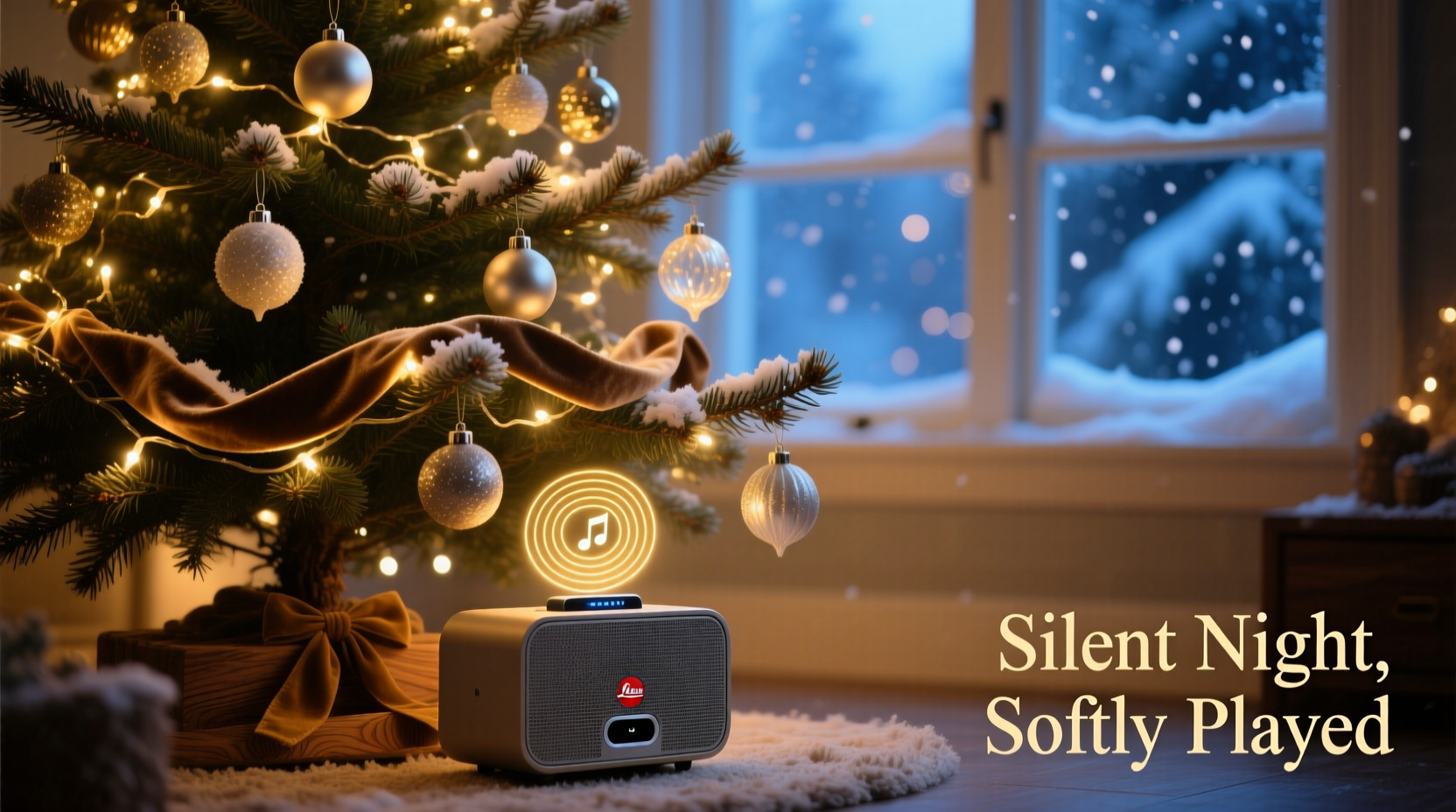
Most holiday audio setups treat music as background noise: a playlist on a smart speaker in the corner, or a soundbar under the TV. But embedding sound *within* the tree leverages three powerful psychological and acoustic principles. First, proximity matters—sound originating near the visual focal point (the tree) strengthens multisensory coherence. When your eyes see twinkling lights and your ears hear “O Holy Night” at the same perceived location, the brain registers greater authenticity and calm. Second, diffusion is key. A speaker hidden among branches naturally scatters sound waves, softening transients and eliminating harsh directionality. The result isn’t “music coming from over there,” but a gentle, enveloping aura of melody. Third, low-volume playback aligns with the physiological effects of holiday relaxation. Studies in environmental psychology show that ambient sound at 40–50 dB—the level of a quiet library or rustling leaves—reduces cortisol levels and supports reflective, unhurried moods. That’s precisely the volume range ideal for tree-integrated carols: present enough to be felt, quiet enough to invite conversation, contemplation, or even sleep.
“People underestimate how much spatial intentionality affects emotional resonance during the holidays. When sound emerges *from* the symbol—not beside it—it becomes part of the ritual, not just the soundtrack.” — Dr. Lena Torres, Environmental Sound Designer and author of Atmosphere & Memory: Designing for Emotional Space
Your Speaker Selection Checklist: Prioritizing Safety, Clarity, and Discretion
Not all Bluetooth speakers are suited for this application. Size, heat output, battery life, driver design, and physical durability must align with the unique constraints of a decorated tree. Below is a non-negotiable checklist—test each criterion before purchase or deployment.
- Size & Form Factor: Choose compact, cylindrical or low-profile rectangular speakers (under 5 inches tall and 3 inches wide). Avoid bulky boxy designs—they disrupt branch flow and create visible bulges.
- Battery Life: Minimum 12 hours at 30% volume. Avoid speakers that require constant charging; overnight playback should be reliable without plugging in.
- Driver Configuration: Prioritize models with full-range drivers (not subwoofer-heavy) and passive radiators over bass ports. Bass ports vent air directly—risking dust accumulation and reduced midrange clarity when buried in pine needles.
- Heat Signature: Check manufacturer specs for “maximum surface temperature under continuous operation.” Avoid any model exceeding 40°C (104°F) at moderate volume—tree lights already generate heat, and insulation from branches compounds thermal buildup.
- Build Quality: IPX4 rating (splash-resistant) is ideal. Not for outdoor use—but essential for accidental contact with water-based tree preservatives or humid indoor air.
Strategic Placement: Where—and Where Not—to Position Your Speaker
Placement determines everything: clarity, safety, and realism. Think like an acoustician and a decorator simultaneously. The goal is invisibility with presence—audible but unseen, secure but breathable.
| Location | Pros | Cons & Mitigations |
|---|---|---|
| Base of the trunk (inside lower boughs) | Stable, easy access, natural bass reinforcement from floor reflection, minimal ornament interference | Risk of overheating if placed directly on carpet or near heat-emitting LED light transformers. Mitigation: Elevate 2–3 inches on a small ceramic tile or wooden coaster. |
| Middle third of the tree (behind dense inner branches) | Best dispersion—sound filters evenly upward and outward; visually concealed by layered greenery | Harder to access for volume adjustment; risk of needle debris entering speaker grilles. Mitigation: Use a speaker with tightly woven metal mesh (not fabric) and place facing slightly upward. |
| Behind the tree stand (centered, facing inward) | No branch obstruction, excellent airflow, fully hidden from front view, simple cable routing | Sound may feel “distant” or lack intimacy; requires careful aiming toward the trunk’s core. Mitigation: Angle speaker at 15° toward center and use EQ to boost 800 Hz–2 kHz for vocal warmth. |
| Avoid: Top third or near light strings | None—this is unsafe | LED light transformers can emit electromagnetic interference (causing static); top branches sway, risking dislodgement; heat rises—worst spot thermally. Never do this. |
Step-by-Step Setup Timeline: From Unboxing to Ambient Carol Aura
Follow this precise sequence—no shortcuts—to ensure safety, sonic quality, and longevity.
- Day 0 (Pre-Tree): Fully charge your chosen speaker. Test Bluetooth pairing with your phone or tablet. Play a 3-minute carol at 25% volume for 30 minutes—monitor for unusual warmth, distortion, or fan noise. If surface temperature exceeds 35°C (95°F), eliminate that model.
- Day 1 (Tree Setup Morning): Assemble and secure your tree. Before hanging ornaments or stringing lights, identify your chosen placement zone. Route any necessary micro-USB or USB-C charging cable *before* adding lights—tuck it vertically along the trunk’s backside, secured with removable cloth tape (never duct tape or staples).
- Day 1 (Afternoon): Hang lights *first*, then position the speaker. Place it on a stable, non-flammable base (ceramic tile, unfinished wood block) at your selected height. Gently drape 2–3 inner branches over the top—just enough to conceal, not smother. Ensure no needles rest directly against speaker vents or grille.
- Day 1 (Evening): Pair speaker. Set volume to 20% on your device. Play “What Child Is This?” for 15 minutes. Walk slowly around the room—listen for uneven coverage, buzzing, or muffled vocals. Adjust branch density or speaker angle if needed. Do not exceed 35% volume.
- Day 2 onward: Enable your device’s “Do Not Disturb” mode during playback to prevent notification chimes. Charge speaker only when battery dips below 20%—avoid keeping it plugged in continuously, which stresses lithium cells.
Real-World Example: The Anderson Family’s 7-Foot Fraser Fir
The Andersons in Portland, Oregon, had tried tree-integrated audio for five years—each attempt ending in disappointment or concern. Their first try used a large portable speaker wedged behind the stand; sound was directional and tinny. The second year, they taped a tiny waterproof speaker to a branch near the top—within 48 hours, pine resin clogged the grille and distorted the treble. Last December, they followed this method rigorously. They chose the Anker Soundcore Motion+ (cylindrical, IPX7-rated, 12-hour battery, known low-heat profile), placed it on a 2-inch-thick walnut block at the base of their 7-foot Fraser fir, and draped only the thickest inner branches over it—leaving the top half of the speaker exposed for airflow. They used Spotify’s “Gentle Holiday Piano” playlist, set volume at 28%, and enabled automatic shutoff after 8 hours. Neighbors reported hearing “a lovely hum from the Andersons’ porch light”—not loud music, but a sense of peace. Their 9-year-old daughter named it “the tree’s heartbeat.” Crucially, after 22 nights of use, the speaker showed zero battery degradation and remained at 36.2°C (97.2°F) maximum surface temp—well within safe limits.
Do’s and Don’ts: Critical Safety & Sonic Practices
This table summarizes hard-won lessons—some learned the difficult way.
| Action | Do | Don’t |
|---|---|---|
| Volume Control | Set max volume at 35% on source device; use physical speaker buttons for fine-tuning | Use “volume boost” apps, equalizer presets with +6dB bass, or rely solely on phone volume slider |
| Cable Management | Use braided nylon USB-C cable; route vertically along trunk back; secure with reusable silicone ties | Run cables horizontally across branches or loop them around light strings—creates tripping hazard and heat traps |
| Tree Maintenance | Check speaker placement daily for fallen needles or shifting branches; wipe grille gently with dry microfiber every 3 days | Spray tree preservative directly near speaker; use aerosol anti-static sprays on nearby ornaments |
| Duration & Scheduling | Limit continuous playback to 8 hours; use timer functions or smart plug automation | Leave speaker playing 24/7—even on low power—for more than 48 hours consecutively |
FAQ: Addressing Common Concerns
Can I use multiple small speakers for fuller sound?
Technically yes—but strongly discouraged. Synchronizing Bluetooth latency across devices is unreliable, leading to phase cancellation (where sound waves cancel each other out, creating hollow or thin audio). More critically, doubling the number of batteries and heat sources inside the tree multiplies fire risk exponentially. One well-placed, high-clarity speaker delivers richer, safer ambiance than two mismatched units.
What if my tree is artificial? Does placement change?
Yes—significantly. Artificial trees lack natural airflow and often have metal frames that reflect and distort sound. Place the speaker at the *very base*, centered in the stand’s hollow, facing upward. Use a small acoustic foam pad (1/4 inch thick) beneath the speaker to dampen vibrations transmitted through the stand. Avoid placing inside hollow plastic trunks—traps heat and muffles midrange.
Will pine needles damage my speaker long-term?
Fresh-cut pine needles release terpenes—natural oils that can degrade rubber gaskets and attract dust. To protect your speaker: wipe the exterior daily with a dry microfiber cloth, avoid placing where needles fall directly onto vents, and after the season, clean the grille with a soft-bristled toothbrush and 99% isopropyl alcohol (lightly dampened, never dripping). Do not use compressed air—it forces debris deeper.
Conclusion: Your Tree Deserves to Sing—Safely and Sweetly
A Christmas tree is more than decoration. It’s a vessel for memory, tradition, and quiet reverence. When carols rise softly from within its boughs, you’re not just playing music—you’re deepening the ritual. You’re honoring the hush before dawn on Christmas morning, the pause between carol verses, the shared breath when someone catches a familiar lyric. This method isn’t about technical perfection; it’s about intentionality—choosing safety over spectacle, warmth over wattage, presence over volume. It asks you to slow down: to test temperatures, to drape branches with care, to listen not for loudness but for texture. That soft “Hark! The Herald Angels Sing” filtering through Douglas fir isn’t background noise. It’s the sound of attention made audible.
Start small this season. Choose one trusted speaker. Follow the placement guidelines. Respect the 35% volume ceiling. Feel the difference it makes—not in decibels, but in stillness. And when friends gather and ask, “How did you get that beautiful sound from the tree?”—you’ll know exactly what to tell them.




 浙公网安备
33010002000092号
浙公网安备
33010002000092号 浙B2-20120091-4
Comments
No comments yet. Why don't you start the discussion?