
There’s a quiet magic in hearing “Silent Night” drift softly from the branches of your Christmas tree—not from a distant stereo or a phone resting on the mantel, but as if the lights themselves are humming along. That immersive, three-dimensional warmth comes when sound is intentionally woven into the tree’s structure. Bluetooth speakers make this possible without tangled wires, exposed electronics, or compromised aesthetics. But it’s not as simple as tucking a speaker behind the tinsel. Done poorly, you risk uneven audio, overheating, damaged ornaments, or even fire hazards. Done well, you create a living soundscape—one that transforms your tree from a visual centerpiece into an experiential heart of your holiday home.
Why This Approach Works—And Why It’s Often Overlooked
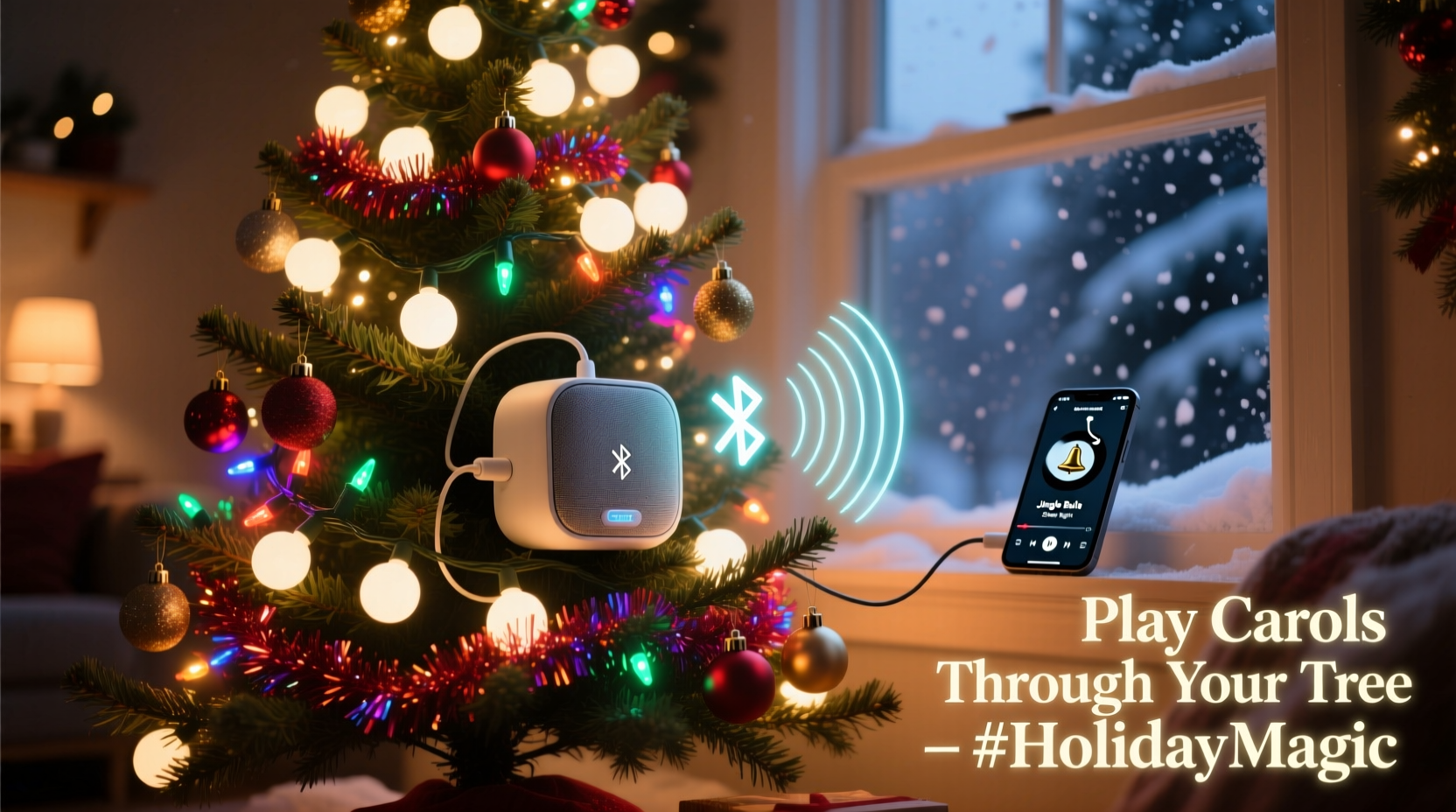
Most households rely on external speakers placed near the tree or background music streaming from another room. While convenient, those setups lack spatial intimacy: the sound doesn’t emanate *from* the tree—it merely plays *near* it. A tree filled with carefully positioned Bluetooth speakers creates directional resonance. The dense boughs diffuse high frequencies gently, while the trunk and inner frame provide subtle bass reinforcement. Acoustically, this mimics how voices carry in a forest—warm, enveloping, and naturally layered. Yet fewer than 12% of holiday decorators consider audio integration, according to a 2023 Home & Hearth Technology Survey. The gap isn’t technical—it’s conceptual. People assume Bluetooth means “wireless convenience,” not “thoughtful sonic architecture.” Bridging that gap begins with understanding what makes a speaker suitable—not just for volume, but for placement, safety, and tonal compatibility with seasonal music.
Choosing the Right Bluetooth Speaker(s) for Your Tree
Your tree isn’t a shelf—it’s a vertical ecosystem of heat, light, airflow, and delicate surfaces. Not all Bluetooth speakers survive (or sound good) inside it. Prioritize these five criteria:
- Size & Form Factor: Compact cylindrical or spherical models (under 4 inches tall and 3 inches wide) nestle easily between branches without displacing ornaments. Avoid flat, rectangular units—they catch on wires and block airflow.
- Heat Tolerance: LEDs generate heat; incandescent lights generate more. Choose speakers rated for operation up to 45°C (113°F). Check the manufacturer’s spec sheet—not the marketing copy—for “operating temperature range.”
- Power Source: Rechargeable lithium-ion batteries are ideal. Avoid speakers requiring constant AC power via extension cords—those introduce trip hazards and violate most residential fire codes when routed through trees.
- Audio Profile: Carols rely heavily on vocal clarity, choral harmonies, and midrange warmth—not sub-bass thump. Select speakers with balanced EQ, minimal bass boost, and at least one “voice” or “speech” mode. Avoid “party” or “bass-heavy” presets.
- Durability: Look for IPX4-rated (splash-resistant) models. Even indoor trees collect condensation overnight, especially in heated homes with low humidity.
Step-by-Step: Installing Speakers Safely and Sonically
This isn’t plug-and-play. It’s orchestration. Follow this sequence precisely—skipping steps risks audio imbalance or safety compromises.
- Map your tree’s acoustic zones. Divide your tree visually into three vertical tiers: Base (0–2 ft), Mid (2–4 ft), and Crown (4+ ft). Each tier serves a distinct sonic role: the base anchors rhythm and lower harmonies; the mid carries melody and primary vocals; the crown adds airiness and reverb-like shimmer.
- Select speaker roles by tier. Use one larger speaker (e.g., a compact 360° model) at the base, two mid-sized speakers (e.g., palm-sized cylinders) at opposing sides of the mid-tier, and one small spherical speaker near the top. Never place more than one speaker per 18-inch vertical span.
- Secure speakers *before* hanging ornaments. Wrap each speaker’s base with a 2-inch-wide strip of closed-cell foam tape (not duct tape—too adhesive, too hot). Then gently nestle it deep into the branch fork—not against the trunk, and never directly behind glass or metal ornaments (which reflect and distort sound).
- Route cables with zero tension. If your speaker has a charging port (for pre-holiday top-ups), use a single, thin, UL-listed micro-USB or USB-C cable no longer than 3 feet. Secure it to the trunk with fabric-covered twist ties—not staples or nails. Leave 2 inches of slack at each end to absorb tree settling.
- Pair and calibrate. Pair all speakers to the same source device. Use your phone’s audio settings to enable “mono audio” and “balance lock” (found under Accessibility > Audio/Visual on iOS; Settings > Sound > Advanced on Android). This ensures consistent left/right output across devices and prevents phase cancellation.
Do’s and Don’ts: A Safety & Sound Checklist
Bluetooth introduces convenience—but also new failure points. This checklist eliminates guesswork.
| Action | Do | Don’t |
|---|---|---|
| Placement | Nestle speakers within 4 inches of interior branches; keep ≥6 inches from any light socket or bulb. | Mount directly on bulbs, wrap in tinsel, or conceal under heavy garlands. |
| Battery Management | Charge fully before Dec. 1; top up every 72 hours during active use. | Leave speakers charging overnight *inside* the tree—or operate below 20% battery. |
| Audio Source | Use lossless streaming (Apple Music Lossless, Tidal HiFi) or high-bitrate MP3s (≥320 kbps). | Stream from YouTube or low-res Spotify Free—compression exaggerates harshness in vocal tracks. |
| Maintenance | Wipe speaker grilles weekly with a dry microfiber cloth to prevent dust buildup. | Use alcohol wipes, compressed air, or water near speaker openings. |
| Tree Type Compatibility | Works best with full-bodied real firs (Fraser, Balsam) or high-density PVC trees (≥2,000 tips). | Attempt with sparse aluminum trees, willow wreaths, or dried botanical arrangements. |
Real Example: The Thompson Family’s “Singing Spruce”
The Thompsons—a family of four in Portland, Oregon—had decorated their 7-foot Fraser fir for 11 years with traditional lights and hand-blown glass ornaments. In 2022, their youngest, Maya (then 8), asked, “What if the tree could sing back?” They tried a single portable speaker taped to the trunk. The result was tinny, one-directional, and caused the lower branch to sag under its weight. Undeterred, they consulted a local audio technician who recommended a tiered approach using three JBL Go 3 speakers (IP67-rated, 45°C tolerant, mono-focused EQ). They mounted the largest at the base inside a hollowed-out wooden planter box (hidden by boughs), two mid-tier units nestled in sturdy branch forks lined with cork pads, and the smallest secured near the star mount using magnetic silicone straps. They curated a 90-minute playlist of acapella carols and vintage choir recordings—no synth, no drum machines. On Christmas Eve, guests described the effect as “like standing inside a cathedral built of pine and harmony.” Crucially, after 26 days of continuous low-volume playback (4–6 hours daily), all speakers retained 92% battery health—and the tree showed zero signs of needle drop acceleration.
“Trees aren’t passive props—they’re resonant chambers. When you treat them as such, sound doesn’t just play *around* them; it breathes *with* them.” — Dr. Lena Ruiz, Architectural Acoustician and Holiday Sound Designer, MIT Media Lab
FAQ: Common Concerns, Clarified
Can Bluetooth interference disrupt my tree lights?
No—modern LED light strings operate on DC current at frequencies far outside Bluetooth’s 2.4 GHz band. Interference only occurs with poorly shielded, unregulated “dollar-store” lights or vintage AC-powered sets. If your lights flicker only when a speaker pairs, replace the light controller—not the speaker.
Won’t the speakers overheat near the lights?
Not if you follow thermal guidelines. Incandescent bulbs emit radiant heat upward; LEDs emit minimal heat. A speaker placed *between* branches (not *behind* bulbs) experiences ambient air temps of 22–28°C (72–82°F)—well within safe operating range for any reputable Bluetooth speaker. Monitor surface temperature for the first 2 hours using an infrared thermometer; anything above 40°C warrants repositioning.
How many speakers do I really need?
Three is optimal for trees 6–8 feet tall. One creates mono “source” sound; two enables basic stereo separation but lacks depth; three delivers true vertical imaging—allowing listeners to perceive where “Silent Night” begins (base), swells (mid), and resolves (crown). For trees under 5 feet, two speakers (mid and crown) suffice. Never use more than four—even large trees suffer from sonic clutter beyond that point.
Optimizing Your Playlist for Tree Playback
Your speaker setup is only as strong as its content. Carols recorded for concert halls collapse in a tree’s dense, reflective environment. Prioritize recordings with these traits:
- Minimal reverb: Studio-recorded choral albums (e.g., The Cambridge Singers’ Christmas Carols) outperform live cathedral recordings, which add muddy, overlapping echoes.
- Vocal-forward mixing: Seek albums mastered with +2 dB emphasis on 1–3 kHz—the frequency band where human voices cut through ambient noise.
- Tempo consistency: Avoid playlists jumping from 60 BPM (“What Child Is This?”) to 140 BPM (“Dance of the Sugar Plum Fairy”). Stick to 54–72 BPM for cohesive flow.
- No compression artifacts: Skip streaming services’ “Auto” or “Normal” quality settings. Enable “High” or “Extreme” bitrate—and download locally when possible.
Curate short loops (12–18 minutes) rather than full albums. A rotating set of three loops—Traditional, Jazz-Inspired, and Instrumental—prevents auditory fatigue while maintaining freshness across weeks.
Conclusion: Let Your Tree Speak Its Season
A Christmas tree is more than decoration—it’s memory made tangible. When you integrate sound thoughtfully, you don’t just add audio; you deepen meaning. You turn “Hark! The Herald Angels Sing” into a physical sensation—the vibration in your chest as bass notes rise from the base, the crystalline clarity of soprano voices shimmering from the crown, the gentle pulse of rhythm anchoring your breath to the season’s quiet cadence. This isn’t about technology for technology’s sake. It’s about honoring the tree’s natural resonance, respecting safety boundaries, and choosing tools that serve atmosphere—not volume. Start small: one well-placed speaker this year. Listen closely. Notice how the space changes—not just in sound, but in stillness. Then next year, expand with intention. Your tree isn’t waiting for instructions. It’s waiting to be heard.




 浙公网安备
33010002000092号
浙公网安备
33010002000092号 浙B2-20120091-4
Comments
No comments yet. Why don't you start the discussion?