
Dorm rooms are small, temporary, and tightly regulated spaces—yet they’re also where students build community, express identity, and seek comfort during long academic terms. For many, stringing up a few warm-white LED lights transforms a sterile cinderblock box into something that feels like home—especially during the holidays. But here’s the reality: most university housing policies prohibit standard holiday lighting outright, not because administrators dislike cheer, but because of well-documented fire risks tied to overloaded circuits, flammable materials, and improper installation. The good news? It’s entirely possible to create a safe, inviting, code-compliant glow—*if* you understand what the codes actually require, how enforcement works on campus, and which products and techniques meet those standards. This isn’t about loopholes. It’s about working *with* safety infrastructure—not around it.
Why dorm fire codes treat lights so strictly
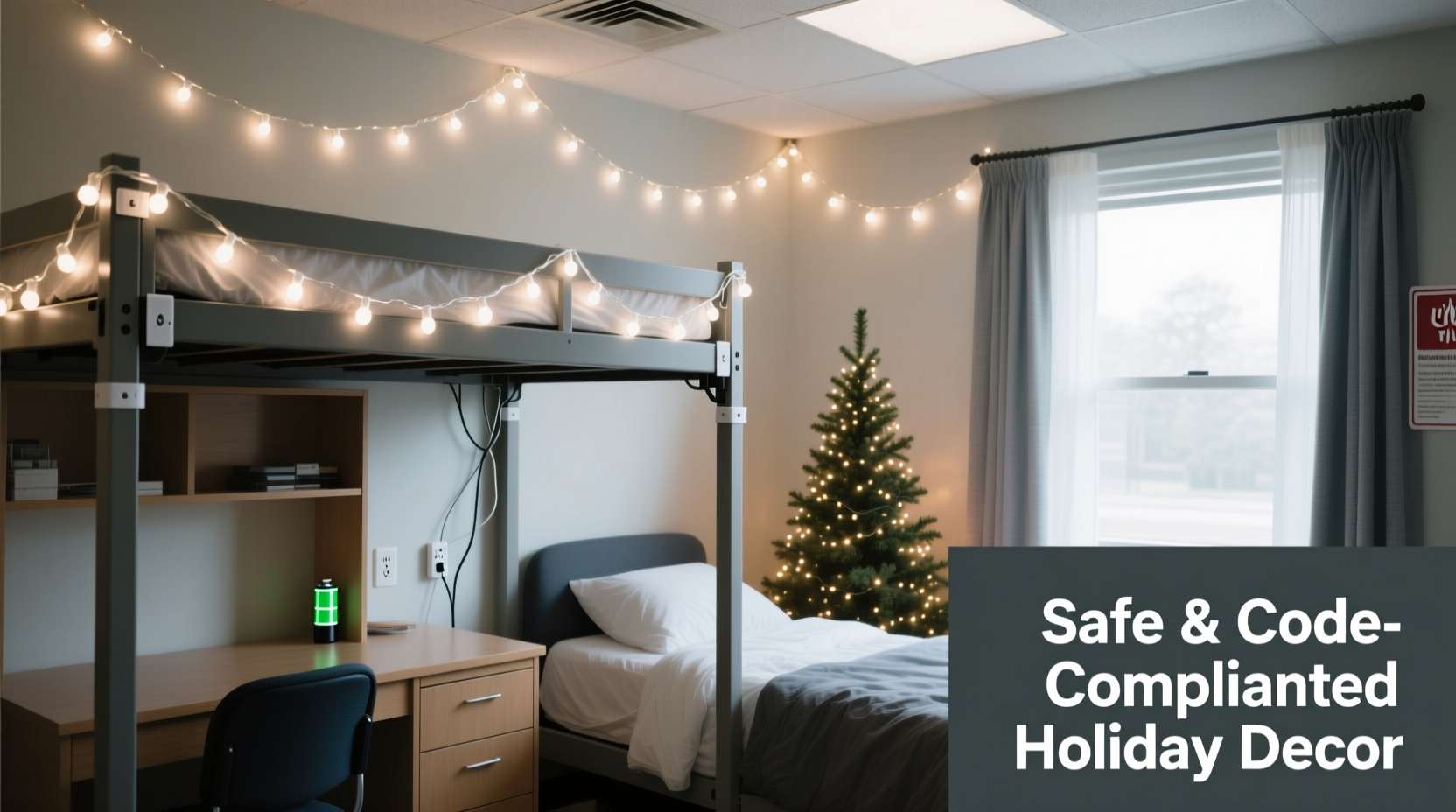
University fire codes aren’t arbitrary. They stem directly from the 2021 NFPA 101® Life Safety Code (adopted by 49 states and all major collegiate housing associations), which classifies residence halls as “Group R-2 Occupancies”—a high-risk category due to occupant density, limited egress options, and frequent presence of combustible personal items (bedding, posters, paper, clothing). In this context, lighting becomes a critical hazard vector. Between 2017–2022, the U.S. Fire Administration recorded 137 fires in college residence halls linked to decorative lighting—62% involved extension cords or power strips, 28% involved non-UL-listed strings, and 19% occurred when lights were draped over curtains or bedding. What makes dorms uniquely vulnerable isn’t just the lights themselves, but how they’re used: taped to painted drywall (risking overheating behind adhesive), plugged into daisy-chained power strips (overloading circuits rated for 15 amps), or left unattended overnight (when thermal buildup peaks).
“Students often assume ‘LED = safe,’ but voltage drop, poor insulation, and counterfeit certification are real issues. A light string labeled ‘UL Listed’ means nothing if it’s a knockoff sold through an unverified marketplace seller.” — Dr. Lena Torres, Senior Fire Safety Engineer, National Fire Protection Association (NFPA)
The 5 non-negotiable compliance requirements
Every major university housing policy references three foundational standards: NFPA 101®, the International Fire Code (IFC), and UL 588 (the safety standard for seasonal decorative lighting). These converge into five enforceable requirements—none of which can be waived, even for “low-wattage” or “battery-operated” setups:
- Circuit Load Limit: No more than 80% of a circuit’s rated capacity may be used continuously. Most dorm outlets share a 15-amp, 120-volt circuit (1,800 watts max → 1,440 watts usable). A single incandescent mini-light string draws ~21 watts per 100 bulbs; most LED strings draw 4–7 watts—but cheap LEDs may lack accurate labeling.
- Mounting Method: Adhesives (tape, putty, glue) cannot be used on walls, ceilings, or doors unless explicitly approved by facility management. Heat buildup under tape can degrade paint, drywall paper, or insulation—and conceal wiring faults.
- Proximity to Combustibles: Lights must maintain at least 3 feet of clearance from curtains, bedding, upholstered furniture, papers, or clothing piles. This includes “hidden” proximity—e.g., lights tucked behind a headboard or under a desk shelf.
- Power Source Integrity: Only one power strip per outlet is permitted, and it must be UL 1363-certified (not “UL Recognized” or “UL Listed” for other uses). Daisy-chaining—plugging one strip into another—is prohibited.
- Automatic Shutoff: Any lighting left unattended for more than 2 hours must include either a built-in timer or a plug-in smart timer. Overnight operation (past midnight) requires explicit written permission from housing staff.
Step-by-step: Installing compliant lights in under 20 minutes
Follow this sequence precisely. Skipping a step—even one—can invalidate compliance and expose you to violation penalties (fines up to $250, mandatory removal, or conduct board review):
- Verify your circuit’s load: Unplug everything from your outlet. Plug in a Kill A Watt meter (rentable from campus sustainability offices), then add each device you’ll use simultaneously: laptop charger (65W), LED desk lamp (9W), phone charger (5W), and your light string. Total must stay ≤1,440W. If using multiple outlets on the same wall, assume they’re on one circuit unless confirmed otherwise by facilities.
- Select only UL 588–certified LED strings: Look for the full UL Mark (not “UL Certified” or “UL Approved”) and check the packaging for “Indoor Use Only” and “For Temporary Use Only.” Avoid strings with exposed copper wire ends or non-removable plugs.
- Mount using approved methods only: Use removable adhesive hooks rated for ≤1 lb (e.g., 3M Command™ Small Picture Hanging Strips), tension rods across closet openings, or clip-on hangers attached to bed frames—not walls. Never staple, nail, or tape wires.
- Route wiring safely: Run cords along baseboards—not across walkways or under rugs. Secure loose sections with cord clips (not tape). Keep all connections elevated and visible—not buried under blankets or inside drawers.
- Install automatic shutoff: Use a mechanical timer (e.g., Woods 7-Day Programmable Timer) set to cut power at 11:00 PM and restore at 7:00 AM. Smart plugs require Wi-Fi access, which many dorm networks restrict for security reasons—mechanical timers are universally accepted.
Do’s and Don’ts: A dorm lighting compliance table
| Action | Compliant? | Why / Notes |
|---|---|---|
| Using battery-powered fairy lights with built-in 6-hour timer | ✅ Yes | No circuit load; no cords. Verify batteries are alkaline (not lithium-ion) and replace before swelling occurs. |
| Taping LED string to painted drywall with double-sided tape | ❌ No | Violates mounting rules; adhesive traps heat and damages paint. Facilities may charge restoration fees. |
| Plugging lights into a UL 1363-certified power strip with surge protection | ✅ Yes | Only if strip has individual outlet switches and is not daisy-chained. Label it clearly: “DORM LIGHTS ONLY.” |
| Wrapping lights around a fabric headboard or poster-covered bulletin board | ❌ No | Violates 3-foot combustible clearance. Even flame-retardant fabric accumulates dust and lint—both highly ignitable. |
| Hanging lights from ceiling tiles using lightweight plastic clips | ❌ No | Ceiling tiles are acoustical material (Class B or C), not structural. Clips may dislodge tiles or damage grid systems—prohibited in >95% of campus policies. |
| Using a 12V low-voltage LED kit with external transformer plugged into outlet | ✅ Yes | Transformer must be UL-listed; output wires must be secured and never exceed 50 ft in length (voltage drop risk). |
Real example: How Maya avoided a violation at University of Michigan–Ann Arbor
Maya, a sophomore in East Quad, wanted soft lighting above her study desk and bed frame. She initially bought $12 “warm white micro-LEDs” online—no UL mark, no wattage label, and adhesive backing. On move-in day, her RA noticed the tape residue on her wall during the mandatory safety walkthrough and issued a “Notice of Noncompliance.” Rather than remove everything, Maya visited the university’s Housing Sustainability Hub, where staff helped her:
- Swap her lights for UL 588–certified 20-ft LED strings (4.8W each) from the campus bookstore;
- Borrow a Kill A Watt meter to confirm her total load was 1,220W (well under 1,440W);
- Use Command™ Picture Hanging Strips (rated for 0.5 lb) to mount hooks on her metal bed frame—not the wall;
- Set a mechanical timer to power lights only from 4–11 PM, aligning with her study schedule.
Two weeks later, her RA returned for a follow-up and cleared the space. Maya kept the same setup all semester—no violations, no fines, and consistent positive feedback from floormates who borrowed her timer tips. Her key insight? “Compliance isn’t about less light—it’s about smarter placement, verified gear, and respecting the engineering behind the rules.”
FAQ: Dorm lighting compliance questions answered
Can I use string lights with my dorm-provided LED desk lamp?
Yes—if the lamp is UL-listed and operates independently (i.e., not sharing a power strip with your lights). Never plug both into the same outlet via a splitter. Instead, use separate outlets on opposite sides of the room, and verify both are on different circuits using your Kill A Watt meter. If both outlets trip the same breaker, they’re on one circuit—you’ll need to consolidate loads.
Are solar-powered lights allowed indoors?
No. Solar panels require direct UV exposure to charge, making indoor use ineffective. More critically, many solar string lights use lithium-polymer batteries not rated for continuous indoor charging—posing thermal runaway risks. Campus policies universally prohibit unapproved rechargeable batteries in sleeping areas.
What if my RA says “no lights at all”—even UL-certified ones?
That’s not policy—it’s misinterpretation. NFPA 101® and IFC explicitly permit compliant decorative lighting. Politely ask your RA to cite the specific section of your housing agreement that bans UL-listed, low-wattage, timed LED strings. Then email housing@university.edu with a copy of UL 588 documentation and request clarification. Most universities issue written guidance within 48 hours.
Conclusion: Light responsibly, live intentionally
Festive lighting in a dorm isn’t frivolous—it’s emotional infrastructure. That gentle glow reduces seasonal affective symptoms, signals belonging in an unfamiliar environment, and turns functional space into meaningful place. But safety isn’t the enemy of ambiance; it’s the foundation that makes sustained joy possible. When you choose UL-certified LEDs, respect circuit limits, mount thoughtfully, and automate shutoffs, you’re not just following rules—you’re practicing stewardship: of your space, your neighbors’ well-being, and the shared responsibility that defines campus life. Start tonight. Check your outlet’s load. Swap one non-compliant string for a certified one. Use that timer. You’ll sleep easier knowing your holiday warmth carries zero risk—and your RA will notice the care you’ve taken. That kind of intentionality doesn’t go unnoticed. It builds trust. It models leadership. And in a world that often feels unstable, it’s one small, luminous act of grounded confidence.




 浙公网安备
33010002000092号
浙公网安备
33010002000092号 浙B2-20120091-4
Comments
No comments yet. Why don't you start the discussion?