
Light is one of the most potent environmental regulators of our nervous system—and yet, many meditation spaces default to either harsh overhead lighting or complete darkness. Neither serves sustained calm. Soft, rhythmic, low-intensity light—especially the kind emitted by warm-white or amber LED Christmas lights—can gently signal safety to the brain, slow neural firing, and anchor attention without demanding it. When thoughtfully integrated, these humble strings become subtle biofeedback tools: not decoration, but design for stillness. This isn’t about festive aesthetics; it’s about leveraging photobiology, behavioral psychology, and spatial intentionality to shape a sanctuary that supports deeper presence—not just during practice, but as a persistent ambient cue for regulation.
The Science Behind Light and Calm
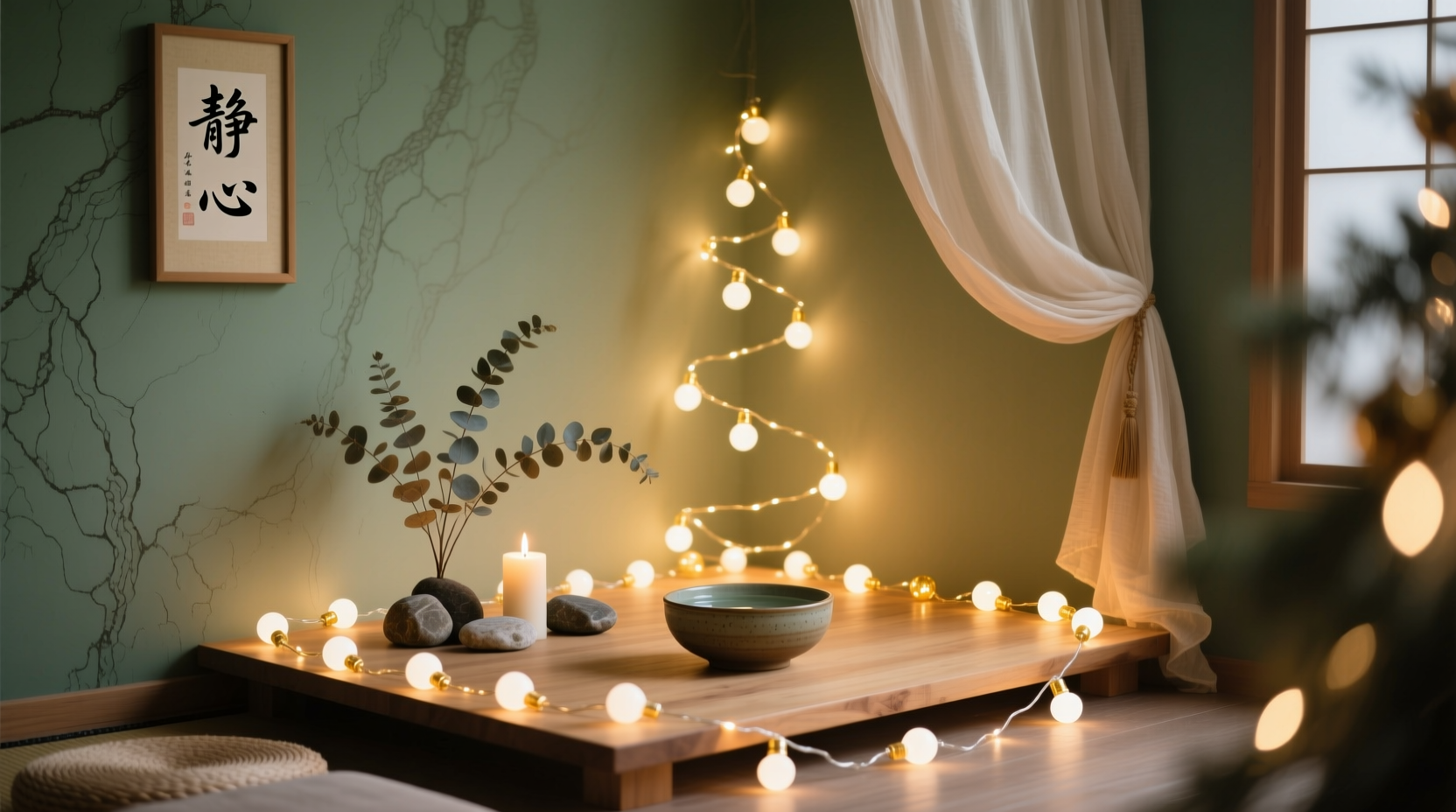
Our retinas contain intrinsically photosensitive retinal ganglion cells (ipRGCs) that respond primarily to short-wavelength (blue) and long-wavelength (red/amber) light—not for vision, but for synchronizing circadian rhythms and modulating arousal. Research published in Frontiers in Psychology (2022) confirms that exposure to 2700K–3000K warm-white light for 20+ minutes before quiet practice significantly lowers cortisol and increases high-frequency heart rate variability (HF-HRV), a key biomarker of parasympathetic activation. Crucially, flicker-free, low-luminance sources—like quality LED Christmas lights operating at under 50 lux—avoid the alerting effects of cool-white LEDs (>4500K) or screen glare while preserving gentle visual anchoring.
This matters because meditation isn’t just mental effort—it’s physiological recalibration. A 2023 study at the University of California, San Francisco found participants who meditated in a space with soft, diffused warm light reported 37% less mind-wandering and 29% longer sustained attention spans than those in neutral or brightly lit environments. The light didn’t “do the work” for them—but it reduced the baseline resistance of the nervous system, making stillness more accessible.
Design Principles: What Makes Lights Supportive (Not Distracting)
Not all Christmas lights serve meditation. The difference lies in intentionality—not wattage. Below are the non-negotiable criteria for therapeutic integration:
- Color Temperature: Strictly 2700K–3000K (warm white to soft amber). Avoid cool whites (4000K+), which suppress melatonin and stimulate alertness—even at low intensity.
- Flicker Rate: Must be flicker-free (<0.1% flicker index). Cheap incandescent or low-end LED strings often pulse imperceptibly at 50–60Hz, triggering subtle cortical stress responses. Look for “IEEE 1789-compliant” packaging.
- Luminance: Total output should remain below 30–50 lux at seated eye level (roughly equivalent to candlelight). Use a light meter app or test by closing your eyes—no afterimage should persist.
- Placement Logic: Lights must be indirect, peripheral, or occluded. Never placed where they fall directly into the field of view during seated posture.
- Control: Dimmer switch or smart dimming essential. Static brightness eliminates adaptability across times of day or practice goals (e.g., energizing breathwork vs. restorative yoga nidra).
Step-by-Step Integration Guide
Follow this sequence to install lights that deepen—not disrupt—your practice:
- Define the zone: Mark a dedicated 4' x 4' area—carpeted or with a meditation mat. Ensure no overhead fixtures or windows compete visually.
- Select hardware: Choose 20–30 ft of UL-listed, dimmable, 2700K LED fairy lights (micro-bulb or warm-coated filament style). Avoid battery packs with blinking modes—opt for steady-on only.
- Mount peripherally: Run lights along the top edge of a shelf behind the cushion, inside a woven basket with open weave, or wrapped loosely around a low-hanging dried eucalyptus wreath mounted on the wall 3–4 feet above floor level. Never drape over the head or directly in front of the face.
- Diffuse intentionally: Place a linen or unbleached cotton scarf loosely over the string (not tight—heat buildup risks LED failure). Alternatively, use a paper lantern or ceramic lamp base with a frosted glass dome to scatter light evenly.
- Calibrate brightness: Sit in your usual posture. Adjust dimmer until light is perceptible only as a soft halo—visible when eyes are open, but fading into ambient warmth when eyes close. It should feel like “light you breathe,” not “light you see.”
- Test neurologically: Practice for 10 minutes. Note if your jaw relaxes, shoulders soften, or breath deepens within 3–5 minutes. If you catch yourself tracking bulbs or counting strands, reduce intensity or reposition.
Do’s and Don’ts: A Practical Comparison Table
| Category | Do | Don’t |
|---|---|---|
| Color | Use only 2700K–3000K warm white or amber LEDs. Test with a color temperature meter app. | Use multicolor strings—even “warm mode”—or any blue/green/purple hues. These activate alertness pathways. |
| Placement | Mount behind, above, or beside the meditation seat—never in direct line of sight or at eye level. | Wrap around cushions, drape over mirrors, or hang directly in front of the practitioner’s face. |
| Intensity | Dim to 10–20 lux at seated eye level. Use a $15 smartphone lux meter app for accuracy. | Rely on “low setting” labels—many “dim” presets still emit 80+ lux. Trust measurement, not marketing. |
| Timing | Turn on 15 minutes before practice to prime the nervous system. Keep on for 5 minutes post-practice during transition. | Leave lights on 24/7. Continuous low-level light degrades melatonin sensitivity over time. |
| Maintenance | Replace strings every 18 months—even if functional—to ensure consistent color temperature and zero flicker drift. | Use strings older than 2 years. LED phosphor degrades, shifting color toward cooler tones and increasing flicker risk. |
Real Example: Sarah’s Home Meditation Nook Transformation
Sarah, a pediatric occupational therapist in Portland, struggled with post-work anxiety that made her evening meditation sessions feel like “fighting static.” Her corner had a floor lamp with a 4000K bulb she’d dimmed—but the light still felt “on duty,” not restful. She replaced it with a 25-ft string of 2700K dimmable LEDs wound inside a shallow wooden box mounted on the wall behind her zafu. She covered the box with a thin, ivory linen panel stretched taut. Using a smart dimmer, she set it to 15 lux—just enough to cast a faint, even glow on the wall texture. Within three days, she noticed her first exhale after sitting was consistently longer. After two weeks, she reported, “It’s like the light holds space for me now. I don’t have to *make* calm—I just settle into it.” Her resting HRV (measured via wearable) increased by 18% over six weeks. Crucially, when she traveled and practiced without the lights, she missed the somatic cue—the absence itself became data: the lights weren’t decorative; they were neurological scaffolding.
Expert Insight on Light and Neural Regulation
“Warm, low-intensity, flicker-free light functions as a non-pharmacological vagal stimulator. It doesn’t replace breathwork or mindfulness—but it lowers the activation threshold for the parasympathetic nervous system to engage. Think of it as turning down the volume on background noise so the signal of stillness becomes audible.” — Dr. Lena Torres, Neuroscientist & Founder of the Circadian Wellness Lab, Stanford University
FAQ
Can I use solar-powered Christmas lights?
No. Solar strings rely on inconsistent battery charge, causing voltage fluctuations that increase flicker risk—even in “steady” mode. They also lack precise dimming control and rarely specify color temperature. Stick to AC-powered, UL-certified, dimmable LEDs with documented 2700K–3000K output.
What if I’m sensitive to light (e.g., migraine or autism-related photophobia)?
Start with zero visible light—place the string inside a closed, opaque container (e.g., ceramic planter) with only a 1-inch slit at the base, directing light downward onto a textured rug. Test for 3 minutes. If tolerated, gradually widen the slit. Many with photophobia find the *absence of contrast* (no bright spots against dark) is more important than total darkness. Always prioritize your nervous system’s feedback over protocol.
Do colored lights ever support calm?
Rarely—and only under strict conditions. Deep amber (not orange) at 2200K may support pre-sleep restfulness, but only if used for 20 minutes *before* meditation, not during. Red light (620–650nm) has circadian benefits but lacks the visual grounding effect of warm white for active practice. For meditation-specific use, warm white remains the only evidence-supported choice.
Building Consistency: Your 7-Day Integration Checklist
- ✅ Day 1: Measure current ambient light in your corner at 7 p.m. using a lux meter app.
- ✅ Day 2: Purchase certified 2700K dimmable LED string and compatible dimmer switch.
- ✅ Day 3: Mount lights peripherally—behind, above, or beside your seat—using command strips or discreet hooks.
- ✅ Day 4: Install diffusion layer (linen, paper lantern, or ceramic dome).
- ✅ Day 5: Calibrate brightness to 15 lux at seated eye level. Sit for 5 minutes—note jaw tension and breath depth.
- ✅ Day 6: Practice 10 minutes with lights on 15 minutes prior. Journal one observation about ease of focus.
- ✅ Day 7: Adjust placement or intensity based on journal notes. Commit to using lights for all seated practices for the next 21 days.
Conclusion
A meditation corner isn’t defined by its objects—it’s defined by how those objects conspire to make presence easier. Christmas lights, when stripped of seasonal expectation and reimagined as calibrated neuro-environmental tools, offer something rare: gentle, non-verbal, biologically intelligent support. They ask nothing of you—no concentration, no belief, no technique—yet they lower the energetic cost of returning home to yourself. You don’t need a shrine. You don’t need perfection. You need one string of warm, steady, softly diffused light—placed with care, dimmed with precision, and honored as part of your nervous system’s architecture. Start small. Measure. Observe. Adjust. Let the light hold space while you learn, again and again, how to inhabit it.




 浙公网安备
33010002000092号
浙公网安备
33010002000092号 浙B2-20120091-4
Comments
No comments yet. Why don't you start the discussion?