
Introducing soft holiday light into a nursery can bring warmth, seasonal joy, and gentle visual interest—but it also carries real developmental, physiological, and safety considerations. Infants and toddlers process sensory input differently than older children: their retinas are more sensitive, circadian rhythms are still maturing, and neural pathways for attention regulation are actively forming. A string of blinking multicolor LEDs may delight an adult, but it can trigger cortisol spikes, delay melatonin onset, or even provoke reflexive distress in a baby under six months. This isn’t about eliminating festive ambiance—it’s about designing light intentionally. Drawing from pediatric sleep science, occupational therapy principles, and fire safety standards (UL 588, CPSC guidelines), this guide details how to integrate Christmas lights thoughtfully, ethically, and sustainably in a nursery space.
Why Overstimulation Matters More Than You Think
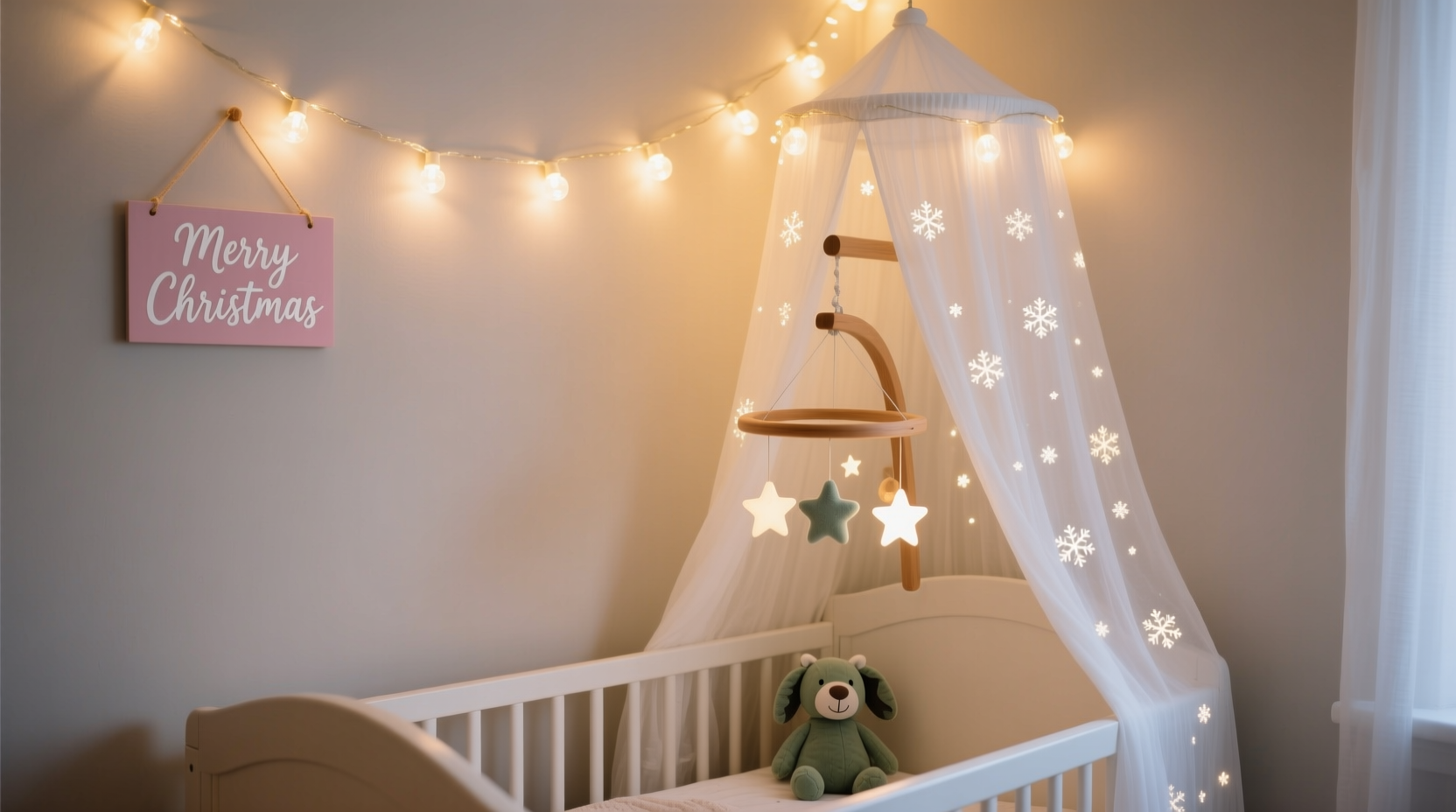
Overstimulation isn’t just fussiness—it’s a measurable neurobiological response. When infants are exposed to rapid light changes, high contrast, or unpredictable brightness shifts, their autonomic nervous system activates the “fight-or-flight” response. Cortisol rises, heart rate variability decreases, and parasympathetic calming slows. For babies under four months, whose visual acuity is only 6–12 inches and who lack full color discrimination (especially reds and greens), bright, flickering lights can appear as overwhelming visual noise—not decoration. Pediatric occupational therapist Dr. Lena Patel explains:
“The infant brain isn’t built to filter irrelevant sensory input. What looks ‘soft’ or ‘subtle’ to an adult may register as chaotic bombardment to a developing visual cortex. Light isn’t neutral—it’s neurological input.”This is especially critical during sleep windows, feeding times, and quiet alert states—the very moments when nurseries should support regulation, not disruption.
Light Safety Fundamentals: What Every Parent Must Verify
Before aesthetics enter the conversation, foundational safety must be non-negotiable. The U.S. Consumer Product Safety Commission reports that holiday lighting accounts for an average of 700 home fires annually—and infants are disproportionately vulnerable due to proximity to floor-level cords and low-hanging fixtures. These five criteria are mandatory—not optional—for any light used within three meters of a crib, changing table, or play mat:
- UL Certification: Look for the Underwriters Laboratories mark (UL 588 or UL 2593 for LED sets). Avoid generic “indoor use only” labels without certification.
- Low-Voltage Operation: Use only 12V or 24V DC-powered lights (not standard 120V AC). Transformers must be externally mounted, cool to touch after 30 minutes, and placed out of reach—never tucked behind furniture or under rugs.
- Cord Management: All wiring must be fully secured with cord clips or raceways—not taped, knotted, or draped across crib rails. No exposed splices or frayed insulation.
- Heat Emission: LEDs must be rated for “touch-safe” operation (<35°C surface temperature). Test by holding your palm against a lit bulb for 5 seconds—if it feels warm, it’s unsafe near bedding or curious hands.
- Mounting Integrity: Adhesive-backed lights require wall-surface compatibility testing first. Never attach to painted drywall, textured wallpaper, or crib slats—use removable 3M Command Strips rated for the weight and repositionable adhesive only.
The Overstimulation Threshold: Light Metrics That Matter
Not all light is equal—and not all “soft” light is safe. Below is a practical reference table comparing common nursery lighting options against evidence-based thresholds for infant tolerance. Values reflect measurements taken at 1 meter distance (typical crib-to-light proximity) using calibrated lux meters and flicker analyzers:
| Light Type | Average Lux at 1m | Flicker Percentage | Color Temperature (K) | Suitable for Nursery? | Rationale |
|---|---|---|---|---|---|
| Incandescent mini-lights (old-style) | 4–8 lux | <1% | 2700K (warm amber) | ✅ Yes, with caution | Low flicker, warm spectrum—but bulbs run hot; must be fully enclosed. |
| Non-dimmable RGB LED string | 35–60 lux | 22–48% | Varies (5000–9000K peak) | ❌ No | High flicker + blue-rich white disrupts melatonin; color shifts confuse developing vision. |
| Dual-mode LED (warm white only, dimmable) | 3–12 lux (dimmed) | <3.5% | 2200–2400K | ✅ Yes, ideal | Ultra-low flicker, candle-like warmth, dimmable to 5% output. |
| Fairy lights in opaque glass jar | 1.5–3 lux | 0% | 2100K | ✅ Yes, excellent | Diffused, zero flicker, no directional glare—ideal for night feedings. |
| Battery-operated puck light (motion-activated) | 25 lux (burst) | N/A (instant on/off) | 3000K | ⚠️ Conditional | Acceptable only if motion sensor is disabled and manually switched on *only* during caregiver activity. |
Note: The American Academy of Pediatrics recommends ambient nursery lighting stay below 10 lux during nighttime hours to preserve melatonin production. Anything above 20 lux—even if “warm”—can suppress nighttime hormone release by up to 50% in infants under 12 months.
A Step-by-Step Implementation Plan
Follow this seven-step sequence to introduce lights safely, gradually, and responsively—aligned with your baby’s developmental cues, not the calendar:
- Week 1 — Observe Baseline: For three days, note your baby’s natural responses to existing light: Does direct sunlight cause squinting or turning away? Do ceiling fan lights elicit wide-eyed staring or fussing? Document reactions to duration, movement, and color.
- Week 2 — Introduce Static Warm Light: Place one 2200K, non-flickering LED string (no blinking, no color shift) along the top edge of a bookshelf—fully out of reach, facing upward to bounce light off the ceiling. Run for 2 hours daily during calm daytime play. Monitor for lip tightening, prolonged blinking, or gaze aversion.
- Week 3 — Add Diffusion: Enclose the same string inside a woven basket or ceramic lantern with matte interior. Measure lux at crib level—it must read ≤5 lux. If higher, add a second layer of sheer muslin over the enclosure.
- Week 4 — Extend Duration & Context: Use only during pre-nap wind-down (15 minutes max) and post-feeding quiet time. Never during active sleep onset or overnight. Keep lights off during diaper changes and cuddle sessions unless baby shows clear, relaxed visual engagement.
- Week 5 — Evaluate Neurological Signals: Track three metrics for 48 hours: (a) time to fall asleep post-light exposure, (b) number of night wakings, (c) frequency of self-soothing vs. distress vocalizations. If any metric worsens by >25%, pause and reassess.
- Week 6 — Introduce Rhythm (Optional): Only if Weeks 1–5 show consistent positive response, add a programmable timer set to fade on at 5:30 PM and fade off by 7:00 PM—mimicking natural dusk. Never use timers for overnight operation.
- Ongoing — Monthly Audit: Every 30 days, unplug lights, inspect cords for micro-cracks, test transformer temperature, and re-measure lux levels. Replace any string showing >5% flicker increase or color shift.
Real-World Example: The Henderson Family’s Low-Light Approach
When Maya Henderson brought her twin daughters home at 34 weeks gestation, her neonatologist advised strict environmental control: no screens, no overhead lights after 6 PM, and minimal visual novelty until corrected age 4 months. Undeterred by the “no holiday decor” directive, Maya collaborated with a pediatric occupational therapist to design a sensory-respectful lighting plan. She chose a single 2-meter string of 2200K, 12V DC, silicone-coated LEDs—mounted vertically behind a floating oak shelf, facing the wall. Light reflected softly onto the ceiling, creating a gentle gradient glow visible only from the crib’s center position. She added a handmade linen pouch filled with dried lavender and weighted with rice (0.8 kg) beside the transformer—so its subtle scent and tactile presence anchored the space without visual demand. For six weeks, she used the lights only during supervised tummy time between 3–4 PM, gradually extending to 15-minute pre-nap sessions. At 5 months corrected age, both twins tracked the light source smoothly, smiled at its reflection in their crib mobile, and showed no signs of sleep fragmentation. Crucially, Maya never used the lights during night feeds—opting instead for a single 2100K, 3-lux clip-on reading light aimed at her lap, not the baby’s face. Her outcome wasn’t “festive cheer”—it was regulatory stability, with holiday warmth woven in as texture, not stimulus.
What Not to Do: The Critical Don’ts List
This checklist distills high-risk behaviors identified in CPSC incident reports and AAP clinical advisories. If any apply to your current setup, discontinue immediately:
- ❌ Using lights with built-in music, sound sensors, or motion activation in the nursery
- ❌ Placing strings within 1.2 meters of a crib mattress surface (including draped over railings)
- ❌ Operating lights overnight—even with timers—unless clinically prescribed for circadian support (e.g., preterm NICU graduates)
- ❌ Choosing lights with “twinkle,” “chase,” or “fade” modes (all exceed safe flicker thresholds)
- ❌ Using extension cords or power strips beneath rugs, cribs, or furniture
- ❌ Leaving battery-operated lights on unattended (risk of overheating lithium cells)
- ❌ Assuming “LED = safe”: many budget LEDs lack proper current regulation, causing invisible high-frequency flicker
FAQ: Addressing Common Concerns
Can I use Christmas lights if my baby has colic or reflux?
Yes—with heightened caution. Babies with gastrointestinal discomfort often exhibit heightened sensory sensitivity. Prioritize absolute stillness (no movement or pulsing), eliminate all blue/green wavelengths (use only 2100–2200K sources), and limit exposure to ≤10 minutes during calm, upright holding positions. Discontinue immediately if arching, clenched fists, or breath-holding occurs.
Are fiber optic lights safer than traditional strings?
Generally yes—but verify construction. True fiber optic sets (light source remote, fibers cold and flexible) produce zero heat, zero flicker, and minimal EMF. However, many “fiber optic” products on e-commerce sites are mislabeled LED strings with plastic filaments. Insist on manufacturer documentation confirming passive light transmission and independent flicker testing.
My baby stares intently at the lights—is that a sign they like them?
Not necessarily. Sustained visual fixation in infants under 5 months can indicate sensory overload, not enjoyment. Look for accompanying cues: Is the jaw relaxed or clenched? Are hands open or fisted? Is breathing rhythmic or shallow? Genuine engagement includes smiling, cooing, or reaching—without physiological stress markers. When in doubt, turn it off and observe the reset.
Conclusion: Light as Nurturance, Not Decoration
Christmas lights in a nursery shouldn’t compete with the profound, quiet work happening inside your baby’s developing brain. Every photon matters—not as ornament, but as input. When chosen with scientific rigor and applied with developmental humility, warm, static, ultra-low-flicker light becomes part of the caregiving ecosystem: supporting circadian alignment, offering gentle visual scaffolding, and honoring the sacred stillness that tiny humans need to grow. You don’t need brightness to convey love. You need intention. Start small—choose one string, verify its specs, measure its output, and watch your baby’s response without agenda. Adjust not to match tradition, but to meet your child’s neurology. That’s where true safety lives: not in compliance checkboxes, but in attuned presence.




 浙公网安备
33010002000092号
浙公网安备
33010002000092号 浙B2-20120091-4
Comments
No comments yet. Why don't you start the discussion?