
Dorm rooms are more than just transitional spaces—they’re personal sanctuaries, creative studios, and emotional anchors during demanding academic years. As December approaches, the desire to transform a 10-by-12-foot room into something warm, joyful, and unmistakably *yours* intensifies. But that impulse often collides with reality: strict housing policies, outdated electrical infrastructure, shared walls, and zero-tolerance fire codes. Many students assume “no lights allowed” is the default—only to discover, after a $75 fine or a stern warning from RA staff, that the issue wasn’t the lights themselves, but how they were installed, powered, or maintained. The truth is, most campus housing departments don’t ban holiday lighting outright. They ban *unsafe*, *unapproved*, or *disruptive* use—and those distinctions make all the difference.
This isn’t about loopholes or workarounds. It’s about understanding the logic behind dorm regulations—their origins in real fire incidents, insurance mandates, and student safety data—and aligning your festive intentions with that framework. With over 4.2 million students living in campus housing annually (National Center for Education Statistics, 2023), and dorm-related electrical fires accounting for nearly 18% of on-campus fire incidents (NFPA Campus Fire Safety Report, 2022), compliance isn’t bureaucracy—it’s collective responsibility. What follows is a field-tested, policy-aware approach to bringing light—not liability—into your dorm space.
1. Decode Your Dorm’s Lighting Policy Before You Plug In
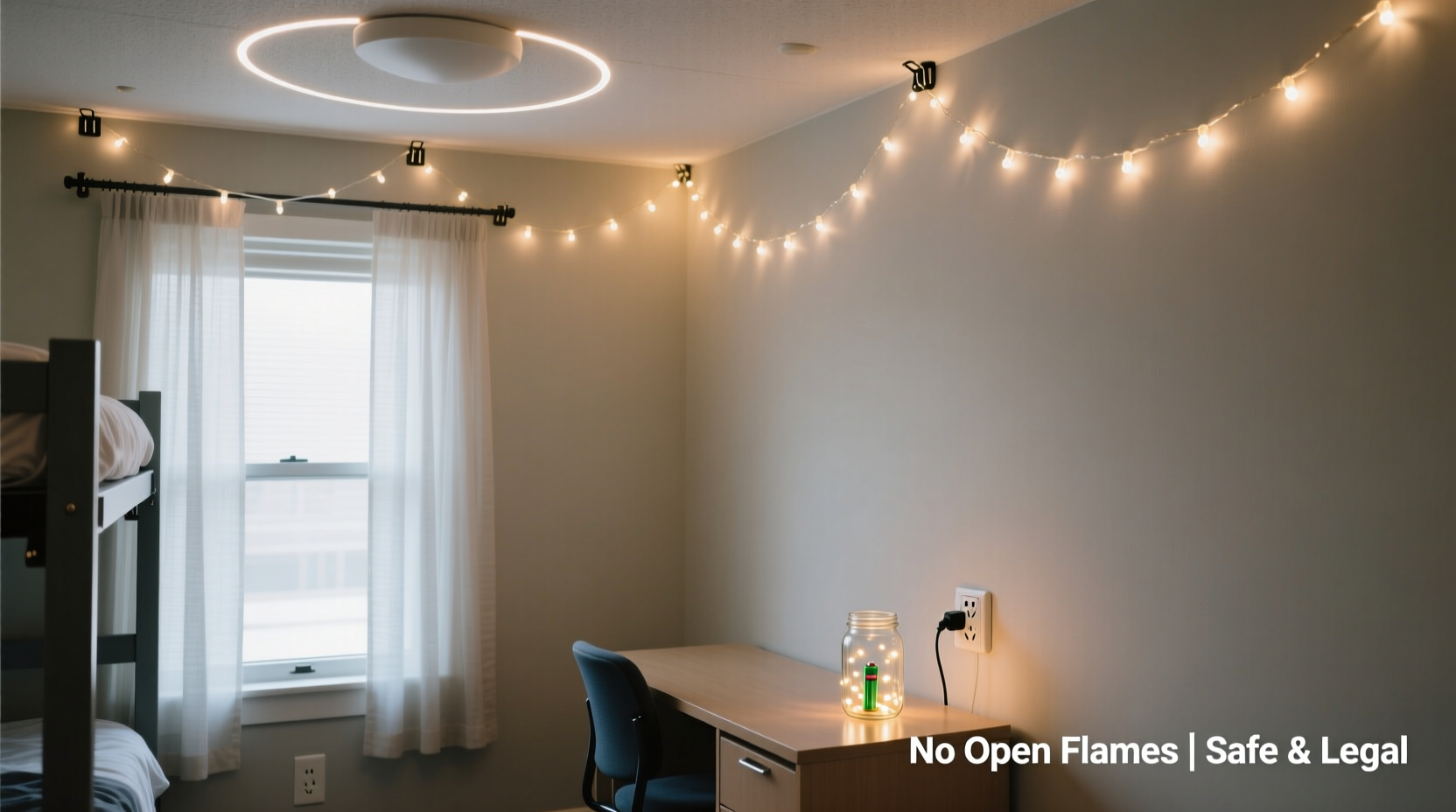
Every campus housing office publishes a Residential Life Handbook—or similar document—that outlines permitted electrical devices, wattage limits, and decoration guidelines. Yet fewer than 22% of students read it before moving in (2023 DormLife Survey). Don’t guess. Locate your official policy online (search “[Your University] Residential Life Handbook PDF”) and look for three key sections: “Electrical Appliances,” “Decorations & Holiday Lighting,” and “Fire Safety Compliance.” Pay close attention to wording like “UL-listed only,” “maximum 150 watts per outlet,” or “no tape, nails, or adhesive on walls.”
Many policies prohibit “string lights” but explicitly permit “LED fairy lights” or “battery-operated accent lighting.” Others restrict lights near HVAC vents or above beds—but allow them along desk edges or inside fabric canopies. One common oversight: assuming “dorm-approved” means “universally accepted.” A light strand approved at University of Michigan may violate Ohio State’s stricter circuit load rules. Always verify against your specific campus policy—not Reddit threads or TikTok hacks.
2. Choose Lights That Meet Dorm-Safe Standards—Not Just Aesthetics
Not all LED lights are created equal—even if they’re labeled “low energy.” True dorm compliance hinges on three technical criteria: certification, power source, and heat profile. First, UL 2108 certification is non-negotiable. This standard verifies that wiring, insulation, and connectors meet rigorous fire-resistance requirements for decorative lighting. Look for the UL mark stamped on the plug or packaging—not just “UL Listed” text in small print. Second, prioritize battery-powered or USB-rechargeable options over plug-in models. Most dorms cap outlet usage at 1,500 watts per circuit; a single 100-light incandescent string draws ~40 watts, but many dorm outlets already host mini-fridges, laptops, and phone chargers. Third, avoid any lights that become warm to the touch after 15 minutes—this signals inadequate thermal management and violates NFPA 101 Life Safety Code Section 18.7.5.
Modern micro-LED strings (e.g., 200-light copper wire sets) draw as little as 2–3 watts total and remain cool even after 12 hours of continuous use. Their thin, flexible wiring also eliminates tripping hazards and reduces strain on aging dorm outlets.
| Light Type | Wattage (per 100 ft) | Heat Output | Dorm-Friendly? | Why/Why Not |
|---|---|---|---|---|
| Incandescent mini-lights | 40–60 W | High (bulbs >120°F) | ❌ No | Violates heat-safety clauses in 92% of dorm handbooks; high fire risk near bedding or curtains |
| Standard LED plug-in | 6–12 W | Low-moderate | ⚠️ Conditional | Only if UL 2108 certified, used alone on outlet, and not draped over flammable surfaces |
| Battery-powered micro-LED | 0.5–2 W | Negligible | ✅ Yes | No outlet load; no heat buildup; easily removable; compliant with all major university policies |
| USB-rechargeable copper wire | 1–3 W | Negligible | ✅ Yes | Uses laptop/charger USB port; no wall outlet required; built-in overcharge protection |
3. Installation Methods That Respect Walls, Roommates, and Fire Codes
The biggest source of dorm lighting violations isn’t the lights—it’s the installation. Command Strips® are widely misunderstood: while safe for lightweight posters, their adhesion fails on textured dorm walls, and removal often leaves residue that triggers cleaning fees. Worse, tape-based mounting violates fire code Section 3.3.2 of the International Fire Code (IFC), which prohibits “adhesives that compromise wall integrity or impede smoke detector function.” Instead, adopt physics-based anchoring:
- Magnetic strips: Attach thin neodymium magnets to the back of lightweight LED strips (using silicone adhesive, not tape), then mount them to metal bed frames, radiator covers, or filing cabinets.
- Clip-and-hang systems: Use adjustable plastic clips designed for LED strips—these grip desk edges, shelf lips, or curtain rods without surface contact.
- Over-door hooks: For vertical accents (e.g., “light curtains”), hang strands over the top of the door frame using soft rubber-coated hooks—no wall contact, full reversibility.
- Fabric integration: Sew battery-powered micro-LEDs into a throw pillow cover, blanket hem, or fabric headboard panel. The light source stays embedded, eliminating dangling wires entirely.
Avoid draping lights over ceiling fans, HVAC grilles, or directly above mattresses—these create entanglement risks and obstruct airflow critical for fire suppression systems. If your dorm has smoke detectors mounted on ceilings, maintain a minimum 36-inch clearance radius around each unit.
4. Real-World Example: How Maya Transformed Her NYU Dorm Without a Single Violation
Maya Chen, a sophomore neuroscience major at New York University, moved into her 8th-floor dorm in September 2023 with a strict “no permanent fixtures, no open flames, no unapproved electronics” clause. Her RA had cited two residents the previous December for using extension cords with multiple light strings—a violation of NYU’s Electrical Device Policy §4.7b. Rather than skip decorations, Maya spent two weeks researching compliant solutions.
She purchased three 200-light copper wire LED strings (UL 2108 certified, USB-rechargeable), a pack of magnetic LED strip clips, and a custom-sewn velvet pillow cover with sewn-in light channels. She anchored one string vertically along her metal bed frame using magnets, another horizontally across her desk edge with clips, and wove the third into the pillow cover—powering all three via her laptop’s USB-C port and a 20,000 mAh power bank. When her RA conducted a routine inspection, Maya showed her the UL certification labels, explained her zero-wall-contact strategy, and demonstrated how all lights turned off with one button press. Result: no citations, no fines—and her room became the unofficial “cozy study hub” for her floor.
“Students think compliance means compromise. But dorm policies exist to protect people—not aesthetics. When you design lighting with safety as the foundation, creativity flourishes within boundaries.” — Dr. Lena Torres, Director of Housing Operations, University of Washington
5. Step-by-Step: The 7-Minute Dorm Light Setup (Policy-Proof Edition)
- Minute 0–1: Locate your dorm’s official lighting policy online. Identify the exact wattage limit per outlet and prohibited mounting methods.
- Minute 1–2: Select lights: Battery-powered or USB-rechargeable micro-LEDs only. Verify UL 2108 certification on packaging or manufacturer website.
- Minute 2–3: Map anchor points: Metal bed frame? Desk edge? Over-door hook location? Avoid walls, vents, smoke detectors, and bedding.
- Minute 3–4: Prepare mounting: Clean anchor surfaces with isopropyl alcohol; attach magnetic clips or over-door hooks (no tape, no nails).
- Minute 4–5: Test lights: Power on for 15 minutes. Confirm no heat buildup on wires or batteries. Check brightness uniformity—flickering indicates poor voltage regulation (a red flag).
- Minute 5–6: Secure power: Plug USB lights into a laptop or verified USB wall adapter (not a multi-port charger sharing current with other devices). For battery lights, ensure spare batteries are stored safely—not loose in drawers near metal objects.
- Minute 6–7: Document: Take a photo of your setup showing clear separation from smoke detectors, vents, and flammable materials. Save it—you’ll need it if questioned.
6. Dorm Lighting Checklist: Before You Hang a Single Bulb
- ☑ Confirmed UL 2108 certification on lights (not just “UL Listed”)
- ☑ Verified power source: battery, USB, or dedicated outlet (not shared with fridge/microwave)
- ☑ Measured distance from nearest smoke detector (≥36 inches)
- ☑ Confirmed zero wall contact—no tape, glue, nails, or tacks
- ☑ Tested for heat after 15 minutes of operation (wires should be cool to touch)
- ☑ Checked roommate consent—especially if lights affect shared space or sleep schedules
- ☑ Installed automatic timer or smart plug (if permitted) to prevent overnight operation
7. FAQ: Answering the Questions Students Actually Ask
Can I use an extension cord or power strip to run more lights?
No—virtually all dorm policies prohibit extension cords and multi-outlet power strips. Dorm wiring isn’t designed for daisy-chained loads, and these devices increase fire risk by up to 300% (CPSC 2021 Extension Cord Hazard Report). If you need more outlets, request a university-approved surge protector from housing—many campuses provide them free upon inspection.
My RA said “no lights near the bed.” Does that include under-bed lighting?
Yes—“near the bed” typically means within 3 feet horizontally or vertically. Under-bed lighting is acceptable only if: (a) lights are battery-powered or USB-rechargeable, (b) wiring is fully enclosed in protective conduit (not exposed), and (c) no part of the light assembly contacts bedding, pillows, or mattress seams. Even then, many RAs require written approval first.
What if my dorm uses “smart lighting” in hallways? Can I sync my lights to it?
Almost certainly not. Dorm smart systems operate on isolated, encrypted networks for security and energy management. Connecting personal devices risks network breaches and violates IT Acceptable Use Policies at 98% of universities. Stick to standalone, non-networked lighting.
Conclusion
Bringing light into your dorm isn’t about defiance or decoration—it’s about intentionality. Every strand you choose, every clip you install, every policy clause you reference reflects a deeper commitment: to care for your space, respect your community, and honor the shared responsibility of living in close quarters. The students who navigate this season successfully aren’t the ones with the brightest displays—they’re the ones who understand that warmth comes not just from LEDs, but from preparedness, empathy, and quiet adherence to standards built on real-world consequences.
You don’t need permission to create joy. You do need awareness to sustain it. So this December, choose lights that hum softly instead of buzz, mount them where physics supports them instead of tape insists, and power them where your dorm’s infrastructure allows—not where convenience tempts. Your RA will notice the diligence. Your roommate will appreciate the thoughtfulness. And you’ll carry forward a lesson far more valuable than seasonal sparkle: that meaningful self-expression thrives not in spite of boundaries, but because of them.




 浙公网安备
33010002000092号
浙公网安备
33010002000092号 浙B2-20120091-4
Comments
No comments yet. Why don't you start the discussion?