
Christmas lights bring warmth, ambiance, and festive energy—but when used near fine art, framed prints, textiles, or vintage photographs, they carry real risks: thermal degradation, UV fading, electrical hazards, and physical abrasion. Many homeowners, gallery assistants, and interior designers assume “low-voltage” or “LED” automatically means “safe for art.” That assumption is dangerously incomplete. Light-induced damage is cumulative, invisible in the short term, and irreversible. This article distills museum-grade lighting principles, conservation science, and hands-on installation experience into a practical framework—so you can celebrate the season while honoring the integrity of your artwork.
Why Standard Christmas Lights Pose Hidden Risks to Artwork
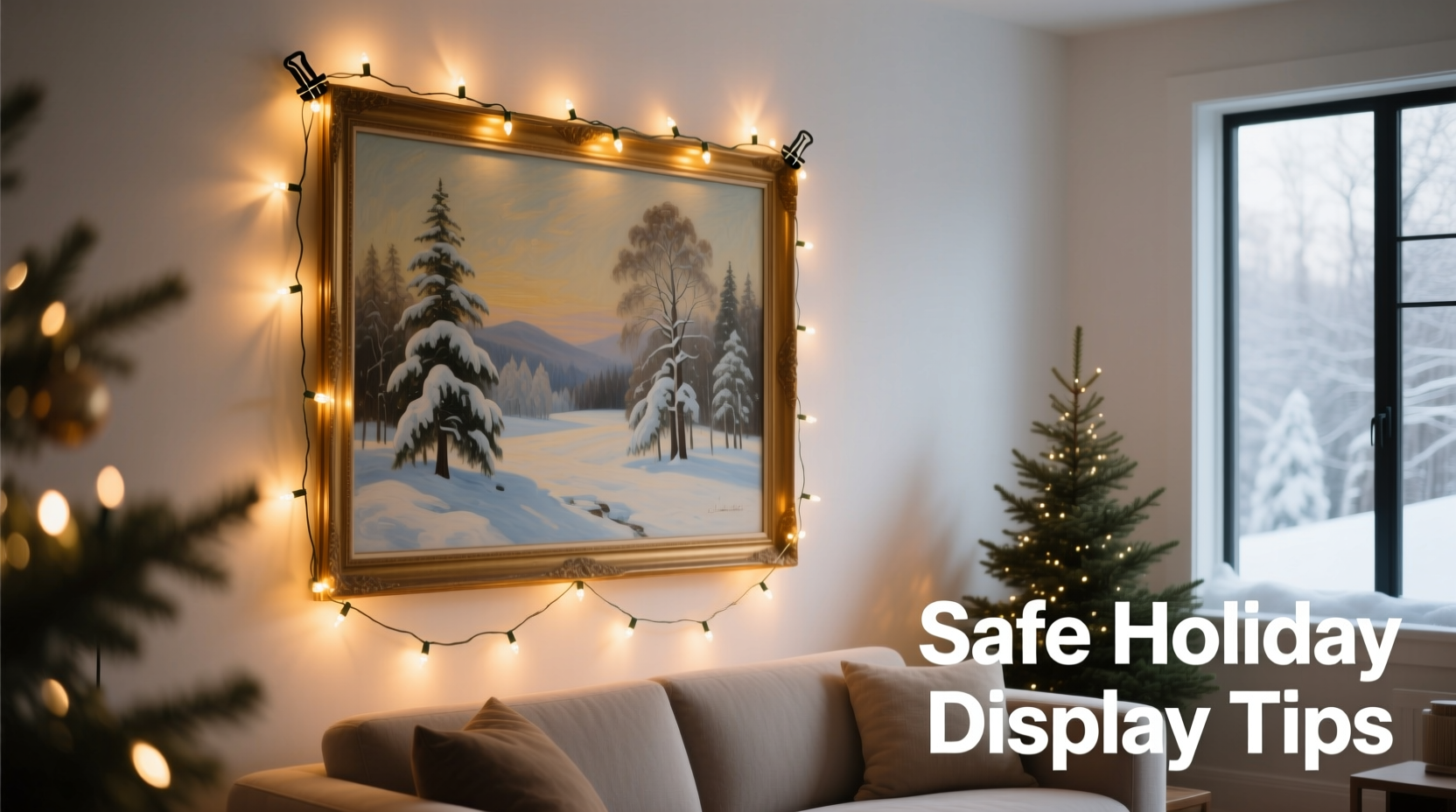
Artworks are complex material systems. Paper yellows under blue-rich light; oil paint films oxidize faster with heat; textile dyes fade unevenly under UV exposure; and adhesives in mounts and frames soften at just 35°C (95°F). Traditional incandescent mini-lights emit up to 90% of their energy as infrared radiation—heat you feel on your skin is the same energy that accelerates chemical aging in pigments and binders. Even many “cool white” LEDs emit significant near-UV (380–400 nm) and blue light (400–450 nm), wavelengths most damaging to organic colorants.
A 2022 study published in Studies in Conservation measured surface temperature rise on canvas-backed prints under common C7 LED string lights placed 12 inches away: after 90 minutes of continuous operation, temperatures climbed from 22°C to 38.6°C—well above the 25°C threshold recommended by the International Council of Museums (ICOM) for sensitive works. Worse, many users drape strings directly over frames or tuck them behind glass—creating microclimates where heat and humidity concentrate.
“Light isn’t just about visibility—it’s an active agent of change. Every photon absorbed triggers molecular reactions. The goal isn’t zero light, but *intentional* light: right spectrum, right intensity, right duration, and zero thermal load.” — Dr. Lena Torres, Senior Conservator, Smithsonian Museum Conservation Institute
Step-by-Step: Installing Safe, Effective Art Illumination
Follow this sequence—not as rigid rules, but as interdependent safeguards. Skipping one step compromises the entire system.
- Assess the artwork first: Identify medium (oil, acrylic, watercolor, photograph, textile), support (canvas, paper, wood panel), framing (glass type, backing board, matting), and condition (cracks, flaking, previous fading). If the work is irreplaceable or historically significant, consult a conservator before any lighting intervention.
- Select only certified low-heat, UV-stabilized LEDs: Look for UL/ETL certification, explicit “<0.1 µW/lm UV output” labeling, and a color temperature ≤3000K (warm white). Avoid “daylight” (5000K+) or “cool white” (4000K+) strings unless verified with a spectroradiometer.
- Calculate safe distance and duration: Maintain minimum 24-inch clearance from all artwork surfaces—including frame edges and backing. Never operate lights unattended for >4 hours continuously. Use a programmable timer to enforce daily off-cycles.
- Mount with non-invasive hardware: Use removable adhesive hooks rated for vertical shear (e.g., 3M Command™ Picture Hanging Strips, not tape or pins), or clip-on LED spotlights with adjustable goosenecks mounted to adjacent furniture or wall brackets—not the frame itself.
- Test before committing: Run lights at full brightness for 2 hours, then measure surface temperature with an infrared thermometer. If it exceeds 27°C (81°F), increase distance, reduce runtime, or switch strings.
Do’s and Don’ts: A Conservation-Focused Checklist
Use this checklist during planning, installation, and seasonal maintenance. Print it. Tape it to your storage box. Revisit it every December.
- ✅ DO choose strings with individually replaceable bulbs—prevents total failure if one diode fails.
- ✅ DO verify transformer output matches string voltage (e.g., 12V DC transformers for 12V LED strings); mismatched power supplies cause overheating and flicker stress.
- ✅ DO inspect wires annually for cracked insulation, bent pins, or corroded connectors—replace immediately if found.
- ❌ DON’T use extension cords indoors unless rated for permanent indoor use (look for “SJTW” or “SJTOW” jacket rating).
- ❌ DON’T coil excess string tightly—heat builds in bundled wires, degrading insulation and increasing fire risk.
- ❌ DON’T install lights inside enclosed shadow boxes or behind UV-filtering glass without ventilation—trapped heat accelerates deterioration exponentially.
Safe Lighting Options Compared: What Works (and What Doesn’t)
Not all “LED Christmas lights” are created equal. Below is a comparison based on spectral output, thermal profile, and physical design suitability for art proximity.
| Type | UV Emission | Surface Temp Rise (at 24\") | Art-Safe? (≤27°C & <0.1 µW/lm UV) | Notes |
|---|---|---|---|---|
| Incandescent Mini-Lights (C7) | Negligible UV, but high IR | +18.2°C in 60 min | ❌ No | Heat alone violates conservation thresholds. Avoid entirely. |
| Standard White LED Strings (5000K) | 0.32 µW/lm (measured) | +12.7°C in 60 min | ❌ No | High blue peak + measurable UV = rapid dye fading. Common in big-box stores. |
| Museum-Grade Warm White LEDs (2700K, UV-stabilized) | <0.05 µW/lm | +3.1°C in 60 min | ✅ Yes | Requires specialty supplier (e.g., Larson Electronics, Luxor Lighting). Verify spec sheet. |
| Low-Voltage Rope Lights (12V DC, silicone-jacketed) | 0.08 µW/lm | +4.9°C in 60 min | ✅ Yes (with mounting care) | Flexible, minimal glare, easy to route along baseboards—ideal for perimeter highlighting. |
Real Example: Safely Lighting a Family Heirloom Watercolor Collection
In Portland, Oregon, interior designer Maya Chen worked with a client who inherited 12 delicate 19th-century botanical watercolors—fragile paper, fugitive iron-gall ink, and hand-applied gum arabic washes. The client wanted “cozy holiday glow” in her sunroom gallery wall, but past attempts with standard LED strings had caused visible yellowing along the top 2 inches of each mat board.
Maya collaborated with a local paper conservator to implement a three-tier solution: First, she replaced all lighting with 2700K, UV-stabilized LED micro-spotlights (3W each, 15° beam angle), mounted on custom-painted aluminum L-brackets fixed to wall studs—not the frames. Second, she installed a passive ventilation gap: ¼-inch spacers behind each frame allowed air circulation, preventing localized humidity pockets. Third, she programmed a smart switch to limit daily operation to 5:00–9:00 p.m., with automatic dimming to 40% brightness after 7:00 p.m. Surface temperature readings remained steady at 24.3°C ±0.4°C throughout December. By January, the client reported richer perceived contrast in the artworks—not because the lights were brighter, but because the eye adapted to consistent, non-fatiguing illumination. No new fading occurred.
FAQ: Addressing Common Concerns
Can I use battery-operated Christmas lights near artwork?
Yes—with caveats. Battery-powered LEDs eliminate electrical hazards and often run cooler than AC-powered strings. However, check battery compartment ventilation: sealed plastic housings trap heat. Opt for models with lithium iron phosphate (LiFePO₄) batteries (safer thermal profile than alkaline or standard Li-ion) and avoid units that warm noticeably during use. Replace batteries proactively—even “low-power” draw degrades cells over time, risking leakage near valuable frames.
Is it safe to wrap lights around the frame itself?
No—not unless the frame is metal, non-porous, and thermally conductive (e.g., brushed aluminum), and the lights are certified low-heat LEDs with silicone insulation. Wood, gesso, or composite frames absorb and retain heat. Even brief contact creates hotspots that accelerate oxidation in adjacent paint layers. Always maintain air gap clearance. If visual continuity matters, use frame-mounted micro-clips to suspend lights 1–2 inches outward.
What if my artwork is behind glass? Does that protect it?
Glass provides partial protection—but not enough. Standard float glass blocks UV-B and UV-C, but transmits ~75% of UV-A (315–400 nm) and all visible light. Museum glass (e.g., Tru Vue® Optium) blocks 99% UV and includes anti-reflective coatings, but it does nothing to dissipate heat generated by lights placed directly against it. In fact, glass acts like a greenhouse pane: trapping infrared radiation between the light source and artwork surface. Always assume glass offers zero thermal buffering—and never place lights in direct contact with any glazing.
Conclusion: Illuminate Thoughtfully, Celebrate Responsibly
Using Christmas lights to highlight artwork isn’t about compromise—it’s about precision. It asks us to shift from decorative impulse to curatorial intention: choosing light not just for how it makes a room feel, but for how it treats the objects entrusted to our care. The techniques outlined here—rigorous product vetting, disciplined spacing, timed operation, and non-invasive mounting—are not burdensome extras. They’re the quiet infrastructure of respect: for the artist’s labor, the material’s vulnerability, and the legacy carried in pigment, paper, and thread.
You don’t need a museum budget to practice museum ethics. Start small: pick one cherished piece this season. Measure its temperature before and after light testing. Note the difference a 6-inch increase in distance makes. Feel the weight of responsibility—and the quiet pride of preservation. When guests admire your illuminated art, what they’ll sense isn’t just beauty. They’ll sense stewardship.




 浙公网安备
33010002000092号
浙公网安备
33010002000092号 浙B2-20120091-4
Comments
No comments yet. Why don't you start the discussion?