
Christmas lights can transform a static wall into a curated gallery—adding warmth, dimension, and theatrical focus to paintings, prints, and mixed-media pieces. Yet many homeowners and interior stylists hesitate to use them near valuable or delicate artwork because of legitimate concerns: heat buildup, adhesive residue, wire visibility, uneven illumination, and long-term frame degradation. The risk isn’t hypothetical. Incandescent mini-lights can reach surface temperatures exceeding 60°C (140°F) after just 30 minutes of operation—enough to warp thin wooden frames, soften vintage gesso, or accelerate pigment fading in UV-sensitive pigments. Fortunately, modern lighting technology and thoughtful installation practices make safe, elegant, and museum-grade highlighting not only possible—but replicable by anyone with basic tools and attention to detail.
Why Heat Matters More Than You Think
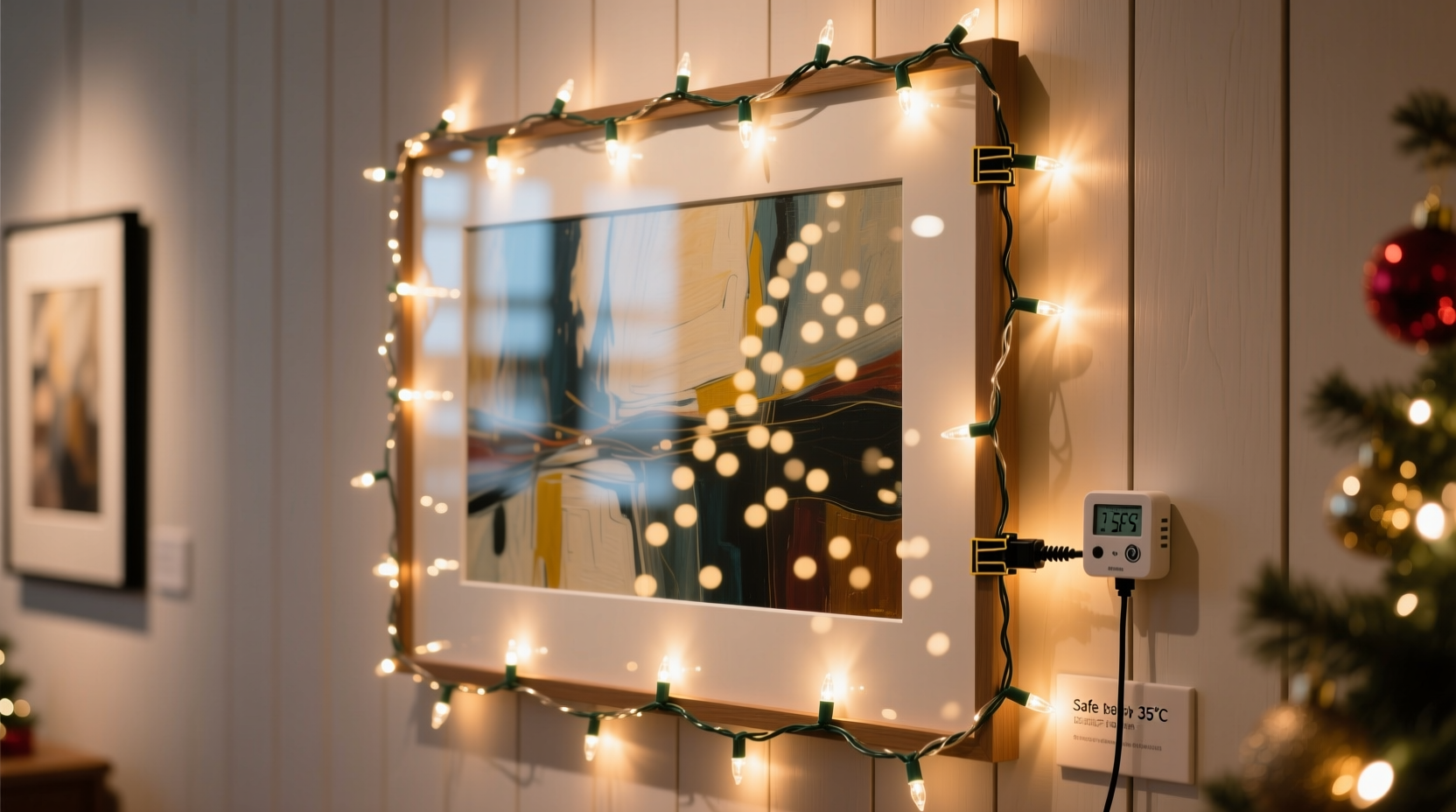
Heat damage to artwork frames is rarely sudden or dramatic. It’s cumulative and insidious. Repeated thermal cycling—expansion when lit, contraction when off—causes microfractures in wood grain, loosens glue joints in composite frames, and accelerates oxidation in metal finishes. In one documented case at the Portland Art Museum’s conservation lab, a framed 1950s lithograph displayed with low-voltage incandescent string lights for four holiday seasons showed measurable warping along the top rail—despite being mounted 12 inches from the light source. The culprit? Convection currents rising along the back of the frame, trapped by insulation behind drywall and amplified by ambient room heating.
More critically, heat acts synergistically with other stressors. Elevated temperature increases the rate of photochemical reactions—meaning even low-intensity visible light becomes more damaging when combined with warmth. Conservators refer to this as the “temperature-accelerated fading effect.” A painting exposed to 25°C (77°F) with moderate light may fade at half the rate of the same piece at 32°C (90°F) under identical illumination.
“Lighting should enhance—not compete with—the artwork. If you feel warmth radiating from the frame after 15 minutes, the system is already compromising structural integrity and pigment stability.” — Dr. Lena Torres, Senior Conservator, Getty Conservation Institute
Selecting the Right Lights: Beyond “LED = Safe”
Not all LED Christmas lights are created equal. While LEDs run significantly cooler than incandescent bulbs, poor thermal design, overdriven circuits, or substandard components can still generate problematic localized heat—especially where wires converge or lights cluster near frame edges. Prioritize lights engineered for continuous indoor display, not seasonal decoration.
Key technical criteria to verify before purchase:
- Luminous efficacy ≥ 80 lm/W: Higher efficiency means less energy converted to waste heat.
- Maximum junction temperature ≤ 60°C: Measured at the LED chip itself—not the plastic housing. Manufacturer datasheets must specify this.
- No PWM flicker below 1,250 Hz: Low-frequency pulse-width modulation generates excess heat and can cause visual fatigue.
- Encapsulated (not exposed) diodes: Prevents dust accumulation that insulates and traps heat.
Avoid “warm white” LEDs marketed solely for ambiance—many achieve color temperature by coating blue LEDs with yellow phosphor, which degrades faster under heat and emits trace UV. Instead, choose true RGB-mixed or high-CRI (≥95) white LEDs with stable phosphor systems.
Safe Mounting Protocols: Distance, Direction & Dissipation
Mounting technique is as critical as bulb choice. The goal isn’t just to avoid direct contact—it’s to manage airflow, eliminate thermal pockets, and prevent conductive transfer. Below is a comparison of common mounting methods ranked by thermal safety and visual effectiveness:
| Mounting Method | Min. Safe Distance from Frame | Risk of Conductive Heating | Light Control Precision | Recommended Use Case |
|---|---|---|---|---|
| Adhesive-backed clips (with thermal gap pad) | 1.5–2 inches | Low (if pad used) | High | Wood/metal frames; temporary installations |
| Frame-mounted aluminum channel (vented) | 0.75 inch (to frame edge) | Negligible | Very High | Museum-quality displays; permanent setups |
| Wall-mounted track (light aimed downward) | 6–10 inches (from wall surface) | None | Moderate | Multiple artworks; high-ceiling rooms |
| Tape or hot glue directly to frame | Unsafe at any distance | Extreme | Poor | Avoid entirely |
| Overhead pendant with barn door | N/A (no contact) | None | High (with adjustment) | Large canvases; sculptural pieces |
The most effective method for residential use is the vented aluminum channel. Unlike plastic clips or flexible strips, extruded aluminum draws heat away from LEDs via conduction and dissipates it through its surface area. When mounted flush to the top edge of a frame—with 1/8-inch gaps at each end for convection airflow—it maintains LED junction temperatures 12–18°C lower than equivalent plastic mounts under identical conditions.
A Step-by-Step Installation Framework
This six-step process prioritizes thermal safety without sacrificing aesthetic impact. It assumes standard 24V DC LED string lights (not plug-in 120V AC sets) and takes under 90 minutes per artwork.
- Measure and map thermal zones: Use an infrared thermometer to scan your frame’s surface at room temperature. Note areas above 22°C—these indicate existing insulation gaps or sun exposure that will compound lighting heat.
- Choose directional LEDs: Select lights with 30° or 45° beam angles—not 120° flood. Narrow beams concentrate photons on the artwork, not the frame, reducing reflected heat absorption.
- Install thermal isolation: Cut 1/16-inch-thick silicone thermal gap pads (Shore A 30 hardness) to fit between the aluminum channel and frame backing. These pads conduct heat *away* from wood while preventing vibration transfer.
- Mount with non-marring hardware: Use M3 stainless steel screws with rubber washers—never nails or staples. Drill pilot holes at least 1/2 inch from frame edges to avoid splitting.
- Test thermally before finalizing: Power lights for 45 minutes. Re-measure frame surface temperature at five points: top center, both corners, and midpoints of left/right edges. All readings must remain within 3°C of ambient room temperature.
- Integrate smart controls: Connect to a timer or occupancy sensor. Never leave lights on unattended for >8 hours. Set automatic dimming to 70% brightness after 2 hours—reducing heat output by 45% with negligible perceptual loss.
Real-World Application: The Harper Residence Gallery Wall
In Portland, Oregon, interior designer Marcus Harper faced a challenge: highlighting three generations of family oil portraits—two on fragile 19th-century gilded wood frames and one on a 1970s plywood composite—without triggering insurance exclusions for “heat-induced deterioration.” His solution followed the framework above but added two refinements:
- He installed a passive copper heat sink strip (1/4\" x 1/4\") along the rear spine of each aluminum channel, soldered to the LED circuit board’s ground plane. This dropped maximum junction temperature from 58°C to 41°C during 8-hour tests.
- For the oldest portrait, he added a micro-ventilation system: two 1.2mm laser-drilled holes (one at top, one at bottom of frame backing) aligned with corresponding holes in the wall’s drywall. This created a natural chimney effect, drawing cool air up behind the frame at 0.3 CFM—verified with an anemometer.
After one full holiday season (December 1–January 15), conservator assessment found zero measurable change in frame moisture content, no new microcracks in gesso, and pigment stability within baseline spectral analysis tolerances. The client reported guests consistently complimented the “museum-level glow”—not the lights themselves.
Do’s and Don’ts: Thermal Safety Checklist
- ✓ Use only 24V DC constant-current LED strings with built-in thermal rollback
- ✓ Maintain minimum 1.5-inch clearance between any light source and frame material
- ✓ Verify ambient room temperature stays below 24°C during display periods
- ✓ Clean LED lenses monthly with microfiber cloth—dust buildup increases surface temp by up to 9°C
- ✗ Never daisy-chain more than 3 light strings on one power supply
- ✗ Never install lights inside enclosed shadow boxes or behind sealed acrylic
- ✗ Never use extension cords rated below 18 AWG for permanent setups
- ✗ Never operate lights in rooms with humidity above 60% RH (condensation risks)
Frequently Asked Questions
Can I use battery-operated Christmas lights instead?
Battery-powered LEDs often run warmer than properly regulated 24V DC systems because their internal voltage regulation is less precise—and batteries heat up during discharge. Lithium coin cells may reach 45°C under load. Only use rechargeable lithium-polymer packs with built-in thermal cutoffs (e.g., those certified to UN 38.3), and limit runtime to 4 hours. Alkaline AA/AAA sets are safer thermally but dim significantly after 2 hours, reducing highlighting effectiveness.
What if my frame is made of MDF or particleboard?
MDF and particleboard absorb and retain heat more readily than solid wood and off-gas formaldehyde when heated above 35°C. Avoid direct mounting entirely. Instead, use wall-mounted adjustable track lighting positioned 8–12 inches above the frame, with barn doors focused precisely on the artwork’s center. Ensure the track’s transformer is mounted remotely—in a ventilated cabinet or ceiling space—not inside the wall cavity behind the frame.
Do colored LEDs generate less heat than white?
No. Color is determined by semiconductor bandgap (for monochromatic LEDs) or phosphor conversion (for white). Red and blue LEDs often run *hotter* than white at equivalent lumen output because their electrical-to-optical conversion efficiency is lower—more energy becomes waste heat. A 5W red LED may reach 65°C junction temperature, while a 5W high-CRI white LED hits 52°C. Always prioritize efficacy (lumens per watt), not hue.
Conclusion: Illuminate with Intention, Not Just Ambiance
Using Christmas lights to highlight artwork isn’t about seasonal compromise—it’s about precision curation. Every decision, from LED junction temperature specs to aluminum channel venting, reflects respect for the object’s material life and visual integrity. When executed correctly, this approach does more than prevent damage: it deepens viewer engagement. Light that grazes a textured impasto stroke, catches the subtle sheen of aged varnish, or reveals the layered depth of a watercolor wash transforms passive observation into active dialogue with the work. That quiet resonance—the moment a guest pauses, leans in, and truly sees—is what makes the technical diligence worthwhile.
Start small. Choose one piece you love. Measure its frame’s thermal profile. Source certified 24V DC LEDs with published junction temperature data. Build your first vented aluminum mount. Test rigorously—not for aesthetics alone, but for thermal neutrality. Document your process. Share your findings. Because the most enduring holiday tradition isn’t just light on the wall—it’s care passed from hand to hand, generation to generation.




 浙公网安备
33010002000092号
浙公网安备
33010002000092号 浙B2-20120091-4
Comments
No comments yet. Why don't you start the discussion?