
White LED string lights are the unsung workhorses of holiday lighting: energy-efficient, long-lasting, and brilliantly bright. But their clinical cool or neutral white tone often lacks the warmth, depth, or seasonal character many decorators seek. Rather than replacing entire light sets—or investing in expensive smart bulbs—you can transform them with precision, control, and artistic intention using colored lighting gels. These thin, translucent sheets—originally developed for theater and photography—are affordable, reversible, and surprisingly versatile when applied thoughtfully to holiday lighting. This isn’t about slapping on a red filter and calling it “festive.” It’s about understanding how light interacts with color, selecting the right materials for durability and safety, and layering hues intentionally to evoke mood, harmony, and authenticity.
Why Gels Beat Alternatives for Custom Hue Control
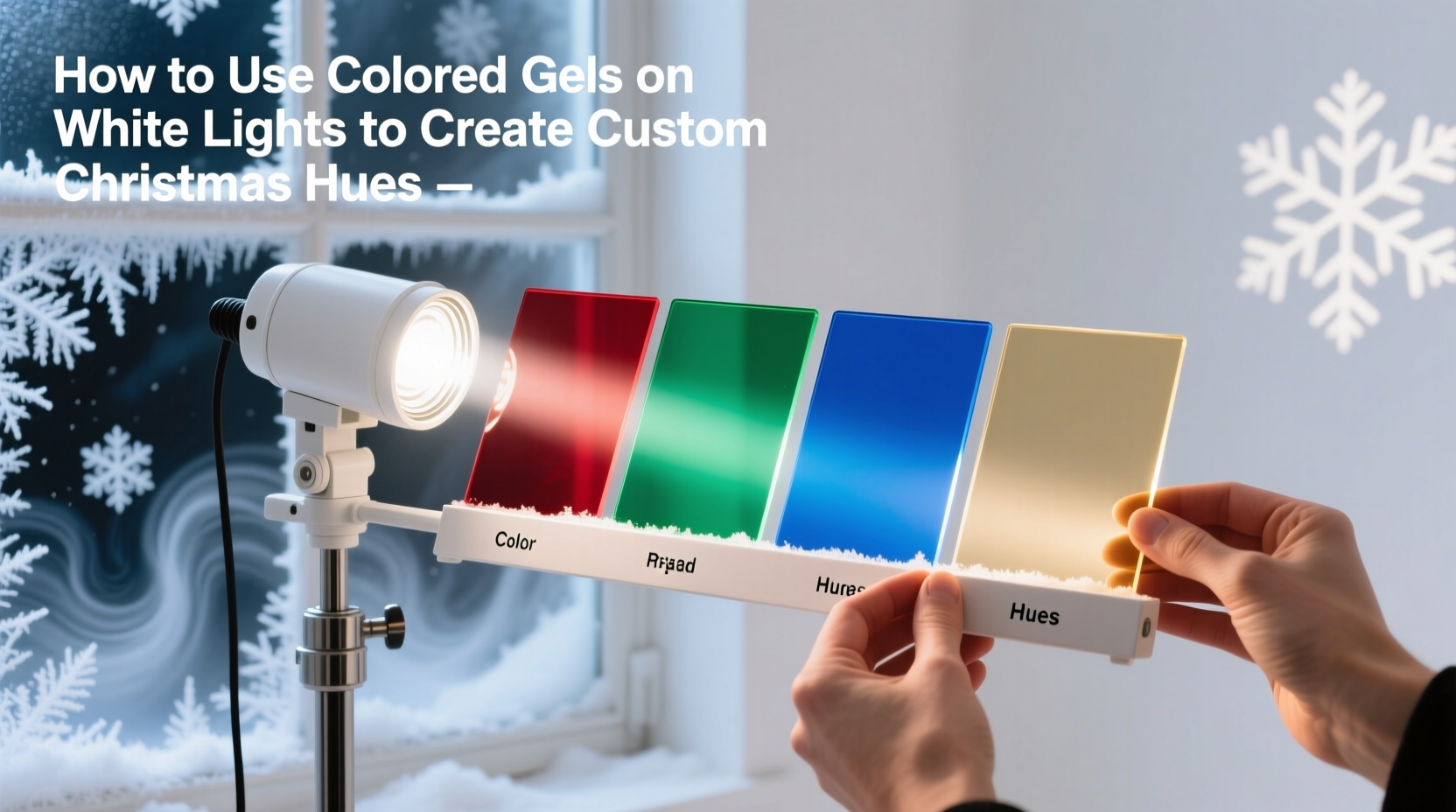
Before reaching for the gel sheet, it helps to understand why this method stands apart from other hue-shifting options. Smart RGB lights offer programmability but often suffer from inconsistent color rendering, limited dimming fidelity, and complex setup. Painted bulbs fade, crack, and void warranties. Colored plastic sleeves trap heat and degrade quickly outdoors. Gels—when chosen and installed correctly—offer something rare in holiday lighting: optical purity, thermal safety, and full reversibility.
Their advantage lies in subtractive color mixing: white light contains all visible wavelengths (red, green, blue, plus amber, cyan, magenta). A gel acts as a spectral filter—absorbing some wavelengths while transmitting others. A deep cobalt blue gel transmits only blue and violet light, absorbing reds and greens; an amber gel passes warm yellows and oranges while blocking blues. Unlike digital LEDs that simulate hues through rapid pulsing (PWM), gels deliver continuous-spectrum color—softer on the eyes, more natural in reflection, and truer under camera or video capture.
Choosing the Right Gel Material: Safety, Clarity & Longevity
Not all gels are created equal—and not all are safe for proximity to LED heat sources. Most modern white LED strings operate at surface temperatures between 35°C–55°C (95°F–131°F) under continuous use. While far cooler than incandescent bulbs, sustained contact with low-grade plastics can still cause warping, yellowing, or off-gassing. Prioritize professional-grade lighting gels designed for stage and studio use—not party store cellophane or craft acetate.
| Gel Type | Heat Tolerance | UV Resistance | Lifespan (Outdoor Use) | Notes |
|---|---|---|---|---|
| Rosco Supergel® | Up to 70°C | Excellent (with UV inhibitor) | 6–12 months | Industry standard; consistent density; available in 180+ colors |
| Lee Filters 216 (Full CTB) | 65°C | Good | 4–8 months | Stronger blue shift; ideal for cooling warm-white strings |
| Colortran Color-Set Sheets | 55°C | Fair | 2–4 months | Budget option; may fade faster in direct sun |
| Craft Acetate / Party Cellophane | <40°C | Poor | 1–3 weeks | Avoid: melts, emits odor, blocks light unevenly |
Look for gels labeled “LED-safe,” “heat-stable,” or “polycarbonate-based.” Avoid anything described as “vinyl” or “PVC”—these release chlorine gas when heated. Rosco’s Supergel line uses polyester film with proprietary dye dispersion, offering high transmission (up to 85% for primary colors) and minimal color shift over time. For outdoor applications, pair gels with weather-resistant mounting (more on that shortly) and avoid installing directly over non-ventilated bulb housings.
Color Theory for Holiday Lighting: Beyond Red & Green
Holiday color palettes thrive on contrast, cohesion, and emotional resonance—not just tradition. Understanding basic additive and subtractive relationships helps you move beyond predictable combinations. White light + red gel = red. But white light + red + blue gel ≠ purple—it equals *magenta*, because green is absorbed twice, intensifying saturation. Layering requires restraint: two gels reduce total light output by ~30–50% per layer. Three layers often yield murky, desaturated results unless precisely calibrated.
For cohesive schemes, start with a base hue and build complementary accents:
- Winter Solstice Palette: Cool white (base) + Lee 201 Full Blue + Rosco 27 Medium Amber = icy teal with golden undertones—evokes frost on pine boughs.
- Vintage Hearth Palette: Warm white (2700K) + Rosco 19 Fire + Rosco 25 Light Orange = glowing ember-orange, rich without being garish.
- Moonlit Forest Palette: Neutral white (4000K) + Rosco 80 Primary Green + Rosco 71 Slate Blue = deep forest green with cool shadow depth—ideal for wreaths and garlands.
Pro tip: Use a color wheel oriented for subtractive mixing (RYB or CMY), not RGB. Red + Yellow = Orange. Blue + Yellow = Green. Red + Blue = Violet. Avoid mixing complementary opposites (e.g., red + green) unless aiming for a deliberate, muted olive or brown—often useful for rustic or woodland themes.
“Gels let decorators speak in light like painters speak in pigment—layering, glazing, and toning with physical materials. That tactile control is irreplaceable in creating emotionally resonant spaces.” — Lena Torres, Lighting Designer & Author of Light as Atmosphere
Step-by-Step: Applying Gels to String Lights (Indoor & Outdoor)
This process assumes standard E12 candelabra or wedge-base LED mini lights (the most common residential type). Adjust spacing and technique slightly for net lights, icicle strands, or commercial C7/C9 bulbs.
- Unplug and inspect. Ensure all bulbs function and sockets are clean and dry. Discard any cracked, discolored, or flickering bulbs before proceeding.
- Cut gel sheets precisely. Use sharp scissors or a craft knife on a cutting mat. Cut squares or rectangles 1.5× the bulb’s widest dimension (e.g., 2.25\" × 2.25\" for a 1.5\" wide bulb). Rounded corners prevent peeling. Never stretch or wrinkle the gel during cutting.
- Prepare mounting method. For indoor use: double-stick foam tape (1/8\" wide, 3M 5510) applied to the bulb’s upper third works best—secure, removable, no residue. For outdoor use: use UV-resistant silicone adhesive dots (e.g., Loctite PL Premium Dots) placed at 12, 4, and 8 o’clock positions. Avoid glue guns—heat degrades gel clarity.
- Apply gel smoothly. Peel tape backing. Center gel over bulb. Press gently from center outward to eliminate air bubbles. Do not over-tighten—if gel wrinkles, lift and reposition. For multi-layer effects, apply the deepest (most saturated) gel first, then the lighter layer on top.
- Test before finalizing. Plug in for 15 minutes. Check for hotspots, bubbling, or discoloration near adhesive points. Observe color consistency across multiple bulbs—batch variations in white LEDs mean slight hue shifts are normal; adjust gel selection if uniformity is critical.
- Seal outdoor installations. After 24 hours of curing, lightly brush edges with clear, flexible acrylic sealer (e.g., Krylon UV-Resistant Clear Coat) to prevent moisture wicking and wind lift. Do not spray directly—use a soft brush for controlled application.
Real-World Application: The Heritage Row Townhouse Project
In December 2023, interior stylist Maya Chen transformed the front façade of a 1890s brick townhouse in Boston’s Beacon Hill. Client goals: “elegant, not kitschy; traditional, but not cliché.” Standard red-and-green strings felt too literal against the charcoal mortar and wrought-iron railings. Instead, Maya used 200 feet of 5mm warm-white LED mini lights (2700K, 12V) wrapped around porch columns and eaves.
She cut Rosco Supergel 19 (Fire) and 25 (Light Orange) into 2\" squares, applying them in alternating sequence—two reds, one orange, repeat—with 3M foam tape. At the entry arch, she layered Rosco 27 (Medium Amber) over Rosco 19 on every third bulb to create subtle, glowing focal points. For the evergreen swag above the door, she used Rosco 80 (Primary Green) alone—keeping it lush and botanical, not artificial.
The result? A unified, dimensional palette: pillars glowed with hearth-like warmth, the arch pulsed with candlelit intimacy, and the greenery read as living, not synthetic. Neighbors reported “feeling the warmth from across the street.” Crucially, removal in January took under 90 minutes—gels lifted cleanly, bulbs undamaged, and the same strings were reused in March for a spring floral installation with pale pink and mint gels.
Do’s and Don’ts of Gel-Based Holiday Lighting
| Action | Do | Don’t |
|---|---|---|
| Mounting | Use archival-quality double-stick tape or silicone dots rated for outdoor temps | Use rubber cement, hot glue, or duct tape—they stain, melt, or leave residue |
| Storage | Roll gels loosely around a cardboard tube; store flat in acid-free box away from sunlight | Stack under heavy objects or fold sharply—causes permanent creases and micro-fractures |
| Layering | Limit to two gels; choose hues with shared bias (e.g., both warm or both cool) | Combine red + green or blue + orange expecting “brown”—you’ll get muddy gray with poor transmission |
| Safety | Verify bulb surface temp with IR thermometer before full installation | Install gels on enclosed fixtures or bulbs with poor airflow—risk of thermal buildup |
| Color Matching | Hold gel over white paper in daylight to assess true hue before application | Rely solely on monitor previews—screens misrepresent gel saturation and value |
FAQ
Can I wash or reuse gels after the season?
Yes—with care. Gently wipe with a microfiber cloth dampened with distilled water. Avoid alcohol, ammonia, or window cleaners—they strip dyes and cloud film. Let air-dry flat, not hung. Reuse is viable for 2–3 seasons indoors; outdoors, expect one-season performance due to UV exposure. Inspect for brittleness or fading before reapplying.
Will gels affect my light’s energy efficiency?
No—gels do not increase power draw. However, they reduce lumen output proportionally to absorption (e.g., deep blue gels transmit ~40% of incident light). To compensate, use slightly higher-density strings (e.g., 100 bulbs/16ft instead of 50/16ft) rather than overdriving circuits. Efficiency remains unchanged; brightness is optically managed.
Are there fire-rated gels for commercial installations?
Yes. Rosco Supergel FR (Flame Retardant) and Lee Filters 216FR meet NFPA 701 and ASTM E84 standards for flame spread and smoke development. Required for public venues, churches, and retail spaces. They cost ~25% more but are non-negotiable for liability and code compliance.
Conclusion
Creating custom Christmas hues with colored gels isn’t a hack—it’s a craft. It demands attention to material science, respect for light physics, and an eye for seasonal storytelling. You’re not masking white light; you’re conducting it, shaping its emotional temperature, and anchoring your space in intentional atmosphere. Whether you’re evoking the quiet hush of snow-lit pines, the crackle of a vintage fireplace, or the crisp clarity of a starlit midnight, gels give you the palette—and the precision—to make it real. No app updates. No firmware conflicts. Just light, color, and your hands.
Start small: take one strand of warm-white lights, pick one gel that speaks to your vision—a deep forest green, a buttery amber, a twilight violet—and apply it to five bulbs. Step back. Observe how it changes the texture of your wall, the mood of your entryway, the way shadows pool beneath a branch. Then layer. Then refine. Your home doesn’t need more lights. It needs better light—thoughtfully filtered, deliberately chosen, authentically yours.




 浙公网安备
33010002000092号
浙公网安备
33010002000092号 浙B2-20120091-4
Comments
No comments yet. Why don't you start the discussion?