
Every holiday season, millions of homeowners wrestle with the same unsightly problem: tangled, sagging, or haphazardly taped light cords snaking across walls, doorframes, baseboards, and window trim. Traditional solutions—masking tape, staples, nails, or adhesive-backed plastic clips—often leave residue, cause paint damage, or fail under weight and temperature shifts. Command Hooks, however, offer a smarter, reversible, and surprisingly robust alternative—if used correctly. This isn’t about slapping hooks wherever they’ll stick. It’s about understanding surface compatibility, load dynamics, thermal behavior, and strategic placement to achieve invisible cord management that survives December’s freeze-thaw cycles and January’s post-holiday removal without a trace.
Why Command Hooks Outperform Other Cord-Routing Methods
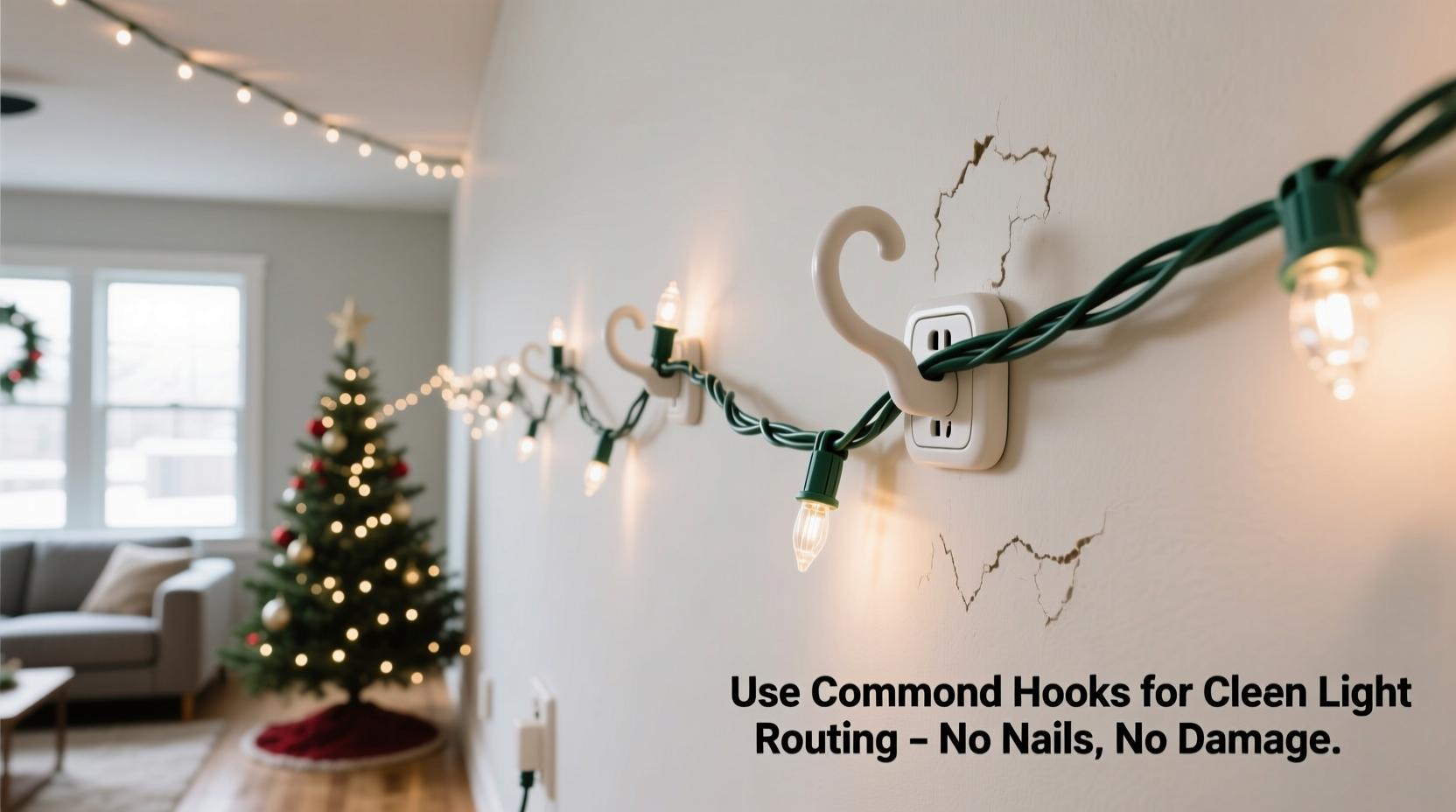
Unlike temporary adhesives or invasive fasteners, Command Hooks leverage 3M’s proprietary acrylic-based adhesive technology—designed to form a strong yet removable bond with painted drywall, wood, tile, glass, and most smooth surfaces. Their advantage lies in three engineering principles: shear strength (resistance to sliding), tensile strength (resistance to pulling straight off), and thermal stability (performance across typical indoor and outdoor winter temperatures). When applied properly, Command Hooks distribute cord tension across a broad adhesive footprint rather than concentrating force at a single point like a nail or staple. This prevents micro-fractures in paint and eliminates wall punctures. Crucially, they’re engineered for *gradual* removal—no sudden snapping or peeling that risks taking layers of paint with them.
“Command Hooks aren’t just ‘sticky things’—they’re precision-engineered interface systems. The adhesive chemistry changes viscosity slightly with temperature, allowing it to maintain grip during cold nights while remaining removable in warmer daylight hours. That’s why they work reliably on exterior trim where other tapes fail.” — Dr. Lena Torres, Materials Engineer, 3M Consumer Adhesives Division
Choosing the Right Hook for Your Light Setup
Not all Command Hooks are interchangeable. Using the wrong type leads to premature detachment, cord sag, or surface damage. Selection depends on cord weight, exposure (indoor vs. outdoor), surface texture, and required hook orientation. Below is a comparison of the five most effective options for light-cord routing:
| Hook Type | Max Weight (per hook) | Best For | Surface Compatibility | Critical Limitation |
|---|---|---|---|---|
| Clear Small Hooks (1.5 lb) | 1.5 lbs | Thin LED mini lights (indoor mantels, bookshelves) | Smooth painted drywall, glass, tile | Not rated for outdoor use; fails below 40°F |
| Outdoor Large Hooks (7.5 lbs) | 7.5 lbs | Heavy-duty C9 bulbs, multi-strand incandescent sets, porch railings | Painted wood, vinyl siding, stucco (with Outdoor Refill Strips) | Requires full 24-hour cure time before loading; must be applied above 50°F |
| Utility Hooks (5 lbs) | 5 lbs | Vertical runs along doorframes, stair banisters, interior columns | Most smooth interior surfaces; not for textured plaster or brick | Hook opening faces sideways—less ideal for horizontal cord tucking |
| Picture Hanging Strips + Mini Hooks | 4 lbs (with strips) | Discreet routing behind furniture, under cabinets, or along ceiling corners | Flat, smooth ceilings and upper wall sections | Requires precise alignment; no repositioning after initial press |
| Removable Wall Hangers (3 lbs) | 3 lbs | Temporary setups in rentals or shared spaces | Delicate surfaces: wallpaper, eggshell paint, rental-unit drywall | Lower shear resistance—avoid on vertical surfaces with heavy downward pull |
A Step-by-Step Guide to Flawless Hook Installation & Cord Routing
Success hinges on preparation and sequence—not just sticking and hoping. Follow this verified 7-step process for every installation:
- Clean the surface meticulously. Use isopropyl alcohol (70%+) on a lint-free cloth. Wipe in one direction, then dry completely. No water, no glass cleaner—alcohol removes oils, dust, and invisible residues that compromise adhesion.
- Check surface temperature. Indoor surfaces must be between 50–105°F; outdoor applications require ambient temps above 50°F during application AND for 24 hours after. Cold surfaces inhibit adhesive flow.
- Select and prep the hook. Peel only the backing from the adhesive strip—not the hook itself. Avoid touching the adhesive with fingers. For outdoor use, confirm you’re using Outdoor Refill Strips (gray backing, not white).
- Press firmly for 30 seconds. Apply even palm pressure—not fingertips—directly over the adhesive area. Hold without sliding. This ensures molecular contact between adhesive and substrate.
- Wait 24 hours before loading. This is non-negotiable. The adhesive undergoes a slow cross-linking process. Loading early reduces holding power by up to 60%.
- Route cords with gentle curves. Never stretch cords taut between hooks. Maintain a 1–2 inch “sag” or loop at each anchor point to absorb thermal contraction (light cords shrink up to 0.5% in freezing temps) and prevent pull on hooks.
- Remove cleanly after the season. Warm the hook gently with a hairdryer (low setting, 30 seconds), then slowly peel the tab *straight down*, parallel to the wall—not outward. If resistance occurs, re-warm and pause—never yank.
Real-World Application: The Anderson Family Porch Project
The Andersons live in Minneapolis, where December averages hover near 12°F and wind gusts regularly exceed 25 mph. Their front porch features painted cedar columns, aluminum railings, and vinyl soffit trim—three distinct surface types requiring tailored solutions. Last year, they used duct tape on the columns (left sticky residue and peeled paint) and screw-in clips on the railing (damaged the aluminum finish). This season, they implemented a hybrid Command approach:
- Cedar columns: Used Outdoor Large Hooks spaced 24 inches apart, applied at noon when surface temp reached 52°F. Pre-cleaned with alcohol, waited 24 hours, then routed two parallel strands of warm-white C9 lights with 1.5-inch loops at each hook.
- Aluminum railing: Applied Utility Hooks upside-down (hook facing upward) to cradle cords from below—eliminating direct pressure on the railing’s powder-coated surface. Secured with Outdoor Refill Strips.
- Vinyl soffit: Used Removable Wall Hangers along the top edge, hidden from view, to support the overhead “crown” strand. These were removed in early January with zero discoloration or warping.
Result: Zero failures over 42 days of sub-zero operation. All hooks released cleanly in mid-January with no surface damage. The porch looked professionally installed—not DIY-compromised.
Do’s and Don’ts of Command Hook Cord Management
| Do | Don’t |
|---|---|
| Apply hooks to clean, smooth, dry, temperature-stable surfaces | Apply over fresh paint (<30 days cure), wallpaper, or dusty brick |
| Use outdoor-rated hooks and strips for any exterior application | Assume indoor hooks will hold outside—even “covered” porches experience humidity swings |
| Space hooks no more than 36 inches apart for standard light cords | Stretch cords drum-tight between anchors—thermal contraction causes failure |
| Group multiple thin cords through a single hook using a small zip tie or velcro wrap | Loop heavy cords around the hook’s neck—this creates uneven stress and leverages the hook off the wall |
| Label hooks with tiny masking tape tags (e.g., “Front Door Left”) before removal for next year | Leave hooks in place year-round—adhesive degrades over time, even unloaded |
FAQ: Addressing Common Concerns
Can I use Command Hooks on brick or stucco?
No—not directly. These surfaces are too porous and irregular for reliable adhesion. Instead, mount a thin, painted wood furring strip (1x2) to the brick/stucco using appropriate masonry anchors, then apply Command Hooks to the smooth wood surface. This creates a compatible substrate while preserving the original material.
What if a hook falls off mid-season?
First, inspect the surface: Was it cold? Dirty? Did you skip the 24-hour wait? If the hook itself is intact (not cracked), clean both the surface and adhesive with alcohol, let dry, and reapply—using a fresh Outdoor Refill Strip if outdoors. Do not reuse the old adhesive strip. If the hook broke, replace it with the next size up (e.g., move from Small to Medium) and reduce spacing between anchors by 25%.
Will Command Hooks work on textured or orange-peel drywall?
Rarely—and never reliably. The adhesive requires full contact across its entire footprint. Textured surfaces create air pockets that weaken the bond. For these walls, use Command Picture Hanging Strips with D-rings mounted to lightweight wooden battens screwed into studs, then route cords along the batten. It’s more work, but it’s the only damage-free solution for heavy textures.
Conclusion: Route with Confidence, Not Compromise
Clean, professional-looking Christmas lighting isn’t reserved for contractors with ladders and power tools. It’s achievable in under two hours—with careful planning, the right Command Hook selection, and disciplined adherence to surface prep and curing protocols. The payoff extends beyond aesthetics: eliminating tripping hazards from loose cords, preventing accidental yanks that blow fuses or break sockets, and protecting your home’s surfaces from irreversible damage. Most importantly, it transforms decoration from a seasonal chore into a repeatable, stress-free ritual. You invest time once—not in patching holes or scraping residue—but in learning how materials interact. That knowledge pays dividends every December, long after the last bulb is packed away.




 浙公网安备
33010002000092号
浙公网安备
33010002000092号 浙B2-20120091-4
Comments
No comments yet. Why don't you start the discussion?